

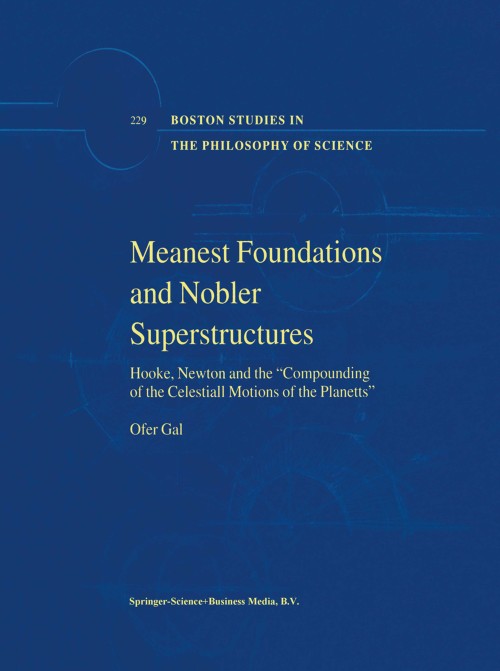
Meanest Foundations and Nobler Superstructures [electronic resource] : Hooke, Newton and the Compounding of the Celestiall Motions of the Planetts / by Ofer Gal.
Erişim Adresi
ISBN
9789401722230
Dil Kodu
İngilizce
Yer Numarası
DK/8906
Yazar
Basım Bildirimi
1st ed. 2002.
Yayın Bilgisi
Dordrecht : Springer Netherlands : Imprint: Springer, 2002.
Fiziksel Niteleme
XIV, 252 p. online resource.
Dizi
Boston Studies in the Philosophy and History of Science, 2214-7942 ; 229
İçindekiler Notu
Introduction -- Part A: The Historical Question. 1. Gallileo's Challenge. 2. The Correspondence. 3. Hooke's Programme -- Part B: The Historiographic Difficulty. 4. Hooke vs. Newton. 5. The Genius vs. The Mechanic. 1. Inflection. Introduction: The Bad Ending -- Part A: The Novelty. 1. Hooke's Programme. 2. Setting the Question Right -- Part B: Employing Inflection. 3. Inflection. 4. Application as Manipulation.-- Part C: Producing Inflection in the Workshop. 5. Construction. 6. Implementation. 7. Tentative Conclusion -- 1.st Interlude: Practice. 1. Introduction - Methodological Lessons. 2. Hacking. 3. The Realism Snare. 2. Power -- Part A: 1. Introduction. 2. De Potentia Restitutiva, or: Of Spring -- Part B: 3. Horology. 4. The Spring Watch. 5. Springs and Forces -- Part C: 6. The Origins of the Vibration Theory. 7. Of Spring again. 8. Springs as a Topos. 9. A Clockwork Theory of Matter and Power -- 2.nd Interlude: Representation. 1. Rorty. 2. 'Knowledge Of and 'Knowledge That'. 3. Hacking and Rorty. 3. Newton's Synthesis. 1. Introduction. 2. Newton Before and After. 3. Hooke's Programme. Notes. Introduction. 1. Inflection. 1st Interlude: Practice. 2. Clocks, Pendulums and Springs -- 2.nd Interlude: Representation. 3. Newton's Synthesis -- Bibliography -- Index.
Özet, vb.
This book is a historical-epistemological study of one of the most consequential breakthroughs in the history of celestial mechanics: Robert Hooke's (1635-1703) proposal to "compoun[d] the celestial motions of the planets of a direct motion by the tangent & an attractive motion towards a centrat body" (Newton, The Correspondence li, 297. Henceforth: Correspondence). This is the challenge Hooke presented to Isaac Newton (1642-1727) in a short but intense correspondence in the winter of 1679-80, which set Newton on course for his 1687 Principia, transforming the very concept of "the planetary heavens" in the process (Herivel, 301: De Motu, Version III). 1 It is difficult to overstate the novelty of Hooke 's Programme • The celestial motions, it suggested, those proverbial symbols of stability and immutability, werein fact a process of continuous change: a deflection of the planets from original rectilinear paths by "a centraU attractive power" (Correspondence, li, 313). There was nothing necessary or essential in the shape of planetary orbits. Already known to be "not circular nor concentricall" (ibid. ), Hooke claimed that these apparently closed "curve Line[ s ]" should be understood and calculated as mere effects of rectilinear motions and rectilinear attraction. And as Newton was quick to realize, this also implied that "the planets neither move exactly in ellipse nor revolve twice in the same orbit, so that there are as many orbits to a planet as it has revolutions" (Herivel, 301: De Motu, Version III).
Konu
History.
Science __ Philosophy.
Physics __ Philosophy.
Astronomy __ Observations.
Technology __ Philosophy.
History.
Philosophy of Science.
Philosophical Foundations of Physics and Astronomy.
Astronomy, Observations and Techniques.
Philosophy of Technology.
Science __ Philosophy.
Physics __ Philosophy.
Astronomy __ Observations.
Technology __ Philosophy.
History.
Philosophy of Science.
Philosophical Foundations of Physics and Astronomy.
Astronomy, Observations and Techniques.
Philosophy of Technology.
Kurum Adı
Eseri Alıntıla
Referansları kullanmadan önce gözden geçirmeniz ve varsa gerekli düzeltmeleri yapmanız önerilir.
Dijital Kaynak
MARC Görünümü
LEADER 05746nam a22006495i 4500
001 807613
003 TR_AnAIT
005 20260127004446
007 cr nn 008mamaa
008 130909s2002 ne | s |||| 0|eng d
020 |a9789401722230|9978-94-017-2223-0
024 7 |a10.1007/978-94-017-2223-0|2doi
041 |aeng
049 |aTürk Tarih Kurumu Kütüphanesi
050 4|aD1-2027
072 7|aHB|2bicssc
072 7|aHBAH|2bicssc
072 7|aHIS000000|2bisacsh
072 7|aNH|2thema
072 7|aNHAH|2thema
082 04|a900|223
090 |aDK/8906
100 1 |aGal, Ofer.|eauthor.|4aut|4http://id.loc.gov/vocabulary/relators/aut
245 10|aMeanest Foundations and Nobler Superstructures|h[electronic resource] :|bHooke, Newton and the Compounding of the Celestiall Motions of the Planetts /|cby Ofer Gal.
250 |a1st ed. 2002.
264 1|aDordrecht :|bSpringer Netherlands :|bImprint: Springer,|c2002.
300 |aXIV, 252 p.|bonline resource.
336 |atext|btxt|2rdacontent
337 |acomputer|bc|2rdamedia
338 |aonline resource|bcr|2rdacarrier
347 |atext file|bPDF|2rda
490 1 |aBoston Studies in the Philosophy and History of Science,|x2214-7942 ;|v229
505 0 |aIntroduction -- Part A: The Historical Question. 1. Gallileo's Challenge. 2. The Correspondence. 3. Hooke's Programme -- Part B: The Historiographic Difficulty. 4. Hooke vs. Newton. 5. The Genius vs. The Mechanic. 1. Inflection. Introduction: The Bad Ending -- Part A: The Novelty. 1. Hooke's Programme. 2. Setting the Question Right -- Part B: Employing Inflection. 3. Inflection. 4. Application as Manipulation.-- Part C: Producing Inflection in the Workshop. 5. Construction. 6. Implementation. 7. Tentative Conclusion -- 1.st Interlude: Practice. 1. Introduction - Methodological Lessons. 2. Hacking. 3. The Realism Snare. 2. Power -- Part A: 1. Introduction. 2. De Potentia Restitutiva, or: Of Spring -- Part B: 3. Horology. 4. The Spring Watch. 5. Springs and Forces -- Part C: 6. The Origins of the Vibration Theory. 7. Of Spring again. 8. Springs as a Topos. 9. A Clockwork Theory of Matter and Power -- 2.nd Interlude: Representation. 1. Rorty. 2. 'Knowledge Of and 'Knowledge That'. 3. Hacking and Rorty. 3. Newton's Synthesis. 1. Introduction. 2. Newton Before and After. 3. Hooke's Programme. Notes. Introduction. 1. Inflection. 1st Interlude: Practice. 2. Clocks, Pendulums and Springs -- 2.nd Interlude: Representation. 3. Newton's Synthesis -- Bibliography -- Index.
520 |aThis book is a historical-epistemological study of one of the most consequential breakthroughs in the history of celestial mechanics: Robert Hooke's (1635-1703) proposal to "compoun[d] the celestial motions of the planets of a direct motion by the tangent & an attractive motion towards a centrat body" (Newton, The Correspondence li, 297. Henceforth: Correspondence). This is the challenge Hooke presented to Isaac Newton (1642-1727) in a short but intense correspondence in the winter of 1679-80, which set Newton on course for his 1687 Principia, transforming the very concept of "the planetary heavens" in the process (Herivel, 301: De Motu, Version III). 1 It is difficult to overstate the novelty of Hooke 's Programme • The celestial motions, it suggested, those proverbial symbols of stability and immutability, werein fact a process of continuous change: a deflection of the planets from original rectilinear paths by "a centraU attractive power" (Correspondence, li, 313). There was nothing necessary or essential in the shape of planetary orbits. Already known to be "not circular nor concentricall" (ibid. ), Hooke claimed that these apparently closed "curve Line[ s ]" should be understood and calculated as mere effects of rectilinear motions and rectilinear attraction. And as Newton was quick to realize, this also implied that "the planets neither move exactly in ellipse nor revolve twice in the same orbit, so that there are as many orbits to a planet as it has revolutions" (Herivel, 301: De Motu, Version III).
532 8 |aAccessibility summary: This PDF is not accessible. It is based on scanned pages and does not support features such as screen reader compatibility or described non-text content (images, graphs etc). However, it likely supports searchable and selectable text based on OCR (Optical Character Recognition). Users with accessibility needs may not be able to use this content effectively. Please contact us at accessibilitysupport@springernature.com if you require assistance or an alternative format.
532 8 |aInaccessible, or known limited accessibility
532 8 |aNo reading system accessibility options actively disabled
532 8 |aPublisher contact for further accessibility information: accessibilitysupport@springernature.com
650 0|aHistory.
650 0|aScience|xPhilosophy.
650 0|aPhysics|xPhilosophy.
650 0|aAstronomy|xObservations.
650 0|aTechnology|xPhilosophy.
650 14|aHistory.
650 24|aPhilosophy of Science.
650 24|aPhilosophical Foundations of Physics and Astronomy.
650 24|aAstronomy, Observations and Techniques.
650 24|aPhilosophy of Technology.
710 2 |aSpringerLink (Online service)
773 0 |tSpringer Nature eBook
776 08|iPrinted edition:|z9781402007323
776 08|iPrinted edition:|z9789048160679
776 08|iPrinted edition:|z9789401722247
830 0|aBoston Studies in the Philosophy and History of Science,|x2214-7942 ;|v229
856 40|uhttps://doi.org/10.1007/978-94-017-2223-0
912 |aZDB-2-SHU
912 |aZDB-2-SXH
912 |aZDB-2-BAE
950 |aHumanities, Social Sciences and Law (SpringerNature-11648)
950 |aHistory (R0) (SpringerNature-43722)
001 807613
003 TR_AnAIT
005 20260127004446
007 cr nn 008mamaa
008 130909s2002 ne | s |||| 0|eng d
020 |a9789401722230|9978-94-017-2223-0
024 7 |a10.1007/978-94-017-2223-0|2doi
041 |aeng
049 |aTürk Tarih Kurumu Kütüphanesi
050 4|aD1-2027
072 7|aHB|2bicssc
072 7|aHBAH|2bicssc
072 7|aHIS000000|2bisacsh
072 7|aNH|2thema
072 7|aNHAH|2thema
082 04|a900|223
090 |aDK/8906
100 1 |aGal, Ofer.|eauthor.|4aut|4http://id.loc.gov/vocabulary/relators/aut
245 10|aMeanest Foundations and Nobler Superstructures|h[electronic resource] :|bHooke, Newton and the Compounding of the Celestiall Motions of the Planetts /|cby Ofer Gal.
250 |a1st ed. 2002.
264 1|aDordrecht :|bSpringer Netherlands :|bImprint: Springer,|c2002.
300 |aXIV, 252 p.|bonline resource.
336 |atext|btxt|2rdacontent
337 |acomputer|bc|2rdamedia
338 |aonline resource|bcr|2rdacarrier
347 |atext file|bPDF|2rda
490 1 |aBoston Studies in the Philosophy and History of Science,|x2214-7942 ;|v229
505 0 |aIntroduction -- Part A: The Historical Question. 1. Gallileo's Challenge. 2. The Correspondence. 3. Hooke's Programme -- Part B: The Historiographic Difficulty. 4. Hooke vs. Newton. 5. The Genius vs. The Mechanic. 1. Inflection. Introduction: The Bad Ending -- Part A: The Novelty. 1. Hooke's Programme. 2. Setting the Question Right -- Part B: Employing Inflection. 3. Inflection. 4. Application as Manipulation.-- Part C: Producing Inflection in the Workshop. 5. Construction. 6. Implementation. 7. Tentative Conclusion -- 1.st Interlude: Practice. 1. Introduction - Methodological Lessons. 2. Hacking. 3. The Realism Snare. 2. Power -- Part A: 1. Introduction. 2. De Potentia Restitutiva, or: Of Spring -- Part B: 3. Horology. 4. The Spring Watch. 5. Springs and Forces -- Part C: 6. The Origins of the Vibration Theory. 7. Of Spring again. 8. Springs as a Topos. 9. A Clockwork Theory of Matter and Power -- 2.nd Interlude: Representation. 1. Rorty. 2. 'Knowledge Of and 'Knowledge That'. 3. Hacking and Rorty. 3. Newton's Synthesis. 1. Introduction. 2. Newton Before and After. 3. Hooke's Programme. Notes. Introduction. 1. Inflection. 1st Interlude: Practice. 2. Clocks, Pendulums and Springs -- 2.nd Interlude: Representation. 3. Newton's Synthesis -- Bibliography -- Index.
520 |aThis book is a historical-epistemological study of one of the most consequential breakthroughs in the history of celestial mechanics: Robert Hooke's (1635-1703) proposal to "compoun[d] the celestial motions of the planets of a direct motion by the tangent & an attractive motion towards a centrat body" (Newton, The Correspondence li, 297. Henceforth: Correspondence). This is the challenge Hooke presented to Isaac Newton (1642-1727) in a short but intense correspondence in the winter of 1679-80, which set Newton on course for his 1687 Principia, transforming the very concept of "the planetary heavens" in the process (Herivel, 301: De Motu, Version III). 1 It is difficult to overstate the novelty of Hooke 's Programme • The celestial motions, it suggested, those proverbial symbols of stability and immutability, werein fact a process of continuous change: a deflection of the planets from original rectilinear paths by "a centraU attractive power" (Correspondence, li, 313). There was nothing necessary or essential in the shape of planetary orbits. Already known to be "not circular nor concentricall" (ibid. ), Hooke claimed that these apparently closed "curve Line[ s ]" should be understood and calculated as mere effects of rectilinear motions and rectilinear attraction. And as Newton was quick to realize, this also implied that "the planets neither move exactly in ellipse nor revolve twice in the same orbit, so that there are as many orbits to a planet as it has revolutions" (Herivel, 301: De Motu, Version III).
532 8 |aAccessibility summary: This PDF is not accessible. It is based on scanned pages and does not support features such as screen reader compatibility or described non-text content (images, graphs etc). However, it likely supports searchable and selectable text based on OCR (Optical Character Recognition). Users with accessibility needs may not be able to use this content effectively. Please contact us at accessibilitysupport@springernature.com if you require assistance or an alternative format.
532 8 |aInaccessible, or known limited accessibility
532 8 |aNo reading system accessibility options actively disabled
532 8 |aPublisher contact for further accessibility information: accessibilitysupport@springernature.com
650 0|aHistory.
650 0|aScience|xPhilosophy.
650 0|aPhysics|xPhilosophy.
650 0|aAstronomy|xObservations.
650 0|aTechnology|xPhilosophy.
650 14|aHistory.
650 24|aPhilosophy of Science.
650 24|aPhilosophical Foundations of Physics and Astronomy.
650 24|aAstronomy, Observations and Techniques.
650 24|aPhilosophy of Technology.
710 2 |aSpringerLink (Online service)
773 0 |tSpringer Nature eBook
776 08|iPrinted edition:|z9781402007323
776 08|iPrinted edition:|z9789048160679
776 08|iPrinted edition:|z9789401722247
830 0|aBoston Studies in the Philosophy and History of Science,|x2214-7942 ;|v229
856 40|uhttps://doi.org/10.1007/978-94-017-2223-0
912 |aZDB-2-SHU
912 |aZDB-2-SXH
912 |aZDB-2-BAE
950 |aHumanities, Social Sciences and Law (SpringerNature-11648)
950 |aHistory (R0) (SpringerNature-43722)
Materyaller
Depodan talep edilen materyal sadece kütüphane içerisinde kullanılmaktadır.
Materyal dışarıya ödünç verilmemektedir.
Materyal dışarıya ödünç verilmemektedir.
