

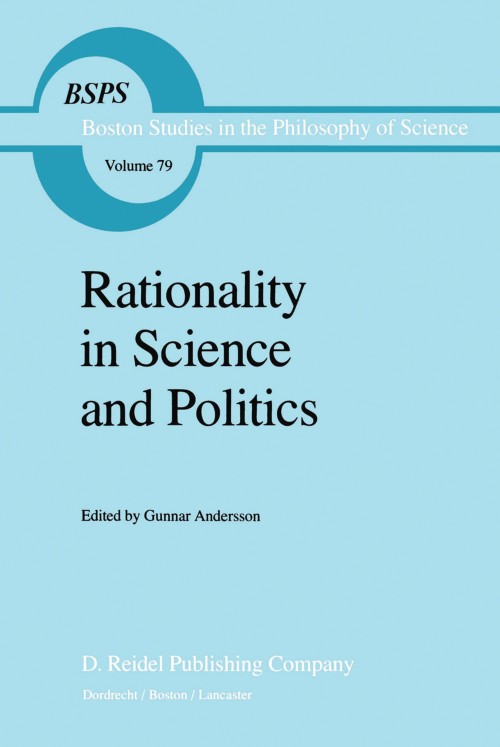
Rationality in Science and Politics [electronic resource] / edited by G. Andersson.
Erişim Adresi
ISBN
9789400962545
Dil Kodu
İngilizce
Yer Numarası
DK/8922
Basım Bildirimi
1st ed. 1984.
Yayın Bilgisi
Dordrecht : Springer Netherlands : Imprint: Springer, 1984.
Fiziksel Niteleme
XI, 307 p. online resource.
Dizi
Boston Studies in the Philosophy and History of Science, 2214-7942 ; 79
İçindekiler Notu
Creativity and Criticism in Science and Politics -- The Social Base of Scientific Theory and Practice -- Transcendental Realism and Rational Heuristics: Critical Rationalism and the Problem of Method -- How to Accept Fallible Test Statements? Popper’s Criticist Solution -- Logical Strength and Demarcation -- Xenophanes: A Forerunner of Critical Rationalism? -- The Social Roots of Modern Egalitarianism -- Explication and Implications of the Placebo Concept -- Analytic and Synthetic Philosophy -- Ethical Problems in Science Communication -- A Philosophical Conception of Finality in Biology -- The Justification of Scientific Progress -- Against Induction: One of Many Arguments -- The Problem of Ideology and Critical Rationalism -- Poincaré versus Le Roy on Incommensurability -- On Early Forms of Critical Rationalism -- Gerard Radnitzky: From Positivism, via Critical Theory, to Critical Rationalism -- Notes on Contributors -- Index of Names.
Özet, vb.
This remarkable collection of essays, diverse but united by the theme of critical reasoning, testifies to the attention and respect paid by the authors to the philosophical career of Gerard Radnitzky. We, too, greet Professor Radnitzky for his decades of intellectual labor devoted to the establishment of rational analysis of human problems. Not least of his concerns has been to understand what it is to be rational, to disentangle the apparently rational and the genuine, to separate dogma from justified belief, to cherish imagination while seeking its test. If Radnitzky has long been known for his careful elaboration of the spectrum of modem approaches to epistemology, those who have gathered to celebrate his work in this volume will also be widely known for their own writings on this matter of critical methodology. Their signposts (or are they warning lights?) will be familiar to thoughtful philosophers and scientists, and they appear as queries as we read these papers: the rational heuristic and the irrational heuristic? accepting the fallible? differing societies but one rational cognitive practice? accepting evidence which is placebogenic? choosing among the incommensurables? what remains of the logic of demarcation? purpose in nature? progress of science? rationality in politics? a humane reasonableness and a critical rationalism? Gunnar Andersson sets the focus well for the reader. We need not choose between dogmatism and relativism, he argues. And then he tells the political lesson: we might avoid both anarchy and despotism.
Konu
Science __ Philosophy.
Philosophy and social sciences.
Philosophy of Science.
Philosophy of the Social Sciences.
Philosophy and social sciences.
Philosophy of Science.
Philosophy of the Social Sciences.
Diğer Yazarlar
Kurum Adı
Eseri Alıntıla
Referansları kullanmadan önce gözden geçirmeniz ve varsa gerekli düzeltmeleri yapmanız önerilir.
Dijital Kaynak
MARC Görünümü
LEADER 05113nam a22005655i 4500
001 807629
003 TR_AnAIT
005 20260127004504
007 cr nn 008mamaa
008 121227s1984 ne | s |||| 0|eng d
020 |a9789400962545|9978-94-009-6254-5
024 7 |a10.1007/978-94-009-6254-5|2doi
041 |aeng
049 |aTürk Tarih Kurumu Kütüphanesi
050 4|aQ174-175.3
050 4|aB67
072 7|aPDA|2bicssc
072 7|aSCI075000|2bisacsh
072 7|aPDA|2thema
082 04|a501|223
090 |aDK/8922
245 10|aRationality in Science and Politics|h[electronic resource] /|cedited by G. Andersson.
250 |a1st ed. 1984.
264 1|aDordrecht :|bSpringer Netherlands :|bImprint: Springer,|c1984.
300 |aXI, 307 p.|bonline resource.
336 |atext|btxt|2rdacontent
337 |acomputer|bc|2rdamedia
338 |aonline resource|bcr|2rdacarrier
347 |atext file|bPDF|2rda
490 1 |aBoston Studies in the Philosophy and History of Science,|x2214-7942 ;|v79
505 0 |aCreativity and Criticism in Science and Politics -- The Social Base of Scientific Theory and Practice -- Transcendental Realism and Rational Heuristics: Critical Rationalism and the Problem of Method -- How to Accept Fallible Test Statements? Popper’s Criticist Solution -- Logical Strength and Demarcation -- Xenophanes: A Forerunner of Critical Rationalism? -- The Social Roots of Modern Egalitarianism -- Explication and Implications of the Placebo Concept -- Analytic and Synthetic Philosophy -- Ethical Problems in Science Communication -- A Philosophical Conception of Finality in Biology -- The Justification of Scientific Progress -- Against Induction: One of Many Arguments -- The Problem of Ideology and Critical Rationalism -- Poincaré versus Le Roy on Incommensurability -- On Early Forms of Critical Rationalism -- Gerard Radnitzky: From Positivism, via Critical Theory, to Critical Rationalism -- Notes on Contributors -- Index of Names.
520 |aThis remarkable collection of essays, diverse but united by the theme of critical reasoning, testifies to the attention and respect paid by the authors to the philosophical career of Gerard Radnitzky. We, too, greet Professor Radnitzky for his decades of intellectual labor devoted to the establishment of rational analysis of human problems. Not least of his concerns has been to understand what it is to be rational, to disentangle the apparently rational and the genuine, to separate dogma from justified belief, to cherish imagination while seeking its test. If Radnitzky has long been known for his careful elaboration of the spectrum of modem approaches to epistemology, those who have gathered to celebrate his work in this volume will also be widely known for their own writings on this matter of critical methodology. Their signposts (or are they warning lights?) will be familiar to thoughtful philosophers and scientists, and they appear as queries as we read these papers: the rational heuristic and the irrational heuristic? accepting the fallible? differing societies but one rational cognitive practice? accepting evidence which is placebogenic? choosing among the incommensurables? what remains of the logic of demarcation? purpose in nature? progress of science? rationality in politics? a humane reasonableness and a critical rationalism? Gunnar Andersson sets the focus well for the reader. We need not choose between dogmatism and relativism, he argues. And then he tells the political lesson: we might avoid both anarchy and despotism.
532 8 |aAccessibility summary: This PDF is not accessible. It is based on scanned pages and does not support features such as screen reader compatibility or described non-text content (images, graphs etc). However, it likely supports searchable and selectable text based on OCR (Optical Character Recognition). Users with accessibility needs may not be able to use this content effectively. Please contact us at accessibilitysupport@springernature.com if you require assistance or an alternative format.
532 8 |aInaccessible, or known limited accessibility
532 8 |aNo reading system accessibility options actively disabled
532 8 |aPublisher contact for further accessibility information: accessibilitysupport@springernature.com
650 0|aScience|xPhilosophy.
650 0|aPhilosophy and social sciences.
650 14|aPhilosophy of Science.
650 24|aPhilosophy of the Social Sciences.
700 1 |aAndersson, G.|eeditor.|4edt|4http://id.loc.gov/vocabulary/relators/edt
710 2 |aSpringerLink (Online service)
773 0 |tSpringer Nature eBook
776 08|iPrinted edition:|z9789027715753
776 08|iPrinted edition:|z9789027719539
776 08|iPrinted edition:|z9789400962552
830 0|aBoston Studies in the Philosophy and History of Science,|x2214-7942 ;|v79
856 40|uhttps://doi.org/10.1007/978-94-009-6254-5
912 |aZDB-2-SHU
912 |aZDB-2-SXPR
912 |aZDB-2-BAE
950 |aHumanities, Social Sciences and Law (SpringerNature-11648)
950 |aPhilosophy and Religion (R0) (SpringerNature-43725)
001 807629
003 TR_AnAIT
005 20260127004504
007 cr nn 008mamaa
008 121227s1984 ne | s |||| 0|eng d
020 |a9789400962545|9978-94-009-6254-5
024 7 |a10.1007/978-94-009-6254-5|2doi
041 |aeng
049 |aTürk Tarih Kurumu Kütüphanesi
050 4|aQ174-175.3
050 4|aB67
072 7|aPDA|2bicssc
072 7|aSCI075000|2bisacsh
072 7|aPDA|2thema
082 04|a501|223
090 |aDK/8922
245 10|aRationality in Science and Politics|h[electronic resource] /|cedited by G. Andersson.
250 |a1st ed. 1984.
264 1|aDordrecht :|bSpringer Netherlands :|bImprint: Springer,|c1984.
300 |aXI, 307 p.|bonline resource.
336 |atext|btxt|2rdacontent
337 |acomputer|bc|2rdamedia
338 |aonline resource|bcr|2rdacarrier
347 |atext file|bPDF|2rda
490 1 |aBoston Studies in the Philosophy and History of Science,|x2214-7942 ;|v79
505 0 |aCreativity and Criticism in Science and Politics -- The Social Base of Scientific Theory and Practice -- Transcendental Realism and Rational Heuristics: Critical Rationalism and the Problem of Method -- How to Accept Fallible Test Statements? Popper’s Criticist Solution -- Logical Strength and Demarcation -- Xenophanes: A Forerunner of Critical Rationalism? -- The Social Roots of Modern Egalitarianism -- Explication and Implications of the Placebo Concept -- Analytic and Synthetic Philosophy -- Ethical Problems in Science Communication -- A Philosophical Conception of Finality in Biology -- The Justification of Scientific Progress -- Against Induction: One of Many Arguments -- The Problem of Ideology and Critical Rationalism -- Poincaré versus Le Roy on Incommensurability -- On Early Forms of Critical Rationalism -- Gerard Radnitzky: From Positivism, via Critical Theory, to Critical Rationalism -- Notes on Contributors -- Index of Names.
520 |aThis remarkable collection of essays, diverse but united by the theme of critical reasoning, testifies to the attention and respect paid by the authors to the philosophical career of Gerard Radnitzky. We, too, greet Professor Radnitzky for his decades of intellectual labor devoted to the establishment of rational analysis of human problems. Not least of his concerns has been to understand what it is to be rational, to disentangle the apparently rational and the genuine, to separate dogma from justified belief, to cherish imagination while seeking its test. If Radnitzky has long been known for his careful elaboration of the spectrum of modem approaches to epistemology, those who have gathered to celebrate his work in this volume will also be widely known for their own writings on this matter of critical methodology. Their signposts (or are they warning lights?) will be familiar to thoughtful philosophers and scientists, and they appear as queries as we read these papers: the rational heuristic and the irrational heuristic? accepting the fallible? differing societies but one rational cognitive practice? accepting evidence which is placebogenic? choosing among the incommensurables? what remains of the logic of demarcation? purpose in nature? progress of science? rationality in politics? a humane reasonableness and a critical rationalism? Gunnar Andersson sets the focus well for the reader. We need not choose between dogmatism and relativism, he argues. And then he tells the political lesson: we might avoid both anarchy and despotism.
532 8 |aAccessibility summary: This PDF is not accessible. It is based on scanned pages and does not support features such as screen reader compatibility or described non-text content (images, graphs etc). However, it likely supports searchable and selectable text based on OCR (Optical Character Recognition). Users with accessibility needs may not be able to use this content effectively. Please contact us at accessibilitysupport@springernature.com if you require assistance or an alternative format.
532 8 |aInaccessible, or known limited accessibility
532 8 |aNo reading system accessibility options actively disabled
532 8 |aPublisher contact for further accessibility information: accessibilitysupport@springernature.com
650 0|aScience|xPhilosophy.
650 0|aPhilosophy and social sciences.
650 14|aPhilosophy of Science.
650 24|aPhilosophy of the Social Sciences.
700 1 |aAndersson, G.|eeditor.|4edt|4http://id.loc.gov/vocabulary/relators/edt
710 2 |aSpringerLink (Online service)
773 0 |tSpringer Nature eBook
776 08|iPrinted edition:|z9789027715753
776 08|iPrinted edition:|z9789027719539
776 08|iPrinted edition:|z9789400962552
830 0|aBoston Studies in the Philosophy and History of Science,|x2214-7942 ;|v79
856 40|uhttps://doi.org/10.1007/978-94-009-6254-5
912 |aZDB-2-SHU
912 |aZDB-2-SXPR
912 |aZDB-2-BAE
950 |aHumanities, Social Sciences and Law (SpringerNature-11648)
950 |aPhilosophy and Religion (R0) (SpringerNature-43725)
Materyaller
Depodan talep edilen materyal sadece kütüphane içerisinde kullanılmaktadır.
Materyal dışarıya ödünç verilmemektedir.
Materyal dışarıya ödünç verilmemektedir.
