

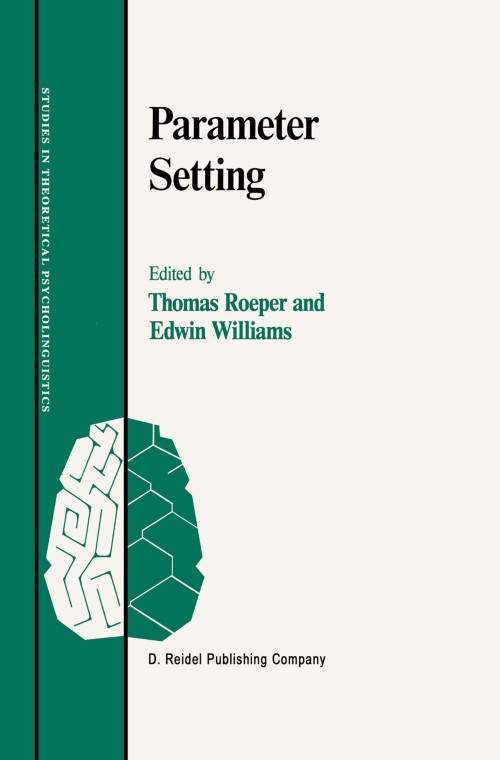
Parameter Setting [electronic resource] / edited by Thomas Roeper, Edwin Williams.
Erişim Adresi
ISBN
9789400937277
Dil Kodu
İngilizce
Yer Numarası
DK/8927
Basım Bildirimi
1st ed. 1987.
Yayın Bilgisi
Dordrecht : Springer Netherlands : Imprint: Springer, 1987.
Fiziksel Niteleme
XX, 253 p. online resource.
Dizi
Studies in Theoretical Psycholinguistics, 2215-1788 ; 4
İçindekiler Notu
The Theory of Parameters and Syntactic Development -- Comments on Hyams -- Parameters and Learnability in Binding Theory -- Comments on Wexler and Manzini -- Deductive Parameters and the Growth of Empty Categories -- The Maturation of Syntax -- Comments on Borer and Wexler -- Parameter Setting and the Development of Pronouns and Reflexives -- Comments on Solan -- The Pro-Drop Parameter in Second Language Acquisition -- A Note on Phinney -- List of Contributors.
Özet, vb.
In May 1985 the University of Massachusetts held the first conference on the parameter setting model of grammar and acquisition. The conference was conceived in the belief that there is a new possibility of tightly connecting grammatical studies and language acquisition studies, and that this new possibility has grown out of the new generation of ideas about the relation of Universal Grammar to the grammar of particular languages. The papers in this volume are all concerned in one way or another with the 'parametric' model of grammar, and with its role in explaining the acquisition of language. Before summarizing the accompanying papers, I would like to sketch the intellectual background of these new ideas. It has long been the acknowledged goal of grammatical theorists to explicate the relation between the experience of the child and the knowledge of the adult. Somehow, the child selects a unique grammar (by assumption) compatible with a random partially unreliable sample of some language. In the earliest work in generative grammar, starting with Chomsky's Aspects, and extending to such works as Jackendoffs Lexicalist Syntax (1977), the model of this account was the formal evaluation metric, accompanied by a general rule writing system. The model of acquisition was the following: the child composed a grammar by writing rules in the rule writing system, under the constraint that the rules must be compatible with the data, and that the grammar must be the one most highly valued by the evaluation metric.
Konu
Psycholinguistics.
Psycholinguistics and Cognitive Lingusitics.
Psycholinguistics and Cognitive Lingusitics.
Diğer Yazarlar
Kurum Adı
Eseri Alıntıla
Referansları kullanmadan önce gözden geçirmeniz ve varsa gerekli düzeltmeleri yapmanız önerilir.
Dijital Kaynak
MARC Görünümü
LEADER 04546nam a22005415i 4500
001 807634
003 TR_AnAIT
005 20260127004509
007 cr nn 008mamaa
008 121227s1987 ne | s |||| 0|eng d
020 |a9789400937277|9978-94-009-3727-7
024 7 |a10.1007/978-94-009-3727-7|2doi
041 |aeng
049 |aTürk Tarih Kurumu Kütüphanesi
050 4|aP37-37.5
072 7|aCFD|2bicssc
072 7|aLAN009040|2bisacsh
072 7|aCFD|2thema
082 04|a401.9|223
090 |aDK/8927
245 10|aParameter Setting|h[electronic resource] /|cedited by Thomas Roeper, Edwin Williams.
250 |a1st ed. 1987.
264 1|aDordrecht :|bSpringer Netherlands :|bImprint: Springer,|c1987.
300 |aXX, 253 p.|bonline resource.
336 |atext|btxt|2rdacontent
337 |acomputer|bc|2rdamedia
338 |aonline resource|bcr|2rdacarrier
347 |atext file|bPDF|2rda
490 1 |aStudies in Theoretical Psycholinguistics,|x2215-1788 ;|v4
505 0 |aThe Theory of Parameters and Syntactic Development -- Comments on Hyams -- Parameters and Learnability in Binding Theory -- Comments on Wexler and Manzini -- Deductive Parameters and the Growth of Empty Categories -- The Maturation of Syntax -- Comments on Borer and Wexler -- Parameter Setting and the Development of Pronouns and Reflexives -- Comments on Solan -- The Pro-Drop Parameter in Second Language Acquisition -- A Note on Phinney -- List of Contributors.
520 |aIn May 1985 the University of Massachusetts held the first conference on the parameter setting model of grammar and acquisition. The conference was conceived in the belief that there is a new possibility of tightly connecting grammatical studies and language acquisition studies, and that this new possibility has grown out of the new generation of ideas about the relation of Universal Grammar to the grammar of particular languages. The papers in this volume are all concerned in one way or another with the 'parametric' model of grammar, and with its role in explaining the acquisition of language. Before summarizing the accompanying papers, I would like to sketch the intellectual background of these new ideas. It has long been the acknowledged goal of grammatical theorists to explicate the relation between the experience of the child and the knowledge of the adult. Somehow, the child selects a unique grammar (by assumption) compatible with a random partially unreliable sample of some language. In the earliest work in generative grammar, starting with Chomsky's Aspects, and extending to such works as Jackendoffs Lexicalist Syntax (1977), the model of this account was the formal evaluation metric, accompanied by a general rule writing system. The model of acquisition was the following: the child composed a grammar by writing rules in the rule writing system, under the constraint that the rules must be compatible with the data, and that the grammar must be the one most highly valued by the evaluation metric.
532 8 |aAccessibility summary: This PDF is not accessible. It is based on scanned pages and does not support features such as screen reader compatibility or described non-text content (images, graphs etc). However, it likely supports searchable and selectable text based on OCR (Optical Character Recognition). Users with accessibility needs may not be able to use this content effectively. Please contact us at accessibilitysupport@springernature.com if you require assistance or an alternative format.
532 8 |aInaccessible, or known limited accessibility
532 8 |aNo reading system accessibility options actively disabled
532 8 |aPublisher contact for further accessibility information: accessibilitysupport@springernature.com
650 0|aPsycholinguistics.
650 14|aPsycholinguistics and Cognitive Lingusitics.
700 1 |aRoeper, Thomas.|eeditor.|4edt|4http://id.loc.gov/vocabulary/relators/edt
700 1 |aWilliams, Edwin.|eeditor.|4edt|4http://id.loc.gov/vocabulary/relators/edt
710 2 |aSpringerLink (Online service)
773 0 |tSpringer Nature eBook
776 08|iPrinted edition:|z9789027723154
776 08|iPrinted edition:|z9789027723161
776 08|iPrinted edition:|z9789400937284
830 0|aStudies in Theoretical Psycholinguistics,|x2215-1788 ;|v4
856 40|uhttps://doi.org/10.1007/978-94-009-3727-7
912 |aZDB-2-SHU
912 |aZDB-2-SXS
912 |aZDB-2-BAE
950 |aHumanities, Social Sciences and Law (SpringerNature-11648)
950 |aSocial Sciences (R0) (SpringerNature-43726)
001 807634
003 TR_AnAIT
005 20260127004509
007 cr nn 008mamaa
008 121227s1987 ne | s |||| 0|eng d
020 |a9789400937277|9978-94-009-3727-7
024 7 |a10.1007/978-94-009-3727-7|2doi
041 |aeng
049 |aTürk Tarih Kurumu Kütüphanesi
050 4|aP37-37.5
072 7|aCFD|2bicssc
072 7|aLAN009040|2bisacsh
072 7|aCFD|2thema
082 04|a401.9|223
090 |aDK/8927
245 10|aParameter Setting|h[electronic resource] /|cedited by Thomas Roeper, Edwin Williams.
250 |a1st ed. 1987.
264 1|aDordrecht :|bSpringer Netherlands :|bImprint: Springer,|c1987.
300 |aXX, 253 p.|bonline resource.
336 |atext|btxt|2rdacontent
337 |acomputer|bc|2rdamedia
338 |aonline resource|bcr|2rdacarrier
347 |atext file|bPDF|2rda
490 1 |aStudies in Theoretical Psycholinguistics,|x2215-1788 ;|v4
505 0 |aThe Theory of Parameters and Syntactic Development -- Comments on Hyams -- Parameters and Learnability in Binding Theory -- Comments on Wexler and Manzini -- Deductive Parameters and the Growth of Empty Categories -- The Maturation of Syntax -- Comments on Borer and Wexler -- Parameter Setting and the Development of Pronouns and Reflexives -- Comments on Solan -- The Pro-Drop Parameter in Second Language Acquisition -- A Note on Phinney -- List of Contributors.
520 |aIn May 1985 the University of Massachusetts held the first conference on the parameter setting model of grammar and acquisition. The conference was conceived in the belief that there is a new possibility of tightly connecting grammatical studies and language acquisition studies, and that this new possibility has grown out of the new generation of ideas about the relation of Universal Grammar to the grammar of particular languages. The papers in this volume are all concerned in one way or another with the 'parametric' model of grammar, and with its role in explaining the acquisition of language. Before summarizing the accompanying papers, I would like to sketch the intellectual background of these new ideas. It has long been the acknowledged goal of grammatical theorists to explicate the relation between the experience of the child and the knowledge of the adult. Somehow, the child selects a unique grammar (by assumption) compatible with a random partially unreliable sample of some language. In the earliest work in generative grammar, starting with Chomsky's Aspects, and extending to such works as Jackendoffs Lexicalist Syntax (1977), the model of this account was the formal evaluation metric, accompanied by a general rule writing system. The model of acquisition was the following: the child composed a grammar by writing rules in the rule writing system, under the constraint that the rules must be compatible with the data, and that the grammar must be the one most highly valued by the evaluation metric.
532 8 |aAccessibility summary: This PDF is not accessible. It is based on scanned pages and does not support features such as screen reader compatibility or described non-text content (images, graphs etc). However, it likely supports searchable and selectable text based on OCR (Optical Character Recognition). Users with accessibility needs may not be able to use this content effectively. Please contact us at accessibilitysupport@springernature.com if you require assistance or an alternative format.
532 8 |aInaccessible, or known limited accessibility
532 8 |aNo reading system accessibility options actively disabled
532 8 |aPublisher contact for further accessibility information: accessibilitysupport@springernature.com
650 0|aPsycholinguistics.
650 14|aPsycholinguistics and Cognitive Lingusitics.
700 1 |aRoeper, Thomas.|eeditor.|4edt|4http://id.loc.gov/vocabulary/relators/edt
700 1 |aWilliams, Edwin.|eeditor.|4edt|4http://id.loc.gov/vocabulary/relators/edt
710 2 |aSpringerLink (Online service)
773 0 |tSpringer Nature eBook
776 08|iPrinted edition:|z9789027723154
776 08|iPrinted edition:|z9789027723161
776 08|iPrinted edition:|z9789400937284
830 0|aStudies in Theoretical Psycholinguistics,|x2215-1788 ;|v4
856 40|uhttps://doi.org/10.1007/978-94-009-3727-7
912 |aZDB-2-SHU
912 |aZDB-2-SXS
912 |aZDB-2-BAE
950 |aHumanities, Social Sciences and Law (SpringerNature-11648)
950 |aSocial Sciences (R0) (SpringerNature-43726)
Materyaller
Depodan talep edilen materyal sadece kütüphane içerisinde kullanılmaktadır.
Materyal dışarıya ödünç verilmemektedir.
Materyal dışarıya ödünç verilmemektedir.
