LEADER 04179nam a22005055i 4500
001 807724
003 TR_AnAIT
005 20260127004657
007 cr nn 008mamaa
008 130828s2014 xxu| s |||| 0|eng d
020 |a9781461478799|9978-1-4614-7879-9
024 7 |a10.1007/978-1-4614-7879-9|2doi
041 |aeng
049 |aTürk Tarih Kurumu Kütüphanesi
050 4|aJF20-1177
072 7|aJPB|2bicssc
072 7|aPOL009000|2bisacsh
072 7|aJPB|2thema
082 04|a320.3|223
090 |aDK/9017
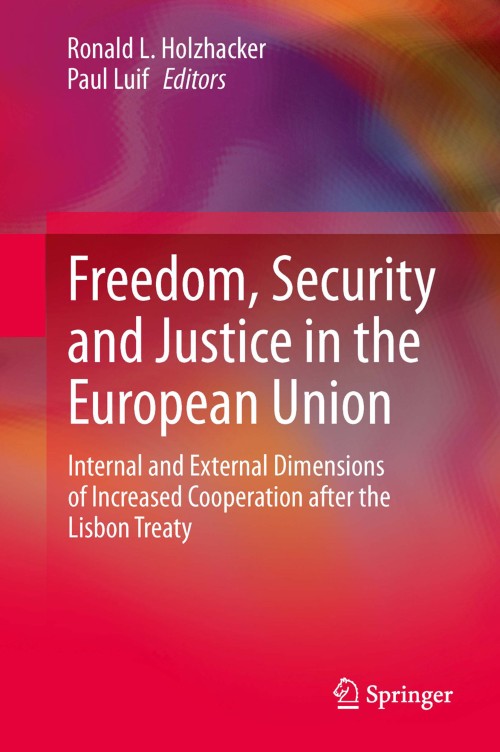
245 10|aFreedom, Security and Justice in the European Union|h[electronic resource] :|bInternal and External Dimensions of Increased Cooperation after the Lisbon Treaty /|cedited by Ronald L. Holzhacker, Paul Luif.
250 |a1st ed. 2014.
264 1|aNew York, NY :|bSpringer New York :|bImprint: Springer,|c2014.
300 |aV, 146 p.|bonline resource.
336 |atext|btxt|2rdacontent
337 |acomputer|bc|2rdamedia
338 |aonline resource|bcr|2rdacarrier
347 |atext file|bPDF|2rda
505 0 |a1. Freedom, Security, and Justice: Intern- and Extern- alization in the EU and the Member States after the Lisbon Treaty -- 2. New Parliamentary Practices in Justice and Home Affairs: Some Observations -- 3. Non-Binding Peer Evaluation within an Area of Freedom, Security, and Justice -- 4. Redefining the relationship between security, data retention and human rights -- 5. The Externalization of undocumented migration controls as a threat for the EU’s constitutional commitment to fundamental human rights? -- 6. Prüm Treaty and Prüm decision -- 7. The Interface between the Area of Freedom, Security and Justice and the Common Foreign and Security Policy of the EU: Legal Constraints to Political Objectives .
520 |aAs the European Union has evolved, it has also begun to address policy questions which are closer to the very heart of the state. From cooperation in Justice and Home Affairs, originally conceived as the third pillar of European cooperation, has emerged the Area of Freedom, Security, and Justice (AFSJ). A unique aspect of policy in this area is the desire to integrate the internal and external dimensions of this policy area. One of the tensions in this policy area has been balancing the protection of fundamental rights and increasing security. The first part of this book focuses on the institutional relations of policymaking in AFSJ, both within member states and between member states, in particular the issues of national executive control, national parliamentary scrutiny and peer review across the member states with regard to AFSJ. The second part focuses on specific policy areas which are part of AFSJ. Two chapters highlight the tension found in this policy area between security and human or fundamental rights, the first related to data retention and the second on policing external borders. The final two chapters are concerned with data exchange among European countries and transatlantically with the US, and the interface between AFSJ and the Common Foreign and Security Policy (CFSP). The chapters contained in the book were presented at the Dutch Ministry of the Interior and Kingdom Relations and the Dutch national parliament (Tweede Kamer), making it of interest to scholars and practitioners alike.
650 0|aComparative government.
650 0|aEurope|xEconomic integration.
650 0|aInternational relations.
650 14|aComparative Politics.
650 24|aEuropean Economic Integration.
650 24|aInternational Relations.
700 1 |aHolzhacker, Ronald L.|eeditor.|4edt|4http://id.loc.gov/vocabulary/relators/edt
700 1 |aLuif, Paul.|eeditor.|4edt|4http://id.loc.gov/vocabulary/relators/edt
710 2 |aSpringerLink (Online service)
773 0 |tSpringer Nature eBook
776 08|iPrinted edition:|z9781461478782
776 08|iPrinted edition:|z9781461478805
776 08|iPrinted edition:|z9781489992680
856 40|uhttps://doi.org/10.1007/978-1-4614-7879-9
912 |aZDB-2-SHU
912 |aZDB-2-SXPI
950 |aHumanities, Social Sciences and Law (SpringerNature-11648)
950 |aPolitical Science and International Studies (R0) (SpringerNature-43724)