

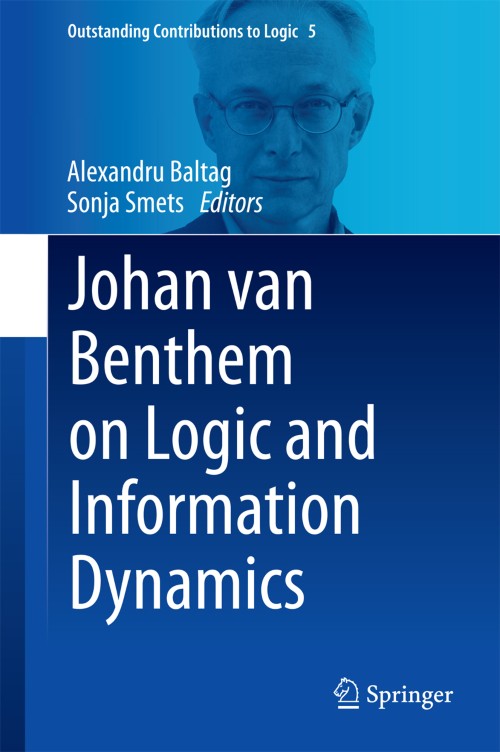
Johan van Benthem on Logic and Information Dynamics [electronic resource] / edited by Alexandru Baltag, Sonja Smets.
Erişim Adresi
ISBN
9783319060255
Dil Kodu
İngilizce
Yer Numarası
DK/9025
Basım Bildirimi
1st ed. 2014.
Yayın Bilgisi
Cham : Springer International Publishing : Imprint: Springer, 2014.
Fiziksel Niteleme
XIII, 1027 p. 115 illus. online resource.
Dizi
Outstanding Contributions to Logic, 2211-2766 ; 5
İçindekiler Notu
Preface; Johan van Benthem -- Introduction; Alexandru Baltag and Sonja Smets -- Part I. Mathematical and Computational Perspectives -- The Freedoms of (Guarded) Bisimulation; Erich Grädel and Martin Otto -- Expressiveness Modulo Bisimilarity: A Coalgebraic Perspective; Yde Venema -- Schema Mappings: A Case of Logical Dynamics in Database Theory; Balder ten Cate and Phokion G. Kolaitis -- On Dependence Logic; Pietro Galliani, Jouko Väänänen -- Intensionality, Definability and Computation; Samson Abramsky -- Comparing Theories: The Dynamics of Changing Vocabulary; Hajnal Andréka and István Németi -- Part II. Dynamics of Knowledge and Belief Over Time -- Dynamic Epistemic Logics; Jan van Eijck -- Belief Revision and Dynamic Logic; Patrick Girard and Hans Rott -- Temporal Aspects of the Dynamics of Knowledge; Valentin Goranko and Eric Pacuit -- Logic and Learning; Nina Gierasimczuk, Vincent F. Hendricks, and Dick de Jongh -- A Computational Learning Semantics for Inductive Empirical Knowledge; Kevin T. Kelly -- Structures for Epistemic Logic; Nick Bezhanishvili and Wiebe van der Hoek -- Logic and Probabilistic Update; Lorenz Demey and Barteld Kooi -- Belief as a Simplification of Probability, and What This Entails; Hannes Leitgeb -- Part III. Games -- Logic and Game Theory; Giacomo Bonanno and Cédric Dégremont -- Knowledge Games and Coalitional Abilities; Thomas ågotnes and Hans van Ditmarsch -- On Definitive Solutions of Strategic Games; Sergei Artemov -- Logical Player Types for a Theory of Play; Ram Ramanujam -- An Alternative Analysis of Signaling Games; Gabriel Sandu -- Part IV. Agency -- Them and Us: Autonomous Agents in Vivo and in Silico; Peter Millican and Michael Wooldridge -- Incorporating Action Models into the Situation Calculus; Yongmei Liu and Hector J. Levesque -- Roles, Rigidity, and Quantification in Epistemic Logic; Wesley H. Holliday and John Perry -- Stit Logics, Games, Knowledge, and Freedom; Roberto Ciuni and John Horty -- The Logic of Best Actions from aDeontic Perspective; Olivier Roy, Albert J.J. Anglberger and Norbert Gratzl -- When Are Two Arguments the Same? Equivalence in Abstract Argumentation; Dov Gabbay and Davide Grossi -- Part V. Language and Cognition -- Three Etudes on Logical Dynamics and the Program of Natural Logic; Lawrence S. Moss -- From Good to Better: Using Contextual Shifts to Define Preference in Terms of Monadic Value; Sven Ove Hansson and Fenrong Liu -- Arguing about Dynamic Meaning; Martin Stokhof -- Logic of and for Language, and Logic of and for Mind; Hans Kamp -- Logic and Complexity in Cognitive Science; Alistair M.C. Isaac and Jakub Szymanik and Rineke Verbrugge -- Computational Complexity and Cognitive Science: How the Body and the World Help the Mind be Efficient; Peter Gärdenfors -- Part VI. Styles of Reasoning -- Dynamic vs. Classical consequence; Denis Bonnay and Dag Westerståhl -- Dynamic Epistemic Logic as a Substructural Logic; Guillaume Aucher -- Arrows Pointing at Arrows: Arrow Logic, Relevance Logic, and Relation Algebras; J. Michael Dunn -- Situation Theory Reconsidered; Jeremy Seligman -- Unified Correspondence; Willem Conradie, Silvio Ghilardi, Alessandra Palmigiano -- Conclusions -- Reflections; Johan van Benthem -- Scientific Autobiography; Johan van Benthem -- Bibliography -- Publications. .
Özet, vb.
This book illustrates the program of Logical-Informational Dynamics. Rational agents exploit the information available in the world in delicate ways, adopt a wide range of epistemic attitudes, and in that process, constantly change the world itself. Logical-Informational Dynamics is about logical systems putting such activities at center stage, focusing on the events by which we acquire information and change attitudes. Its contributions show many current logics of information and change at work, often in multi-agent settings where social behavior is essential, and often stressing Johan van Benthem's pioneering work in establishing this program. However, this is not a Festschrift, but a rich tapestry for a field with a wealth of strands of its own. The reader will see the state of the art in such topics as information update, belief change, preference, learning over time, and strategic interaction in games. Moreover, no tight boundary has been enforced, and some chapters add more general mathematical or philosophical foundations or links to current trends in computer science. The theme of this book lies at the interface of many disciplines. Logic is the main methodology, but the various chapters cross easily between mathematics, computer science, philosophy, linguistics, cognitive and social sciences, while also ranging from pure theory to empirical work. Accordingly, the authors of this book represent a wide variety of original thinkers from different research communities. And their interconnected themes challenge at the same time how we think of logic, philosophy and computation. Thus, very much in line with van Benthem's work over many decades, the volume shows how all these disciplines forma natural unity in the perspective of dynamic logicians (broadly conceived) exploring their new themes today. And at the same time, in doing so, it offers a broader conception of logic with a certain grandeur, moving its horizons beyond the traditional study of consequence relations.
Konu
Logic.
Mathematical logic.
Logic design.
Logic.
Mathematical Logic and Foundations.
Logic Design.
Mathematical logic.
Logic design.
Logic.
Mathematical Logic and Foundations.
Logic Design.
Diğer Yazarlar
Kurum Adı
Eseri Alıntıla
Referansları kullanmadan önce gözden geçirmeniz ve varsa gerekli düzeltmeleri yapmanız önerilir.
Dijital Kaynak
MARC Görünümü
LEADER 07261nam a22005295i 4500
001 807732
003 TR_AnAIT
005 20260127004706
007 cr nn 008mamaa
008 140826s2014 sz | s |||| 0|eng d
020 |a9783319060255|9978-3-319-06025-5
024 7 |a10.1007/978-3-319-06025-5|2doi
041 |aeng
049 |aTürk Tarih Kurumu Kütüphanesi
050 4|aBC1-199
072 7|aHPL|2bicssc
072 7|aPHI011000|2bisacsh
072 7|aQDTL|2thema
082 04|a160|223
090 |aDK/9025
245 10|aJohan van Benthem on Logic and Information Dynamics|h[electronic resource] /|cedited by Alexandru Baltag, Sonja Smets.
250 |a1st ed. 2014.
264 1|aCham :|bSpringer International Publishing :|bImprint: Springer,|c2014.
300 |aXIII, 1027 p. 115 illus.|bonline resource.
336 |atext|btxt|2rdacontent
337 |acomputer|bc|2rdamedia
338 |aonline resource|bcr|2rdacarrier
347 |atext file|bPDF|2rda
490 1 |aOutstanding Contributions to Logic,|x2211-2766 ;|v5
505 0 |aPreface; Johan van Benthem -- Introduction; Alexandru Baltag and Sonja Smets -- Part I. Mathematical and Computational Perspectives -- The Freedoms of (Guarded) Bisimulation; Erich Grädel and Martin Otto -- Expressiveness Modulo Bisimilarity: A Coalgebraic Perspective; Yde Venema -- Schema Mappings: A Case of Logical Dynamics in Database Theory; Balder ten Cate and Phokion G. Kolaitis -- On Dependence Logic; Pietro Galliani, Jouko Väänänen -- Intensionality, Definability and Computation; Samson Abramsky -- Comparing Theories: The Dynamics of Changing Vocabulary; Hajnal Andréka and István Németi -- Part II. Dynamics of Knowledge and Belief Over Time -- Dynamic Epistemic Logics; Jan van Eijck -- Belief Revision and Dynamic Logic; Patrick Girard and Hans Rott -- Temporal Aspects of the Dynamics of Knowledge; Valentin Goranko and Eric Pacuit -- Logic and Learning; Nina Gierasimczuk, Vincent F. Hendricks, and Dick de Jongh -- A Computational Learning Semantics for Inductive Empirical Knowledge; Kevin T. Kelly -- Structures for Epistemic Logic; Nick Bezhanishvili and Wiebe van der Hoek -- Logic and Probabilistic Update; Lorenz Demey and Barteld Kooi -- Belief as a Simplification of Probability, and What This Entails; Hannes Leitgeb -- Part III. Games -- Logic and Game Theory; Giacomo Bonanno and Cédric Dégremont -- Knowledge Games and Coalitional Abilities; Thomas ågotnes and Hans van Ditmarsch -- On Definitive Solutions of Strategic Games; Sergei Artemov -- Logical Player Types for a Theory of Play; Ram Ramanujam -- An Alternative Analysis of Signaling Games; Gabriel Sandu -- Part IV. Agency -- Them and Us: Autonomous Agents in Vivo and in Silico; Peter Millican and Michael Wooldridge -- Incorporating Action Models into the Situation Calculus; Yongmei Liu and Hector J. Levesque -- Roles, Rigidity, and Quantification in Epistemic Logic; Wesley H. Holliday and John Perry -- Stit Logics, Games, Knowledge, and Freedom; Roberto Ciuni and John Horty -- The Logic of Best Actions from aDeontic Perspective; Olivier Roy, Albert J.J. Anglberger and Norbert Gratzl -- When Are Two Arguments the Same? Equivalence in Abstract Argumentation; Dov Gabbay and Davide Grossi -- Part V. Language and Cognition -- Three Etudes on Logical Dynamics and the Program of Natural Logic; Lawrence S. Moss -- From Good to Better: Using Contextual Shifts to Define Preference in Terms of Monadic Value; Sven Ove Hansson and Fenrong Liu -- Arguing about Dynamic Meaning; Martin Stokhof -- Logic of and for Language, and Logic of and for Mind; Hans Kamp -- Logic and Complexity in Cognitive Science; Alistair M.C. Isaac and Jakub Szymanik and Rineke Verbrugge -- Computational Complexity and Cognitive Science: How the Body and the World Help the Mind be Efficient; Peter Gärdenfors -- Part VI. Styles of Reasoning -- Dynamic vs. Classical consequence; Denis Bonnay and Dag Westerståhl -- Dynamic Epistemic Logic as a Substructural Logic; Guillaume Aucher -- Arrows Pointing at Arrows: Arrow Logic, Relevance Logic, and Relation Algebras; J. Michael Dunn -- Situation Theory Reconsidered; Jeremy Seligman -- Unified Correspondence; Willem Conradie, Silvio Ghilardi, Alessandra Palmigiano -- Conclusions -- Reflections; Johan van Benthem -- Scientific Autobiography; Johan van Benthem -- Bibliography -- Publications. .
520 |aThis book illustrates the program of Logical-Informational Dynamics. Rational agents exploit the information available in the world in delicate ways, adopt a wide range of epistemic attitudes, and in that process, constantly change the world itself. Logical-Informational Dynamics is about logical systems putting such activities at center stage, focusing on the events by which we acquire information and change attitudes. Its contributions show many current logics of information and change at work, often in multi-agent settings where social behavior is essential, and often stressing Johan van Benthem's pioneering work in establishing this program. However, this is not a Festschrift, but a rich tapestry for a field with a wealth of strands of its own. The reader will see the state of the art in such topics as information update, belief change, preference, learning over time, and strategic interaction in games. Moreover, no tight boundary has been enforced, and some chapters add more general mathematical or philosophical foundations or links to current trends in computer science. The theme of this book lies at the interface of many disciplines. Logic is the main methodology, but the various chapters cross easily between mathematics, computer science, philosophy, linguistics, cognitive and social sciences, while also ranging from pure theory to empirical work. Accordingly, the authors of this book represent a wide variety of original thinkers from different research communities. And their interconnected themes challenge at the same time how we think of logic, philosophy and computation. Thus, very much in line with van Benthem's work over many decades, the volume shows how all these disciplines forma natural unity in the perspective of dynamic logicians (broadly conceived) exploring their new themes today. And at the same time, in doing so, it offers a broader conception of logic with a certain grandeur, moving its horizons beyond the traditional study of consequence relations.
650 0|aLogic.
650 0|aMathematical logic.
650 0|aLogic design.
650 14|aLogic.
650 24|aMathematical Logic and Foundations.
650 24|aLogic Design.
700 1 |aBaltag, Alexandru.|eeditor.|4edt|4http://id.loc.gov/vocabulary/relators/edt
700 1 |aSmets, Sonja.|eeditor.|4edt|4http://id.loc.gov/vocabulary/relators/edt
710 2 |aSpringerLink (Online service)
773 0 |tSpringer Nature eBook
776 08|iPrinted edition:|z9783319060248
776 08|iPrinted edition:|z9783319060262
776 08|iPrinted edition:|z9783319382975
830 0|aOutstanding Contributions to Logic,|x2211-2766 ;|v5
856 40|uhttps://doi.org/10.1007/978-3-319-06025-5
912 |aZDB-2-SHU
912 |aZDB-2-SXPR
950 |aHumanities, Social Sciences and Law (SpringerNature-11648)
950 |aPhilosophy and Religion (R0) (SpringerNature-43725)
001 807732
003 TR_AnAIT
005 20260127004706
007 cr nn 008mamaa
008 140826s2014 sz | s |||| 0|eng d
020 |a9783319060255|9978-3-319-06025-5
024 7 |a10.1007/978-3-319-06025-5|2doi
041 |aeng
049 |aTürk Tarih Kurumu Kütüphanesi
050 4|aBC1-199
072 7|aHPL|2bicssc
072 7|aPHI011000|2bisacsh
072 7|aQDTL|2thema
082 04|a160|223
090 |aDK/9025
245 10|aJohan van Benthem on Logic and Information Dynamics|h[electronic resource] /|cedited by Alexandru Baltag, Sonja Smets.
250 |a1st ed. 2014.
264 1|aCham :|bSpringer International Publishing :|bImprint: Springer,|c2014.
300 |aXIII, 1027 p. 115 illus.|bonline resource.
336 |atext|btxt|2rdacontent
337 |acomputer|bc|2rdamedia
338 |aonline resource|bcr|2rdacarrier
347 |atext file|bPDF|2rda
490 1 |aOutstanding Contributions to Logic,|x2211-2766 ;|v5
505 0 |aPreface; Johan van Benthem -- Introduction; Alexandru Baltag and Sonja Smets -- Part I. Mathematical and Computational Perspectives -- The Freedoms of (Guarded) Bisimulation; Erich Grädel and Martin Otto -- Expressiveness Modulo Bisimilarity: A Coalgebraic Perspective; Yde Venema -- Schema Mappings: A Case of Logical Dynamics in Database Theory; Balder ten Cate and Phokion G. Kolaitis -- On Dependence Logic; Pietro Galliani, Jouko Väänänen -- Intensionality, Definability and Computation; Samson Abramsky -- Comparing Theories: The Dynamics of Changing Vocabulary; Hajnal Andréka and István Németi -- Part II. Dynamics of Knowledge and Belief Over Time -- Dynamic Epistemic Logics; Jan van Eijck -- Belief Revision and Dynamic Logic; Patrick Girard and Hans Rott -- Temporal Aspects of the Dynamics of Knowledge; Valentin Goranko and Eric Pacuit -- Logic and Learning; Nina Gierasimczuk, Vincent F. Hendricks, and Dick de Jongh -- A Computational Learning Semantics for Inductive Empirical Knowledge; Kevin T. Kelly -- Structures for Epistemic Logic; Nick Bezhanishvili and Wiebe van der Hoek -- Logic and Probabilistic Update; Lorenz Demey and Barteld Kooi -- Belief as a Simplification of Probability, and What This Entails; Hannes Leitgeb -- Part III. Games -- Logic and Game Theory; Giacomo Bonanno and Cédric Dégremont -- Knowledge Games and Coalitional Abilities; Thomas ågotnes and Hans van Ditmarsch -- On Definitive Solutions of Strategic Games; Sergei Artemov -- Logical Player Types for a Theory of Play; Ram Ramanujam -- An Alternative Analysis of Signaling Games; Gabriel Sandu -- Part IV. Agency -- Them and Us: Autonomous Agents in Vivo and in Silico; Peter Millican and Michael Wooldridge -- Incorporating Action Models into the Situation Calculus; Yongmei Liu and Hector J. Levesque -- Roles, Rigidity, and Quantification in Epistemic Logic; Wesley H. Holliday and John Perry -- Stit Logics, Games, Knowledge, and Freedom; Roberto Ciuni and John Horty -- The Logic of Best Actions from aDeontic Perspective; Olivier Roy, Albert J.J. Anglberger and Norbert Gratzl -- When Are Two Arguments the Same? Equivalence in Abstract Argumentation; Dov Gabbay and Davide Grossi -- Part V. Language and Cognition -- Three Etudes on Logical Dynamics and the Program of Natural Logic; Lawrence S. Moss -- From Good to Better: Using Contextual Shifts to Define Preference in Terms of Monadic Value; Sven Ove Hansson and Fenrong Liu -- Arguing about Dynamic Meaning; Martin Stokhof -- Logic of and for Language, and Logic of and for Mind; Hans Kamp -- Logic and Complexity in Cognitive Science; Alistair M.C. Isaac and Jakub Szymanik and Rineke Verbrugge -- Computational Complexity and Cognitive Science: How the Body and the World Help the Mind be Efficient; Peter Gärdenfors -- Part VI. Styles of Reasoning -- Dynamic vs. Classical consequence; Denis Bonnay and Dag Westerståhl -- Dynamic Epistemic Logic as a Substructural Logic; Guillaume Aucher -- Arrows Pointing at Arrows: Arrow Logic, Relevance Logic, and Relation Algebras; J. Michael Dunn -- Situation Theory Reconsidered; Jeremy Seligman -- Unified Correspondence; Willem Conradie, Silvio Ghilardi, Alessandra Palmigiano -- Conclusions -- Reflections; Johan van Benthem -- Scientific Autobiography; Johan van Benthem -- Bibliography -- Publications. .
520 |aThis book illustrates the program of Logical-Informational Dynamics. Rational agents exploit the information available in the world in delicate ways, adopt a wide range of epistemic attitudes, and in that process, constantly change the world itself. Logical-Informational Dynamics is about logical systems putting such activities at center stage, focusing on the events by which we acquire information and change attitudes. Its contributions show many current logics of information and change at work, often in multi-agent settings where social behavior is essential, and often stressing Johan van Benthem's pioneering work in establishing this program. However, this is not a Festschrift, but a rich tapestry for a field with a wealth of strands of its own. The reader will see the state of the art in such topics as information update, belief change, preference, learning over time, and strategic interaction in games. Moreover, no tight boundary has been enforced, and some chapters add more general mathematical or philosophical foundations or links to current trends in computer science. The theme of this book lies at the interface of many disciplines. Logic is the main methodology, but the various chapters cross easily between mathematics, computer science, philosophy, linguistics, cognitive and social sciences, while also ranging from pure theory to empirical work. Accordingly, the authors of this book represent a wide variety of original thinkers from different research communities. And their interconnected themes challenge at the same time how we think of logic, philosophy and computation. Thus, very much in line with van Benthem's work over many decades, the volume shows how all these disciplines forma natural unity in the perspective of dynamic logicians (broadly conceived) exploring their new themes today. And at the same time, in doing so, it offers a broader conception of logic with a certain grandeur, moving its horizons beyond the traditional study of consequence relations.
650 0|aLogic.
650 0|aMathematical logic.
650 0|aLogic design.
650 14|aLogic.
650 24|aMathematical Logic and Foundations.
650 24|aLogic Design.
700 1 |aBaltag, Alexandru.|eeditor.|4edt|4http://id.loc.gov/vocabulary/relators/edt
700 1 |aSmets, Sonja.|eeditor.|4edt|4http://id.loc.gov/vocabulary/relators/edt
710 2 |aSpringerLink (Online service)
773 0 |tSpringer Nature eBook
776 08|iPrinted edition:|z9783319060248
776 08|iPrinted edition:|z9783319060262
776 08|iPrinted edition:|z9783319382975
830 0|aOutstanding Contributions to Logic,|x2211-2766 ;|v5
856 40|uhttps://doi.org/10.1007/978-3-319-06025-5
912 |aZDB-2-SHU
912 |aZDB-2-SXPR
950 |aHumanities, Social Sciences and Law (SpringerNature-11648)
950 |aPhilosophy and Religion (R0) (SpringerNature-43725)
Materyaller
Depodan talep edilen materyal sadece kütüphane içerisinde kullanılmaktadır.
Materyal dışarıya ödünç verilmemektedir.
Materyal dışarıya ödünç verilmemektedir.
