

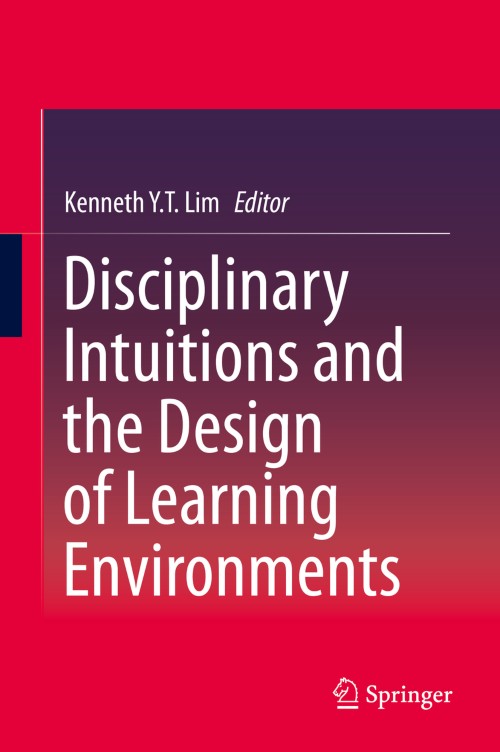
Disciplinary Intuitions and the Design of Learning Environments [electronic resource] / edited by Kenneth Y. T. Lim.
Erişim Adresi
ISBN
9789812871824
Dil Kodu
İngilizce
Yer Numarası
DK/9026
Basım Bildirimi
1st ed. 2015.
Yayın Bilgisi
Singapore : Springer Nature Singapore : Imprint: Springer, 2015.
Fiziksel Niteleme
XXIII, 201 p. 31 illus. online resource.
İçindekiler Notu
PART ONE Theoretical and historical foundations -- Chapter 1 Intuitions all around us -- Chapter 2 On the nature of Disciplinary Intuitions -- Chapter 3 Learning through intuition in early China -- Chapter 4 Applying Disciplinary Intuitions to classroom contexts: a constructivist perspective -- PART TWO Delving into Disciplines -- Chapter 5 Developing Disciplinary Intuitions in the Natural Sciences -- Chapter 6 The nature of Intuition in Design -- Chapter 7 From seasons to cisterns - the nature of Geographical Intuition -- Chapter 8 Second Language Intuition: native language and linguistic universals -- Chapter 9 Manifestations of intuitions in the English Language -- Chapter 10 Disciplinary Intuitions in the English Language classroom: implications for practice -- Chapter 11 Surfacing Intuitions through visual novels -- Chapter 12 Mathematical Intuition and storytelling for meaningful learning -- PART THREE Coda -- Chapter 13 Disciplinary Intuitions as Praxis: the role of Intuition in Social Education -- Chapter 14 Misconceptions, Intuitions and Elementary Physics: harnessing everyday understanding in learning environment design.
Özet, vb.
As children, we would have spilt glasses of milk, dropped things, and broken things. As children, therefore, we would have developed intuitions about how the world ‘works’, but we would not necessarily have been able to explain these ‘workings’. It would only have been till we entered formal schooling that we would have learned codifications of canon within each respective discipline, and consequently how to articulate the canon to explain the intuition. The preceding example was from the natural sciences, but one could just have easily taken an example from, say, the environmental sciences or from the social sciences. Indeed, much of this book does just that, as it seeks to chart the territory of a new theory of learning around Disciplinary Intuitions. Many of the chapters within draw frequent and explicit linkages to curriculum design, from the premise of the need to go beyond addressing the conceptions of learners, to seeking to understand the substrate upon which these conceptions are founded. The argument is made that this substrate comprises the particular set of lived experiences of each learner, and how – because these lived experiences are as tacit as they are diverse – designing curriculum around misconceptions and preconceptions alone would not lead to enduring understanding from first principles. From this perspective, Disciplinary Intuitions constitute an exciting field at the nexus of learning theories and curriculum design.
Konu
Education __ Curricula.
Learning, Psychology of.
Educational psychology.
Curriculum Studies.
Instructional Psychology.
Educational Psychology.
Learning, Psychology of.
Educational psychology.
Curriculum Studies.
Instructional Psychology.
Educational Psychology.
Diğer Yazarlar
Kurum Adı
Eseri Alıntıla
Referansları kullanmadan önce gözden geçirmeniz ve varsa gerekli düzeltmeleri yapmanız önerilir.
Dijital Kaynak
MARC Görünümü
LEADER 04344nam a22004935i 4500
001 807733
003 TR_AnAIT
005 20260127004707
007 cr nn 008mamaa
008 141019s2015 si | s |||| 0|eng d
020 |a9789812871824|9978-981-287-182-4
024 7 |a10.1007/978-981-287-182-4|2doi
041 |aeng
049 |aTürk Tarih Kurumu Kütüphanesi
050 4|aLB2806.15
072 7|aJNKC|2bicssc
072 7|aEDU007000|2bisacsh
072 7|aJNDG|2thema
082 04|a375|223
090 |aDK/9026
245 10|aDisciplinary Intuitions and the Design of Learning Environments|h[electronic resource] /|cedited by Kenneth Y. T. Lim.
250 |a1st ed. 2015.
264 1|aSingapore :|bSpringer Nature Singapore :|bImprint: Springer,|c2015.
300 |aXXIII, 201 p. 31 illus.|bonline resource.
336 |atext|btxt|2rdacontent
337 |acomputer|bc|2rdamedia
338 |aonline resource|bcr|2rdacarrier
347 |atext file|bPDF|2rda
505 0 |aPART ONE Theoretical and historical foundations -- Chapter 1 Intuitions all around us -- Chapter 2 On the nature of Disciplinary Intuitions -- Chapter 3 Learning through intuition in early China -- Chapter 4 Applying Disciplinary Intuitions to classroom contexts: a constructivist perspective -- PART TWO Delving into Disciplines -- Chapter 5 Developing Disciplinary Intuitions in the Natural Sciences -- Chapter 6 The nature of Intuition in Design -- Chapter 7 From seasons to cisterns - the nature of Geographical Intuition -- Chapter 8 Second Language Intuition: native language and linguistic universals -- Chapter 9 Manifestations of intuitions in the English Language -- Chapter 10 Disciplinary Intuitions in the English Language classroom: implications for practice -- Chapter 11 Surfacing Intuitions through visual novels -- Chapter 12 Mathematical Intuition and storytelling for meaningful learning -- PART THREE Coda -- Chapter 13 Disciplinary Intuitions as Praxis: the role of Intuition in Social Education -- Chapter 14 Misconceptions, Intuitions and Elementary Physics: harnessing everyday understanding in learning environment design.
520 |aAs children, we would have spilt glasses of milk, dropped things, and broken things. As children, therefore, we would have developed intuitions about how the world ‘works’, but we would not necessarily have been able to explain these ‘workings’. It would only have been till we entered formal schooling that we would have learned codifications of canon within each respective discipline, and consequently how to articulate the canon to explain the intuition. The preceding example was from the natural sciences, but one could just have easily taken an example from, say, the environmental sciences or from the social sciences. Indeed, much of this book does just that, as it seeks to chart the territory of a new theory of learning around Disciplinary Intuitions. Many of the chapters within draw frequent and explicit linkages to curriculum design, from the premise of the need to go beyond addressing the conceptions of learners, to seeking to understand the substrate upon which these conceptions are founded. The argument is made that this substrate comprises the particular set of lived experiences of each learner, and how – because these lived experiences are as tacit as they are diverse – designing curriculum around misconceptions and preconceptions alone would not lead to enduring understanding from first principles. From this perspective, Disciplinary Intuitions constitute an exciting field at the nexus of learning theories and curriculum design.
650 0|aEducation|xCurricula.
650 0|aLearning, Psychology of.
650 0|aEducational psychology.
650 14|aCurriculum Studies.
650 24|aInstructional Psychology.
650 24|aEducational Psychology.
700 1 |aLim, Kenneth Y. T.|eeditor.|4edt|4http://id.loc.gov/vocabulary/relators/edt
710 2 |aSpringerLink (Online service)
773 0 |tSpringer Nature eBook
776 08|iPrinted edition:|z9789812871817
776 08|iPrinted edition:|z9789812871831
776 08|iPrinted edition:|z9789811011689
856 40|uhttps://doi.org/10.1007/978-981-287-182-4
912 |aZDB-2-SHU
912 |aZDB-2-SXED
950 |aHumanities, Social Sciences and Law (SpringerNature-11648)
950 |aEducation (R0) (SpringerNature-43721)
001 807733
003 TR_AnAIT
005 20260127004707
007 cr nn 008mamaa
008 141019s2015 si | s |||| 0|eng d
020 |a9789812871824|9978-981-287-182-4
024 7 |a10.1007/978-981-287-182-4|2doi
041 |aeng
049 |aTürk Tarih Kurumu Kütüphanesi
050 4|aLB2806.15
072 7|aJNKC|2bicssc
072 7|aEDU007000|2bisacsh
072 7|aJNDG|2thema
082 04|a375|223
090 |aDK/9026
245 10|aDisciplinary Intuitions and the Design of Learning Environments|h[electronic resource] /|cedited by Kenneth Y. T. Lim.
250 |a1st ed. 2015.
264 1|aSingapore :|bSpringer Nature Singapore :|bImprint: Springer,|c2015.
300 |aXXIII, 201 p. 31 illus.|bonline resource.
336 |atext|btxt|2rdacontent
337 |acomputer|bc|2rdamedia
338 |aonline resource|bcr|2rdacarrier
347 |atext file|bPDF|2rda
505 0 |aPART ONE Theoretical and historical foundations -- Chapter 1 Intuitions all around us -- Chapter 2 On the nature of Disciplinary Intuitions -- Chapter 3 Learning through intuition in early China -- Chapter 4 Applying Disciplinary Intuitions to classroom contexts: a constructivist perspective -- PART TWO Delving into Disciplines -- Chapter 5 Developing Disciplinary Intuitions in the Natural Sciences -- Chapter 6 The nature of Intuition in Design -- Chapter 7 From seasons to cisterns - the nature of Geographical Intuition -- Chapter 8 Second Language Intuition: native language and linguistic universals -- Chapter 9 Manifestations of intuitions in the English Language -- Chapter 10 Disciplinary Intuitions in the English Language classroom: implications for practice -- Chapter 11 Surfacing Intuitions through visual novels -- Chapter 12 Mathematical Intuition and storytelling for meaningful learning -- PART THREE Coda -- Chapter 13 Disciplinary Intuitions as Praxis: the role of Intuition in Social Education -- Chapter 14 Misconceptions, Intuitions and Elementary Physics: harnessing everyday understanding in learning environment design.
520 |aAs children, we would have spilt glasses of milk, dropped things, and broken things. As children, therefore, we would have developed intuitions about how the world ‘works’, but we would not necessarily have been able to explain these ‘workings’. It would only have been till we entered formal schooling that we would have learned codifications of canon within each respective discipline, and consequently how to articulate the canon to explain the intuition. The preceding example was from the natural sciences, but one could just have easily taken an example from, say, the environmental sciences or from the social sciences. Indeed, much of this book does just that, as it seeks to chart the territory of a new theory of learning around Disciplinary Intuitions. Many of the chapters within draw frequent and explicit linkages to curriculum design, from the premise of the need to go beyond addressing the conceptions of learners, to seeking to understand the substrate upon which these conceptions are founded. The argument is made that this substrate comprises the particular set of lived experiences of each learner, and how – because these lived experiences are as tacit as they are diverse – designing curriculum around misconceptions and preconceptions alone would not lead to enduring understanding from first principles. From this perspective, Disciplinary Intuitions constitute an exciting field at the nexus of learning theories and curriculum design.
650 0|aEducation|xCurricula.
650 0|aLearning, Psychology of.
650 0|aEducational psychology.
650 14|aCurriculum Studies.
650 24|aInstructional Psychology.
650 24|aEducational Psychology.
700 1 |aLim, Kenneth Y. T.|eeditor.|4edt|4http://id.loc.gov/vocabulary/relators/edt
710 2 |aSpringerLink (Online service)
773 0 |tSpringer Nature eBook
776 08|iPrinted edition:|z9789812871817
776 08|iPrinted edition:|z9789812871831
776 08|iPrinted edition:|z9789811011689
856 40|uhttps://doi.org/10.1007/978-981-287-182-4
912 |aZDB-2-SHU
912 |aZDB-2-SXED
950 |aHumanities, Social Sciences and Law (SpringerNature-11648)
950 |aEducation (R0) (SpringerNature-43721)
Materyaller
Depodan talep edilen materyal sadece kütüphane içerisinde kullanılmaktadır.
Materyal dışarıya ödünç verilmemektedir.
Materyal dışarıya ödünç verilmemektedir.
