LEADER 03493nam a22005895i 4500
001 807790
003 TR_AnAIT
005 20260127004815
007 cr nn 008mamaa
008 100301s2009 ne | s |||| 0|eng d
020 |a9789048125548|9978-90-481-2554-8
024 7 |a10.1007/978-90-481-2554-8|2doi
041 |aeng
049 |aTürk Tarih Kurumu Kütüphanesi
050 4|aB63
072 7|aHPS|2bicssc
072 7|aPHI034000|2bisacsh
072 7|aQDTS|2thema
082 04|a300.1|223
090 |aDK/9083
100 1 |aMargolis, Joseph.|eauthor.|4aut|4http://id.loc.gov/vocabulary/relators/aut
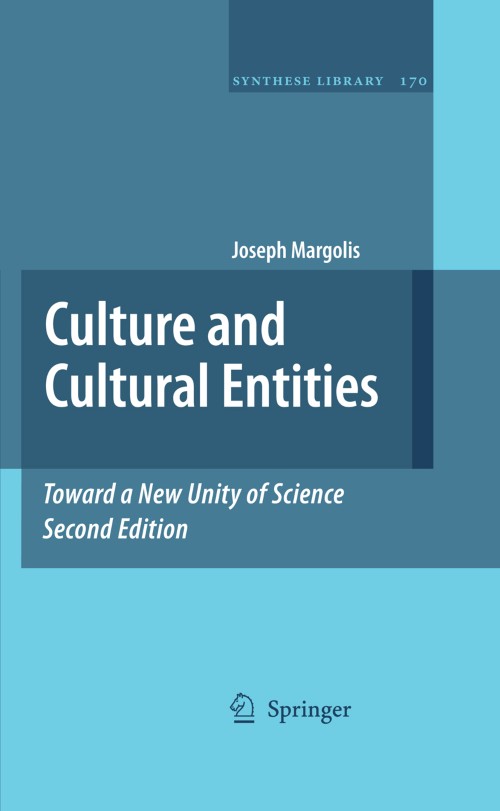
245 10|aCulture and Cultural Entities - Toward a New Unity of Science|h[electronic resource] /|cby Joseph Margolis.
250 |a2nd ed. 2009.
264 1|aDordrecht :|bSpringer Netherlands :|bImprint: Springer,|c2009.
300 |aXVI, 156 p.|bonline resource.
336 |atext|btxt|2rdacontent
337 |acomputer|bc|2rdamedia
338 |aonline resource|bcr|2rdacarrier
347 |atext file|bPDF|2rda
490 1 |aSynthese Library, Studies in Epistemology, Logic, Methodology, and Philosophy of Science,|x2542-8292 ;|v170
505 0 |aNature, Culture, and Persons -- The Concept of Consciousness -- Animal and Human Minds -- Action and Causality -- Puzzles About the Causal Explanation of Human Actions -- Cognitivism and the Problem of Explaining Human Intelligence -- Wittgenstein and Natural Languages -- Afterwords (2009).
520 |aCulture and Cultural Entities provides an original philosophical analysis of the nature and explanation of cultural phenomena, with special attention to ontology and methodology. It addresses in depth such topics as: the relation between physical and biological nature and cultural phenomena; the analysis of intentionality; the nature and explanation of action; causality; causal explanation and the unity of science; theories of language; historicity; animal and human intelligence; psychological and social phenomena; technology and evolution. Its approach features a form of non-reductive materialism, examines a wide range of views, and is highly readable, making it suitable for professionals, advanced undergraduate and graduate students, and an informed general audience. A new chapter was added to give a sense of pertinent trends since the appearance of the first edition, particularly with respect to the history of philosophy, pragmatism, the unity of science, and evolution. The unity, scope, and simplicity of the theory are well-regarded.
650 0|aPhilosophy and social sciences.
650 0|aEthics.
650 0|aPhilosophy of mind.
650 0|aSociology|xMethodology.
650 0|aMetaphysics.
650 0|aOntology.
650 14|aPhilosophy of the Social Sciences.
650 24|aMoral Philosophy and Applied Ethics.
650 24|aPhilosophy of Mind.
650 24|aSociological Methods.
650 24|aMetaphysics.
650 24|aOntology.
710 2 |aSpringerLink (Online service)
773 0 |tSpringer Nature eBook
776 08|iPrinted edition:|z9789048125531
776 08|iPrinted edition:|z9789048125753
776 08|iPrinted edition:|z9789048185054
830 0|aSynthese Library, Studies in Epistemology, Logic, Methodology, and Philosophy of Science,|x2542-8292 ;|v170
856 40|uhttps://doi.org/10.1007/978-90-481-2554-8
912 |aZDB-2-SHU
912 |aZDB-2-SXPR
950 |aHumanities, Social Sciences and Law (SpringerNature-11648)
950 |aPhilosophy and Religion (R0) (SpringerNature-43725)