

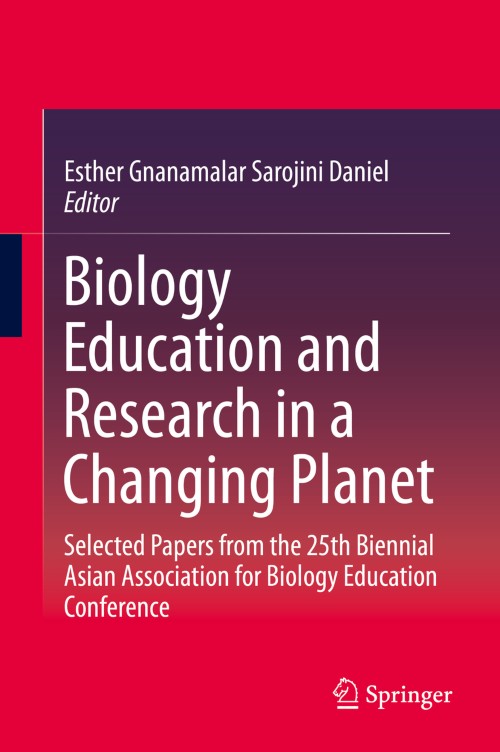
Biology Education and Research in a Changing Planet [electronic resource] : Selected Papers from the 25th Biennial Asian Association for Biology Education Conference / edited by Esther Gnanamalar Sarojini Daniel.
Erişim Adresi
ISBN
9789812875242
Dil Kodu
İngilizce
Yer Numarası
DK/9112
Basım Bildirimi
1st ed. 2015.
Yayın Bilgisi
Singapore : Springer Nature Singapore : Imprint: Springer, 2015.
Fiziksel Niteleme
XI, 225 p. 47 illus., 18 illus. in color. online resource.
İçindekiler Notu
Biology Education in an X, Y, Z World -- Chapter 1 An Evaluation of Knowledge and Attitudes towards Reproductive Health among Biology Non-Majors at the University of the Philippines Diliman Extension Programme in Pampanga -- Chapter 2 Kitchen PCR: An experimental programme to Experience Plant Genetic Diversity at the DNA Level -- Chapter 3 Students' Knowledge on Climate Change: Implications on Interdisciplinary Learning -- Chapter 4 Why Do School Students' Have Misconceptions about Life Processes? -- Chapter 5 Environmental Science Issues for Higher Order Thinking Skills (HOTS) Development: A Case Study in the Philippines -- Chapter 6 Is Gallery Walk An Effective Teaching and Learning Strategy for Biology? -- Chapter 7 Undergraduate Primary School Teachers' Attitudes towards Using ICT in Biology Courses -- Chapter 8 The Effect of Concept Cartoons as an Instructional Material and Formative Assessment Tool in Teaching Evolution and Diversity on the Achievement of Freshmen College Students -- Chapter 9 Tertiary Education of Evolutionary Biology in Asia -- Chapter 10 Student Biology Teachers: Passive Recipients to Active Participants (A Case Study - University of Malaya, Malaysia) -- The Endangered Planet - How can Biology Education Help? -- Chapter 11 Selection of Low-Cost Culture Medium for the Production of Bacterial Protease for Application in Para Rubber Manufacturing -- Chapter 12 The Species Diversity and Assessment of Marine Molluscs in Coral Reefs from Sattahip District, Chonburi Province, Thailand -- Chapter 13 Screening Alcohol - and Acid-Tolerant Microorganisms for Rice Vinegar Production -- Chapter 14 Optimization of PCR Condition for Potentially Novel Species of Lipolytic Bioluminescent Bacteria Isolated and Purified from Selected Philippine Epipelagic Organisms -- Chapter 15 Proximate Composition of Mango (Mangifera indica L.) and Honeydew (Cucumis melo) Wastes Fermented with Mono-Culture of Probiotics Lactobacillus Species -- Research in Bio logy -- Chapter 16 Isolation and Screening of Cellulase Producing Microorganisms and the Study Some Characteristics of Enzymes -- Chapter 17 Comparison of Chemical Compositions and Fatty Acids Profile of Cultured Common Carp (Cyprinus carpio) and Silver Carp (Hipophthalmichthys molitrix) -- Chapter 18 Antifungal Activity of Some Medicinal Plants and Their Interactive Effects with Antibiotic on Some Species of Candida Causing Candidiasis -- Chapter 19 Expression of Yeast Metal Accumulation Gene (CCC1) in Tobacco -- Chapter 20 Transformation of rice (Oryza sativa) cultivar Taichung 65 mediated by Agrobacterium tumefaciens -- Chapter 21 Biomass production of Spirulina platensis in medium containing effluent from Para rubber sheet manufacturing process -- Chapter 22 Effect of Decreasing Dietary Protein with Optimum Level of Methionine on Hematological and Biochemical Parameters of Rainbow Trout (Oncorhynchus Mykiss) -- Chapter 23 Conclusion: Be it Elementary or Tertiary Level of Biology that we Teach, We need TPACK.
Özet, vb.
This book presents selected conference proceedings from the 25th Biennial Asian Association for Biology Education Conference. It clarifies the differences between the structure of biology education for educators and researchers. It solves open problems by creating a bridge between biological research and its application in education and the sustainable development of communities. The book’s first topic is Biology Education in an X, Y, Z World, which provides ideas for how biology can be taught in innovative ways. The second topic, The Endangered Planet – How can Biology Education Help? discusses how humans depend on other species for survival and how they have the power to cause or to prevent extinctions. The third and final topic, Research in Biology, encompasses the growing wealth of biological information resulting from scientific research, especially in universities. Educators can use these findings to enhance their teaching.
Konu
Science __ Study and teaching.
Science Education.
Science Education.
Diğer Yazarlar
Kurum Adı
Eseri Alıntıla
Referansları kullanmadan önce gözden geçirmeniz ve varsa gerekli düzeltmeleri yapmanız önerilir.
Dijital Kaynak
MARC Görünümü
LEADER 05834nam a22004935i 4500
001 807819
003 TR_AnAIT
005 20260127004851
007 cr nn 008mamaa
008 150817s2015 si | s |||| 0|eng d
020 |a9789812875242|9978-981-287-524-2
024 7 |a10.1007/978-981-287-524-2|2doi
041 |aeng
049 |aTürk Tarih Kurumu Kütüphanesi
050 4|aQ181-183.4
072 7|aJNU|2bicssc
072 7|aPD|2bicssc
072 7|aSCI063000|2bisacsh
072 7|aJNU|2thema
072 7|aPD|2thema
082 04|a507.1|223
090 |aDK/9112
245 10|aBiology Education and Research in a Changing Planet|h[electronic resource] :|bSelected Papers from the 25th Biennial Asian Association for Biology Education Conference /|cedited by Esther Gnanamalar Sarojini Daniel.
250 |a1st ed. 2015.
264 1|aSingapore :|bSpringer Nature Singapore :|bImprint: Springer,|c2015.
300 |aXI, 225 p. 47 illus., 18 illus. in color.|bonline resource.
336 |atext|btxt|2rdacontent
337 |acomputer|bc|2rdamedia
338 |aonline resource|bcr|2rdacarrier
347 |atext file|bPDF|2rda
505 0 |aBiology Education in an X, Y, Z World -- Chapter 1 An Evaluation of Knowledge and Attitudes towards Reproductive Health among Biology Non-Majors at the University of the Philippines Diliman Extension Programme in Pampanga -- Chapter 2 Kitchen PCR: An experimental programme to Experience Plant Genetic Diversity at the DNA Level -- Chapter 3 Students' Knowledge on Climate Change: Implications on Interdisciplinary Learning -- Chapter 4 Why Do School Students' Have Misconceptions about Life Processes? -- Chapter 5 Environmental Science Issues for Higher Order Thinking Skills (HOTS) Development: A Case Study in the Philippines -- Chapter 6 Is Gallery Walk An Effective Teaching and Learning Strategy for Biology? -- Chapter 7 Undergraduate Primary School Teachers' Attitudes towards Using ICT in Biology Courses -- Chapter 8 The Effect of Concept Cartoons as an Instructional Material and Formative Assessment Tool in Teaching Evolution and Diversity on the Achievement of Freshmen College Students -- Chapter 9 Tertiary Education of Evolutionary Biology in Asia -- Chapter 10 Student Biology Teachers: Passive Recipients to Active Participants (A Case Study - University of Malaya, Malaysia) -- The Endangered Planet - How can Biology Education Help? -- Chapter 11 Selection of Low-Cost Culture Medium for the Production of Bacterial Protease for Application in Para Rubber Manufacturing -- Chapter 12 The Species Diversity and Assessment of Marine Molluscs in Coral Reefs from Sattahip District, Chonburi Province, Thailand -- Chapter 13 Screening Alcohol - and Acid-Tolerant Microorganisms for Rice Vinegar Production -- Chapter 14 Optimization of PCR Condition for Potentially Novel Species of Lipolytic Bioluminescent Bacteria Isolated and Purified from Selected Philippine Epipelagic Organisms -- Chapter 15 Proximate Composition of Mango (Mangifera indica L.) and Honeydew (Cucumis melo) Wastes Fermented with Mono-Culture of Probiotics Lactobacillus Species -- Research in Bio logy -- Chapter 16 Isolation and Screening of Cellulase Producing Microorganisms and the Study Some Characteristics of Enzymes -- Chapter 17 Comparison of Chemical Compositions and Fatty Acids Profile of Cultured Common Carp (Cyprinus carpio) and Silver Carp (Hipophthalmichthys molitrix) -- Chapter 18 Antifungal Activity of Some Medicinal Plants and Their Interactive Effects with Antibiotic on Some Species of Candida Causing Candidiasis -- Chapter 19 Expression of Yeast Metal Accumulation Gene (CCC1) in Tobacco -- Chapter 20 Transformation of rice (Oryza sativa) cultivar Taichung 65 mediated by Agrobacterium tumefaciens -- Chapter 21 Biomass production of Spirulina platensis in medium containing effluent from Para rubber sheet manufacturing process -- Chapter 22 Effect of Decreasing Dietary Protein with Optimum Level of Methionine on Hematological and Biochemical Parameters of Rainbow Trout (Oncorhynchus Mykiss) -- Chapter 23 Conclusion: Be it Elementary or Tertiary Level of Biology that we Teach, We need TPACK.
520 |aThis book presents selected conference proceedings from the 25th Biennial Asian Association for Biology Education Conference. It clarifies the differences between the structure of biology education for educators and researchers. It solves open problems by creating a bridge between biological research and its application in education and the sustainable development of communities. The book’s first topic is Biology Education in an X, Y, Z World, which provides ideas for how biology can be taught in innovative ways. The second topic, The Endangered Planet – How can Biology Education Help? discusses how humans depend on other species for survival and how they have the power to cause or to prevent extinctions. The third and final topic, Research in Biology, encompasses the growing wealth of biological information resulting from scientific research, especially in universities. Educators can use these findings to enhance their teaching.
650 0|aScience|xStudy and teaching.
650 14|aScience Education.
700 1 |aGnanamalar Sarojini Daniel, Esther.|eeditor.|4edt|4http://id.loc.gov/vocabulary/relators/edt
710 2 |aSpringerLink (Online service)
773 0 |tSpringer Nature eBook
776 08|iPrinted edition:|z9789812875235
776 08|iPrinted edition:|z9789812875259
776 08|iPrinted edition:|z9789811012778
856 40|uhttps://doi.org/10.1007/978-981-287-524-2
912 |aZDB-2-SHU
912 |aZDB-2-SXED
912 |aZDB-2-SXPE
950 |aHumanities, Social Sciences and Law (SpringerNature-11648)
950 |aEducation (R0) (SpringerNature-43721)
950 |aSpringer Nature Proceedings excluding Computer Science (SpringerNature-85345)
001 807819
003 TR_AnAIT
005 20260127004851
007 cr nn 008mamaa
008 150817s2015 si | s |||| 0|eng d
020 |a9789812875242|9978-981-287-524-2
024 7 |a10.1007/978-981-287-524-2|2doi
041 |aeng
049 |aTürk Tarih Kurumu Kütüphanesi
050 4|aQ181-183.4
072 7|aJNU|2bicssc
072 7|aPD|2bicssc
072 7|aSCI063000|2bisacsh
072 7|aJNU|2thema
072 7|aPD|2thema
082 04|a507.1|223
090 |aDK/9112
245 10|aBiology Education and Research in a Changing Planet|h[electronic resource] :|bSelected Papers from the 25th Biennial Asian Association for Biology Education Conference /|cedited by Esther Gnanamalar Sarojini Daniel.
250 |a1st ed. 2015.
264 1|aSingapore :|bSpringer Nature Singapore :|bImprint: Springer,|c2015.
300 |aXI, 225 p. 47 illus., 18 illus. in color.|bonline resource.
336 |atext|btxt|2rdacontent
337 |acomputer|bc|2rdamedia
338 |aonline resource|bcr|2rdacarrier
347 |atext file|bPDF|2rda
505 0 |aBiology Education in an X, Y, Z World -- Chapter 1 An Evaluation of Knowledge and Attitudes towards Reproductive Health among Biology Non-Majors at the University of the Philippines Diliman Extension Programme in Pampanga -- Chapter 2 Kitchen PCR: An experimental programme to Experience Plant Genetic Diversity at the DNA Level -- Chapter 3 Students' Knowledge on Climate Change: Implications on Interdisciplinary Learning -- Chapter 4 Why Do School Students' Have Misconceptions about Life Processes? -- Chapter 5 Environmental Science Issues for Higher Order Thinking Skills (HOTS) Development: A Case Study in the Philippines -- Chapter 6 Is Gallery Walk An Effective Teaching and Learning Strategy for Biology? -- Chapter 7 Undergraduate Primary School Teachers' Attitudes towards Using ICT in Biology Courses -- Chapter 8 The Effect of Concept Cartoons as an Instructional Material and Formative Assessment Tool in Teaching Evolution and Diversity on the Achievement of Freshmen College Students -- Chapter 9 Tertiary Education of Evolutionary Biology in Asia -- Chapter 10 Student Biology Teachers: Passive Recipients to Active Participants (A Case Study - University of Malaya, Malaysia) -- The Endangered Planet - How can Biology Education Help? -- Chapter 11 Selection of Low-Cost Culture Medium for the Production of Bacterial Protease for Application in Para Rubber Manufacturing -- Chapter 12 The Species Diversity and Assessment of Marine Molluscs in Coral Reefs from Sattahip District, Chonburi Province, Thailand -- Chapter 13 Screening Alcohol - and Acid-Tolerant Microorganisms for Rice Vinegar Production -- Chapter 14 Optimization of PCR Condition for Potentially Novel Species of Lipolytic Bioluminescent Bacteria Isolated and Purified from Selected Philippine Epipelagic Organisms -- Chapter 15 Proximate Composition of Mango (Mangifera indica L.) and Honeydew (Cucumis melo) Wastes Fermented with Mono-Culture of Probiotics Lactobacillus Species -- Research in Bio logy -- Chapter 16 Isolation and Screening of Cellulase Producing Microorganisms and the Study Some Characteristics of Enzymes -- Chapter 17 Comparison of Chemical Compositions and Fatty Acids Profile of Cultured Common Carp (Cyprinus carpio) and Silver Carp (Hipophthalmichthys molitrix) -- Chapter 18 Antifungal Activity of Some Medicinal Plants and Their Interactive Effects with Antibiotic on Some Species of Candida Causing Candidiasis -- Chapter 19 Expression of Yeast Metal Accumulation Gene (CCC1) in Tobacco -- Chapter 20 Transformation of rice (Oryza sativa) cultivar Taichung 65 mediated by Agrobacterium tumefaciens -- Chapter 21 Biomass production of Spirulina platensis in medium containing effluent from Para rubber sheet manufacturing process -- Chapter 22 Effect of Decreasing Dietary Protein with Optimum Level of Methionine on Hematological and Biochemical Parameters of Rainbow Trout (Oncorhynchus Mykiss) -- Chapter 23 Conclusion: Be it Elementary or Tertiary Level of Biology that we Teach, We need TPACK.
520 |aThis book presents selected conference proceedings from the 25th Biennial Asian Association for Biology Education Conference. It clarifies the differences between the structure of biology education for educators and researchers. It solves open problems by creating a bridge between biological research and its application in education and the sustainable development of communities. The book’s first topic is Biology Education in an X, Y, Z World, which provides ideas for how biology can be taught in innovative ways. The second topic, The Endangered Planet – How can Biology Education Help? discusses how humans depend on other species for survival and how they have the power to cause or to prevent extinctions. The third and final topic, Research in Biology, encompasses the growing wealth of biological information resulting from scientific research, especially in universities. Educators can use these findings to enhance their teaching.
650 0|aScience|xStudy and teaching.
650 14|aScience Education.
700 1 |aGnanamalar Sarojini Daniel, Esther.|eeditor.|4edt|4http://id.loc.gov/vocabulary/relators/edt
710 2 |aSpringerLink (Online service)
773 0 |tSpringer Nature eBook
776 08|iPrinted edition:|z9789812875235
776 08|iPrinted edition:|z9789812875259
776 08|iPrinted edition:|z9789811012778
856 40|uhttps://doi.org/10.1007/978-981-287-524-2
912 |aZDB-2-SHU
912 |aZDB-2-SXED
912 |aZDB-2-SXPE
950 |aHumanities, Social Sciences and Law (SpringerNature-11648)
950 |aEducation (R0) (SpringerNature-43721)
950 |aSpringer Nature Proceedings excluding Computer Science (SpringerNature-85345)
Materyaller
Depodan talep edilen materyal sadece kütüphane içerisinde kullanılmaktadır.
Materyal dışarıya ödünç verilmemektedir.
Materyal dışarıya ödünç verilmemektedir.
