

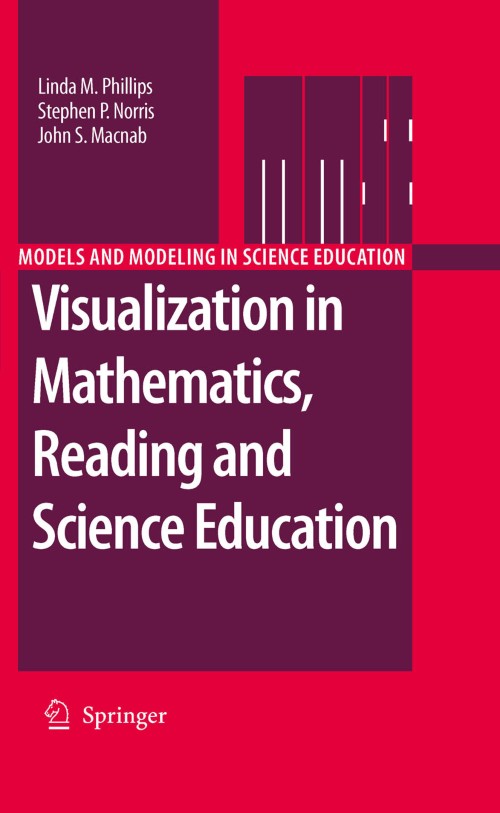
Visualization in Mathematics, Reading and Science Education [electronic resource] / by Linda M. Phillips, Stephen P. Norris, John S. Macnab.
Erişim Adresi
ISBN
9789048188161
Dil Kodu
İngilizce
Yer Numarası
DK/9114
Yazar
Basım Bildirimi
1st ed. 2010.
Yayın Bilgisi
Dordrecht : Springer Netherlands : Imprint: Springer, 2010.
Fiziksel Niteleme
XIV, 106 p. online resource.
Dizi
Models and Modeling in Science Education, 2213-2260 ; 5
İçindekiler Notu
An Introduction To Visualization -- A Commonsense View and Its Problems -- A History of Visualization in Psychology and Science -- The Concept of Visualization -- Cognitive Theory -- Current Educational Research -- Visualizations and Mathematics -- Visualizations and Reading -- Visualizations and Science -- Cautions and Recommendations -- Research and Guidelines on Computer-Generated Visualizations -- Concluding Comments, Recommendations, and Further Considerations.
Özet, vb.
Visualizations—either self-created or external visual stimuli used as an aid to learning—are probably as old as learning itself. Yet surprisingly little research has been done either into how precisely they help us learn, or how to produce ones that are effective pedagogical tools. This volume, a comprehensive review of theory and research on the use of visualization in mathematics, science and reading, contrasts the two dominant theoretical paradigms of how people construct and interpret visualizations. However, the authors never lose sight of practical applications, providing frequent, accessible synopses of research findings in addition to succinct summaries of how the research affects practice. Written by a team with decades of experience in research and practice in the three subjects, the chapters show how cognitive psychology can enhance practical pedagogy, place visualizations in their proper historical context, and analyze in detail the effectiveness of paper-, computer- and video-based visualizations, with some surprising results. The book is published at a time when, it seems, there is no limit to the art of creating visualizations, as powerful computers make graphics ever more colorful and realistic and ‘interactivity’ is firmly established as a buzzword in the educational lexicon. The aim of the volume is to explore some central questions in the field, including how to evaluate visualizations and whether or not they can act as an aid to reading development, and to mathematics and science learning. The authors also point to potentially fruitful subjects for future research, and offer their own conclusions and recommendations. As the debate continues over the value of visualizations, with polarized arguments on the one hand lauding them and on the other dismissing them as gimmicks, this book introduces a voice of reason to the discussion that will be welcomed by psychologists and educationalists alike.
Konu
Science __ Study and teaching.
Science Education.
Science Education.
Diğer Yazarlar
Kurum Adı
Eseri Alıntıla
Referansları kullanmadan önce gözden geçirmeniz ve varsa gerekli düzeltmeleri yapmanız önerilir.
Dijital Kaynak
MARC Görünümü
LEADER 04378nam a22005175i 4500
001 807821
003 TR_AnAIT
005 20260127004853
007 cr nn 008mamaa
008 100907s2010 ne | s |||| 0|eng d
020 |a9789048188161|9978-90-481-8816-1
024 7 |a10.1007/978-90-481-8816-1|2doi
041 |aeng
049 |aTürk Tarih Kurumu Kütüphanesi
050 4|aQ181-183.4
072 7|aJNU|2bicssc
072 7|aPD|2bicssc
072 7|aSCI063000|2bisacsh
072 7|aJNU|2thema
072 7|aPD|2thema
082 04|a507.1|223
090 |aDK/9114
100 1 |aPhillips, Linda M.|eauthor.|4aut|4http://id.loc.gov/vocabulary/relators/aut
245 10|aVisualization in Mathematics, Reading and Science Education|h[electronic resource] /|cby Linda M. Phillips, Stephen P. Norris, John S. Macnab.
250 |a1st ed. 2010.
264 1|aDordrecht :|bSpringer Netherlands :|bImprint: Springer,|c2010.
300 |aXIV, 106 p.|bonline resource.
336 |atext|btxt|2rdacontent
337 |acomputer|bc|2rdamedia
338 |aonline resource|bcr|2rdacarrier
347 |atext file|bPDF|2rda
490 1 |aModels and Modeling in Science Education,|x2213-2260 ;|v5
505 0 |aAn Introduction To Visualization -- A Commonsense View and Its Problems -- A History of Visualization in Psychology and Science -- The Concept of Visualization -- Cognitive Theory -- Current Educational Research -- Visualizations and Mathematics -- Visualizations and Reading -- Visualizations and Science -- Cautions and Recommendations -- Research and Guidelines on Computer-Generated Visualizations -- Concluding Comments, Recommendations, and Further Considerations.
520 |aVisualizations—either self-created or external visual stimuli used as an aid to learning—are probably as old as learning itself. Yet surprisingly little research has been done either into how precisely they help us learn, or how to produce ones that are effective pedagogical tools. This volume, a comprehensive review of theory and research on the use of visualization in mathematics, science and reading, contrasts the two dominant theoretical paradigms of how people construct and interpret visualizations. However, the authors never lose sight of practical applications, providing frequent, accessible synopses of research findings in addition to succinct summaries of how the research affects practice. Written by a team with decades of experience in research and practice in the three subjects, the chapters show how cognitive psychology can enhance practical pedagogy, place visualizations in their proper historical context, and analyze in detail the effectiveness of paper-, computer- and video-based visualizations, with some surprising results. The book is published at a time when, it seems, there is no limit to the art of creating visualizations, as powerful computers make graphics ever more colorful and realistic and ‘interactivity’ is firmly established as a buzzword in the educational lexicon. The aim of the volume is to explore some central questions in the field, including how to evaluate visualizations and whether or not they can act as an aid to reading development, and to mathematics and science learning. The authors also point to potentially fruitful subjects for future research, and offer their own conclusions and recommendations. As the debate continues over the value of visualizations, with polarized arguments on the one hand lauding them and on the other dismissing them as gimmicks, this book introduces a voice of reason to the discussion that will be welcomed by psychologists and educationalists alike.
650 0|aScience|xStudy and teaching.
650 14|aScience Education.
700 1 |aNorris, Stephen P.|eauthor.|4aut|4http://id.loc.gov/vocabulary/relators/aut
700 1 |aMacnab, John S.|eauthor.|4aut|4http://id.loc.gov/vocabulary/relators/aut
710 2 |aSpringerLink (Online service)
773 0 |tSpringer Nature eBook
776 08|iPrinted edition:|z9789048188154
776 08|iPrinted edition:|z9789048188239
776 08|iPrinted edition:|z9789400733350
830 0|aModels and Modeling in Science Education,|x2213-2260 ;|v5
856 40|uhttps://doi.org/10.1007/978-90-481-8816-1
912 |aZDB-2-SHU
912 |aZDB-2-SXED
950 |aHumanities, Social Sciences and Law (SpringerNature-11648)
950 |aEducation (R0) (SpringerNature-43721)
001 807821
003 TR_AnAIT
005 20260127004853
007 cr nn 008mamaa
008 100907s2010 ne | s |||| 0|eng d
020 |a9789048188161|9978-90-481-8816-1
024 7 |a10.1007/978-90-481-8816-1|2doi
041 |aeng
049 |aTürk Tarih Kurumu Kütüphanesi
050 4|aQ181-183.4
072 7|aJNU|2bicssc
072 7|aPD|2bicssc
072 7|aSCI063000|2bisacsh
072 7|aJNU|2thema
072 7|aPD|2thema
082 04|a507.1|223
090 |aDK/9114
100 1 |aPhillips, Linda M.|eauthor.|4aut|4http://id.loc.gov/vocabulary/relators/aut
245 10|aVisualization in Mathematics, Reading and Science Education|h[electronic resource] /|cby Linda M. Phillips, Stephen P. Norris, John S. Macnab.
250 |a1st ed. 2010.
264 1|aDordrecht :|bSpringer Netherlands :|bImprint: Springer,|c2010.
300 |aXIV, 106 p.|bonline resource.
336 |atext|btxt|2rdacontent
337 |acomputer|bc|2rdamedia
338 |aonline resource|bcr|2rdacarrier
347 |atext file|bPDF|2rda
490 1 |aModels and Modeling in Science Education,|x2213-2260 ;|v5
505 0 |aAn Introduction To Visualization -- A Commonsense View and Its Problems -- A History of Visualization in Psychology and Science -- The Concept of Visualization -- Cognitive Theory -- Current Educational Research -- Visualizations and Mathematics -- Visualizations and Reading -- Visualizations and Science -- Cautions and Recommendations -- Research and Guidelines on Computer-Generated Visualizations -- Concluding Comments, Recommendations, and Further Considerations.
520 |aVisualizations—either self-created or external visual stimuli used as an aid to learning—are probably as old as learning itself. Yet surprisingly little research has been done either into how precisely they help us learn, or how to produce ones that are effective pedagogical tools. This volume, a comprehensive review of theory and research on the use of visualization in mathematics, science and reading, contrasts the two dominant theoretical paradigms of how people construct and interpret visualizations. However, the authors never lose sight of practical applications, providing frequent, accessible synopses of research findings in addition to succinct summaries of how the research affects practice. Written by a team with decades of experience in research and practice in the three subjects, the chapters show how cognitive psychology can enhance practical pedagogy, place visualizations in their proper historical context, and analyze in detail the effectiveness of paper-, computer- and video-based visualizations, with some surprising results. The book is published at a time when, it seems, there is no limit to the art of creating visualizations, as powerful computers make graphics ever more colorful and realistic and ‘interactivity’ is firmly established as a buzzword in the educational lexicon. The aim of the volume is to explore some central questions in the field, including how to evaluate visualizations and whether or not they can act as an aid to reading development, and to mathematics and science learning. The authors also point to potentially fruitful subjects for future research, and offer their own conclusions and recommendations. As the debate continues over the value of visualizations, with polarized arguments on the one hand lauding them and on the other dismissing them as gimmicks, this book introduces a voice of reason to the discussion that will be welcomed by psychologists and educationalists alike.
650 0|aScience|xStudy and teaching.
650 14|aScience Education.
700 1 |aNorris, Stephen P.|eauthor.|4aut|4http://id.loc.gov/vocabulary/relators/aut
700 1 |aMacnab, John S.|eauthor.|4aut|4http://id.loc.gov/vocabulary/relators/aut
710 2 |aSpringerLink (Online service)
773 0 |tSpringer Nature eBook
776 08|iPrinted edition:|z9789048188154
776 08|iPrinted edition:|z9789048188239
776 08|iPrinted edition:|z9789400733350
830 0|aModels and Modeling in Science Education,|x2213-2260 ;|v5
856 40|uhttps://doi.org/10.1007/978-90-481-8816-1
912 |aZDB-2-SHU
912 |aZDB-2-SXED
950 |aHumanities, Social Sciences and Law (SpringerNature-11648)
950 |aEducation (R0) (SpringerNature-43721)
Materyaller
Depodan talep edilen materyal sadece kütüphane içerisinde kullanılmaktadır.
Materyal dışarıya ödünç verilmemektedir.
Materyal dışarıya ödünç verilmemektedir.
