

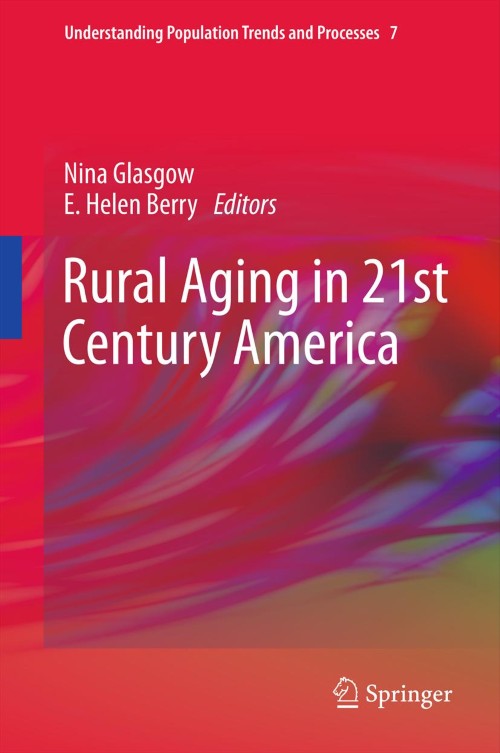
Rural Aging in 21st Century America [electronic resource] / edited by Nina Glasgow, E. Helen Berry.
Erişim Adresi
ISBN
9789400755673
Dil Kodu
İngilizce
Yer Numarası
DK/9123
Basım Bildirimi
1st ed. 2013.
Yayın Bilgisi
Dordrecht : Springer Netherlands : Imprint: Springer, 2013.
Fiziksel Niteleme
XVI, 384 p. online resource.
Dizi
Understanding Population Trends and Processes ; 7
İçindekiler Notu
1: Introduction to Rural Aging in 21st Century America: Nina Glasgow and E. Helen Berry -- Part I: Overview of the Rural Elderly Population -- 2:Demography of Rural Aging: E. Helen Berry and Annabel Kirschner -- 3: The Geography of Rural Aging in a Regional Context, 1990–2008: Peter B. Nelson -- Part II: Economic Inequalities -- 4: Aging and Economic Well-Being in Rural America: Exploring Income and Employment Challenges: Tim Slack and Tracey E. Rizzuto -- 5: Baby Boomers’ Impact on Work Force and Tax Issues in the Great Plains: Richard Rathge, Justin Garosi and Karen Olson -- Part III: Race/Ethnic Inequalities: 6: Place and Race: Health of African Americans in Nonmetropolitan Areas: Marlene Lee and Joachim Singelmann -- 7: Latino Elderly in Nonmetropolitan America: Rogelio Saenz, Amber Fox and San Juanita Garcia -- 8: Elderly Asian Americans in the Nonmetropolitan and Rural United States: Dudley L. Poston, Yu-Ting Chang and Lei He -- 9: Aging on Indian Reservations: The Ugly, the Bad, and the Good: Gundars Rudzitis, Nicolas Barbier and Diane Mallickan -- Part IV: Rural Institutional and Community Structures: 10: Health and Healthcare among the Rural Aging: Lois Wright Morton and Chih-Yuan Weng -- 11: Rural Long-term Care and Informal Caregiving: Nan E. Johnson -- 12: Aging Populations and Rural Places: Impacts on and Innovations in Land Use Planning: Kathryn Brasier, Anouk Patel-Campillo and Jill Findeis -- 13: Volunteerism and Social Entrepreneurship among Older In-Migrants to Rural Areas: Nina Glasgow, Hosik Min and David L. Brown -- 14: Intergenerational Relationships and Rural Return Migration: Christiane von Reichert, John B. Cromartie and Ryan O. Arthun -- Part V: Older Rural Migration and Aging-in-Place: 15: Rural Retirement Destinations: Natural Decrease and the SharedDemographic Destinies of Elderly and Hispanics: Kenneth M. Johnson and Daniel T. Lichter -- 16: Comparisons across Three Race/Ethnic Groups in Rural Retirement Counties: Glenn V. Fuguitt -- 17: Retirement Migration to Unconventional Places: Benjamin C. Bolender and László J. Kulcsár -- 18: Elderly Immigrants in Rural America: Trends and Characteristics: Douglas T. Gurak and Mary M. Kritz -- Part VI: Conclusions and Policy Recommendations:19: Conclusions and Policy Implications for Aging in Rural Places: E. Helen Berry and Nina Glasgow.
Özet, vb.
This book investigates sociological, demographic and geographic aspects of aging in rural and nonmetropolitan areas of the United States. Population aging is one of the most important trends of the 20th and 21st centuries, and it is occurring worldwide, especially in more developed countries such as the United States. Population aging is more rapid in rural than urban areas of the U.S. In 2010, 15 percent of the nonmetropolitan compared to 12 percent of the metropolitan population were 65 years of age and older. By definition rural communities have smaller sized populations, and more limited healthcare, transportation and other aging-relevant services than do urban areas. It is thus especially important to study and understand aging in rural environments. Rural Aging in 21st Century America contributes evidence-based, policy-relevant information on rural aging in the U.S. A primary objective of the book is to improve understanding of what makes the experience of rural aging different from aging in urban areas and to increase understanding of the aged change the nature of rural places. The book addresses unique features of rural aging across economic, racial/ethnic, migration and other structures and patterns, all with a focus on debunking myths about rural aging and to emphasize opportunities and challenges that rural places and older people experience. .
Konu
Aging.
Geriatrics.
Sociology.
Emigration and immigration.
Demography.
Population.
Human geography.
Ageing.
Geriatrics.
Sociology.
Human Migration.
Population and Demography.
Human Geography.
Geriatrics.
Sociology.
Emigration and immigration.
Demography.
Population.
Human geography.
Ageing.
Geriatrics.
Sociology.
Human Migration.
Population and Demography.
Human Geography.
Diğer Yazarlar
Kurum Adı
Eseri Alıntıla
Referansları kullanmadan önce gözden geçirmeniz ve varsa gerekli düzeltmeleri yapmanız önerilir.
Dijital Kaynak
MARC Görünümü
LEADER 05822nam a22006135i 4500
001 807830
003 TR_AnAIT
005 20260127004904
007 cr nn 008mamaa
008 121214s2013 ne | s |||| 0|eng d
020 |a9789400755673|9978-94-007-5567-3
024 7 |a10.1007/978-94-007-5567-3|2doi
041 |aeng
049 |aTürk Tarih Kurumu Kütüphanesi
050 4|aQP86
072 7|aPSA|2bicssc
072 7|aSCI072000|2bisacsh
072 7|aPSA|2thema
082 04|a571.878|223
090 |aDK/9123
245 10|aRural Aging in 21st Century America|h[electronic resource] /|cedited by Nina Glasgow, E. Helen Berry.
250 |a1st ed. 2013.
264 1|aDordrecht :|bSpringer Netherlands :|bImprint: Springer,|c2013.
300 |aXVI, 384 p.|bonline resource.
336 |atext|btxt|2rdacontent
337 |acomputer|bc|2rdamedia
338 |aonline resource|bcr|2rdacarrier
347 |atext file|bPDF|2rda
490 1 |aUnderstanding Population Trends and Processes ;|v7
505 0 |a1: Introduction to Rural Aging in 21st Century America: Nina Glasgow and E. Helen Berry -- Part I: Overview of the Rural Elderly Population -- 2:Demography of Rural Aging: E. Helen Berry and Annabel Kirschner -- 3: The Geography of Rural Aging in a Regional Context, 1990–2008: Peter B. Nelson -- Part II: Economic Inequalities -- 4: Aging and Economic Well-Being in Rural America: Exploring Income and Employment Challenges: Tim Slack and Tracey E. Rizzuto -- 5: Baby Boomers’ Impact on Work Force and Tax Issues in the Great Plains: Richard Rathge, Justin Garosi and Karen Olson -- Part III: Race/Ethnic Inequalities: 6: Place and Race: Health of African Americans in Nonmetropolitan Areas: Marlene Lee and Joachim Singelmann -- 7: Latino Elderly in Nonmetropolitan America: Rogelio Saenz, Amber Fox and San Juanita Garcia -- 8: Elderly Asian Americans in the Nonmetropolitan and Rural United States: Dudley L. Poston, Yu-Ting Chang and Lei He -- 9: Aging on Indian Reservations: The Ugly, the Bad, and the Good: Gundars Rudzitis, Nicolas Barbier and Diane Mallickan -- Part IV: Rural Institutional and Community Structures: 10: Health and Healthcare among the Rural Aging: Lois Wright Morton and Chih-Yuan Weng -- 11: Rural Long-term Care and Informal Caregiving: Nan E. Johnson -- 12: Aging Populations and Rural Places: Impacts on and Innovations in Land Use Planning: Kathryn Brasier, Anouk Patel-Campillo and Jill Findeis -- 13: Volunteerism and Social Entrepreneurship among Older In-Migrants to Rural Areas: Nina Glasgow, Hosik Min and David L. Brown -- 14: Intergenerational Relationships and Rural Return Migration: Christiane von Reichert, John B. Cromartie and Ryan O. Arthun -- Part V: Older Rural Migration and Aging-in-Place: 15: Rural Retirement Destinations: Natural Decrease and the SharedDemographic Destinies of Elderly and Hispanics: Kenneth M. Johnson and Daniel T. Lichter -- 16: Comparisons across Three Race/Ethnic Groups in Rural Retirement Counties: Glenn V. Fuguitt -- 17: Retirement Migration to Unconventional Places: Benjamin C. Bolender and László J. Kulcsár -- 18: Elderly Immigrants in Rural America: Trends and Characteristics: Douglas T. Gurak and Mary M. Kritz -- Part VI: Conclusions and Policy Recommendations:19: Conclusions and Policy Implications for Aging in Rural Places: E. Helen Berry and Nina Glasgow.
520 |aThis book investigates sociological, demographic and geographic aspects of aging in rural and nonmetropolitan areas of the United States. Population aging is one of the most important trends of the 20th and 21st centuries, and it is occurring worldwide, especially in more developed countries such as the United States. Population aging is more rapid in rural than urban areas of the U.S. In 2010, 15 percent of the nonmetropolitan compared to 12 percent of the metropolitan population were 65 years of age and older. By definition rural communities have smaller sized populations, and more limited healthcare, transportation and other aging-relevant services than do urban areas. It is thus especially important to study and understand aging in rural environments. Rural Aging in 21st Century America contributes evidence-based, policy-relevant information on rural aging in the U.S. A primary objective of the book is to improve understanding of what makes the experience of rural aging different from aging in urban areas and to increase understanding of the aged change the nature of rural places. The book addresses unique features of rural aging across economic, racial/ethnic, migration and other structures and patterns, all with a focus on debunking myths about rural aging and to emphasize opportunities and challenges that rural places and older people experience. .
650 0|aAging.
650 0|aGeriatrics.
650 0|aSociology.
650 0|aEmigration and immigration.
650 0|aDemography.
650 0|aPopulation.
650 0|aHuman geography.
650 14|aAgeing.
650 24|aGeriatrics.
650 24|aSociology.
650 24|aHuman Migration.
650 24|aPopulation and Demography.
650 24|aHuman Geography.
700 1 |aGlasgow, Nina.|eeditor.|4edt|4http://id.loc.gov/vocabulary/relators/edt
700 1 |aBerry, E. Helen.|eeditor.|4edt|4http://id.loc.gov/vocabulary/relators/edt
710 2 |aSpringerLink (Online service)
773 0 |tSpringer Nature eBook
776 08|iPrinted edition:|z9789400755666
776 08|iPrinted edition:|z9789400755680
776 08|iPrinted edition:|z9789401781756
830 0|aUnderstanding Population Trends and Processes ;|v7
856 40|uhttps://doi.org/10.1007/978-94-007-5567-3
912 |aZDB-2-SHU
912 |aZDB-2-SXS
950 |aHumanities, Social Sciences and Law (SpringerNature-11648)
950 |aSocial Sciences (R0) (SpringerNature-43726)
001 807830
003 TR_AnAIT
005 20260127004904
007 cr nn 008mamaa
008 121214s2013 ne | s |||| 0|eng d
020 |a9789400755673|9978-94-007-5567-3
024 7 |a10.1007/978-94-007-5567-3|2doi
041 |aeng
049 |aTürk Tarih Kurumu Kütüphanesi
050 4|aQP86
072 7|aPSA|2bicssc
072 7|aSCI072000|2bisacsh
072 7|aPSA|2thema
082 04|a571.878|223
090 |aDK/9123
245 10|aRural Aging in 21st Century America|h[electronic resource] /|cedited by Nina Glasgow, E. Helen Berry.
250 |a1st ed. 2013.
264 1|aDordrecht :|bSpringer Netherlands :|bImprint: Springer,|c2013.
300 |aXVI, 384 p.|bonline resource.
336 |atext|btxt|2rdacontent
337 |acomputer|bc|2rdamedia
338 |aonline resource|bcr|2rdacarrier
347 |atext file|bPDF|2rda
490 1 |aUnderstanding Population Trends and Processes ;|v7
505 0 |a1: Introduction to Rural Aging in 21st Century America: Nina Glasgow and E. Helen Berry -- Part I: Overview of the Rural Elderly Population -- 2:Demography of Rural Aging: E. Helen Berry and Annabel Kirschner -- 3: The Geography of Rural Aging in a Regional Context, 1990–2008: Peter B. Nelson -- Part II: Economic Inequalities -- 4: Aging and Economic Well-Being in Rural America: Exploring Income and Employment Challenges: Tim Slack and Tracey E. Rizzuto -- 5: Baby Boomers’ Impact on Work Force and Tax Issues in the Great Plains: Richard Rathge, Justin Garosi and Karen Olson -- Part III: Race/Ethnic Inequalities: 6: Place and Race: Health of African Americans in Nonmetropolitan Areas: Marlene Lee and Joachim Singelmann -- 7: Latino Elderly in Nonmetropolitan America: Rogelio Saenz, Amber Fox and San Juanita Garcia -- 8: Elderly Asian Americans in the Nonmetropolitan and Rural United States: Dudley L. Poston, Yu-Ting Chang and Lei He -- 9: Aging on Indian Reservations: The Ugly, the Bad, and the Good: Gundars Rudzitis, Nicolas Barbier and Diane Mallickan -- Part IV: Rural Institutional and Community Structures: 10: Health and Healthcare among the Rural Aging: Lois Wright Morton and Chih-Yuan Weng -- 11: Rural Long-term Care and Informal Caregiving: Nan E. Johnson -- 12: Aging Populations and Rural Places: Impacts on and Innovations in Land Use Planning: Kathryn Brasier, Anouk Patel-Campillo and Jill Findeis -- 13: Volunteerism and Social Entrepreneurship among Older In-Migrants to Rural Areas: Nina Glasgow, Hosik Min and David L. Brown -- 14: Intergenerational Relationships and Rural Return Migration: Christiane von Reichert, John B. Cromartie and Ryan O. Arthun -- Part V: Older Rural Migration and Aging-in-Place: 15: Rural Retirement Destinations: Natural Decrease and the SharedDemographic Destinies of Elderly and Hispanics: Kenneth M. Johnson and Daniel T. Lichter -- 16: Comparisons across Three Race/Ethnic Groups in Rural Retirement Counties: Glenn V. Fuguitt -- 17: Retirement Migration to Unconventional Places: Benjamin C. Bolender and László J. Kulcsár -- 18: Elderly Immigrants in Rural America: Trends and Characteristics: Douglas T. Gurak and Mary M. Kritz -- Part VI: Conclusions and Policy Recommendations:19: Conclusions and Policy Implications for Aging in Rural Places: E. Helen Berry and Nina Glasgow.
520 |aThis book investigates sociological, demographic and geographic aspects of aging in rural and nonmetropolitan areas of the United States. Population aging is one of the most important trends of the 20th and 21st centuries, and it is occurring worldwide, especially in more developed countries such as the United States. Population aging is more rapid in rural than urban areas of the U.S. In 2010, 15 percent of the nonmetropolitan compared to 12 percent of the metropolitan population were 65 years of age and older. By definition rural communities have smaller sized populations, and more limited healthcare, transportation and other aging-relevant services than do urban areas. It is thus especially important to study and understand aging in rural environments. Rural Aging in 21st Century America contributes evidence-based, policy-relevant information on rural aging in the U.S. A primary objective of the book is to improve understanding of what makes the experience of rural aging different from aging in urban areas and to increase understanding of the aged change the nature of rural places. The book addresses unique features of rural aging across economic, racial/ethnic, migration and other structures and patterns, all with a focus on debunking myths about rural aging and to emphasize opportunities and challenges that rural places and older people experience. .
650 0|aAging.
650 0|aGeriatrics.
650 0|aSociology.
650 0|aEmigration and immigration.
650 0|aDemography.
650 0|aPopulation.
650 0|aHuman geography.
650 14|aAgeing.
650 24|aGeriatrics.
650 24|aSociology.
650 24|aHuman Migration.
650 24|aPopulation and Demography.
650 24|aHuman Geography.
700 1 |aGlasgow, Nina.|eeditor.|4edt|4http://id.loc.gov/vocabulary/relators/edt
700 1 |aBerry, E. Helen.|eeditor.|4edt|4http://id.loc.gov/vocabulary/relators/edt
710 2 |aSpringerLink (Online service)
773 0 |tSpringer Nature eBook
776 08|iPrinted edition:|z9789400755666
776 08|iPrinted edition:|z9789400755680
776 08|iPrinted edition:|z9789401781756
830 0|aUnderstanding Population Trends and Processes ;|v7
856 40|uhttps://doi.org/10.1007/978-94-007-5567-3
912 |aZDB-2-SHU
912 |aZDB-2-SXS
950 |aHumanities, Social Sciences and Law (SpringerNature-11648)
950 |aSocial Sciences (R0) (SpringerNature-43726)
Materyaller
Depodan talep edilen materyal sadece kütüphane içerisinde kullanılmaktadır.
Materyal dışarıya ödünç verilmemektedir.
Materyal dışarıya ödünç verilmemektedir.
