

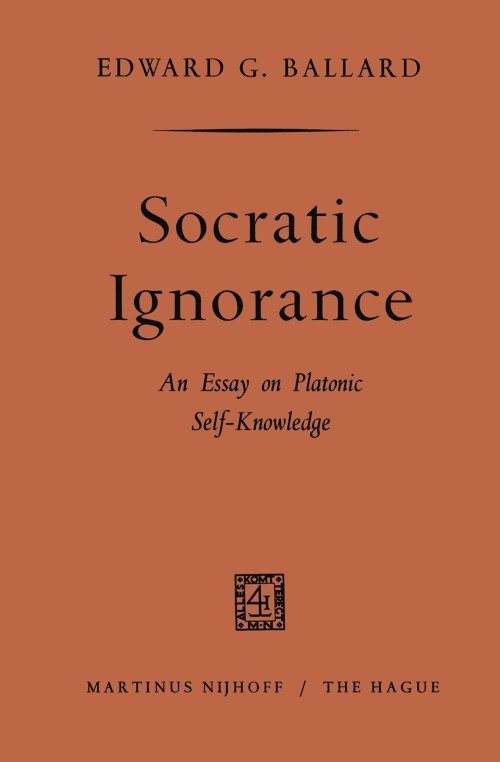
Socratic ignorance [electronic resource] / by Edward G. Ballard.
Erişim Adresi
ISBN
9789401194327
Dil Kodu
İngilizce
Yer Numarası
DK/9146
Yazar
Basım Bildirimi
1st ed. 1965.
Yayın Bilgisi
Dordrecht : Springer Netherlands : Imprint: Springer, 1965.
Fiziksel Niteleme
189 p. online resource.
İçindekiler Notu
I. Introduction -- II. Socrates’ Moral Problem -- I. Justice: Internal and External -- II. Self-Knowledge and its Problems -- III. On the Nature of the Self -- III. The Problem of Art or Techne -- I. The Analysis of Art -- II. The Whole of Art -- III. Does a Doctrine of the Final Good Exist? -- IV. The Mystical Choice Again, and its Alternative -- V. Summary -- IV. The Problem of Knowledge -- I. On the Earlier Theory of Ideas -- II. The Limits and Conditions of Discourse -- III. The Doctrine and Art of Definition -- IV. Opinion and Image -- V. Knowledge-Theory and Self-Knowledge -- V. The Platonic Universe -- I. The Problem of the Universe of Discourse -- II. The Development of the Platonic Universe -- III. The Unity of the Final Universe -- IV. Knowledge in the New Cosmos -- V. Self-Knowledge and the Microcosm -- VI. Philosophy and Myth -- VI. Conclusion and Criticism -- I. Recapitulation: Ignorance and Self-Knowledge -- II. The Question of Immortality -- III. A Platonic View of the Person.
Özet, vb.
This book is intended to offer an interpretation of an important aspect of Plato's philosophy. The matter to be interpreted will be the Platonic myths and doctrines which bear upon self-knowledge and self-ignorance. It is difficult to say in a word just what sort of thing an interpretation is. Rather than attempting to provide a set of rules or meta-rules supposed to define the ideally perfect interpretation, several distinctions will be suggested. I should like to distinguish the philological scholar from the inter preter by saying that the latter uses what the former produces. The function of the scholarly examination of a text is to make an ancient (or foreign) writing available to the contemporary reader. The scholar solves grammatical, lexical, and historical problems and renders his author readable by the person who lacks this scholarly learning and technique. The function of the interpreter is to make use of such available writings in order to render their content more intelligible and useful to a given audience. Thus, he thinks through this content, explains, and re-expresses it in a form which can be easily related to problems, persons, doctrines, or events of another epoch or of another class of readers. At the minimum, the interpretation of a philosophic writing may be thought to prepare its teaching for application to matters which belong in another time or context. Detailed application of a doctrine is, of course, still another thing.
Konu
Philosophy, Ancient.
Ancient Philosophy / Classical Philosophy.
Ancient Philosophy / Classical Philosophy.
Kurum Adı
Eseri Alıntıla
Referansları kullanmadan önce gözden geçirmeniz ve varsa gerekli düzeltmeleri yapmanız önerilir.
Dijital Kaynak
MARC Görünümü
LEADER 04744nam a22004935i 4500
001 807853
003 TR_AnAIT
005 20260127004931
007 cr nn 008mamaa
008 121227s1965 ne | s |||| 0|eng d
020 |a9789401194327|9978-94-011-9432-7
024 7 |a10.1007/978-94-011-9432-7|2doi
041 |aeng
049 |aTürk Tarih Kurumu Kütüphanesi
050 4|aB108-708
072 7|aHPCA|2bicssc
072 7|aPHI002000|2bisacsh
072 7|aQDHA|2thema
082 04|a180.0901|223
090 |aDK/9146
100 1 |aBallard, Edward G.|eauthor.|4aut|4http://id.loc.gov/vocabulary/relators/aut
245 10|aSocratic ignorance|h[electronic resource] /|cby Edward G. Ballard.
250 |a1st ed. 1965.
264 1|aDordrecht :|bSpringer Netherlands :|bImprint: Springer,|c1965.
300 |a189 p.|bonline resource.
336 |atext|btxt|2rdacontent
337 |acomputer|bc|2rdamedia
338 |aonline resource|bcr|2rdacarrier
347 |atext file|bPDF|2rda
505 0 |aI. Introduction -- II. Socrates’ Moral Problem -- I. Justice: Internal and External -- II. Self-Knowledge and its Problems -- III. On the Nature of the Self -- III. The Problem of Art or Techne -- I. The Analysis of Art -- II. The Whole of Art -- III. Does a Doctrine of the Final Good Exist? -- IV. The Mystical Choice Again, and its Alternative -- V. Summary -- IV. The Problem of Knowledge -- I. On the Earlier Theory of Ideas -- II. The Limits and Conditions of Discourse -- III. The Doctrine and Art of Definition -- IV. Opinion and Image -- V. Knowledge-Theory and Self-Knowledge -- V. The Platonic Universe -- I. The Problem of the Universe of Discourse -- II. The Development of the Platonic Universe -- III. The Unity of the Final Universe -- IV. Knowledge in the New Cosmos -- V. Self-Knowledge and the Microcosm -- VI. Philosophy and Myth -- VI. Conclusion and Criticism -- I. Recapitulation: Ignorance and Self-Knowledge -- II. The Question of Immortality -- III. A Platonic View of the Person.
520 |aThis book is intended to offer an interpretation of an important aspect of Plato's philosophy. The matter to be interpreted will be the Platonic myths and doctrines which bear upon self-knowledge and self-ignorance. It is difficult to say in a word just what sort of thing an interpretation is. Rather than attempting to provide a set of rules or meta-rules supposed to define the ideally perfect interpretation, several distinctions will be suggested. I should like to distinguish the philological scholar from the inter preter by saying that the latter uses what the former produces. The function of the scholarly examination of a text is to make an ancient (or foreign) writing available to the contemporary reader. The scholar solves grammatical, lexical, and historical problems and renders his author readable by the person who lacks this scholarly learning and technique. The function of the interpreter is to make use of such available writings in order to render their content more intelligible and useful to a given audience. Thus, he thinks through this content, explains, and re-expresses it in a form which can be easily related to problems, persons, doctrines, or events of another epoch or of another class of readers. At the minimum, the interpretation of a philosophic writing may be thought to prepare its teaching for application to matters which belong in another time or context. Detailed application of a doctrine is, of course, still another thing.
532 8 |aAccessibility summary: This PDF is not accessible. It is based on scanned pages and does not support features such as screen reader compatibility or described non-text content (images, graphs etc). However, it likely supports searchable and selectable text based on OCR (Optical Character Recognition). Users with accessibility needs may not be able to use this content effectively. Please contact us at accessibilitysupport@springernature.com if you require assistance or an alternative format.
532 8 |aInaccessible, or known limited accessibility
532 8 |aNo reading system accessibility options actively disabled
532 8 |aPublisher contact for further accessibility information: accessibilitysupport@springernature.com
650 0|aPhilosophy, Ancient.
650 14|aAncient Philosophy / Classical Philosophy.
710 2 |aSpringerLink (Online service)
773 0 |tSpringer Nature eBook
776 08|iPrinted edition:|z9789401186452
776 08|iPrinted edition:|z9789401194334
856 40|uhttps://doi.org/10.1007/978-94-011-9432-7
912 |aZDB-2-SHU
912 |aZDB-2-SXPR
912 |aZDB-2-BAE
950 |aHumanities, Social Sciences and Law (SpringerNature-11648)
950 |aPhilosophy and Religion (R0) (SpringerNature-43725)
001 807853
003 TR_AnAIT
005 20260127004931
007 cr nn 008mamaa
008 121227s1965 ne | s |||| 0|eng d
020 |a9789401194327|9978-94-011-9432-7
024 7 |a10.1007/978-94-011-9432-7|2doi
041 |aeng
049 |aTürk Tarih Kurumu Kütüphanesi
050 4|aB108-708
072 7|aHPCA|2bicssc
072 7|aPHI002000|2bisacsh
072 7|aQDHA|2thema
082 04|a180.0901|223
090 |aDK/9146
100 1 |aBallard, Edward G.|eauthor.|4aut|4http://id.loc.gov/vocabulary/relators/aut
245 10|aSocratic ignorance|h[electronic resource] /|cby Edward G. Ballard.
250 |a1st ed. 1965.
264 1|aDordrecht :|bSpringer Netherlands :|bImprint: Springer,|c1965.
300 |a189 p.|bonline resource.
336 |atext|btxt|2rdacontent
337 |acomputer|bc|2rdamedia
338 |aonline resource|bcr|2rdacarrier
347 |atext file|bPDF|2rda
505 0 |aI. Introduction -- II. Socrates’ Moral Problem -- I. Justice: Internal and External -- II. Self-Knowledge and its Problems -- III. On the Nature of the Self -- III. The Problem of Art or Techne -- I. The Analysis of Art -- II. The Whole of Art -- III. Does a Doctrine of the Final Good Exist? -- IV. The Mystical Choice Again, and its Alternative -- V. Summary -- IV. The Problem of Knowledge -- I. On the Earlier Theory of Ideas -- II. The Limits and Conditions of Discourse -- III. The Doctrine and Art of Definition -- IV. Opinion and Image -- V. Knowledge-Theory and Self-Knowledge -- V. The Platonic Universe -- I. The Problem of the Universe of Discourse -- II. The Development of the Platonic Universe -- III. The Unity of the Final Universe -- IV. Knowledge in the New Cosmos -- V. Self-Knowledge and the Microcosm -- VI. Philosophy and Myth -- VI. Conclusion and Criticism -- I. Recapitulation: Ignorance and Self-Knowledge -- II. The Question of Immortality -- III. A Platonic View of the Person.
520 |aThis book is intended to offer an interpretation of an important aspect of Plato's philosophy. The matter to be interpreted will be the Platonic myths and doctrines which bear upon self-knowledge and self-ignorance. It is difficult to say in a word just what sort of thing an interpretation is. Rather than attempting to provide a set of rules or meta-rules supposed to define the ideally perfect interpretation, several distinctions will be suggested. I should like to distinguish the philological scholar from the inter preter by saying that the latter uses what the former produces. The function of the scholarly examination of a text is to make an ancient (or foreign) writing available to the contemporary reader. The scholar solves grammatical, lexical, and historical problems and renders his author readable by the person who lacks this scholarly learning and technique. The function of the interpreter is to make use of such available writings in order to render their content more intelligible and useful to a given audience. Thus, he thinks through this content, explains, and re-expresses it in a form which can be easily related to problems, persons, doctrines, or events of another epoch or of another class of readers. At the minimum, the interpretation of a philosophic writing may be thought to prepare its teaching for application to matters which belong in another time or context. Detailed application of a doctrine is, of course, still another thing.
532 8 |aAccessibility summary: This PDF is not accessible. It is based on scanned pages and does not support features such as screen reader compatibility or described non-text content (images, graphs etc). However, it likely supports searchable and selectable text based on OCR (Optical Character Recognition). Users with accessibility needs may not be able to use this content effectively. Please contact us at accessibilitysupport@springernature.com if you require assistance or an alternative format.
532 8 |aInaccessible, or known limited accessibility
532 8 |aNo reading system accessibility options actively disabled
532 8 |aPublisher contact for further accessibility information: accessibilitysupport@springernature.com
650 0|aPhilosophy, Ancient.
650 14|aAncient Philosophy / Classical Philosophy.
710 2 |aSpringerLink (Online service)
773 0 |tSpringer Nature eBook
776 08|iPrinted edition:|z9789401186452
776 08|iPrinted edition:|z9789401194334
856 40|uhttps://doi.org/10.1007/978-94-011-9432-7
912 |aZDB-2-SHU
912 |aZDB-2-SXPR
912 |aZDB-2-BAE
950 |aHumanities, Social Sciences and Law (SpringerNature-11648)
950 |aPhilosophy and Religion (R0) (SpringerNature-43725)
Materyaller
Depodan talep edilen materyal sadece kütüphane içerisinde kullanılmaktadır.
Materyal dışarıya ödünç verilmemektedir.
Materyal dışarıya ödünç verilmemektedir.
