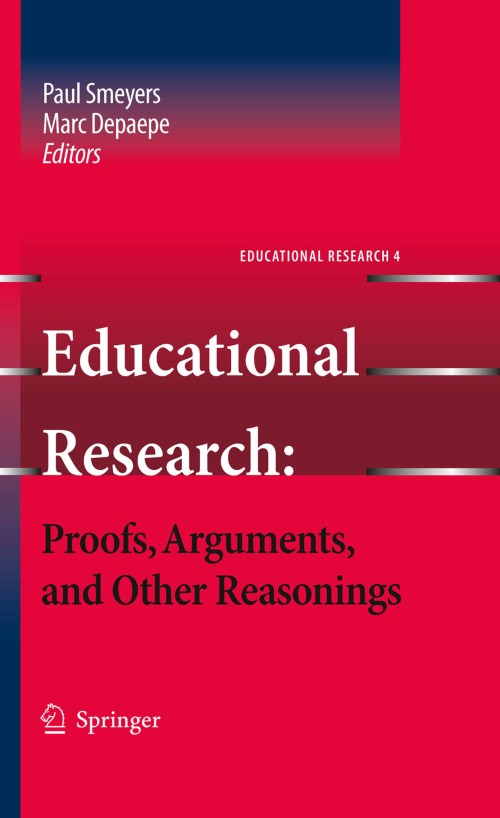
Educational Research: Proofs, Arguments, and Other Reasonings [electronic resource] / edited by Paul Smeyers, Marc Depaepe.
Erişim Adresi
ISBN
9789048132492
Dil Kodu
İngilizce
Yer Numarası
DK/9200
Basım Bildirimi
1st ed. 2010.
Yayın Bilgisi
Dordrecht : Springer Netherlands : Imprint: Springer, 2010.
Fiziksel Niteleme
VI, 199 p. online resource.
Dizi
Educational Research, 2543-0653 ; 4
İçindekiler Notu
Rhetoric and Argument in the Language of Education and of Educational Research -- Beyond Arguments and Ideas: Languages of Education -- Sources in the Making of Histories of Education: Proofs, Arguments, and Other Forms of Reasoning from the Historian’s Workplace -- Educational Formalism and the Language of Goals in American Education, Educational Reform, and Educational History -- The Language of Education and the Language of Educational Research: The Knowledge Economy, Citizenship and Subjectivation -- Parenting in a Technological Age -- Capability and the Language of Educational Research -- A Rhetoric for Educational Research -- Arguments and Proofs About Arguments and Proofs -- Evidence and Argumentation in Educational Research -- Half a Language: Listening in the City of Words -- Revisiting Achilles’ Sadness that No Method Can Be Found -- Reasoning from Educational Research to Policy.
Özet, vb.
This book focuses on the language of educational research as well as on the language of education. It conceives both as social practices and investigates how rhetoric plays a part in the complex process of historically situated argumentation. The book aims to answer such questions as: ‘What is the nature of the arguments and the kinds of sources one relies on?’ and ‘What kind of reasoning is offered to convince practitioners?’ Taking postmodern criticism seriously, the contributors argue that the scholar or researcher cannot indulge in relativism or be satisfied with a description of particular cases. Instead, theoreticians as well as practitioners have to engage in sound thinking and dialogue. The chapters in this volume highlight relevant characteristics of the language of educational research. In addition, attention is paid to the language of particular debates which figure prominently in the wider educational context, such as the language of goals, of parenting, citizenship and capability. ‘This collection of thirteen essays focuses on the language of proofs, argument and rhetoric in educational research in a range of thematically related original pieces that explore the topic and its applications: forms of historical reasoning, the place of rhetoric, educational formalism, the knowledge economy, argumentation, and the role of evidence, amongst others. It explores both the philosophical and methodological meta-issues as well as the important of specific and particular educational languages. The resulting volume is genuinely enlightening and deserves to be read widely by both academic and students within the field of education and across the social sciences.’ Michael A. Peters, Educational Policy Studies, The University of Illinois, USA ‘The contributions to this timely collection of essays place the ‘language’ of education at the centre of a discussion about the practice of educational research and remindsus - both the established and the new researcher - of the need to reflect not only on what we do as researchers and the conceptual tools, methods and sources we use, but also on how we capture in words our actions and conclusions.’ Ian Grosvenor, University of Birmingham, UK This publication, as well as the ones that are mentioned in the preliminary pages of this work, were realized by the Research Community (FWO-Vlaanderen / Research Foundation Flanders, Belgium) Philosophy and History of the Discipline of Education: Evaluation and Evolution of the Criteria for Educational Research.
Konu
Education __ Philosophy.
Education and state.
Educational sociology.
Educational Philosophy.
Educational Policy and Politics.
Sociology of Education.
Education and state.
Educational sociology.
Educational Philosophy.
Educational Policy and Politics.
Sociology of Education.
Diğer Yazarlar
Kurum Adı

Eseri Alıntıla
Referansları kullanmadan önce gözden geçirmeniz ve varsa gerekli düzeltmeleri yapmanız önerilir.
Dijital Kaynak
MARC Görünümü
LEADER 05368nam a22005295i 4500
001 807907
003 TR_AnAIT
005 20260127005036
007 cr nn 008mamaa
008 100301s2010 ne | s |||| 0|eng d
020 |a9789048132492|9978-90-481-3249-2
024 7 |a10.1007/978-90-481-3249-2|2doi
041 |aeng
049 |aTürk Tarih Kurumu Kütüphanesi
050 4|aLB1-3640
072 7|aJNA|2bicssc
072 7|aEDU040000|2bisacsh
072 7|aJNA|2thema
082 04|a370.1|223
090 |aDK/9200
245 10|aEducational Research: Proofs, Arguments, and Other Reasonings|h[electronic resource] /|cedited by Paul Smeyers, Marc Depaepe.
250 |a1st ed. 2010.
264 1|aDordrecht :|bSpringer Netherlands :|bImprint: Springer,|c2010.
300 |aVI, 199 p.|bonline resource.
336 |atext|btxt|2rdacontent
337 |acomputer|bc|2rdamedia
338 |aonline resource|bcr|2rdacarrier
347 |atext file|bPDF|2rda
490 1 |aEducational Research,|x2543-0653 ;|v4
505 0 |aRhetoric and Argument in the Language of Education and of Educational Research -- Beyond Arguments and Ideas: Languages of Education -- Sources in the Making of Histories of Education: Proofs, Arguments, and Other Forms of Reasoning from the Historian’s Workplace -- Educational Formalism and the Language of Goals in American Education, Educational Reform, and Educational History -- The Language of Education and the Language of Educational Research: The Knowledge Economy, Citizenship and Subjectivation -- Parenting in a Technological Age -- Capability and the Language of Educational Research -- A Rhetoric for Educational Research -- Arguments and Proofs About Arguments and Proofs -- Evidence and Argumentation in Educational Research -- Half a Language: Listening in the City of Words -- Revisiting Achilles’ Sadness that No Method Can Be Found -- Reasoning from Educational Research to Policy.
520 |aThis book focuses on the language of educational research as well as on the language of education. It conceives both as social practices and investigates how rhetoric plays a part in the complex process of historically situated argumentation. The book aims to answer such questions as: ‘What is the nature of the arguments and the kinds of sources one relies on?’ and ‘What kind of reasoning is offered to convince practitioners?’ Taking postmodern criticism seriously, the contributors argue that the scholar or researcher cannot indulge in relativism or be satisfied with a description of particular cases. Instead, theoreticians as well as practitioners have to engage in sound thinking and dialogue. The chapters in this volume highlight relevant characteristics of the language of educational research. In addition, attention is paid to the language of particular debates which figure prominently in the wider educational context, such as the language of goals, of parenting, citizenship and capability. ‘This collection of thirteen essays focuses on the language of proofs, argument and rhetoric in educational research in a range of thematically related original pieces that explore the topic and its applications: forms of historical reasoning, the place of rhetoric, educational formalism, the knowledge economy, argumentation, and the role of evidence, amongst others. It explores both the philosophical and methodological meta-issues as well as the important of specific and particular educational languages. The resulting volume is genuinely enlightening and deserves to be read widely by both academic and students within the field of education and across the social sciences.’ Michael A. Peters, Educational Policy Studies, The University of Illinois, USA ‘The contributions to this timely collection of essays place the ‘language’ of education at the centre of a discussion about the practice of educational research and remindsus - both the established and the new researcher - of the need to reflect not only on what we do as researchers and the conceptual tools, methods and sources we use, but also on how we capture in words our actions and conclusions.’ Ian Grosvenor, University of Birmingham, UK This publication, as well as the ones that are mentioned in the preliminary pages of this work, were realized by the Research Community (FWO-Vlaanderen / Research Foundation Flanders, Belgium) Philosophy and History of the Discipline of Education: Evaluation and Evolution of the Criteria for Educational Research.
650 0|aEducation|xPhilosophy.
650 0|aEducation and state.
650 0|aEducational sociology.
650 14|aEducational Philosophy.
650 24|aEducational Policy and Politics.
650 24|aSociology of Education.
700 1 |aSmeyers, Paul.|eeditor.|4edt|4http://id.loc.gov/vocabulary/relators/edt
700 1 |aDepaepe, Marc.|eeditor.|4edt|4http://id.loc.gov/vocabulary/relators/edt
710 2 |aSpringerLink (Online service)
773 0 |tSpringer Nature eBook
776 08|iPrinted edition:|z9789048132485
776 08|iPrinted edition:|z9789048132508
776 08|iPrinted edition:|z9789400730649
830 0|aEducational Research,|x2543-0653 ;|v4
856 40|uhttps://doi.org/10.1007/978-90-481-3249-2
912 |aZDB-2-SHU
912 |aZDB-2-SXED
950 |aHumanities, Social Sciences and Law (SpringerNature-11648)
950 |aEducation (R0) (SpringerNature-43721)
001 807907
003 TR_AnAIT
005 20260127005036
007 cr nn 008mamaa
008 100301s2010 ne | s |||| 0|eng d
020 |a9789048132492|9978-90-481-3249-2
024 7 |a10.1007/978-90-481-3249-2|2doi
041 |aeng
049 |aTürk Tarih Kurumu Kütüphanesi
050 4|aLB1-3640
072 7|aJNA|2bicssc
072 7|aEDU040000|2bisacsh
072 7|aJNA|2thema
082 04|a370.1|223
090 |aDK/9200
245 10|aEducational Research: Proofs, Arguments, and Other Reasonings|h[electronic resource] /|cedited by Paul Smeyers, Marc Depaepe.
250 |a1st ed. 2010.
264 1|aDordrecht :|bSpringer Netherlands :|bImprint: Springer,|c2010.
300 |aVI, 199 p.|bonline resource.
336 |atext|btxt|2rdacontent
337 |acomputer|bc|2rdamedia
338 |aonline resource|bcr|2rdacarrier
347 |atext file|bPDF|2rda
490 1 |aEducational Research,|x2543-0653 ;|v4
505 0 |aRhetoric and Argument in the Language of Education and of Educational Research -- Beyond Arguments and Ideas: Languages of Education -- Sources in the Making of Histories of Education: Proofs, Arguments, and Other Forms of Reasoning from the Historian’s Workplace -- Educational Formalism and the Language of Goals in American Education, Educational Reform, and Educational History -- The Language of Education and the Language of Educational Research: The Knowledge Economy, Citizenship and Subjectivation -- Parenting in a Technological Age -- Capability and the Language of Educational Research -- A Rhetoric for Educational Research -- Arguments and Proofs About Arguments and Proofs -- Evidence and Argumentation in Educational Research -- Half a Language: Listening in the City of Words -- Revisiting Achilles’ Sadness that No Method Can Be Found -- Reasoning from Educational Research to Policy.
520 |aThis book focuses on the language of educational research as well as on the language of education. It conceives both as social practices and investigates how rhetoric plays a part in the complex process of historically situated argumentation. The book aims to answer such questions as: ‘What is the nature of the arguments and the kinds of sources one relies on?’ and ‘What kind of reasoning is offered to convince practitioners?’ Taking postmodern criticism seriously, the contributors argue that the scholar or researcher cannot indulge in relativism or be satisfied with a description of particular cases. Instead, theoreticians as well as practitioners have to engage in sound thinking and dialogue. The chapters in this volume highlight relevant characteristics of the language of educational research. In addition, attention is paid to the language of particular debates which figure prominently in the wider educational context, such as the language of goals, of parenting, citizenship and capability. ‘This collection of thirteen essays focuses on the language of proofs, argument and rhetoric in educational research in a range of thematically related original pieces that explore the topic and its applications: forms of historical reasoning, the place of rhetoric, educational formalism, the knowledge economy, argumentation, and the role of evidence, amongst others. It explores both the philosophical and methodological meta-issues as well as the important of specific and particular educational languages. The resulting volume is genuinely enlightening and deserves to be read widely by both academic and students within the field of education and across the social sciences.’ Michael A. Peters, Educational Policy Studies, The University of Illinois, USA ‘The contributions to this timely collection of essays place the ‘language’ of education at the centre of a discussion about the practice of educational research and remindsus - both the established and the new researcher - of the need to reflect not only on what we do as researchers and the conceptual tools, methods and sources we use, but also on how we capture in words our actions and conclusions.’ Ian Grosvenor, University of Birmingham, UK This publication, as well as the ones that are mentioned in the preliminary pages of this work, were realized by the Research Community (FWO-Vlaanderen / Research Foundation Flanders, Belgium) Philosophy and History of the Discipline of Education: Evaluation and Evolution of the Criteria for Educational Research.
650 0|aEducation|xPhilosophy.
650 0|aEducation and state.
650 0|aEducational sociology.
650 14|aEducational Philosophy.
650 24|aEducational Policy and Politics.
650 24|aSociology of Education.
700 1 |aSmeyers, Paul.|eeditor.|4edt|4http://id.loc.gov/vocabulary/relators/edt
700 1 |aDepaepe, Marc.|eeditor.|4edt|4http://id.loc.gov/vocabulary/relators/edt
710 2 |aSpringerLink (Online service)
773 0 |tSpringer Nature eBook
776 08|iPrinted edition:|z9789048132485
776 08|iPrinted edition:|z9789048132508
776 08|iPrinted edition:|z9789400730649
830 0|aEducational Research,|x2543-0653 ;|v4
856 40|uhttps://doi.org/10.1007/978-90-481-3249-2
912 |aZDB-2-SHU
912 |aZDB-2-SXED
950 |aHumanities, Social Sciences and Law (SpringerNature-11648)
950 |aEducation (R0) (SpringerNature-43721)
Materyaller
Depodan talep edilen materyal sadece kütüphane içerisinde kullanılmaktadır.
Materyal dışarıya ödünç verilmemektedir.
