

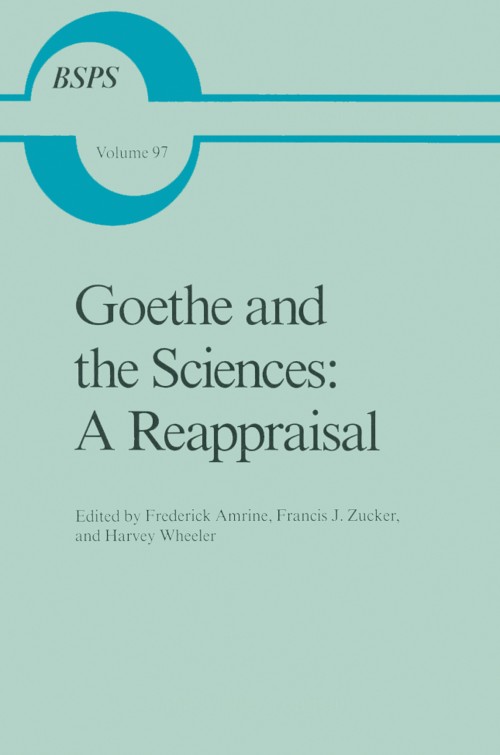
Goethe and the Sciences: A Reappraisal [electronic resource] / edited by F.R. Amrine, Francis J. Zucker, H. Wheeler.
Erişim Adresi
ISBN
9789400937611
Dil Kodu
İngilizce
Yer Numarası
DK/9226
Basım Bildirimi
1st ed. 1987.
Yayın Bilgisi
Dordrecht : Springer Netherlands : Imprint: Springer, 1987.
Fiziksel Niteleme
464 p. 1 illus. online resource.
Dizi
Boston Studies in the Philosophy and History of Science, 2214-7942 ; 97
İçindekiler Notu
I. Goethe in the History of Science -- Goethe’s Relationship to the Theories of Development of His Time -- The Eternal Laws of Form: Morphotypes and the Conditions of Existence in Goethe’s Biological Thought -- Goethe’s Entoptische Farben and the Problem of Polarity -- Goethe and Helmholtz: Science and Sensation -- Goethe and Psychoanalysis -- Goethe’s Color Studies in a New Perspective: Die Farbenlehre in English -- II. Expanding the Limits of Traditional Scientific Methodology and Ontology -- Goethe and Modern Science -- Goethe and the Concept of Metamorphosis -- Is Goethe’s Theory of Color Science? -- Goethe Against Newton: Towards Saving the Phenomenon -- Theory of Science in the Light of Goethe’s Science of Nature -- Facts as Theory: Aspects of Goethe’s Philosophy of Science -- The Theory of Color as the Symbolism of Insight -- III. Contemporary Relevance: A Viable Alternative? -- Form and Cause in Goethe’s Morphology -- Goethean Method in the Work of Jochen Bockemühl -- Whiteness -- Goethe as a Forerunner of Alternative Science -- Self-Knowledge, Freedom and Irony: The Language of Nature in Goethe -- Postscript. Goethe’s Science: An Alternative to Modern Science or within It — or No Alternative at All? -- Goethe and the Sciences: An Annotated Bibliography -- Index of Names.
Özet, vb.
of him in like measure within myself, that is my highest wish. This noble individual was not conscious of the fact that at that very moment the divine within him and the divine of the universe were most intimately united. So, for Goethe, the resonance with a natural rationality seems part of the genius of modern science. Einstein's 'cosmic religion', which reflects Spinoza, also echoes Goethe's remark (Ibid. , Item 575 from 1829): Man must cling to the belief that the incomprehensible is comprehensible. Else he would give up investigating. But how far will Goethe share the devotion of these cosmic rationalists to the beautiful harmonies of mathematics, so distant from any pure and 'direct observation'? Kepler, Spinoza, Einstein need not, and would not, rest with discovery of a pattern within, behind, as a source of, the phenomenal world, and they would not let even the most profound of descriptive generalities satisfy scientific curiosity. For his part, Goethe sought fundamental archetypes, as in his intuition of a Urpjlanze, basic to all plants, infinitely plastic. When such would be found, Goethe would be content, for (as he said to Eckermann, Feb. 18, 1829): . . . to seek something behind (the Urphaenomenon) is futile. Here is the limit. But as a rule men are not satisfied to behold an Urphaenomenon. They think there must be something beyond. They are like children who, having looked into a mirror, turn it around to see what is on the other side.
Konu
Science __ Philosophy.
Philosophy of Science.
Philosophy of Science.
Diğer Yazarlar
Kurum Adı
Eseri Alıntıla
Referansları kullanmadan önce gözden geçirmeniz ve varsa gerekli düzeltmeleri yapmanız önerilir.
Dijital Kaynak
MARC Görünümü
LEADER 05512nam a22005655i 4500
001 807933
003 TR_AnAIT
005 20260127005109
007 cr nn 008mamaa
008 121227s1987 ne | s |||| 0|eng d
020 |a9789400937611|9978-94-009-3761-1
024 7 |a10.1007/978-94-009-3761-1|2doi
041 |aeng
049 |aTürk Tarih Kurumu Kütüphanesi
050 4|aQ174-175.3
050 4|aB67
072 7|aPDA|2bicssc
072 7|aSCI075000|2bisacsh
072 7|aPDA|2thema
082 04|a501|223
090 |aDK/9226
245 10|aGoethe and the Sciences: A Reappraisal|h[electronic resource] /|cedited by F.R. Amrine, Francis J. Zucker, H. Wheeler.
250 |a1st ed. 1987.
264 1|aDordrecht :|bSpringer Netherlands :|bImprint: Springer,|c1987.
300 |a464 p. 1 illus.|bonline resource.
336 |atext|btxt|2rdacontent
337 |acomputer|bc|2rdamedia
338 |aonline resource|bcr|2rdacarrier
347 |atext file|bPDF|2rda
490 1 |aBoston Studies in the Philosophy and History of Science,|x2214-7942 ;|v97
505 0 |aI. Goethe in the History of Science -- Goethe’s Relationship to the Theories of Development of His Time -- The Eternal Laws of Form: Morphotypes and the Conditions of Existence in Goethe’s Biological Thought -- Goethe’s Entoptische Farben and the Problem of Polarity -- Goethe and Helmholtz: Science and Sensation -- Goethe and Psychoanalysis -- Goethe’s Color Studies in a New Perspective: Die Farbenlehre in English -- II. Expanding the Limits of Traditional Scientific Methodology and Ontology -- Goethe and Modern Science -- Goethe and the Concept of Metamorphosis -- Is Goethe’s Theory of Color Science? -- Goethe Against Newton: Towards Saving the Phenomenon -- Theory of Science in the Light of Goethe’s Science of Nature -- Facts as Theory: Aspects of Goethe’s Philosophy of Science -- The Theory of Color as the Symbolism of Insight -- III. Contemporary Relevance: A Viable Alternative? -- Form and Cause in Goethe’s Morphology -- Goethean Method in the Work of Jochen Bockemühl -- Whiteness -- Goethe as a Forerunner of Alternative Science -- Self-Knowledge, Freedom and Irony: The Language of Nature in Goethe -- Postscript. Goethe’s Science: An Alternative to Modern Science or within It — or No Alternative at All? -- Goethe and the Sciences: An Annotated Bibliography -- Index of Names.
520 |aof him in like measure within myself, that is my highest wish. This noble individual was not conscious of the fact that at that very moment the divine within him and the divine of the universe were most intimately united. So, for Goethe, the resonance with a natural rationality seems part of the genius of modern science. Einstein's 'cosmic religion', which reflects Spinoza, also echoes Goethe's remark (Ibid. , Item 575 from 1829): Man must cling to the belief that the incomprehensible is comprehensible. Else he would give up investigating. But how far will Goethe share the devotion of these cosmic rationalists to the beautiful harmonies of mathematics, so distant from any pure and 'direct observation'? Kepler, Spinoza, Einstein need not, and would not, rest with discovery of a pattern within, behind, as a source of, the phenomenal world, and they would not let even the most profound of descriptive generalities satisfy scientific curiosity. For his part, Goethe sought fundamental archetypes, as in his intuition of a Urpjlanze, basic to all plants, infinitely plastic. When such would be found, Goethe would be content, for (as he said to Eckermann, Feb. 18, 1829): . . . to seek something behind (the Urphaenomenon) is futile. Here is the limit. But as a rule men are not satisfied to behold an Urphaenomenon. They think there must be something beyond. They are like children who, having looked into a mirror, turn it around to see what is on the other side.
532 8 |aAccessibility summary: This PDF is not accessible. It is based on scanned pages and does not support features such as screen reader compatibility or described non-text content (images, graphs etc). However, it likely supports searchable and selectable text based on OCR (Optical Character Recognition). Users with accessibility needs may not be able to use this content effectively. Please contact us at accessibilitysupport@springernature.com if you require assistance or an alternative format.
532 8 |aInaccessible, or known limited accessibility
532 8 |aNo reading system accessibility options actively disabled
532 8 |aPublisher contact for further accessibility information: accessibilitysupport@springernature.com
650 0|aScience|xPhilosophy.
650 14|aPhilosophy of Science.
700 1 |aAmrine, F.R.|eeditor.|4edt|4http://id.loc.gov/vocabulary/relators/edt
700 1 |aZucker, Francis J.|eeditor.|4edt|4http://id.loc.gov/vocabulary/relators/edt
700 1 |aWheeler, H.|eeditor.|4edt|4http://id.loc.gov/vocabulary/relators/edt
710 2 |aSpringerLink (Online service)
773 0 |tSpringer Nature eBook
776 08|iPrinted edition:|z9789027722652
776 08|iPrinted edition:|z9789027724007
776 08|iPrinted edition:|z9789400937628
830 0|aBoston Studies in the Philosophy and History of Science,|x2214-7942 ;|v97
856 40|uhttps://doi.org/10.1007/978-94-009-3761-1
912 |aZDB-2-SHU
912 |aZDB-2-SXPR
912 |aZDB-2-BAE
950 |aHumanities, Social Sciences and Law (SpringerNature-11648)
950 |aPhilosophy and Religion (R0) (SpringerNature-43725)
001 807933
003 TR_AnAIT
005 20260127005109
007 cr nn 008mamaa
008 121227s1987 ne | s |||| 0|eng d
020 |a9789400937611|9978-94-009-3761-1
024 7 |a10.1007/978-94-009-3761-1|2doi
041 |aeng
049 |aTürk Tarih Kurumu Kütüphanesi
050 4|aQ174-175.3
050 4|aB67
072 7|aPDA|2bicssc
072 7|aSCI075000|2bisacsh
072 7|aPDA|2thema
082 04|a501|223
090 |aDK/9226
245 10|aGoethe and the Sciences: A Reappraisal|h[electronic resource] /|cedited by F.R. Amrine, Francis J. Zucker, H. Wheeler.
250 |a1st ed. 1987.
264 1|aDordrecht :|bSpringer Netherlands :|bImprint: Springer,|c1987.
300 |a464 p. 1 illus.|bonline resource.
336 |atext|btxt|2rdacontent
337 |acomputer|bc|2rdamedia
338 |aonline resource|bcr|2rdacarrier
347 |atext file|bPDF|2rda
490 1 |aBoston Studies in the Philosophy and History of Science,|x2214-7942 ;|v97
505 0 |aI. Goethe in the History of Science -- Goethe’s Relationship to the Theories of Development of His Time -- The Eternal Laws of Form: Morphotypes and the Conditions of Existence in Goethe’s Biological Thought -- Goethe’s Entoptische Farben and the Problem of Polarity -- Goethe and Helmholtz: Science and Sensation -- Goethe and Psychoanalysis -- Goethe’s Color Studies in a New Perspective: Die Farbenlehre in English -- II. Expanding the Limits of Traditional Scientific Methodology and Ontology -- Goethe and Modern Science -- Goethe and the Concept of Metamorphosis -- Is Goethe’s Theory of Color Science? -- Goethe Against Newton: Towards Saving the Phenomenon -- Theory of Science in the Light of Goethe’s Science of Nature -- Facts as Theory: Aspects of Goethe’s Philosophy of Science -- The Theory of Color as the Symbolism of Insight -- III. Contemporary Relevance: A Viable Alternative? -- Form and Cause in Goethe’s Morphology -- Goethean Method in the Work of Jochen Bockemühl -- Whiteness -- Goethe as a Forerunner of Alternative Science -- Self-Knowledge, Freedom and Irony: The Language of Nature in Goethe -- Postscript. Goethe’s Science: An Alternative to Modern Science or within It — or No Alternative at All? -- Goethe and the Sciences: An Annotated Bibliography -- Index of Names.
520 |aof him in like measure within myself, that is my highest wish. This noble individual was not conscious of the fact that at that very moment the divine within him and the divine of the universe were most intimately united. So, for Goethe, the resonance with a natural rationality seems part of the genius of modern science. Einstein's 'cosmic religion', which reflects Spinoza, also echoes Goethe's remark (Ibid. , Item 575 from 1829): Man must cling to the belief that the incomprehensible is comprehensible. Else he would give up investigating. But how far will Goethe share the devotion of these cosmic rationalists to the beautiful harmonies of mathematics, so distant from any pure and 'direct observation'? Kepler, Spinoza, Einstein need not, and would not, rest with discovery of a pattern within, behind, as a source of, the phenomenal world, and they would not let even the most profound of descriptive generalities satisfy scientific curiosity. For his part, Goethe sought fundamental archetypes, as in his intuition of a Urpjlanze, basic to all plants, infinitely plastic. When such would be found, Goethe would be content, for (as he said to Eckermann, Feb. 18, 1829): . . . to seek something behind (the Urphaenomenon) is futile. Here is the limit. But as a rule men are not satisfied to behold an Urphaenomenon. They think there must be something beyond. They are like children who, having looked into a mirror, turn it around to see what is on the other side.
532 8 |aAccessibility summary: This PDF is not accessible. It is based on scanned pages and does not support features such as screen reader compatibility or described non-text content (images, graphs etc). However, it likely supports searchable and selectable text based on OCR (Optical Character Recognition). Users with accessibility needs may not be able to use this content effectively. Please contact us at accessibilitysupport@springernature.com if you require assistance or an alternative format.
532 8 |aInaccessible, or known limited accessibility
532 8 |aNo reading system accessibility options actively disabled
532 8 |aPublisher contact for further accessibility information: accessibilitysupport@springernature.com
650 0|aScience|xPhilosophy.
650 14|aPhilosophy of Science.
700 1 |aAmrine, F.R.|eeditor.|4edt|4http://id.loc.gov/vocabulary/relators/edt
700 1 |aZucker, Francis J.|eeditor.|4edt|4http://id.loc.gov/vocabulary/relators/edt
700 1 |aWheeler, H.|eeditor.|4edt|4http://id.loc.gov/vocabulary/relators/edt
710 2 |aSpringerLink (Online service)
773 0 |tSpringer Nature eBook
776 08|iPrinted edition:|z9789027722652
776 08|iPrinted edition:|z9789027724007
776 08|iPrinted edition:|z9789400937628
830 0|aBoston Studies in the Philosophy and History of Science,|x2214-7942 ;|v97
856 40|uhttps://doi.org/10.1007/978-94-009-3761-1
912 |aZDB-2-SHU
912 |aZDB-2-SXPR
912 |aZDB-2-BAE
950 |aHumanities, Social Sciences and Law (SpringerNature-11648)
950 |aPhilosophy and Religion (R0) (SpringerNature-43725)
Materyaller
Depodan talep edilen materyal sadece kütüphane içerisinde kullanılmaktadır.
Materyal dışarıya ödünç verilmemektedir.
Materyal dışarıya ödünç verilmemektedir.
