LEADER 04151nam a22005775i 4500
001 807952
003 TR_AnAIT
005 20260127005131
007 cr nn 008mamaa
008 131210s1990 ne | s |||| 0|eng d
020 |a9789400919280|9978-94-009-1928-0
024 7 |a10.1007/978-94-009-1928-0|2doi
041 |aeng
049 |aTürk Tarih Kurumu Kütüphanesi
050 4|aK201-487
050 4|aK140-165
072 7|aLAB|2bicssc
072 7|aLAW000000|2bisacsh
072 7|aLAB|2thema
082 04|a340.1|223
090 |aDK/9245
100 1 |aSadurski, Wojciech.|eauthor.|4aut|4http://id.loc.gov/vocabulary/relators/aut
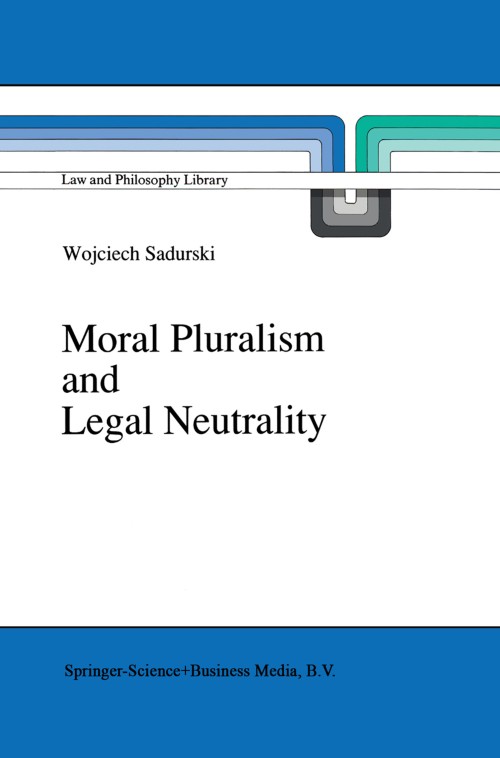
245 10|aMoral Pluralism and Legal Neutrality|h[electronic resource] /|cby Wojciech Sadurski.
250 |a1st ed. 1990.
264 1|aDordrecht :|bSpringer Netherlands :|bImprint: Springer,|c1990.
300 |aVIII, 224 p.|bonline resource.
336 |atext|btxt|2rdacontent
337 |acomputer|bc|2rdamedia
338 |aonline resource|bcr|2rdacarrier
347 |atext file|bPDF|2rda
490 1 |aLaw and Philosophy Library,|x2215-0315 ;|v9
520 |alt is a commonplace that law and morality intersect and interpenetrate in all the areas of legal decision-making; that in order to make sense of constitutional, statutory or common-law questions, judges and other legal decision-makers must first resolve certain philosophical issues which include moral judgments of right and wrang_ This is particularly evident with regard to constitutional interpretation, especially when constitutions give a mandate for the protection of the substantive norms and values entrenched as constitutional rights. In these Situations, as a leading contemporary legal philosopher observed, the "Constitution fuses legal and moral issues, by making the validity of a law depend on an answer to complex moral 1 problems". But the need for substantive value elucidation is not confined, of course, only to constitutional interpretation under Bills of Rights. This, however, immediately raises a dilemma stemming from the moral diversity and pluralism of modern liberal societies. How can law remain sensitive to this pluralism and yet provide clear answers to the problems which call for a legal resolution? Sharply conflicting values in modern societies clash in the debates over the death penalty, abortion, homosexuality, separation of state and religion, the scope of the freedom of the press, or affirmative action. lt would often be difficult to discern a broader consensus within which these clashes of values operate, unless this consensus were described in such vague terms as to render it practically meaningless.
532 8 |aAccessibility summary: This PDF is not accessible. It is based on scanned pages and does not support features such as screen reader compatibility or described non-text content (images, graphs etc). However, it likely supports searchable and selectable text based on OCR (Optical Character Recognition). Users with accessibility needs may not be able to use this content effectively. Please contact us at accessibilitysupport@springernature.com if you require assistance or an alternative format.
532 8 |aInaccessible, or known limited accessibility
532 8 |aNo reading system accessibility options actively disabled
532 8 |aPublisher contact for further accessibility information: accessibilitysupport@springernature.com
650 0|aLaw|xPhilosophy.
650 0|aLaw|xHistory.
650 0|aInternational law.
650 14|aTheories of Law, Philosophy of Law, Legal History.
650 24|aPhilosophy of Law.
650 24|aPublic International Law.
710 2 |aSpringerLink (Online service)
773 0 |tSpringer Nature eBook
776 08|iPrinted edition:|z9780792305651
776 08|iPrinted edition:|z9789400919297
776 08|iPrinted edition:|z9789401073608
830 0|aLaw and Philosophy Library,|x2215-0315 ;|v9
856 40|uhttps://doi.org/10.1007/978-94-009-1928-0
912 |aZDB-2-SHU
912 |aZDB-2-SXLC
912 |aZDB-2-BAE
950 |aHumanities, Social Sciences and Law (SpringerNature-11648)
950 |aLaw and Criminology (R0) (SpringerNature-43727)