

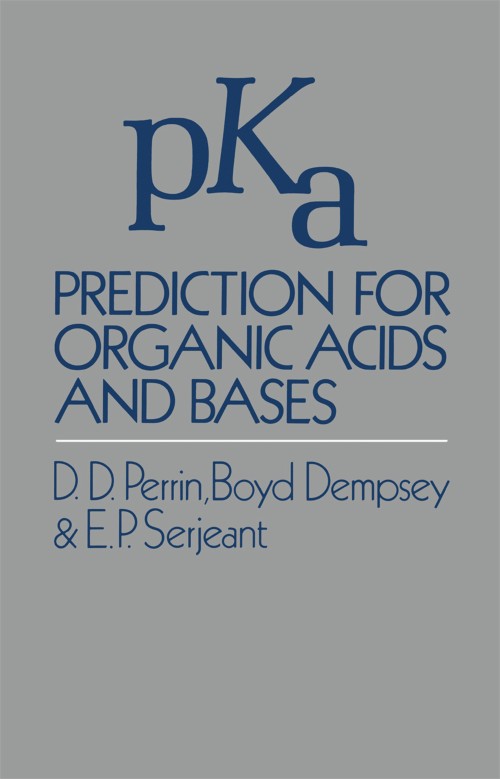
pKa Prediction for Organic Acids and Bases [electronic resource] / by D. Perrin.
Erişim Adresi
ISBN
9789400958838
Dil Kodu
İngilizce
Yer Numarası
DK/9257
Yazar
Basım Bildirimi
1st ed. 1981.
Yayın Bilgisi
Dordrecht : Springer Netherlands : Imprint: Springer, 1981.
Fiziksel Niteleme
X, 146 p. online resource.
İçindekiler Notu
1 Introduction -- 2 Molecular factors that modify pKa values -- 3 Methods of pKa prediction -- 4 Prediction of pKa values of substituted aliphatic acids and bases -- 5 Prediction of pKa values for phenols, aromatic carboxylic acids and aromatic amines -- 6 Further applications of Hammett and Taft equations -- 7 Some more difficult cases -- 8 Extension of the Hammett and Taft equations -- 9 Examples where prediction presents difficulties -- 10 Recapitulation of the main pKa prediction methods -- A.1 Substituent constants for the Hammett and Taft equations -- A.4 Special sigma constants for para substituents -- A.6 Sigma constants for heteroatoms in heterocyclic rings -- References.
Özet, vb.
Many chemists and biochemists require to know the ionization constants of organic acids and bases. This is evident from the Science Citation Index which lists The Determination of Ionization Constants by A. Albert and E. P. Serjeant (1971) as one of the most widely quoted books in the chemical literature. Although, ultimately, there is no satisfactory alternative to experimental measurement, it is not always convenient or practicable to make the necessary measure ments and calculations. Moreover, the massive pK. compilations currently available provide values for only a small fraction of known or possible acids or bases. For example, the compilations listed in Section 1. 3 give pK. data for some 6 000--8 000 acids, whereas if the conservative estimate is made that there are one hundred different substituent groups available to substitute in the benzene ring of benzoic acid, approximately five million tri-substituted benzoic acids are theoretically possible. Thus we have long felt that it is useful to consider methods by which a pK. value might be predicted as an interim value to within several tenths of a pH unit using arguments based on linear free energy relationships, by analogy, by extrapolation, by interpolation from existing data, or in some other way. This degree of precision may be adequate for many purposes such as the recording of spectra of pure species (as anion, neutral molecule or cation), for selection of conditions favourable to solvent extraction, and for the interpretation of pH-profiles for organic reactions.
Konu
Social sciences.
Humanities.
Humanities and Social Sciences.
Humanities.
Humanities and Social Sciences.
Kurum Adı
Eseri Alıntıla
Referansları kullanmadan önce gözden geçirmeniz ve varsa gerekli düzeltmeleri yapmanız önerilir.
Dijital Kaynak
MARC Görünümü
LEADER 04603nam a22005415i 4500
001 807964
003 TR_AnAIT
005 20260127005144
007 cr nn 008mamaa
008 130503s1981 ne | s |||| 0|eng d
020 |a9789400958838|9978-94-009-5883-8
024 7 |a10.1007/978-94-009-5883-8|2doi
041 |aeng
049 |aTürk Tarih Kurumu Kütüphanesi
050 4|aH1-99
050 4|aAZ19.2-999
072 7|aGT|2bicssc
072 7|aNON000000|2bisacsh
072 7|aGT|2thema
082 04|a300|223
082 04|a001.3|223
090 |aDK/9257
100 1 |aPerrin, D.|eauthor.|4aut|4http://id.loc.gov/vocabulary/relators/aut
245 10|apKa Prediction for Organic Acids and Bases|h[electronic resource] /|cby D. Perrin.
250 |a1st ed. 1981.
264 1|aDordrecht :|bSpringer Netherlands :|bImprint: Springer,|c1981.
300 |aX, 146 p.|bonline resource.
336 |atext|btxt|2rdacontent
337 |acomputer|bc|2rdamedia
338 |aonline resource|bcr|2rdacarrier
347 |atext file|bPDF|2rda
505 0 |a1 Introduction -- 2 Molecular factors that modify pKa values -- 3 Methods of pKa prediction -- 4 Prediction of pKa values of substituted aliphatic acids and bases -- 5 Prediction of pKa values for phenols, aromatic carboxylic acids and aromatic amines -- 6 Further applications of Hammett and Taft equations -- 7 Some more difficult cases -- 8 Extension of the Hammett and Taft equations -- 9 Examples where prediction presents difficulties -- 10 Recapitulation of the main pKa prediction methods -- A.1 Substituent constants for the Hammett and Taft equations -- A.4 Special sigma constants for para substituents -- A.6 Sigma constants for heteroatoms in heterocyclic rings -- References.
520 |aMany chemists and biochemists require to know the ionization constants of organic acids and bases. This is evident from the Science Citation Index which lists The Determination of Ionization Constants by A. Albert and E. P. Serjeant (1971) as one of the most widely quoted books in the chemical literature. Although, ultimately, there is no satisfactory alternative to experimental measurement, it is not always convenient or practicable to make the necessary measure ments and calculations. Moreover, the massive pK. compilations currently available provide values for only a small fraction of known or possible acids or bases. For example, the compilations listed in Section 1. 3 give pK. data for some 6 000--8 000 acids, whereas if the conservative estimate is made that there are one hundred different substituent groups available to substitute in the benzene ring of benzoic acid, approximately five million tri-substituted benzoic acids are theoretically possible. Thus we have long felt that it is useful to consider methods by which a pK. value might be predicted as an interim value to within several tenths of a pH unit using arguments based on linear free energy relationships, by analogy, by extrapolation, by interpolation from existing data, or in some other way. This degree of precision may be adequate for many purposes such as the recording of spectra of pure species (as anion, neutral molecule or cation), for selection of conditions favourable to solvent extraction, and for the interpretation of pH-profiles for organic reactions.
532 8 |aAccessibility summary: This PDF is not accessible. It is based on scanned pages and does not support features such as screen reader compatibility or described non-text content (images, graphs etc). However, it likely supports searchable and selectable text based on OCR (Optical Character Recognition). Users with accessibility needs may not be able to use this content effectively. Please contact us at accessibilitysupport@springernature.com if you require assistance or an alternative format.
532 8 |aInaccessible, or known limited accessibility
532 8 |aNo reading system accessibility options actively disabled
532 8 |aPublisher contact for further accessibility information: accessibilitysupport@springernature.com
650 0|aSocial sciences.
650 0|aHumanities.
650 14|aHumanities and Social Sciences.
710 2 |aSpringerLink (Online service)
773 0 |tSpringer Nature eBook
776 08|iPrinted edition:|z9780412221903
776 08|iPrinted edition:|z9789400958845
776 08|iPrinted edition:|z9789400958852
856 40|uhttps://doi.org/10.1007/978-94-009-5883-8
912 |aZDB-2-SHU
912 |aZDB-2-SXH
912 |aZDB-2-BAE
950 |aHumanities, Social Sciences and Law (SpringerNature-11648)
950 |aHistory (R0) (SpringerNature-43722)
001 807964
003 TR_AnAIT
005 20260127005144
007 cr nn 008mamaa
008 130503s1981 ne | s |||| 0|eng d
020 |a9789400958838|9978-94-009-5883-8
024 7 |a10.1007/978-94-009-5883-8|2doi
041 |aeng
049 |aTürk Tarih Kurumu Kütüphanesi
050 4|aH1-99
050 4|aAZ19.2-999
072 7|aGT|2bicssc
072 7|aNON000000|2bisacsh
072 7|aGT|2thema
082 04|a300|223
082 04|a001.3|223
090 |aDK/9257
100 1 |aPerrin, D.|eauthor.|4aut|4http://id.loc.gov/vocabulary/relators/aut
245 10|apKa Prediction for Organic Acids and Bases|h[electronic resource] /|cby D. Perrin.
250 |a1st ed. 1981.
264 1|aDordrecht :|bSpringer Netherlands :|bImprint: Springer,|c1981.
300 |aX, 146 p.|bonline resource.
336 |atext|btxt|2rdacontent
337 |acomputer|bc|2rdamedia
338 |aonline resource|bcr|2rdacarrier
347 |atext file|bPDF|2rda
505 0 |a1 Introduction -- 2 Molecular factors that modify pKa values -- 3 Methods of pKa prediction -- 4 Prediction of pKa values of substituted aliphatic acids and bases -- 5 Prediction of pKa values for phenols, aromatic carboxylic acids and aromatic amines -- 6 Further applications of Hammett and Taft equations -- 7 Some more difficult cases -- 8 Extension of the Hammett and Taft equations -- 9 Examples where prediction presents difficulties -- 10 Recapitulation of the main pKa prediction methods -- A.1 Substituent constants for the Hammett and Taft equations -- A.4 Special sigma constants for para substituents -- A.6 Sigma constants for heteroatoms in heterocyclic rings -- References.
520 |aMany chemists and biochemists require to know the ionization constants of organic acids and bases. This is evident from the Science Citation Index which lists The Determination of Ionization Constants by A. Albert and E. P. Serjeant (1971) as one of the most widely quoted books in the chemical literature. Although, ultimately, there is no satisfactory alternative to experimental measurement, it is not always convenient or practicable to make the necessary measure ments and calculations. Moreover, the massive pK. compilations currently available provide values for only a small fraction of known or possible acids or bases. For example, the compilations listed in Section 1. 3 give pK. data for some 6 000--8 000 acids, whereas if the conservative estimate is made that there are one hundred different substituent groups available to substitute in the benzene ring of benzoic acid, approximately five million tri-substituted benzoic acids are theoretically possible. Thus we have long felt that it is useful to consider methods by which a pK. value might be predicted as an interim value to within several tenths of a pH unit using arguments based on linear free energy relationships, by analogy, by extrapolation, by interpolation from existing data, or in some other way. This degree of precision may be adequate for many purposes such as the recording of spectra of pure species (as anion, neutral molecule or cation), for selection of conditions favourable to solvent extraction, and for the interpretation of pH-profiles for organic reactions.
532 8 |aAccessibility summary: This PDF is not accessible. It is based on scanned pages and does not support features such as screen reader compatibility or described non-text content (images, graphs etc). However, it likely supports searchable and selectable text based on OCR (Optical Character Recognition). Users with accessibility needs may not be able to use this content effectively. Please contact us at accessibilitysupport@springernature.com if you require assistance or an alternative format.
532 8 |aInaccessible, or known limited accessibility
532 8 |aNo reading system accessibility options actively disabled
532 8 |aPublisher contact for further accessibility information: accessibilitysupport@springernature.com
650 0|aSocial sciences.
650 0|aHumanities.
650 14|aHumanities and Social Sciences.
710 2 |aSpringerLink (Online service)
773 0 |tSpringer Nature eBook
776 08|iPrinted edition:|z9780412221903
776 08|iPrinted edition:|z9789400958845
776 08|iPrinted edition:|z9789400958852
856 40|uhttps://doi.org/10.1007/978-94-009-5883-8
912 |aZDB-2-SHU
912 |aZDB-2-SXH
912 |aZDB-2-BAE
950 |aHumanities, Social Sciences and Law (SpringerNature-11648)
950 |aHistory (R0) (SpringerNature-43722)
Materyaller
Depodan talep edilen materyal sadece kütüphane içerisinde kullanılmaktadır.
Materyal dışarıya ödünç verilmemektedir.
Materyal dışarıya ödünç verilmemektedir.
