

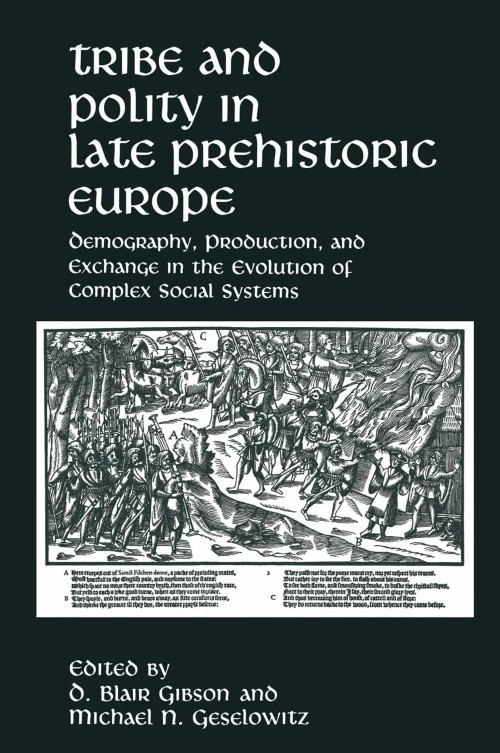
Tribe and Polity in Late Prehistoric Europe [electronic resource] : Demography, Production, and Exchange in the Evolution of Complex Social Systems / edited by D. Blair Gibson, M.N. Geselowitz.
Erişim Adresi
ISBN
9781489907776
Dil Kodu
İngilizce
Yer Numarası
DK/9277
Basım Bildirimi
1st ed. 1988.
Yayın Bilgisi
New York, NY : Springer US : Imprint: Springer, 1988.
Fiziksel Niteleme
XII, 234 p. online resource.
İçindekiler Notu
The Evolution of Complex Society in Late Prehistoric Europe: Toward a Paradigm -- Northern and Western Europe -- Agro-pastoralism and Regional Social Organization in Early Ireland -- Coinage and Complexity: Archaeological Analysis of Socio-political Change in Britain and Non-Mediterranean Gaul during the Later Iron Age -- A Spatial Approach to Socioeconomic Change in Scandinavia: Central Sweden in the First Millennium B.C -- Demographic and Economic Changes in the Hallstatt Period of the Lusatian Culture -- Demographic and Economic Changes in the Hallstatt Period of the Lusatian Culture -- Technology and Social Change: Ironworking in the Rise of Social Complexity in Iron Age Central Europe -- Diet, Status, and Complex Social Structure in Iron Age Central Europe: Some Contributions of Bone Chemistry -- West Central and Southern Europe -- Slavery in Late Prehistoric Europe: Recovering the Evidence for Social Structure in Iron Age Society -- Rise of Complex Societies in Italy: Historical versus Archaeological Perspectives -- Conclusions -- Industry and Society in Late Prehistoric Europe -- Some Comments on Method and Interpretation -- Contributors.
Özet, vb.
During HaA-HaB, many settlements were established in Silesia and in the central part of Poland, and their stability seems to be confirmed by the existence of regional groups and subgroups, by long-lasting colonies, and by long-used burial grounds, located at large settlements. At the end of HaB, many pre-Scythian elements occurred in this area, only partly influenced by the Cimmerians . During that period the peoples living north of the Carpathian and Sudeten Mountains remained very dependent on the productive and cultural circle south of the Carpathians, with which they maintained strong connections . The Lusatian settlement zone , apart from its increasing internal stability, also tended to extend its range . A partition of the Lusatian Culture, which had appeared earlier , became more pronounced under the strong influence of the East Hallstatt cultural and productive center in the eastern Alpine region , and the so-called amber route . The eastern zone of the Lusatian Culture remained under the influence of the Carpathian center, while the western zone was strongly influenced by the pre-Celtic (Bylanska or Horakowska) and northern Illyrian (Calon denberian) cultures. In HaD2' ca. 520-500 B.C., this latter area was the site of an armed incursion of Scythian groups coming from the east through the Karpacka Valley. The most characteristic features of the western zone include its own varieties of more general Hallstatt traits , such as fortified settlements (which date from HaA in the Lusatian Culture) , production of iron (done domestically since HaD), and decorated pottery.
Konu
History.
History.
History.
Diğer Yazarlar
Kurum Adı
Eseri Alıntıla
Referansları kullanmadan önce gözden geçirmeniz ve varsa gerekli düzeltmeleri yapmanız önerilir.
Dijital Kaynak
MARC Görünümü
LEADER 05279nam a22005415i 4500
001 807984
003 TR_AnAIT
005 20260127005207
007 cr nn 008mamaa
008 130610s1988 xxu| s |||| 0|eng d
020 |a9781489907776|9978-1-4899-0777-6
024 7 |a10.1007/978-1-4899-0777-6|2doi
041 |aeng
049 |aTürk Tarih Kurumu Kütüphanesi
050 4|aD1-2027
072 7|aHB|2bicssc
072 7|aHBAH|2bicssc
072 7|aHIS000000|2bisacsh
072 7|aNH|2thema
072 7|aNHAH|2thema
082 04|a900|223
090 |aDK/9277
245 10|aTribe and Polity in Late Prehistoric Europe|h[electronic resource] :|bDemography, Production, and Exchange in the Evolution of Complex Social Systems /|cedited by D. Blair Gibson, M.N. Geselowitz.
250 |a1st ed. 1988.
264 1|aNew York, NY :|bSpringer US :|bImprint: Springer,|c1988.
300 |aXII, 234 p.|bonline resource.
336 |atext|btxt|2rdacontent
337 |acomputer|bc|2rdamedia
338 |aonline resource|bcr|2rdacarrier
347 |atext file|bPDF|2rda
505 0 |aThe Evolution of Complex Society in Late Prehistoric Europe: Toward a Paradigm -- Northern and Western Europe -- Agro-pastoralism and Regional Social Organization in Early Ireland -- Coinage and Complexity: Archaeological Analysis of Socio-political Change in Britain and Non-Mediterranean Gaul during the Later Iron Age -- A Spatial Approach to Socioeconomic Change in Scandinavia: Central Sweden in the First Millennium B.C -- Demographic and Economic Changes in the Hallstatt Period of the Lusatian Culture -- Demographic and Economic Changes in the Hallstatt Period of the Lusatian Culture -- Technology and Social Change: Ironworking in the Rise of Social Complexity in Iron Age Central Europe -- Diet, Status, and Complex Social Structure in Iron Age Central Europe: Some Contributions of Bone Chemistry -- West Central and Southern Europe -- Slavery in Late Prehistoric Europe: Recovering the Evidence for Social Structure in Iron Age Society -- Rise of Complex Societies in Italy: Historical versus Archaeological Perspectives -- Conclusions -- Industry and Society in Late Prehistoric Europe -- Some Comments on Method and Interpretation -- Contributors.
520 |aDuring HaA-HaB, many settlements were established in Silesia and in the central part of Poland, and their stability seems to be confirmed by the existence of regional groups and subgroups, by long-lasting colonies, and by long-used burial grounds, located at large settlements. At the end of HaB, many pre-Scythian elements occurred in this area, only partly influenced by the Cimmerians . During that period the peoples living north of the Carpathian and Sudeten Mountains remained very dependent on the productive and cultural circle south of the Carpathians, with which they maintained strong connections . The Lusatian settlement zone , apart from its increasing internal stability, also tended to extend its range . A partition of the Lusatian Culture, which had appeared earlier , became more pronounced under the strong influence of the East Hallstatt cultural and productive center in the eastern Alpine region , and the so-called amber route . The eastern zone of the Lusatian Culture remained under the influence of the Carpathian center, while the western zone was strongly influenced by the pre-Celtic (Bylanska or Horakowska) and northern Illyrian (Calon denberian) cultures. In HaD2' ca. 520-500 B.C., this latter area was the site of an armed incursion of Scythian groups coming from the east through the Karpacka Valley. The most characteristic features of the western zone include its own varieties of more general Hallstatt traits , such as fortified settlements (which date from HaA in the Lusatian Culture) , production of iron (done domestically since HaD), and decorated pottery.
532 8 |aAccessibility summary: This PDF is not accessible. It is based on scanned pages and does not support features such as screen reader compatibility or described non-text content (images, graphs etc). However, it likely supports searchable and selectable text based on OCR (Optical Character Recognition). Users with accessibility needs may not be able to use this content effectively. Please contact us at accessibilitysupport@springernature.com if you require assistance or an alternative format.
532 8 |aInaccessible, or known limited accessibility
532 8 |aNo reading system accessibility options actively disabled
532 8 |aPublisher contact for further accessibility information: accessibilitysupport@springernature.com
650 0|aHistory.
650 14|aHistory.
700 1 |aGibson, D. Blair.|eeditor.|4edt|4http://id.loc.gov/vocabulary/relators/edt
700 1 |aGeselowitz, M.N.|eeditor.|4edt|4http://id.loc.gov/vocabulary/relators/edt
710 2 |aSpringerLink (Online service)
773 0 |tSpringer Nature eBook
776 08|iPrinted edition:|z9780306429132
776 08|iPrinted edition:|z9781489907783
776 08|iPrinted edition:|z9781489907790
856 40|uhttps://doi.org/10.1007/978-1-4899-0777-6
912 |aZDB-2-SHU
912 |aZDB-2-SXH
912 |aZDB-2-BAE
950 |aHumanities, Social Sciences and Law (SpringerNature-11648)
950 |aHistory (R0) (SpringerNature-43722)
001 807984
003 TR_AnAIT
005 20260127005207
007 cr nn 008mamaa
008 130610s1988 xxu| s |||| 0|eng d
020 |a9781489907776|9978-1-4899-0777-6
024 7 |a10.1007/978-1-4899-0777-6|2doi
041 |aeng
049 |aTürk Tarih Kurumu Kütüphanesi
050 4|aD1-2027
072 7|aHB|2bicssc
072 7|aHBAH|2bicssc
072 7|aHIS000000|2bisacsh
072 7|aNH|2thema
072 7|aNHAH|2thema
082 04|a900|223
090 |aDK/9277
245 10|aTribe and Polity in Late Prehistoric Europe|h[electronic resource] :|bDemography, Production, and Exchange in the Evolution of Complex Social Systems /|cedited by D. Blair Gibson, M.N. Geselowitz.
250 |a1st ed. 1988.
264 1|aNew York, NY :|bSpringer US :|bImprint: Springer,|c1988.
300 |aXII, 234 p.|bonline resource.
336 |atext|btxt|2rdacontent
337 |acomputer|bc|2rdamedia
338 |aonline resource|bcr|2rdacarrier
347 |atext file|bPDF|2rda
505 0 |aThe Evolution of Complex Society in Late Prehistoric Europe: Toward a Paradigm -- Northern and Western Europe -- Agro-pastoralism and Regional Social Organization in Early Ireland -- Coinage and Complexity: Archaeological Analysis of Socio-political Change in Britain and Non-Mediterranean Gaul during the Later Iron Age -- A Spatial Approach to Socioeconomic Change in Scandinavia: Central Sweden in the First Millennium B.C -- Demographic and Economic Changes in the Hallstatt Period of the Lusatian Culture -- Demographic and Economic Changes in the Hallstatt Period of the Lusatian Culture -- Technology and Social Change: Ironworking in the Rise of Social Complexity in Iron Age Central Europe -- Diet, Status, and Complex Social Structure in Iron Age Central Europe: Some Contributions of Bone Chemistry -- West Central and Southern Europe -- Slavery in Late Prehistoric Europe: Recovering the Evidence for Social Structure in Iron Age Society -- Rise of Complex Societies in Italy: Historical versus Archaeological Perspectives -- Conclusions -- Industry and Society in Late Prehistoric Europe -- Some Comments on Method and Interpretation -- Contributors.
520 |aDuring HaA-HaB, many settlements were established in Silesia and in the central part of Poland, and their stability seems to be confirmed by the existence of regional groups and subgroups, by long-lasting colonies, and by long-used burial grounds, located at large settlements. At the end of HaB, many pre-Scythian elements occurred in this area, only partly influenced by the Cimmerians . During that period the peoples living north of the Carpathian and Sudeten Mountains remained very dependent on the productive and cultural circle south of the Carpathians, with which they maintained strong connections . The Lusatian settlement zone , apart from its increasing internal stability, also tended to extend its range . A partition of the Lusatian Culture, which had appeared earlier , became more pronounced under the strong influence of the East Hallstatt cultural and productive center in the eastern Alpine region , and the so-called amber route . The eastern zone of the Lusatian Culture remained under the influence of the Carpathian center, while the western zone was strongly influenced by the pre-Celtic (Bylanska or Horakowska) and northern Illyrian (Calon denberian) cultures. In HaD2' ca. 520-500 B.C., this latter area was the site of an armed incursion of Scythian groups coming from the east through the Karpacka Valley. The most characteristic features of the western zone include its own varieties of more general Hallstatt traits , such as fortified settlements (which date from HaA in the Lusatian Culture) , production of iron (done domestically since HaD), and decorated pottery.
532 8 |aAccessibility summary: This PDF is not accessible. It is based on scanned pages and does not support features such as screen reader compatibility or described non-text content (images, graphs etc). However, it likely supports searchable and selectable text based on OCR (Optical Character Recognition). Users with accessibility needs may not be able to use this content effectively. Please contact us at accessibilitysupport@springernature.com if you require assistance or an alternative format.
532 8 |aInaccessible, or known limited accessibility
532 8 |aNo reading system accessibility options actively disabled
532 8 |aPublisher contact for further accessibility information: accessibilitysupport@springernature.com
650 0|aHistory.
650 14|aHistory.
700 1 |aGibson, D. Blair.|eeditor.|4edt|4http://id.loc.gov/vocabulary/relators/edt
700 1 |aGeselowitz, M.N.|eeditor.|4edt|4http://id.loc.gov/vocabulary/relators/edt
710 2 |aSpringerLink (Online service)
773 0 |tSpringer Nature eBook
776 08|iPrinted edition:|z9780306429132
776 08|iPrinted edition:|z9781489907783
776 08|iPrinted edition:|z9781489907790
856 40|uhttps://doi.org/10.1007/978-1-4899-0777-6
912 |aZDB-2-SHU
912 |aZDB-2-SXH
912 |aZDB-2-BAE
950 |aHumanities, Social Sciences and Law (SpringerNature-11648)
950 |aHistory (R0) (SpringerNature-43722)
Materyaller
Depodan talep edilen materyal sadece kütüphane içerisinde kullanılmaktadır.
Materyal dışarıya ödünç verilmemektedir.
Materyal dışarıya ödünç verilmemektedir.
