

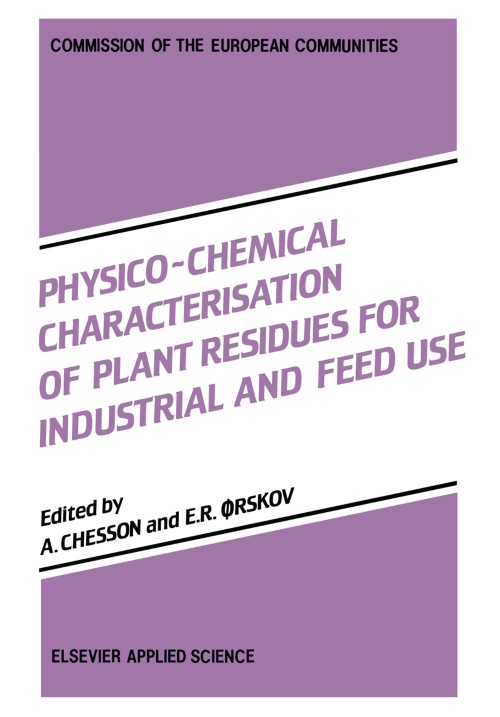
Physico-Chemical Characterisation of Plant Residues for Industrial and Feed Use [electronic resource] / by Andrew Chesson.
Erişim Adresi
ISBN
9789400911314
Dil Kodu
İngilizce
Yer Numarası
DK/9408
Yazar
Basım Bildirimi
1st ed. 1989.
Yayın Bilgisi
Dordrecht : Springer Netherlands : Imprint: Springer, 1989.
Fiziksel Niteleme
VI, 170 p. online resource.
İçindekiler Notu
Use of modern NMR spectroscopy in plant cell wall research -- Near- and mid-infrared studies of the cell wall structure of cereal straw in relation to its rumen degradability -- An introduction to pyrolysis mass spectrometry of lignocellulosic material: case studies on barley straw, corn stem and Agropyron -- Cell wall autofluorescence -- Light microscopy and histology of lignocellulose related to biodegradation -- Electron microscopy as a method to evaluate structure and degradation of plant cell walls -- Some properties of cell wall layers determining ruminant digestion -- Identification and importance of polyphenolic compounds in crop residues -- 13C-NMR spectroscopy of lignins and lignocellulosic materials -- Lignin characterisation of wheat straw samples as determined by chemical degradation procedures -- Determination of phenolic compounds from lignocellulosic by-products by HPLC with electrochemical detector -- Electrochemical approaches to the oxidative degradation of lignins and lignocellulosic materials -- Methods for the evaluation of lignin properties suitable for conversion -- Comparison of chemical and biological methods for predicting feed intakes and animal performance -- Recommendations -- List of Participants.
Özet, vb.
The workshop reported in this volume is one of a series sponsored by the Commission of the European Communities, Directorate-General for Science, Research and Development (DG XII), under the Concerted Action Programme COST 84-bis, entitled "Use of lignocellulose containing by-products and other plant residues for animal feeding". Since COST 84-bis was established there has been a major shift of emphasis in agricultural research in Europe, with the development of alternative uses for crops and their by-products becoming a priority issue. In recognition of this recent workshops he,ld under the aegis of COST 84-bis have been equally concerned with the potential of lignocellulosic residues to form the feedstock for a variety of new and established industrial uses in addition to their established use as animal feed. Development of strategies for the use of plants or plant residues with a high cell wall content is dependant on knowledge of cell wall structure and organisation and how structure relates to the behaviour of the wall during mechanical, chemical or biological processing. Progress in cell wall research has been greatly facilitated by the substantial developments in methods of instrumental analysis that have occurred during the last decade. Plant tissues now can be examined in far greater detail and far more rapidly than was hitherto possible, often without the need for extraction or modification of the cell wall or its component polymers.
Konu
Social sciences.
Humanities.
Humanities and Social Sciences.
Humanities.
Humanities and Social Sciences.
Kurum Adı
Eseri Alıntıla
Referansları kullanmadan önce gözden geçirmeniz ve varsa gerekli düzeltmeleri yapmanız önerilir.
Dijital Kaynak
MARC Görünümü
LEADER 05122nam a22005415i 4500
001 808116
003 TR_AnAIT
005 20260127005442
007 cr nn 008mamaa
008 121227s1989 ne | s |||| 0|eng d
020 |a9789400911314|9978-94-009-1131-4
024 7 |a10.1007/978-94-009-1131-4|2doi
041 |aeng
049 |aTürk Tarih Kurumu Kütüphanesi
050 4|aH1-99
050 4|aAZ19.2-999
072 7|aGT|2bicssc
072 7|aNON000000|2bisacsh
072 7|aGT|2thema
082 04|a300|223
082 04|a001.3|223
090 |aDK/9408
100 1 |aChesson, Andrew.|eauthor.|4aut|4http://id.loc.gov/vocabulary/relators/aut
245 10|aPhysico-Chemical Characterisation of Plant Residues for Industrial and Feed Use|h[electronic resource] /|cby Andrew Chesson.
250 |a1st ed. 1989.
264 1|aDordrecht :|bSpringer Netherlands :|bImprint: Springer,|c1989.
300 |aVI, 170 p.|bonline resource.
336 |atext|btxt|2rdacontent
337 |acomputer|bc|2rdamedia
338 |aonline resource|bcr|2rdacarrier
347 |atext file|bPDF|2rda
505 0 |aUse of modern NMR spectroscopy in plant cell wall research -- Near- and mid-infrared studies of the cell wall structure of cereal straw in relation to its rumen degradability -- An introduction to pyrolysis mass spectrometry of lignocellulosic material: case studies on barley straw, corn stem and Agropyron -- Cell wall autofluorescence -- Light microscopy and histology of lignocellulose related to biodegradation -- Electron microscopy as a method to evaluate structure and degradation of plant cell walls -- Some properties of cell wall layers determining ruminant digestion -- Identification and importance of polyphenolic compounds in crop residues -- 13C-NMR spectroscopy of lignins and lignocellulosic materials -- Lignin characterisation of wheat straw samples as determined by chemical degradation procedures -- Determination of phenolic compounds from lignocellulosic by-products by HPLC with electrochemical detector -- Electrochemical approaches to the oxidative degradation of lignins and lignocellulosic materials -- Methods for the evaluation of lignin properties suitable for conversion -- Comparison of chemical and biological methods for predicting feed intakes and animal performance -- Recommendations -- List of Participants.
520 |aThe workshop reported in this volume is one of a series sponsored by the Commission of the European Communities, Directorate-General for Science, Research and Development (DG XII), under the Concerted Action Programme COST 84-bis, entitled "Use of lignocellulose containing by-products and other plant residues for animal feeding". Since COST 84-bis was established there has been a major shift of emphasis in agricultural research in Europe, with the development of alternative uses for crops and their by-products becoming a priority issue. In recognition of this recent workshops he,ld under the aegis of COST 84-bis have been equally concerned with the potential of lignocellulosic residues to form the feedstock for a variety of new and established industrial uses in addition to their established use as animal feed. Development of strategies for the use of plants or plant residues with a high cell wall content is dependant on knowledge of cell wall structure and organisation and how structure relates to the behaviour of the wall during mechanical, chemical or biological processing. Progress in cell wall research has been greatly facilitated by the substantial developments in methods of instrumental analysis that have occurred during the last decade. Plant tissues now can be examined in far greater detail and far more rapidly than was hitherto possible, often without the need for extraction or modification of the cell wall or its component polymers.
532 8 |aAccessibility summary: This PDF is not accessible. It is based on scanned pages and does not support features such as screen reader compatibility or described non-text content (images, graphs etc). However, it likely supports searchable and selectable text based on OCR (Optical Character Recognition). Users with accessibility needs may not be able to use this content effectively. Please contact us at accessibilitysupport@springernature.com if you require assistance or an alternative format.
532 8 |aInaccessible, or known limited accessibility
532 8 |aNo reading system accessibility options actively disabled
532 8 |aPublisher contact for further accessibility information: accessibilitysupport@springernature.com
650 0|aSocial sciences.
650 0|aHumanities.
650 14|aHumanities and Social Sciences.
710 2 |aSpringerLink (Online service)
773 0 |tSpringer Nature eBook
776 08|iPrinted edition:|z9781851663767
776 08|iPrinted edition:|z9789400911321
776 08|iPrinted edition:|z9789401070010
856 40|uhttps://doi.org/10.1007/978-94-009-1131-4
912 |aZDB-2-SHU
912 |aZDB-2-SXH
912 |aZDB-2-BAE
950 |aHumanities, Social Sciences and Law (SpringerNature-11648)
950 |aHistory (R0) (SpringerNature-43722)
001 808116
003 TR_AnAIT
005 20260127005442
007 cr nn 008mamaa
008 121227s1989 ne | s |||| 0|eng d
020 |a9789400911314|9978-94-009-1131-4
024 7 |a10.1007/978-94-009-1131-4|2doi
041 |aeng
049 |aTürk Tarih Kurumu Kütüphanesi
050 4|aH1-99
050 4|aAZ19.2-999
072 7|aGT|2bicssc
072 7|aNON000000|2bisacsh
072 7|aGT|2thema
082 04|a300|223
082 04|a001.3|223
090 |aDK/9408
100 1 |aChesson, Andrew.|eauthor.|4aut|4http://id.loc.gov/vocabulary/relators/aut
245 10|aPhysico-Chemical Characterisation of Plant Residues for Industrial and Feed Use|h[electronic resource] /|cby Andrew Chesson.
250 |a1st ed. 1989.
264 1|aDordrecht :|bSpringer Netherlands :|bImprint: Springer,|c1989.
300 |aVI, 170 p.|bonline resource.
336 |atext|btxt|2rdacontent
337 |acomputer|bc|2rdamedia
338 |aonline resource|bcr|2rdacarrier
347 |atext file|bPDF|2rda
505 0 |aUse of modern NMR spectroscopy in plant cell wall research -- Near- and mid-infrared studies of the cell wall structure of cereal straw in relation to its rumen degradability -- An introduction to pyrolysis mass spectrometry of lignocellulosic material: case studies on barley straw, corn stem and Agropyron -- Cell wall autofluorescence -- Light microscopy and histology of lignocellulose related to biodegradation -- Electron microscopy as a method to evaluate structure and degradation of plant cell walls -- Some properties of cell wall layers determining ruminant digestion -- Identification and importance of polyphenolic compounds in crop residues -- 13C-NMR spectroscopy of lignins and lignocellulosic materials -- Lignin characterisation of wheat straw samples as determined by chemical degradation procedures -- Determination of phenolic compounds from lignocellulosic by-products by HPLC with electrochemical detector -- Electrochemical approaches to the oxidative degradation of lignins and lignocellulosic materials -- Methods for the evaluation of lignin properties suitable for conversion -- Comparison of chemical and biological methods for predicting feed intakes and animal performance -- Recommendations -- List of Participants.
520 |aThe workshop reported in this volume is one of a series sponsored by the Commission of the European Communities, Directorate-General for Science, Research and Development (DG XII), under the Concerted Action Programme COST 84-bis, entitled "Use of lignocellulose containing by-products and other plant residues for animal feeding". Since COST 84-bis was established there has been a major shift of emphasis in agricultural research in Europe, with the development of alternative uses for crops and their by-products becoming a priority issue. In recognition of this recent workshops he,ld under the aegis of COST 84-bis have been equally concerned with the potential of lignocellulosic residues to form the feedstock for a variety of new and established industrial uses in addition to their established use as animal feed. Development of strategies for the use of plants or plant residues with a high cell wall content is dependant on knowledge of cell wall structure and organisation and how structure relates to the behaviour of the wall during mechanical, chemical or biological processing. Progress in cell wall research has been greatly facilitated by the substantial developments in methods of instrumental analysis that have occurred during the last decade. Plant tissues now can be examined in far greater detail and far more rapidly than was hitherto possible, often without the need for extraction or modification of the cell wall or its component polymers.
532 8 |aAccessibility summary: This PDF is not accessible. It is based on scanned pages and does not support features such as screen reader compatibility or described non-text content (images, graphs etc). However, it likely supports searchable and selectable text based on OCR (Optical Character Recognition). Users with accessibility needs may not be able to use this content effectively. Please contact us at accessibilitysupport@springernature.com if you require assistance or an alternative format.
532 8 |aInaccessible, or known limited accessibility
532 8 |aNo reading system accessibility options actively disabled
532 8 |aPublisher contact for further accessibility information: accessibilitysupport@springernature.com
650 0|aSocial sciences.
650 0|aHumanities.
650 14|aHumanities and Social Sciences.
710 2 |aSpringerLink (Online service)
773 0 |tSpringer Nature eBook
776 08|iPrinted edition:|z9781851663767
776 08|iPrinted edition:|z9789400911321
776 08|iPrinted edition:|z9789401070010
856 40|uhttps://doi.org/10.1007/978-94-009-1131-4
912 |aZDB-2-SHU
912 |aZDB-2-SXH
912 |aZDB-2-BAE
950 |aHumanities, Social Sciences and Law (SpringerNature-11648)
950 |aHistory (R0) (SpringerNature-43722)
Materyaller
Depodan talep edilen materyal sadece kütüphane içerisinde kullanılmaktadır.
Materyal dışarıya ödünç verilmemektedir.
Materyal dışarıya ödünç verilmemektedir.
