

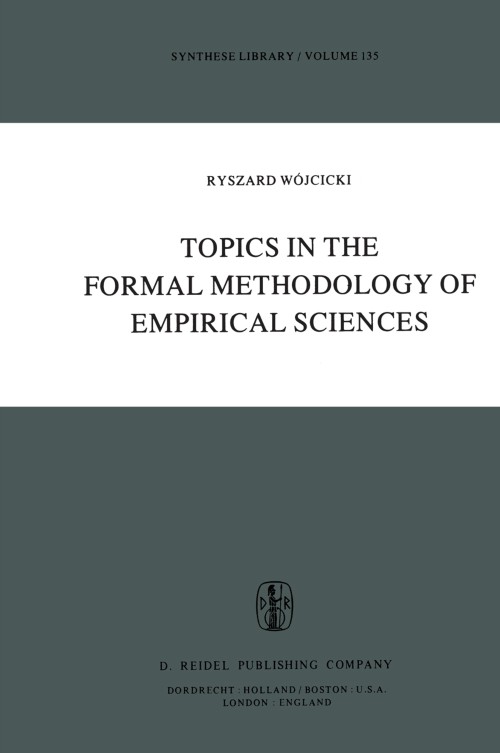
Topics in the Formal Methodology of Empirical Sciences [electronic resource] / by Ryszard Wójcicki.
Erişim Adresi
ISBN
9789400989443
Dil Kodu
İngilizce
Yer Numarası
DK/9427
Yazar
Basım Bildirimi
1st ed. 1979.
Yayın Bilgisi
Dordrecht : Springer Netherlands : Imprint: Springer, 1979.
Fiziksel Niteleme
290 p. online resource.
Dizi
Synthese Library, Studies in Epistemology, Logic, Methodology, and Philosophy of Science, 2542-8292 ; 135
İçindekiler Notu
Preface to the English edition -- Preface to the Polish edition -- I Introduction -- 1.1. Mathematical notation -- 1.2. Numerical systems -- 1.3. Elementary systems -- 1.4. States and histories -- 1.5. Complex systems -- 1.6. Empirical phenomena -- 1.7. Phase-space of a phenomenon and some related technical notions -- 1.8. Semi-interpreted languages -- 1.9. Fundamental semantic concepts -- 1.10. Formalized languages and the deductive concept of a theory -- 1.11. A criterion of consistency -- 1.12. The concept of a theory -- II Regularities -- 2.0. Two conventions -- 2.1. Two types of regularities -- 2.2. State-determined phenomena -- 2.3. Mathematical models for state transformations -- 2.4. History-determined phenomena -- 2.5. Definability -- 2.6. Ontological versus semantic definability -- 2.7. Surrounding conditions -- 2.8. Self-determined phenomena -- 2.9. Invariancy -- 2.10. Notes -- III Empirical Theories -- 3.1. Axiomatic versus set theoretical way of defining theories -- 3.2. Theories as deductive systems -- 3.3. The concept of truth -- 3.4. Empirical theories -- 3.5. Two examples of empirical theories -- 3.6. Models and theories of empirical phenomena -- IV Measurement -- 4.1. Semantic conception of measurement -- 4.2. Complete measurement structures -- 4.3. Approximate measurement -- 4.4. Theoretical versus operational conception of measurement -- 4.5. Notes -- V Operational Structures -- 5.0. Introductory assumptions -- 5.1. Verification procedures -- 5.2. Operational structures -- 5.3. A revised notion of regularity -- 5.4. The concept of truth as related to operational structures -- 5.5. Truth by convention -- 5.6. Confirmation procedures -- 5.7. Probabilistic models -- 5.8. Dispersive operational structures -- 5.9. Evolution of empirical theories -- VI Appendix -- 6.1. Complementary tests -- 6.2. Physical systems -- Index of Symbols -- Index of Names.
Özet, vb.
11 original. Modifications which I introduced are radical and often far going. In my opinion the Polish text had two main drawbacks. It was overloaded with informal considerations and at the same time formal concepts included in some parts of the book were presented in a too complicated way. Of course one of the motives to revise it was also the fact that much time has passed since I finished writing the Polish version and obviously certain decisions and ideas contained in the first edition seem not quite relevant now. So it is not only the desire to make the exposition clearer but also the reasons of substantial nature which motivated writing a revised version. I do not think it desirable to bother the reader with a detailed discussion of all changes to which the Polish version was subjected and that is why I will confine myself to pointing out only the most significant ones. Explanations concerning logical and set-theoretical notions applied in the book have been shortened as much as possible, in the Polish version one whole chapter was devoted to the discussion of them.
Konu
Science __ Philosophy.
Logic.
Philosophy of Science.
Logic.
Logic.
Philosophy of Science.
Logic.
Kurum Adı
Eseri Alıntıla
Referansları kullanmadan önce gözden geçirmeniz ve varsa gerekli düzeltmeleri yapmanız önerilir.
Dijital Kaynak
MARC Görünümü
LEADER 05623nam a22005655i 4500
001 808135
003 TR_AnAIT
005 20260127005504
007 cr nn 008mamaa
008 121227s1979 ne | s |||| 0|eng d
020 |a9789400989443|9978-94-009-8944-3
024 7 |a10.1007/978-94-009-8944-3|2doi
041 |aeng
049 |aTürk Tarih Kurumu Kütüphanesi
050 4|aQ174-175.3
050 4|aB67
072 7|aPDA|2bicssc
072 7|aSCI075000|2bisacsh
072 7|aPDA|2thema
082 04|a501|223
090 |aDK/9427
100 1 |aWójcicki, Ryszard.|eauthor.|4aut|4http://id.loc.gov/vocabulary/relators/aut
245 10|aTopics in the Formal Methodology of Empirical Sciences|h[electronic resource] /|cby Ryszard Wójcicki.
250 |a1st ed. 1979.
264 1|aDordrecht :|bSpringer Netherlands :|bImprint: Springer,|c1979.
300 |a290 p.|bonline resource.
336 |atext|btxt|2rdacontent
337 |acomputer|bc|2rdamedia
338 |aonline resource|bcr|2rdacarrier
347 |atext file|bPDF|2rda
490 1 |aSynthese Library, Studies in Epistemology, Logic, Methodology, and Philosophy of Science,|x2542-8292 ;|v135
505 0 |aPreface to the English edition -- Preface to the Polish edition -- I Introduction -- 1.1. Mathematical notation -- 1.2. Numerical systems -- 1.3. Elementary systems -- 1.4. States and histories -- 1.5. Complex systems -- 1.6. Empirical phenomena -- 1.7. Phase-space of a phenomenon and some related technical notions -- 1.8. Semi-interpreted languages -- 1.9. Fundamental semantic concepts -- 1.10. Formalized languages and the deductive concept of a theory -- 1.11. A criterion of consistency -- 1.12. The concept of a theory -- II Regularities -- 2.0. Two conventions -- 2.1. Two types of regularities -- 2.2. State-determined phenomena -- 2.3. Mathematical models for state transformations -- 2.4. History-determined phenomena -- 2.5. Definability -- 2.6. Ontological versus semantic definability -- 2.7. Surrounding conditions -- 2.8. Self-determined phenomena -- 2.9. Invariancy -- 2.10. Notes -- III Empirical Theories -- 3.1. Axiomatic versus set theoretical way of defining theories -- 3.2. Theories as deductive systems -- 3.3. The concept of truth -- 3.4. Empirical theories -- 3.5. Two examples of empirical theories -- 3.6. Models and theories of empirical phenomena -- IV Measurement -- 4.1. Semantic conception of measurement -- 4.2. Complete measurement structures -- 4.3. Approximate measurement -- 4.4. Theoretical versus operational conception of measurement -- 4.5. Notes -- V Operational Structures -- 5.0. Introductory assumptions -- 5.1. Verification procedures -- 5.2. Operational structures -- 5.3. A revised notion of regularity -- 5.4. The concept of truth as related to operational structures -- 5.5. Truth by convention -- 5.6. Confirmation procedures -- 5.7. Probabilistic models -- 5.8. Dispersive operational structures -- 5.9. Evolution of empirical theories -- VI Appendix -- 6.1. Complementary tests -- 6.2. Physical systems -- Index of Symbols -- Index of Names.
520 |a11 original. Modifications which I introduced are radical and often far going. In my opinion the Polish text had two main drawbacks. It was overloaded with informal considerations and at the same time formal concepts included in some parts of the book were presented in a too complicated way. Of course one of the motives to revise it was also the fact that much time has passed since I finished writing the Polish version and obviously certain decisions and ideas contained in the first edition seem not quite relevant now. So it is not only the desire to make the exposition clearer but also the reasons of substantial nature which motivated writing a revised version. I do not think it desirable to bother the reader with a detailed discussion of all changes to which the Polish version was subjected and that is why I will confine myself to pointing out only the most significant ones. Explanations concerning logical and set-theoretical notions applied in the book have been shortened as much as possible, in the Polish version one whole chapter was devoted to the discussion of them.
532 8 |aAccessibility summary: This PDF is not accessible. It is based on scanned pages and does not support features such as screen reader compatibility or described non-text content (images, graphs etc). However, it likely supports searchable and selectable text based on OCR (Optical Character Recognition). Users with accessibility needs may not be able to use this content effectively. Please contact us at accessibilitysupport@springernature.com if you require assistance or an alternative format.
532 8 |aInaccessible, or known limited accessibility
532 8 |aNo reading system accessibility options actively disabled
532 8 |aPublisher contact for further accessibility information: accessibilitysupport@springernature.com
650 0|aScience|xPhilosophy.
650 0|aLogic.
650 14|aPhilosophy of Science.
650 24|aLogic.
710 2 |aSpringerLink (Online service)
773 0 |tSpringer Nature eBook
776 08|iPrinted edition:|z9789027710048
776 08|iPrinted edition:|z9789400989450
776 08|iPrinted edition:|z9789400989467
830 0|aSynthese Library, Studies in Epistemology, Logic, Methodology, and Philosophy of Science,|x2542-8292 ;|v135
856 40|uhttps://doi.org/10.1007/978-94-009-8944-3
912 |aZDB-2-SHU
912 |aZDB-2-SXPR
912 |aZDB-2-BAE
950 |aHumanities, Social Sciences and Law (SpringerNature-11648)
950 |aPhilosophy and Religion (R0) (SpringerNature-43725)
001 808135
003 TR_AnAIT
005 20260127005504
007 cr nn 008mamaa
008 121227s1979 ne | s |||| 0|eng d
020 |a9789400989443|9978-94-009-8944-3
024 7 |a10.1007/978-94-009-8944-3|2doi
041 |aeng
049 |aTürk Tarih Kurumu Kütüphanesi
050 4|aQ174-175.3
050 4|aB67
072 7|aPDA|2bicssc
072 7|aSCI075000|2bisacsh
072 7|aPDA|2thema
082 04|a501|223
090 |aDK/9427
100 1 |aWójcicki, Ryszard.|eauthor.|4aut|4http://id.loc.gov/vocabulary/relators/aut
245 10|aTopics in the Formal Methodology of Empirical Sciences|h[electronic resource] /|cby Ryszard Wójcicki.
250 |a1st ed. 1979.
264 1|aDordrecht :|bSpringer Netherlands :|bImprint: Springer,|c1979.
300 |a290 p.|bonline resource.
336 |atext|btxt|2rdacontent
337 |acomputer|bc|2rdamedia
338 |aonline resource|bcr|2rdacarrier
347 |atext file|bPDF|2rda
490 1 |aSynthese Library, Studies in Epistemology, Logic, Methodology, and Philosophy of Science,|x2542-8292 ;|v135
505 0 |aPreface to the English edition -- Preface to the Polish edition -- I Introduction -- 1.1. Mathematical notation -- 1.2. Numerical systems -- 1.3. Elementary systems -- 1.4. States and histories -- 1.5. Complex systems -- 1.6. Empirical phenomena -- 1.7. Phase-space of a phenomenon and some related technical notions -- 1.8. Semi-interpreted languages -- 1.9. Fundamental semantic concepts -- 1.10. Formalized languages and the deductive concept of a theory -- 1.11. A criterion of consistency -- 1.12. The concept of a theory -- II Regularities -- 2.0. Two conventions -- 2.1. Two types of regularities -- 2.2. State-determined phenomena -- 2.3. Mathematical models for state transformations -- 2.4. History-determined phenomena -- 2.5. Definability -- 2.6. Ontological versus semantic definability -- 2.7. Surrounding conditions -- 2.8. Self-determined phenomena -- 2.9. Invariancy -- 2.10. Notes -- III Empirical Theories -- 3.1. Axiomatic versus set theoretical way of defining theories -- 3.2. Theories as deductive systems -- 3.3. The concept of truth -- 3.4. Empirical theories -- 3.5. Two examples of empirical theories -- 3.6. Models and theories of empirical phenomena -- IV Measurement -- 4.1. Semantic conception of measurement -- 4.2. Complete measurement structures -- 4.3. Approximate measurement -- 4.4. Theoretical versus operational conception of measurement -- 4.5. Notes -- V Operational Structures -- 5.0. Introductory assumptions -- 5.1. Verification procedures -- 5.2. Operational structures -- 5.3. A revised notion of regularity -- 5.4. The concept of truth as related to operational structures -- 5.5. Truth by convention -- 5.6. Confirmation procedures -- 5.7. Probabilistic models -- 5.8. Dispersive operational structures -- 5.9. Evolution of empirical theories -- VI Appendix -- 6.1. Complementary tests -- 6.2. Physical systems -- Index of Symbols -- Index of Names.
520 |a11 original. Modifications which I introduced are radical and often far going. In my opinion the Polish text had two main drawbacks. It was overloaded with informal considerations and at the same time formal concepts included in some parts of the book were presented in a too complicated way. Of course one of the motives to revise it was also the fact that much time has passed since I finished writing the Polish version and obviously certain decisions and ideas contained in the first edition seem not quite relevant now. So it is not only the desire to make the exposition clearer but also the reasons of substantial nature which motivated writing a revised version. I do not think it desirable to bother the reader with a detailed discussion of all changes to which the Polish version was subjected and that is why I will confine myself to pointing out only the most significant ones. Explanations concerning logical and set-theoretical notions applied in the book have been shortened as much as possible, in the Polish version one whole chapter was devoted to the discussion of them.
532 8 |aAccessibility summary: This PDF is not accessible. It is based on scanned pages and does not support features such as screen reader compatibility or described non-text content (images, graphs etc). However, it likely supports searchable and selectable text based on OCR (Optical Character Recognition). Users with accessibility needs may not be able to use this content effectively. Please contact us at accessibilitysupport@springernature.com if you require assistance or an alternative format.
532 8 |aInaccessible, or known limited accessibility
532 8 |aNo reading system accessibility options actively disabled
532 8 |aPublisher contact for further accessibility information: accessibilitysupport@springernature.com
650 0|aScience|xPhilosophy.
650 0|aLogic.
650 14|aPhilosophy of Science.
650 24|aLogic.
710 2 |aSpringerLink (Online service)
773 0 |tSpringer Nature eBook
776 08|iPrinted edition:|z9789027710048
776 08|iPrinted edition:|z9789400989450
776 08|iPrinted edition:|z9789400989467
830 0|aSynthese Library, Studies in Epistemology, Logic, Methodology, and Philosophy of Science,|x2542-8292 ;|v135
856 40|uhttps://doi.org/10.1007/978-94-009-8944-3
912 |aZDB-2-SHU
912 |aZDB-2-SXPR
912 |aZDB-2-BAE
950 |aHumanities, Social Sciences and Law (SpringerNature-11648)
950 |aPhilosophy and Religion (R0) (SpringerNature-43725)
Materyaller
Depodan talep edilen materyal sadece kütüphane içerisinde kullanılmaktadır.
Materyal dışarıya ödünç verilmemektedir.
Materyal dışarıya ödünç verilmemektedir.
