

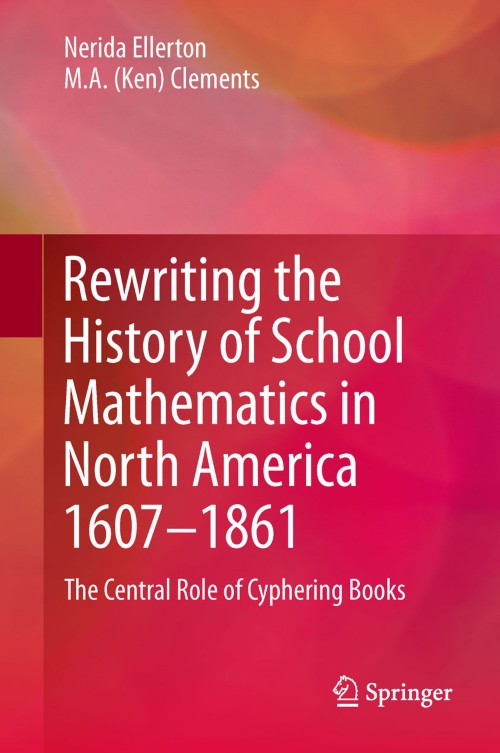
Rewriting the History of School Mathematics in North America 1607-1861 [electronic resource] : The Central Role of Cyphering Books / by Nerida Ellerton, M.A. (Ken) Clements.
Erişim Adresi
ISBN
9789400726390
Dil Kodu
İngilizce
Yer Numarası
DK/9430
Yazar
Basım Bildirimi
1st ed. 2012.
Yayın Bilgisi
Dordrecht : Springer Netherlands : Imprint: Springer, 2012.
Fiziksel Niteleme
XVIII, 226 p. online resource.
İçindekiler Notu
Preface -- Table of Contents -- List of Tables -- List of Figures -- Abstract -- Foreword (by Jeremy Kilpatrick) -- 1. The Historical Challenge -- 2. Development of a Tradition -- 3. Translating the Cyphering-Book Tradition to North America -- 4. Formulating the Research Questions -- 5. The Principal Data Set -- 6. Ending a 600-Year Tradition: The Demise of the Cypering-Book Approach -- 7. Conclusions, and some Final Comments -- References -- Appendices.
Özet, vb.
Two centuries ago, American teachers did not stand at the front of the room and teach, and most students—even those studying mathematics—did not own a mathematics textbook. Written examinations of any kind were not used. Most teachers of mathematics did not have formal qualifications in mathematics. The modern educator might well ask: “If all of that is true, then how were teachers expected to teach and how were students expected to learn mathematics?”
In this book Nerida Ellerton and Ken Clements argue that before 1840 mathematics was taught in North America via a cyphering approach that had been translated from Western Europe to the new settlements. This approach was based on a tradition that had endured since the thirteenth century, and depended heavily on students carefully writing their mathematics in cyphering books. After 1840, schools gradually adopted more teacher-centered whole-class pedagogies for mathematics instruction, and by the beginning of the Civil War, in 1861, the transformation was complete.
In his Foreword to this book, Jeremy Kilpatrick states:
“Ellerton and Clements show that the cyphering approach to learning mathematics has both an extensive history and a complex rationale. In the approach, the learner was to become an independent problem solver by learning to identify problems of various types, learning the rules for their solution, solving such problems, having each solution checked by a tutor or teacher and, only when the solution was correct, copying that solution into a cyphering book using exemplary calligraphy. The handwriting process was not meant to be only copying; it was to be an accompaniment to thinking. The learner was not simply inscribing the solution onto paper; he or she was inscribing it into memory. Cyphering books are a much neglected resource for understanding and appreciating the early history of NorthAmerican mathematics education. The present book marks a major advance in putting that resource to effective use as well as in raising some challenging questions for subsequent research.”
This book provides the first history of early North American school mathematics in which the implemented curriculum—as seen in cyphering books—takes center stage, while the intended curriculum—as evident in textbooks—provides contextual background for the main argument.
In this book Nerida Ellerton and Ken Clements argue that before 1840 mathematics was taught in North America via a cyphering approach that had been translated from Western Europe to the new settlements. This approach was based on a tradition that had endured since the thirteenth century, and depended heavily on students carefully writing their mathematics in cyphering books. After 1840, schools gradually adopted more teacher-centered whole-class pedagogies for mathematics instruction, and by the beginning of the Civil War, in 1861, the transformation was complete.
In his Foreword to this book, Jeremy Kilpatrick states:
“Ellerton and Clements show that the cyphering approach to learning mathematics has both an extensive history and a complex rationale. In the approach, the learner was to become an independent problem solver by learning to identify problems of various types, learning the rules for their solution, solving such problems, having each solution checked by a tutor or teacher and, only when the solution was correct, copying that solution into a cyphering book using exemplary calligraphy. The handwriting process was not meant to be only copying; it was to be an accompaniment to thinking. The learner was not simply inscribing the solution onto paper; he or she was inscribing it into memory. Cyphering books are a much neglected resource for understanding and appreciating the early history of NorthAmerican mathematics education. The present book marks a major advance in putting that resource to effective use as well as in raising some challenging questions for subsequent research.”
This book provides the first history of early North American school mathematics in which the implemented curriculum—as seen in cyphering books—takes center stage, while the intended curriculum—as evident in textbooks—provides contextual background for the main argument.
Konu
Mathematics __ Study and teaching .
Mathematics.
History.
Education __ Curricula.
Mathematics Education.
History of Mathematical Sciences.
Curriculum Studies.
History.
Mathematics.
History.
Education __ Curricula.
Mathematics Education.
History of Mathematical Sciences.
Curriculum Studies.
History.
Diğer Yazarlar
Kurum Adı
Eseri Alıntıla
Referansları kullanmadan önce gözden geçirmeniz ve varsa gerekli düzeltmeleri yapmanız önerilir.
Dijital Kaynak
MARC Görünümü
LEADER 04824nam a22005535i 4500
001 808138
003 TR_AnAIT
005 20260127005508
007 cr nn 008mamaa
008 120116s2012 ne | s |||| 0|eng d
020 |a9789400726390|9978-94-007-2639-0
024 7 |a10.1007/978-94-007-2639-0|2doi
041 |aeng
049 |aTürk Tarih Kurumu Kütüphanesi
050 4|aQA10.92-20
072 7|aJNU|2bicssc
072 7|aPB|2bicssc
072 7|aEDU029010|2bisacsh
072 7|aJNU|2thema
072 7|aPB|2thema
082 04|a510.71|223
090 |aDK/9430
100 1 |aEllerton, Nerida.|eauthor.|4aut|4http://id.loc.gov/vocabulary/relators/aut
245 10|aRewriting the History of School Mathematics in North America 1607-1861|h[electronic resource] :|bThe Central Role of Cyphering Books /|cby Nerida Ellerton, M.A. (Ken) Clements.
250 |a1st ed. 2012.
264 1|aDordrecht :|bSpringer Netherlands :|bImprint: Springer,|c2012.
300 |aXVIII, 226 p.|bonline resource.
336 |atext|btxt|2rdacontent
337 |acomputer|bc|2rdamedia
338 |aonline resource|bcr|2rdacarrier
347 |atext file|bPDF|2rda
505 0 |aPreface -- Table of Contents -- List of Tables -- List of Figures -- Abstract -- Foreword (by Jeremy Kilpatrick) -- 1. The Historical Challenge -- 2. Development of a Tradition -- 3. Translating the Cyphering-Book Tradition to North America -- 4. Formulating the Research Questions -- 5. The Principal Data Set -- 6. Ending a 600-Year Tradition: The Demise of the Cypering-Book Approach -- 7. Conclusions, and some Final Comments -- References -- Appendices.
520 |aTwo centuries ago, American teachers did not stand at the front of the room and teach, and most students—even those studying mathematics—did not own a mathematics textbook. Written examinations of any kind were not used. Most teachers of mathematics did not have formal qualifications in mathematics. The modern educator might well ask: “If all of that is true, then how were teachers expected to teach and how were students expected to learn mathematics?”
In this book Nerida Ellerton and Ken Clements argue that before 1840 mathematics was taught in North America via a cyphering approach that had been translated from Western Europe to the new settlements. This approach was based on a tradition that had endured since the thirteenth century, and depended heavily on students carefully writing their mathematics in cyphering books. After 1840, schools gradually adopted more teacher-centered whole-class pedagogies for mathematics instruction, and by the beginning of the Civil War, in 1861, the transformation was complete.
In his Foreword to this book, Jeremy Kilpatrick states:
“Ellerton and Clements show that the cyphering approach to learning mathematics has both an extensive history and a complex rationale. In the approach, the learner was to become an independent problem solver by learning to identify problems of various types, learning the rules for their solution, solving such problems, having each solution checked by a tutor or teacher and, only when the solution was correct, copying that solution into a cyphering book using exemplary calligraphy. The handwriting process was not meant to be only copying; it was to be an accompaniment to thinking. The learner was not simply inscribing the solution onto paper; he or she was inscribing it into memory. Cyphering books are a much neglected resource for understanding and appreciating the early history of NorthAmerican mathematics education. The present book marks a major advance in putting that resource to effective use as well as in raising some challenging questions for subsequent research.”
This book provides the first history of early North American school mathematics in which the implemented curriculum—as seen in cyphering books—takes center stage, while the intended curriculum—as evident in textbooks—provides contextual background for the main argument.
650 0|aMathematics|xStudy and teaching .
650 0|aMathematics.
650 0|aHistory.
650 0|aEducation|xCurricula.
650 14|aMathematics Education.
650 24|aHistory of Mathematical Sciences.
650 24|aCurriculum Studies.
650 24|aHistory.
700 1 |aClements, M.A. (Ken).|eauthor.|4aut|4http://id.loc.gov/vocabulary/relators/aut
710 2 |aSpringerLink (Online service)
773 0 |tSpringer Nature eBook
776 08|iPrinted edition:|z9789400726383
776 08|iPrinted edition:|z9789400726406
776 08|iPrinted edition:|z9789401780957
856 40|uhttps://doi.org/10.1007/978-94-007-2639-0
912 |aZDB-2-SHU
912 |aZDB-2-SXED
950 |aHumanities, Social Sciences and Law (SpringerNature-11648)
950 |aEducation (R0) (SpringerNature-43721)
001 808138
003 TR_AnAIT
005 20260127005508
007 cr nn 008mamaa
008 120116s2012 ne | s |||| 0|eng d
020 |a9789400726390|9978-94-007-2639-0
024 7 |a10.1007/978-94-007-2639-0|2doi
041 |aeng
049 |aTürk Tarih Kurumu Kütüphanesi
050 4|aQA10.92-20
072 7|aJNU|2bicssc
072 7|aPB|2bicssc
072 7|aEDU029010|2bisacsh
072 7|aJNU|2thema
072 7|aPB|2thema
082 04|a510.71|223
090 |aDK/9430
100 1 |aEllerton, Nerida.|eauthor.|4aut|4http://id.loc.gov/vocabulary/relators/aut
245 10|aRewriting the History of School Mathematics in North America 1607-1861|h[electronic resource] :|bThe Central Role of Cyphering Books /|cby Nerida Ellerton, M.A. (Ken) Clements.
250 |a1st ed. 2012.
264 1|aDordrecht :|bSpringer Netherlands :|bImprint: Springer,|c2012.
300 |aXVIII, 226 p.|bonline resource.
336 |atext|btxt|2rdacontent
337 |acomputer|bc|2rdamedia
338 |aonline resource|bcr|2rdacarrier
347 |atext file|bPDF|2rda
505 0 |aPreface -- Table of Contents -- List of Tables -- List of Figures -- Abstract -- Foreword (by Jeremy Kilpatrick) -- 1. The Historical Challenge -- 2. Development of a Tradition -- 3. Translating the Cyphering-Book Tradition to North America -- 4. Formulating the Research Questions -- 5. The Principal Data Set -- 6. Ending a 600-Year Tradition: The Demise of the Cypering-Book Approach -- 7. Conclusions, and some Final Comments -- References -- Appendices.
520 |aTwo centuries ago, American teachers did not stand at the front of the room and teach, and most students—even those studying mathematics—did not own a mathematics textbook. Written examinations of any kind were not used. Most teachers of mathematics did not have formal qualifications in mathematics. The modern educator might well ask: “If all of that is true, then how were teachers expected to teach and how were students expected to learn mathematics?”
In this book Nerida Ellerton and Ken Clements argue that before 1840 mathematics was taught in North America via a cyphering approach that had been translated from Western Europe to the new settlements. This approach was based on a tradition that had endured since the thirteenth century, and depended heavily on students carefully writing their mathematics in cyphering books. After 1840, schools gradually adopted more teacher-centered whole-class pedagogies for mathematics instruction, and by the beginning of the Civil War, in 1861, the transformation was complete.
In his Foreword to this book, Jeremy Kilpatrick states:
“Ellerton and Clements show that the cyphering approach to learning mathematics has both an extensive history and a complex rationale. In the approach, the learner was to become an independent problem solver by learning to identify problems of various types, learning the rules for their solution, solving such problems, having each solution checked by a tutor or teacher and, only when the solution was correct, copying that solution into a cyphering book using exemplary calligraphy. The handwriting process was not meant to be only copying; it was to be an accompaniment to thinking. The learner was not simply inscribing the solution onto paper; he or she was inscribing it into memory. Cyphering books are a much neglected resource for understanding and appreciating the early history of NorthAmerican mathematics education. The present book marks a major advance in putting that resource to effective use as well as in raising some challenging questions for subsequent research.”
This book provides the first history of early North American school mathematics in which the implemented curriculum—as seen in cyphering books—takes center stage, while the intended curriculum—as evident in textbooks—provides contextual background for the main argument.
650 0|aMathematics|xStudy and teaching .
650 0|aMathematics.
650 0|aHistory.
650 0|aEducation|xCurricula.
650 14|aMathematics Education.
650 24|aHistory of Mathematical Sciences.
650 24|aCurriculum Studies.
650 24|aHistory.
700 1 |aClements, M.A. (Ken).|eauthor.|4aut|4http://id.loc.gov/vocabulary/relators/aut
710 2 |aSpringerLink (Online service)
773 0 |tSpringer Nature eBook
776 08|iPrinted edition:|z9789400726383
776 08|iPrinted edition:|z9789400726406
776 08|iPrinted edition:|z9789401780957
856 40|uhttps://doi.org/10.1007/978-94-007-2639-0
912 |aZDB-2-SHU
912 |aZDB-2-SXED
950 |aHumanities, Social Sciences and Law (SpringerNature-11648)
950 |aEducation (R0) (SpringerNature-43721)
Materyaller
Depodan talep edilen materyal sadece kütüphane içerisinde kullanılmaktadır.
Materyal dışarıya ödünç verilmemektedir.
Materyal dışarıya ödünç verilmemektedir.
