LEADER 03411nam a22004935i 4500
001 808164
003 TR_AnAIT
005 20260127005536
007 cr nn 008mamaa
008 130727s2011 ne | s |||| 0|eng d
020 |a9789400717398|9978-94-007-1739-8
024 7 |a10.1007/978-94-007-1739-8|2doi
041 |aeng
049 |aTürk Tarih Kurumu Kütüphanesi
050 4|aQA10.92-20
072 7|aJNU|2bicssc
072 7|aPB|2bicssc
072 7|aEDU029010|2bisacsh
072 7|aJNU|2thema
072 7|aPB|2thema
082 04|a510.71|223
090 |aDK/9456
100 1 |aBrown, Tony.|eauthor.|4aut|4http://id.loc.gov/vocabulary/relators/aut
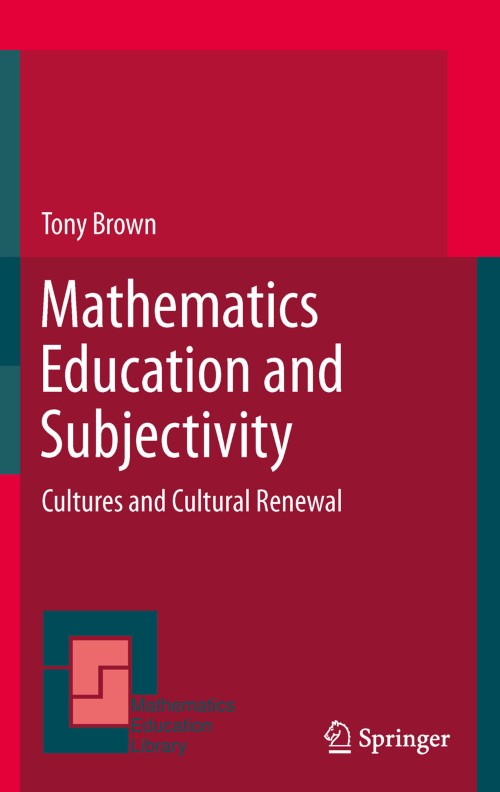
245 10|aMathematics Education and Subjectivity|h[electronic resource] :|bCultures and Cultural Renewal /|cby Tony Brown.
250 |a1st ed. 2011.
264 1|aDordrecht :|bSpringer Netherlands :|bImprint: Springer,|c2011.
300 |aXI, 216 p.|bonline resource.
336 |atext|btxt|2rdacontent
337 |acomputer|bc|2rdamedia
338 |aonline resource|bcr|2rdacarrier
347 |atext file|bPDF|2rda
490 1 |aMathematics Education Library,|x2214-983X ;|v51
505 0 |aAbout the author. - Acknowledgements. - 1 Introduction. – 2 The regulation of spatial perception -- 3 Cultural mediation of mathematics -- 4 Teacher conceptions of curriculum. 5 Subjectivity in mathematics education research -- 6 Lacanian subject of mathematical learning -- 7 The cultural renewal of mathematical learning -- 8 The political shaping of mathematical learning -- 9 Concluding remarks -- References -- Index.
520 |aThis book rethinks mathematical teaching and learning with view to changing them to meet or resist emerging demands. Through considering how teachers, students and researchers make sense of their worlds, the book explores how some linguistic and socio-cultural locations link to prevalent conceptions of mathematics education. The locations include classroom mathematics, spatial awareness, media images of mathematics, curriculum development, teacher education and mathematics education research itself. The book introduces cutting edge theories of subjectivity that trouble more familiar psychological theories of “humans” apprehending mathematical “concepts”. Rather, it suggests that our senses of self and of mathematics result from self-reflections within the various localities in which we live. In foregrounding subjectivity the book shows how mathematics can provoke alternative ways of thinking towards enlivening our transformative capacities. Learning itself is depicted as participation in cultural renewal, where the very mathematics encountered is becoming something new. Addressing teachers, teacher educators and researchers, the book invites the reader to contemplate alternative trajectories of change into fresh ways of being.
650 0|aMathematics|xStudy and teaching .
650 14|aMathematics Education.
710 2 |aSpringerLink (Online service)
773 0 |tSpringer Nature eBook
776 08|iPrinted edition:|z9789400717381
776 08|iPrinted edition:|z9789400717404
776 08|iPrinted edition:|z9789400737440
830 0|aMathematics Education Library,|x2214-983X ;|v51
856 40|uhttps://doi.org/10.1007/978-94-007-1739-8
912 |aZDB-2-SHU
912 |aZDB-2-SXED
950 |aHumanities, Social Sciences and Law (SpringerNature-11648)
950 |aEducation (R0) (SpringerNature-43721)