

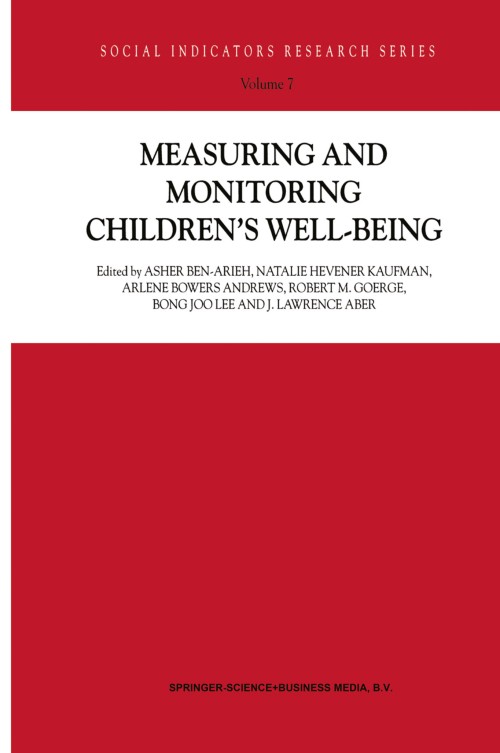
Measuring and Monitoring Children’s Well-Being [electronic resource] / by Asher Ben-Arieh, Natalie Hevener Kaufman, Arlene Bowers Andrews, Robert M. George, Bong Joo Lee, L. J. Aber.
Erişim Adresi
ISBN
9789401722292
Dil Kodu
İngilizce
Yer Numarası
DK/9469
Yazar
Basım Bildirimi
1st ed. 2001.
Yayın Bilgisi
Dordrecht : Springer Netherlands : Imprint: Springer, 2001.
Fiziksel Niteleme
XXIV, 159 p. online resource.
Dizi
Social Indicators Research Series, 2215-0099 ; 7
İçindekiler Notu
1: The Rationale for Measuring and Monitoring Children’s Well-Being -- 2: Existing Efforts Around the World -- 3: Underlying Assumptions and Basic Guidelines for Measuirng and Monitoring Children’s Well-Being -- 4: Five “New” Domains of Children’s Well-Being -- 5: Possible Indicators of Children’s Well-Being -- 6: How to Measure and Monitor Children’s Well-Being -- 7: Measuring and Monitoring Children’s Well-Being at the Community Level -- 8: Measuring and Monitoring Children’s Well-Being and the Making of Policy -- 9: Summary and Agenda for the Future -- Appendix 1: State of the Child Reports -- Appendix 2: Members of the International Project -- Reference.
Özet, vb.
Today, any regular newspaper reader is likely to be exposed to reports on manifold forms of (physical, emotional, sexual) child abuse on the one hand, and abnormal behavior, misconduct or offences of children and minors on the other hand. Occasionally reports on children as victims and children as offenders may appear on the same issue or even the same page. Rather seldom the more complex and largely hidden phenomena of structural hostility or indifference of society with a view to children are being dealt with in the press. Such fragmentary, ambiguous, incoherent or even contradictory perception of children in modem society indicates that, firstly, there is a lack of reliable information on modem childhood, and secondly, children are still treated as a comparatively irrelevant population group in society. This conclusion may be surprising in particular when drawn at the end of The Century of the Child proclaimed by Ellen Key as early as 1902. Actually, there exist unclarities and ambiguities about the evolution of childhood in the last century not only in public opinion, but also in scientific literature. While De Mause with his psycho-historic model of the evolution of childhood, comprising different stages from infanticide, abandonment, ambivalence, intrusion, socialisation to support, underlines the continuous improvement of the condition of childhood throughout history and thus rather confirms Key's expectations, Aries, with his social history of childhood, seems to hold a more culturally pessimistic view.
Konu
Sociology.
Quality of life.
Social service.
Personality.
Difference (Psychology).
International law.
Sociology.
Quality of Life Research.
Social Work.
Personality and Differential Psychology.
Public International Law.
Quality of life.
Social service.
Personality.
Difference (Psychology).
International law.
Sociology.
Quality of Life Research.
Social Work.
Personality and Differential Psychology.
Public International Law.
Diğer Yazarlar
Kurum Adı
Eseri Alıntıla
Referansları kullanmadan önce gözden geçirmeniz ve varsa gerekli düzeltmeleri yapmanız önerilir.
Dijital Kaynak
MARC Görünümü
LEADER 05580nam a22007215i 4500
001 808177
003 TR_AnAIT
005 20260127005551
007 cr nn 008mamaa
008 130125s2001 ne | s |||| 0|eng d
020 |a9789401722292|9978-94-017-2229-2
024 7 |a10.1007/978-94-017-2229-2|2doi
041 |aeng
049 |aTürk Tarih Kurumu Kütüphanesi
050 4|aHM
072 7|aJHB|2bicssc
072 7|aJHB|2bicssc
072 7|aSOC026000|2bisacsh
072 7|aJHB|2thema
072 7|aJHB|2thema
082 04|a301|223
090 |aDK/9469
100 1 |aBen-Arieh, Asher.|eauthor.|4aut|4http://id.loc.gov/vocabulary/relators/aut
245 10|aMeasuring and Monitoring Children’s Well-Being|h[electronic resource] /|cby Asher Ben-Arieh, Natalie Hevener Kaufman, Arlene Bowers Andrews, Robert M. George, Bong Joo Lee, L. J. Aber.
250 |a1st ed. 2001.
264 1|aDordrecht :|bSpringer Netherlands :|bImprint: Springer,|c2001.
300 |aXXIV, 159 p.|bonline resource.
336 |atext|btxt|2rdacontent
337 |acomputer|bc|2rdamedia
338 |aonline resource|bcr|2rdacarrier
347 |atext file|bPDF|2rda
490 1 |aSocial Indicators Research Series,|x2215-0099 ;|v7
505 0 |a1: The Rationale for Measuring and Monitoring Children’s Well-Being -- 2: Existing Efforts Around the World -- 3: Underlying Assumptions and Basic Guidelines for Measuirng and Monitoring Children’s Well-Being -- 4: Five “New” Domains of Children’s Well-Being -- 5: Possible Indicators of Children’s Well-Being -- 6: How to Measure and Monitor Children’s Well-Being -- 7: Measuring and Monitoring Children’s Well-Being at the Community Level -- 8: Measuring and Monitoring Children’s Well-Being and the Making of Policy -- 9: Summary and Agenda for the Future -- Appendix 1: State of the Child Reports -- Appendix 2: Members of the International Project -- Reference.
520 |aToday, any regular newspaper reader is likely to be exposed to reports on manifold forms of (physical, emotional, sexual) child abuse on the one hand, and abnormal behavior, misconduct or offences of children and minors on the other hand. Occasionally reports on children as victims and children as offenders may appear on the same issue or even the same page. Rather seldom the more complex and largely hidden phenomena of structural hostility or indifference of society with a view to children are being dealt with in the press. Such fragmentary, ambiguous, incoherent or even contradictory perception of children in modem society indicates that, firstly, there is a lack of reliable information on modem childhood, and secondly, children are still treated as a comparatively irrelevant population group in society. This conclusion may be surprising in particular when drawn at the end of The Century of the Child proclaimed by Ellen Key as early as 1902. Actually, there exist unclarities and ambiguities about the evolution of childhood in the last century not only in public opinion, but also in scientific literature. While De Mause with his psycho-historic model of the evolution of childhood, comprising different stages from infanticide, abandonment, ambivalence, intrusion, socialisation to support, underlines the continuous improvement of the condition of childhood throughout history and thus rather confirms Key's expectations, Aries, with his social history of childhood, seems to hold a more culturally pessimistic view.
532 8 |aAccessibility summary: This PDF is not accessible. It is based on scanned pages and does not support features such as screen reader compatibility or described non-text content (images, graphs etc). However, it likely supports searchable and selectable text based on OCR (Optical Character Recognition). Users with accessibility needs may not be able to use this content effectively. Please contact us at accessibilitysupport@springernature.com if you require assistance or an alternative format.
532 8 |aInaccessible, or known limited accessibility
532 8 |aNo reading system accessibility options actively disabled
532 8 |aPublisher contact for further accessibility information: accessibilitysupport@springernature.com
650 0|aSociology.
650 0|aQuality of life.
650 0|aSocial service.
650 0|aPersonality.
650 0|aDifference (Psychology).
650 0|aInternational law.
650 14|aSociology.
650 24|aQuality of Life Research.
650 24|aSocial Work.
650 24|aPersonality and Differential Psychology.
650 24|aPublic International Law.
700 1 |aKaufman, Natalie Hevener.|eauthor.|4aut|4http://id.loc.gov/vocabulary/relators/aut
700 1 |aAndrews, Arlene Bowers.|eauthor.|4aut|4http://id.loc.gov/vocabulary/relators/aut
700 1 |aGeorge, Robert M.|eauthor.|4aut|4http://id.loc.gov/vocabulary/relators/aut
700 1 |aBong Joo Lee.|eauthor.|4aut|4http://id.loc.gov/vocabulary/relators/aut
700 1 |aAber, L. J.|eauthor.|4aut|4http://id.loc.gov/vocabulary/relators/aut
710 2 |aSpringerLink (Online service)
773 0 |tSpringer Nature eBook
776 08|iPrinted edition:|z9780792367895
776 08|iPrinted edition:|z9789048156429
776 08|iPrinted edition:|z9789401722308
830 0|aSocial Indicators Research Series,|x2215-0099 ;|v7
856 40|uhttps://doi.org/10.1007/978-94-017-2229-2
912 |aZDB-2-SHU
912 |aZDB-2-SXS
912 |aZDB-2-BAE
950 |aHumanities, Social Sciences and Law (SpringerNature-11648)
950 |aSocial Sciences (R0) (SpringerNature-43726)
001 808177
003 TR_AnAIT
005 20260127005551
007 cr nn 008mamaa
008 130125s2001 ne | s |||| 0|eng d
020 |a9789401722292|9978-94-017-2229-2
024 7 |a10.1007/978-94-017-2229-2|2doi
041 |aeng
049 |aTürk Tarih Kurumu Kütüphanesi
050 4|aHM
072 7|aJHB|2bicssc
072 7|aJHB|2bicssc
072 7|aSOC026000|2bisacsh
072 7|aJHB|2thema
072 7|aJHB|2thema
082 04|a301|223
090 |aDK/9469
100 1 |aBen-Arieh, Asher.|eauthor.|4aut|4http://id.loc.gov/vocabulary/relators/aut
245 10|aMeasuring and Monitoring Children’s Well-Being|h[electronic resource] /|cby Asher Ben-Arieh, Natalie Hevener Kaufman, Arlene Bowers Andrews, Robert M. George, Bong Joo Lee, L. J. Aber.
250 |a1st ed. 2001.
264 1|aDordrecht :|bSpringer Netherlands :|bImprint: Springer,|c2001.
300 |aXXIV, 159 p.|bonline resource.
336 |atext|btxt|2rdacontent
337 |acomputer|bc|2rdamedia
338 |aonline resource|bcr|2rdacarrier
347 |atext file|bPDF|2rda
490 1 |aSocial Indicators Research Series,|x2215-0099 ;|v7
505 0 |a1: The Rationale for Measuring and Monitoring Children’s Well-Being -- 2: Existing Efforts Around the World -- 3: Underlying Assumptions and Basic Guidelines for Measuirng and Monitoring Children’s Well-Being -- 4: Five “New” Domains of Children’s Well-Being -- 5: Possible Indicators of Children’s Well-Being -- 6: How to Measure and Monitor Children’s Well-Being -- 7: Measuring and Monitoring Children’s Well-Being at the Community Level -- 8: Measuring and Monitoring Children’s Well-Being and the Making of Policy -- 9: Summary and Agenda for the Future -- Appendix 1: State of the Child Reports -- Appendix 2: Members of the International Project -- Reference.
520 |aToday, any regular newspaper reader is likely to be exposed to reports on manifold forms of (physical, emotional, sexual) child abuse on the one hand, and abnormal behavior, misconduct or offences of children and minors on the other hand. Occasionally reports on children as victims and children as offenders may appear on the same issue or even the same page. Rather seldom the more complex and largely hidden phenomena of structural hostility or indifference of society with a view to children are being dealt with in the press. Such fragmentary, ambiguous, incoherent or even contradictory perception of children in modem society indicates that, firstly, there is a lack of reliable information on modem childhood, and secondly, children are still treated as a comparatively irrelevant population group in society. This conclusion may be surprising in particular when drawn at the end of The Century of the Child proclaimed by Ellen Key as early as 1902. Actually, there exist unclarities and ambiguities about the evolution of childhood in the last century not only in public opinion, but also in scientific literature. While De Mause with his psycho-historic model of the evolution of childhood, comprising different stages from infanticide, abandonment, ambivalence, intrusion, socialisation to support, underlines the continuous improvement of the condition of childhood throughout history and thus rather confirms Key's expectations, Aries, with his social history of childhood, seems to hold a more culturally pessimistic view.
532 8 |aAccessibility summary: This PDF is not accessible. It is based on scanned pages and does not support features such as screen reader compatibility or described non-text content (images, graphs etc). However, it likely supports searchable and selectable text based on OCR (Optical Character Recognition). Users with accessibility needs may not be able to use this content effectively. Please contact us at accessibilitysupport@springernature.com if you require assistance or an alternative format.
532 8 |aInaccessible, or known limited accessibility
532 8 |aNo reading system accessibility options actively disabled
532 8 |aPublisher contact for further accessibility information: accessibilitysupport@springernature.com
650 0|aSociology.
650 0|aQuality of life.
650 0|aSocial service.
650 0|aPersonality.
650 0|aDifference (Psychology).
650 0|aInternational law.
650 14|aSociology.
650 24|aQuality of Life Research.
650 24|aSocial Work.
650 24|aPersonality and Differential Psychology.
650 24|aPublic International Law.
700 1 |aKaufman, Natalie Hevener.|eauthor.|4aut|4http://id.loc.gov/vocabulary/relators/aut
700 1 |aAndrews, Arlene Bowers.|eauthor.|4aut|4http://id.loc.gov/vocabulary/relators/aut
700 1 |aGeorge, Robert M.|eauthor.|4aut|4http://id.loc.gov/vocabulary/relators/aut
700 1 |aBong Joo Lee.|eauthor.|4aut|4http://id.loc.gov/vocabulary/relators/aut
700 1 |aAber, L. J.|eauthor.|4aut|4http://id.loc.gov/vocabulary/relators/aut
710 2 |aSpringerLink (Online service)
773 0 |tSpringer Nature eBook
776 08|iPrinted edition:|z9780792367895
776 08|iPrinted edition:|z9789048156429
776 08|iPrinted edition:|z9789401722308
830 0|aSocial Indicators Research Series,|x2215-0099 ;|v7
856 40|uhttps://doi.org/10.1007/978-94-017-2229-2
912 |aZDB-2-SHU
912 |aZDB-2-SXS
912 |aZDB-2-BAE
950 |aHumanities, Social Sciences and Law (SpringerNature-11648)
950 |aSocial Sciences (R0) (SpringerNature-43726)
Materyaller
Depodan talep edilen materyal sadece kütüphane içerisinde kullanılmaktadır.
Materyal dışarıya ödünç verilmemektedir.
Materyal dışarıya ödünç verilmemektedir.
