LEADER 03732nam a22004695i 4500
001 808181
003 TR_AnAIT
005 20260127005555
007 cr nn 008mamaa
008 120216s2012 ne | s |||| 0|eng d
020 |a9789400728431|9978-94-007-2843-1
024 7 |a10.1007/978-94-007-2843-1|2doi
041 |aeng
049 |aTürk Tarih Kurumu Kütüphanesi
050 4|aJA1-92
072 7|aJPA|2bicssc
072 7|aPOL000000|2bisacsh
072 7|aJPA|2thema
082 04|a320|223
090 |aDK/9473
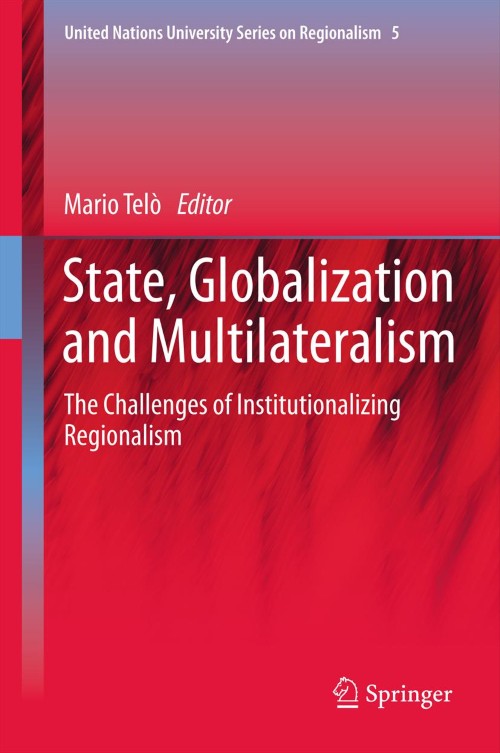
245 10|aState, Globalization and Multilateralism|h[electronic resource] :|bThe challenges of institutionalizing regionalism /|cedited by Mario Telò.
250 |a1st ed. 2012.
264 1|aDordrecht :|bSpringer Netherlands :|bImprint: Springer,|c2012.
300 |aXVI, 188 p.|bonline resource.
336 |atext|btxt|2rdacontent
337 |acomputer|bc|2rdamedia
338 |aonline resource|bcr|2rdacarrier
347 |atext file|bPDF|2rda
490 1 |aUnited Nations University Series on Regionalism,|x2214-9856 ;|v5
505 0 |aTable of Contents -- List of Acrnyms -- Introduction; Mario Telò -- 1. State and multilateralism: system change, diversities and challenges -- State and Multilateralism: History and Perspectives; Mario Telò -- State, Regionalism and global governance: the theoretical debate from the opening of the Berlin wall to the economic crisis; Andrew Gamble -- Economic Multilateralism: A Search for Legitimacy and Coherence in the 21st Century; Richard Higgot -- International Responsibility, Multilateralism and China Foreign Policy; Chen Zhinim.- 2. Globalization and the Transformation of the State: The Theoretical Debate.- The State and Political Economic Change: Beyond Rational Choice and Historical Institutionalism to Discursive Institutionalism; Vivien A. Schmidt -- Globalization, Regionalization and Stateness; Thomas Meyer -- The Rise of Executive Sovereignty in the Era of Globalization; Andreas Vasilache.- Conclusion, State and New Multilateralism in a Multipolar World; Mario Telò -- Bibliography.
520 |aThis volume presents a reconsideration of the concepts of State and political power within the evolving multilateral network of cooperation and conflict. By means of an innovating research strategy, it explains state resilience within global and regional governance while deepening the transformation of the traditional sovereign state concepts, including by emerging powers. Rather than considering the EU as an isolated case study, the book considers the EU as both a reference and a proactive player, which fosters a new research agenda both for comparative studies on regional cooperation and political theory. Lastly, in view of the currently emergent, unprecedented and asymmetrical, ‘multi-polar’ world, and of several forms of continent and instrumental multilateral cooperation, it considers the need for putting regionalism and democratic legitimacy at the very core of a normative and institutionalist research agenda for a ''new multilateralism''.
650 0|aPolitical science.
650 14|aPolitical Science.
700 1 |aTelò, Mario.|eeditor.|4edt|4http://id.loc.gov/vocabulary/relators/edt
710 2 |aSpringerLink (Online service)
773 0 |tSpringer Nature eBook
776 08|iPrinted edition:|z9789400728448
776 08|iPrinted edition:|z9789400728424
776 08|iPrinted edition:|z9789400798519
830 0|aUnited Nations University Series on Regionalism,|x2214-9856 ;|v5
856 40|uhttps://doi.org/10.1007/978-94-007-2843-1
912 |aZDB-2-SHU
912 |aZDB-2-SXPI
950 |aHumanities, Social Sciences and Law (SpringerNature-11648)
950 |aPolitical Science and International Studies (R0) (SpringerNature-43724)