

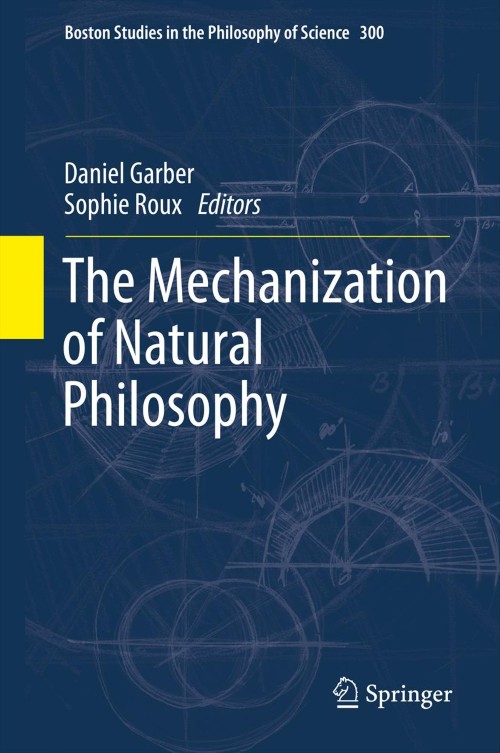
The Mechanization of Natural Philosophy [electronic resource] / by Sophie Roux ; edited by DAN GARBER.
Erişim Adresi
ISBN
9789400743458
Dil Kodu
İngilizce
Yer Numarası
DK/9476
Yazar
Basım Bildirimi
1st ed. 2013.
Yayın Bilgisi
Dordrecht : Springer Netherlands : Imprint: Springer, 2013.
Fiziksel Niteleme
XVIII, 342 p. online resource.
Dizi
Boston Studies in the Philosophy and History of Science, 2214-7942 ; 300
İçindekiler Notu
Preface -- List of Contributors -- Introduction Daniel Garber and Sophie Roux -- 1. The Construction of Historical Categories Remarks on the Pre-History of the Mechanical Philosophy Daniel Garber -- How Bacon Became Baconian Guido Giglioni -- An Empire Divided: French Natural Philosophy (1670–1690) Sophie Roux -- 2. Matter, Motion, Physics and Mathematics Matter and Form in Sixteenth-Century Spain: Some Case Studies Victor Navarro Brotons -- The Isomorphism of Space, Time and Matter in Seventeenth-Century Natural Philosophy Carla Rita Palmerino -- Beeckman, Descartes and Physico-mathematics Frédéric de Buzon -- Between Mathematics and Experimental Philosophy: Hydrostatics in Scotland about 1700 Antoni Malet -- 3. Mechanical Philosophy Applied From a Metaphysical to a Scientific Object: Mechanizing Light in Galilean Science Susana Gómez -- Causation in Descartes’ Les Météores and Late Renaissance Aristotelian Meteorology Craig Martin -- Descartes’ Healthy Machines and the Human Exception Gideon Manning -- Mechanism and Surgery: Dionis' Anatomy (1690) Jacques Lambert -- Du Clos and the Mechanization of Chemical Philosophy Rémi Franckowiak -- Bibliography -- Author Index. .
Özet, vb.
The Mechanisation of Natural Philosophy is devoted to various aspects of the transformation of natural philosophy during the 16th and 17th centuries that is usually described as mechanical philosophy . Drawing the border between the old Aristotelianism and the « new » mechanical philosophy faces historians with a delicate task, if not an impossible mission. There were many natural philosophers who actually crossed the border between the two worlds, and, inside each of these worlds, there was a vast spectrum of doctrines, arguments and intellectual practices. The expression mechanical philosophy is burdened with ambiguities. It may refer to at least three different enterprises: a description of nature in mathematical terms; the comparison of natural phenomena to existing or imaginary machines; the use in natural philosophy of mechanical analogies, i.e. analogies conceived in terms of matter and motion alone.However mechanical philosophy is defined, its ambition was greater than its real successes. There were few mathematisations of phenomena. The machines of mechanical philosophers were not only imaginary, but had little to do with the machines of mecanicians. In most of the natural sciences, analogies in terms of matter and motion alone failed to provide satisfactory accounts of phenomena.By the same authors: Mechanics and Natural Philosophy before the Scientific Revolution (Boston Studies in the Philosophy of Science 254).
Konu
Science __ Philosophy.
Biology __ Philosophy.
Philosophy __ History.
Philosophy of nature.
Philosophy of Science.
Philosophy of Biology.
History of Philosophy.
Philosophy of Nature.
Biology __ Philosophy.
Philosophy __ History.
Philosophy of nature.
Philosophy of Science.
Philosophy of Biology.
History of Philosophy.
Philosophy of Nature.
Diğer Yazarlar
Kurum Adı
Eseri Alıntıla
Referansları kullanmadan önce gözden geçirmeniz ve varsa gerekli düzeltmeleri yapmanız önerilir.
Dijital Kaynak
MARC Görünümü
LEADER 04714nam a22005655i 4500
001 808184
003 TR_AnAIT
005 20260127005559
007 cr nn 008mamaa
008 120928s2013 ne | s |||| 0|eng d
020 |a9789400743458|9978-94-007-4345-8
024 7 |a10.1007/978-94-007-4345-8|2doi
041 |aeng
049 |aTürk Tarih Kurumu Kütüphanesi
050 4|aQ174-175.3
050 4|aB67
072 7|aPDA|2bicssc
072 7|aSCI075000|2bisacsh
072 7|aPDA|2thema
082 04|a501|223
090 |aDK/9476
100 1 |aRoux, Sophie.|eauthor.|4aut|4http://id.loc.gov/vocabulary/relators/aut
245 14|aThe Mechanization of Natural Philosophy|h[electronic resource] /|cby Sophie Roux ; edited by DAN GARBER.
250 |a1st ed. 2013.
264 1|aDordrecht :|bSpringer Netherlands :|bImprint: Springer,|c2013.
300 |aXVIII, 342 p.|bonline resource.
336 |atext|btxt|2rdacontent
337 |acomputer|bc|2rdamedia
338 |aonline resource|bcr|2rdacarrier
347 |atext file|bPDF|2rda
490 1 |aBoston Studies in the Philosophy and History of Science,|x2214-7942 ;|v300
505 0 |a Preface -- List of Contributors -- Introduction Daniel Garber and Sophie Roux -- 1. The Construction of Historical Categories Remarks on the Pre-History of the Mechanical Philosophy Daniel Garber -- How Bacon Became Baconian Guido Giglioni -- An Empire Divided: French Natural Philosophy (1670–1690) Sophie Roux -- 2. Matter, Motion, Physics and Mathematics Matter and Form in Sixteenth-Century Spain: Some Case Studies Victor Navarro Brotons -- The Isomorphism of Space, Time and Matter in Seventeenth-Century Natural Philosophy Carla Rita Palmerino -- Beeckman, Descartes and Physico-mathematics Frédéric de Buzon -- Between Mathematics and Experimental Philosophy: Hydrostatics in Scotland about 1700 Antoni Malet -- 3. Mechanical Philosophy Applied From a Metaphysical to a Scientific Object: Mechanizing Light in Galilean Science Susana Gómez -- Causation in Descartes’ Les Météores and Late Renaissance Aristotelian Meteorology Craig Martin -- Descartes’ Healthy Machines and the Human Exception Gideon Manning -- Mechanism and Surgery: Dionis' Anatomy (1690) Jacques Lambert -- Du Clos and the Mechanization of Chemical Philosophy Rémi Franckowiak -- Bibliography -- Author Index. .
520 |aThe Mechanisation of Natural Philosophy is devoted to various aspects of the transformation of natural philosophy during the 16th and 17th centuries that is usually described as mechanical philosophy . Drawing the border between the old Aristotelianism and the « new » mechanical philosophy faces historians with a delicate task, if not an impossible mission. There were many natural philosophers who actually crossed the border between the two worlds, and, inside each of these worlds, there was a vast spectrum of doctrines, arguments and intellectual practices. The expression mechanical philosophy is burdened with ambiguities. It may refer to at least three different enterprises: a description of nature in mathematical terms; the comparison of natural phenomena to existing or imaginary machines; the use in natural philosophy of mechanical analogies, i.e. analogies conceived in terms of matter and motion alone.However mechanical philosophy is defined, its ambition was greater than its real successes. There were few mathematisations of phenomena. The machines of mechanical philosophers were not only imaginary, but had little to do with the machines of mecanicians. In most of the natural sciences, analogies in terms of matter and motion alone failed to provide satisfactory accounts of phenomena.By the same authors: Mechanics and Natural Philosophy before the Scientific Revolution (Boston Studies in the Philosophy of Science 254).
650 0|aScience|xPhilosophy.
650 0|aBiology|xPhilosophy.
650 0|aPhilosophy|xHistory.
650 0|aPhilosophy of nature.
650 14|aPhilosophy of Science.
650 24|aPhilosophy of Biology.
650 24|aHistory of Philosophy.
650 24|aPhilosophy of Nature.
700 1 |aGARBER, DAN.|eeditor.|4edt|4http://id.loc.gov/vocabulary/relators/edt
710 2 |aSpringerLink (Online service)
773 0 |tSpringer Nature eBook
776 08|iPrinted edition:|z9789400743441
776 08|iPrinted edition:|z9789400743465
776 08|iPrinted edition:|z9789400798786
830 0|aBoston Studies in the Philosophy and History of Science,|x2214-7942 ;|v300
856 40|uhttps://doi.org/10.1007/978-94-007-4345-8
912 |aZDB-2-SHU
912 |aZDB-2-SXPR
950 |aHumanities, Social Sciences and Law (SpringerNature-11648)
950 |aPhilosophy and Religion (R0) (SpringerNature-43725)
001 808184
003 TR_AnAIT
005 20260127005559
007 cr nn 008mamaa
008 120928s2013 ne | s |||| 0|eng d
020 |a9789400743458|9978-94-007-4345-8
024 7 |a10.1007/978-94-007-4345-8|2doi
041 |aeng
049 |aTürk Tarih Kurumu Kütüphanesi
050 4|aQ174-175.3
050 4|aB67
072 7|aPDA|2bicssc
072 7|aSCI075000|2bisacsh
072 7|aPDA|2thema
082 04|a501|223
090 |aDK/9476
100 1 |aRoux, Sophie.|eauthor.|4aut|4http://id.loc.gov/vocabulary/relators/aut
245 14|aThe Mechanization of Natural Philosophy|h[electronic resource] /|cby Sophie Roux ; edited by DAN GARBER.
250 |a1st ed. 2013.
264 1|aDordrecht :|bSpringer Netherlands :|bImprint: Springer,|c2013.
300 |aXVIII, 342 p.|bonline resource.
336 |atext|btxt|2rdacontent
337 |acomputer|bc|2rdamedia
338 |aonline resource|bcr|2rdacarrier
347 |atext file|bPDF|2rda
490 1 |aBoston Studies in the Philosophy and History of Science,|x2214-7942 ;|v300
505 0 |a Preface -- List of Contributors -- Introduction Daniel Garber and Sophie Roux -- 1. The Construction of Historical Categories Remarks on the Pre-History of the Mechanical Philosophy Daniel Garber -- How Bacon Became Baconian Guido Giglioni -- An Empire Divided: French Natural Philosophy (1670–1690) Sophie Roux -- 2. Matter, Motion, Physics and Mathematics Matter and Form in Sixteenth-Century Spain: Some Case Studies Victor Navarro Brotons -- The Isomorphism of Space, Time and Matter in Seventeenth-Century Natural Philosophy Carla Rita Palmerino -- Beeckman, Descartes and Physico-mathematics Frédéric de Buzon -- Between Mathematics and Experimental Philosophy: Hydrostatics in Scotland about 1700 Antoni Malet -- 3. Mechanical Philosophy Applied From a Metaphysical to a Scientific Object: Mechanizing Light in Galilean Science Susana Gómez -- Causation in Descartes’ Les Météores and Late Renaissance Aristotelian Meteorology Craig Martin -- Descartes’ Healthy Machines and the Human Exception Gideon Manning -- Mechanism and Surgery: Dionis' Anatomy (1690) Jacques Lambert -- Du Clos and the Mechanization of Chemical Philosophy Rémi Franckowiak -- Bibliography -- Author Index. .
520 |aThe Mechanisation of Natural Philosophy is devoted to various aspects of the transformation of natural philosophy during the 16th and 17th centuries that is usually described as mechanical philosophy . Drawing the border between the old Aristotelianism and the « new » mechanical philosophy faces historians with a delicate task, if not an impossible mission. There were many natural philosophers who actually crossed the border between the two worlds, and, inside each of these worlds, there was a vast spectrum of doctrines, arguments and intellectual practices. The expression mechanical philosophy is burdened with ambiguities. It may refer to at least three different enterprises: a description of nature in mathematical terms; the comparison of natural phenomena to existing or imaginary machines; the use in natural philosophy of mechanical analogies, i.e. analogies conceived in terms of matter and motion alone.However mechanical philosophy is defined, its ambition was greater than its real successes. There were few mathematisations of phenomena. The machines of mechanical philosophers were not only imaginary, but had little to do with the machines of mecanicians. In most of the natural sciences, analogies in terms of matter and motion alone failed to provide satisfactory accounts of phenomena.By the same authors: Mechanics and Natural Philosophy before the Scientific Revolution (Boston Studies in the Philosophy of Science 254).
650 0|aScience|xPhilosophy.
650 0|aBiology|xPhilosophy.
650 0|aPhilosophy|xHistory.
650 0|aPhilosophy of nature.
650 14|aPhilosophy of Science.
650 24|aPhilosophy of Biology.
650 24|aHistory of Philosophy.
650 24|aPhilosophy of Nature.
700 1 |aGARBER, DAN.|eeditor.|4edt|4http://id.loc.gov/vocabulary/relators/edt
710 2 |aSpringerLink (Online service)
773 0 |tSpringer Nature eBook
776 08|iPrinted edition:|z9789400743441
776 08|iPrinted edition:|z9789400743465
776 08|iPrinted edition:|z9789400798786
830 0|aBoston Studies in the Philosophy and History of Science,|x2214-7942 ;|v300
856 40|uhttps://doi.org/10.1007/978-94-007-4345-8
912 |aZDB-2-SHU
912 |aZDB-2-SXPR
950 |aHumanities, Social Sciences and Law (SpringerNature-11648)
950 |aPhilosophy and Religion (R0) (SpringerNature-43725)
Materyaller
Depodan talep edilen materyal sadece kütüphane içerisinde kullanılmaktadır.
Materyal dışarıya ödünç verilmemektedir.
Materyal dışarıya ödünç verilmemektedir.
