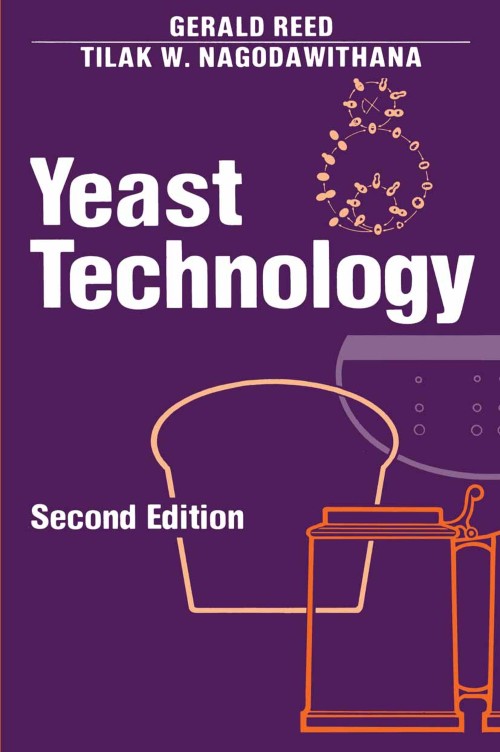
Yeast technology [electronic resource] / edited by Gerald Reed.
Erişim Adresi
ISBN
9789401197717
Dil Kodu
İngilizce
Yer Numarası
DK/9486
Basım Bildirimi
1st ed. 1991.
Yayın Bilgisi
Dordrecht : Springer Netherlands : Imprint: Springer, 1991.
Fiziksel Niteleme
X, 454 p. 65 illus. online resource.
İçindekiler Notu
Preservation -- Nutrition -- 1 General Classification of Yeast -- Classification -- Impact of Recent Taxonomic Revision on Industry -- Yeasts of Economic Importance -- Culture Collection -- 2 Yeast Genetics -- Life Cycle -- Techniques Applicable to Yeast Strain Development -- Baker’s Yeast -- Brewer’s Yeast -- 3 Brewer’s Yeast -- General Characteristics of Yeast -- Yeast Characteristics Important for Brewing -- Brewing Process -- Brewery Contaminants -- Biochemistry of Brewing -- Recent Developments -- 4 Wine Yeasts -- Ecology -- Terminology -- Natural Yeasts and Their Occurrence on Grapes and in Musts -- Natural Fermentations -- Description of Species -- Selected Pure Culture Yeasts and Active Dry Wine Yeasts -- Preparation of Starter Cultures -- Biochemistry of Wine Fermentation165 -- The Killer Factor184 -- By-products of the Alcoholic Fermentation and Aroma Compounds -- Microbiological Reduction of Acids193 -- Genetic Manipulation of Wine Yeasts198 -- Microbial Spoilage of Wines199 -- B?otrytis cineria 201 -- Biogenic Amines and Ethyl Carbamate202 -- Technology of Wine Making204 -- Further Readings -- 5 Distiller’s Yeasts -- Whisky227 -- Distillates from Sugar-Containing Raw Materials238 -- Characteristics and Strains of Distiller’s Yeasts242 -- Flavor Compounds248 -- Fermentation Alcohol as Fuel252 -- Further Readings -- 6 Baker’s Yeast Production -- Manufacturing Process Outline262 -- Strains263 -- Principles of Aerobic Growth264 -- Raw Materials271 -- Environmental Parameters280 -- Practice of Aerobic Growth284 -- Further Readings -- 7 Use of Yeast in Baking -- Function of Yeast in Baking316 -- Bread Flavor334 -- White Pan Bread Technology336 -- Active Dry Yeast -- Further Readings -- 8 Yeast-Derived Products -- Flavor Products and Flavor Enhancers370 -- Nutritional Yeast385 -- Colorants Derived from Yeast390 -- Yeast-Derived Enzymes393 -- Products of Pharmaceutical and Cosmetic Value, -- 9 Food and Feed Yeast -- Composition415 -- Use of Yeast as a Major Protein Source424 -- Production of Biomass426 -- Further Readings -- 10 Use of Yeasts in the Dairy Industry -- Cheese441 -- Lactose-free Milk441 -- Acidophilus-Yeast Milk442 -- Kefir442 -- Koumiss444 -- Desugaring of Eggs.
Özet, vb.
Yeasts are the active agents responsible for three of our most important foods - bread, wine, and beer - and for the almost universally used mind/ personality-altering drug, ethanol. Anthropologists have suggested that it was the production of ethanol that motivated primitive people to settle down and become farmers. The Earth is thought to be about 4. 5 billion years old. Fossil microorganisms have been found in Earth rock 3. 3 to 3. 5 billion years old. Microbes have been on Earth for that length of time carrying out their principal task of recycling organic matter as they still do today. Yeasts have most likely been on Earth for at least 2 billion years before humans arrived, and they playa key role in the conversion of sugars to alcohol and carbon dioxide. Early humans had no concept of either microorganisms or fermentation, yet the earliest historical records indicate that by 6000 B. C. they knew how to make bread, beer, and wine. Earliest humans were foragers who col lected andate leaves, tubers, fruits, berries, nuts, and cereal seeds most of the day much as apes do today in the wild. Crushed fruits readily undergo natural fermentation by indigenous yeasts, and moist seeds germinate and develop amylases that produce fermentable sugars. Honey, the first con centrated sweet known to humans, also spontaneously ferments to alcohol if it is by chance diluted with rainwater. Thus, yeasts and other microbes have had a long history of 2 to 3.
Konu
Social sciences.
Humanities.
Humanities and Social Sciences.
Humanities.
Humanities and Social Sciences.
Diğer Yazarlar
Kurum Adı

Eseri Alıntıla
Referansları kullanmadan önce gözden geçirmeniz ve varsa gerekli düzeltmeleri yapmanız önerilir.
Dijital Kaynak
MARC Görünümü
LEADER 06102nam a22005535i 4500
001 808194
003 TR_AnAIT
005 20260127005612
007 cr nn 008mamaa
008 121227s1991 ne | s |||| 0|eng d
020 |a9789401197717|9978-94-011-9771-7
024 7 |a10.1007/978-94-011-9771-7|2doi
041 |aeng
049 |aTürk Tarih Kurumu Kütüphanesi
050 4|aH1-99
050 4|aAZ19.2-999
072 7|aGT|2bicssc
072 7|aNON000000|2bisacsh
072 7|aGT|2thema
082 04|a300|223
082 04|a001.3|223
090 |aDK/9486
245 10|aYeast technology|h[electronic resource] /|cedited by Gerald Reed.
250 |a1st ed. 1991.
264 1|aDordrecht :|bSpringer Netherlands :|bImprint: Springer,|c1991.
300 |aX, 454 p. 65 illus.|bonline resource.
336 |atext|btxt|2rdacontent
337 |acomputer|bc|2rdamedia
338 |aonline resource|bcr|2rdacarrier
347 |atext file|bPDF|2rda
505 0 |aPreservation -- Nutrition -- 1 General Classification of Yeast -- Classification -- Impact of Recent Taxonomic Revision on Industry -- Yeasts of Economic Importance -- Culture Collection -- 2 Yeast Genetics -- Life Cycle -- Techniques Applicable to Yeast Strain Development -- Baker’s Yeast -- Brewer’s Yeast -- 3 Brewer’s Yeast -- General Characteristics of Yeast -- Yeast Characteristics Important for Brewing -- Brewing Process -- Brewery Contaminants -- Biochemistry of Brewing -- Recent Developments -- 4 Wine Yeasts -- Ecology -- Terminology -- Natural Yeasts and Their Occurrence on Grapes and in Musts -- Natural Fermentations -- Description of Species -- Selected Pure Culture Yeasts and Active Dry Wine Yeasts -- Preparation of Starter Cultures -- Biochemistry of Wine Fermentation165 -- The Killer Factor184 -- By-products of the Alcoholic Fermentation and Aroma Compounds -- Microbiological Reduction of Acids193 -- Genetic Manipulation of Wine Yeasts198 -- Microbial Spoilage of Wines199 -- B?otrytis cineria 201 -- Biogenic Amines and Ethyl Carbamate202 -- Technology of Wine Making204 -- Further Readings -- 5 Distiller’s Yeasts -- Whisky227 -- Distillates from Sugar-Containing Raw Materials238 -- Characteristics and Strains of Distiller’s Yeasts242 -- Flavor Compounds248 -- Fermentation Alcohol as Fuel252 -- Further Readings -- 6 Baker’s Yeast Production -- Manufacturing Process Outline262 -- Strains263 -- Principles of Aerobic Growth264 -- Raw Materials271 -- Environmental Parameters280 -- Practice of Aerobic Growth284 -- Further Readings -- 7 Use of Yeast in Baking -- Function of Yeast in Baking316 -- Bread Flavor334 -- White Pan Bread Technology336 -- Active Dry Yeast -- Further Readings -- 8 Yeast-Derived Products -- Flavor Products and Flavor Enhancers370 -- Nutritional Yeast385 -- Colorants Derived from Yeast390 -- Yeast-Derived Enzymes393 -- Products of Pharmaceutical and Cosmetic Value, -- 9 Food and Feed Yeast -- Composition415 -- Use of Yeast as a Major Protein Source424 -- Production of Biomass426 -- Further Readings -- 10 Use of Yeasts in the Dairy Industry -- Cheese441 -- Lactose-free Milk441 -- Acidophilus-Yeast Milk442 -- Kefir442 -- Koumiss444 -- Desugaring of Eggs.
520 |aYeasts are the active agents responsible for three of our most important foods - bread, wine, and beer - and for the almost universally used mind/ personality-altering drug, ethanol. Anthropologists have suggested that it was the production of ethanol that motivated primitive people to settle down and become farmers. The Earth is thought to be about 4. 5 billion years old. Fossil microorganisms have been found in Earth rock 3. 3 to 3. 5 billion years old. Microbes have been on Earth for that length of time carrying out their principal task of recycling organic matter as they still do today. Yeasts have most likely been on Earth for at least 2 billion years before humans arrived, and they playa key role in the conversion of sugars to alcohol and carbon dioxide. Early humans had no concept of either microorganisms or fermentation, yet the earliest historical records indicate that by 6000 B. C. they knew how to make bread, beer, and wine. Earliest humans were foragers who col lected andate leaves, tubers, fruits, berries, nuts, and cereal seeds most of the day much as apes do today in the wild. Crushed fruits readily undergo natural fermentation by indigenous yeasts, and moist seeds germinate and develop amylases that produce fermentable sugars. Honey, the first con centrated sweet known to humans, also spontaneously ferments to alcohol if it is by chance diluted with rainwater. Thus, yeasts and other microbes have had a long history of 2 to 3.
532 8 |aAccessibility summary: This PDF is not accessible. It is based on scanned pages and does not support features such as screen reader compatibility or described non-text content (images, graphs etc). However, it likely supports searchable and selectable text based on OCR (Optical Character Recognition). Users with accessibility needs may not be able to use this content effectively. Please contact us at accessibilitysupport@springernature.com if you require assistance or an alternative format.
532 8 |aInaccessible, or known limited accessibility
532 8 |aNo reading system accessibility options actively disabled
532 8 |aPublisher contact for further accessibility information: accessibilitysupport@springernature.com
650 0|aSocial sciences.
650 0|aHumanities.
650 14|aHumanities and Social Sciences.
700 1 |aReed, Gerald.|eeditor.|4edt|4http://id.loc.gov/vocabulary/relators/edt
710 2 |aSpringerLink (Online service)
773 0 |tSpringer Nature eBook
776 08|iPrinted edition:|z9780442318925
776 08|iPrinted edition:|z9789401197724
776 08|iPrinted edition:|z9789401197731
776 08|iPrinted edition:|z9789402419658
856 40|uhttps://doi.org/10.1007/978-94-011-9771-7
912 |aZDB-2-SHU
912 |aZDB-2-SXH
912 |aZDB-2-BAE
950 |aHumanities, Social Sciences and Law (SpringerNature-11648)
950 |aHistory (R0) (SpringerNature-43722)
001 808194
003 TR_AnAIT
005 20260127005612
007 cr nn 008mamaa
008 121227s1991 ne | s |||| 0|eng d
020 |a9789401197717|9978-94-011-9771-7
024 7 |a10.1007/978-94-011-9771-7|2doi
041 |aeng
049 |aTürk Tarih Kurumu Kütüphanesi
050 4|aH1-99
050 4|aAZ19.2-999
072 7|aGT|2bicssc
072 7|aNON000000|2bisacsh
072 7|aGT|2thema
082 04|a300|223
082 04|a001.3|223
090 |aDK/9486
245 10|aYeast technology|h[electronic resource] /|cedited by Gerald Reed.
250 |a1st ed. 1991.
264 1|aDordrecht :|bSpringer Netherlands :|bImprint: Springer,|c1991.
300 |aX, 454 p. 65 illus.|bonline resource.
336 |atext|btxt|2rdacontent
337 |acomputer|bc|2rdamedia
338 |aonline resource|bcr|2rdacarrier
347 |atext file|bPDF|2rda
505 0 |aPreservation -- Nutrition -- 1 General Classification of Yeast -- Classification -- Impact of Recent Taxonomic Revision on Industry -- Yeasts of Economic Importance -- Culture Collection -- 2 Yeast Genetics -- Life Cycle -- Techniques Applicable to Yeast Strain Development -- Baker’s Yeast -- Brewer’s Yeast -- 3 Brewer’s Yeast -- General Characteristics of Yeast -- Yeast Characteristics Important for Brewing -- Brewing Process -- Brewery Contaminants -- Biochemistry of Brewing -- Recent Developments -- 4 Wine Yeasts -- Ecology -- Terminology -- Natural Yeasts and Their Occurrence on Grapes and in Musts -- Natural Fermentations -- Description of Species -- Selected Pure Culture Yeasts and Active Dry Wine Yeasts -- Preparation of Starter Cultures -- Biochemistry of Wine Fermentation165 -- The Killer Factor184 -- By-products of the Alcoholic Fermentation and Aroma Compounds -- Microbiological Reduction of Acids193 -- Genetic Manipulation of Wine Yeasts198 -- Microbial Spoilage of Wines199 -- B?otrytis cineria 201 -- Biogenic Amines and Ethyl Carbamate202 -- Technology of Wine Making204 -- Further Readings -- 5 Distiller’s Yeasts -- Whisky227 -- Distillates from Sugar-Containing Raw Materials238 -- Characteristics and Strains of Distiller’s Yeasts242 -- Flavor Compounds248 -- Fermentation Alcohol as Fuel252 -- Further Readings -- 6 Baker’s Yeast Production -- Manufacturing Process Outline262 -- Strains263 -- Principles of Aerobic Growth264 -- Raw Materials271 -- Environmental Parameters280 -- Practice of Aerobic Growth284 -- Further Readings -- 7 Use of Yeast in Baking -- Function of Yeast in Baking316 -- Bread Flavor334 -- White Pan Bread Technology336 -- Active Dry Yeast -- Further Readings -- 8 Yeast-Derived Products -- Flavor Products and Flavor Enhancers370 -- Nutritional Yeast385 -- Colorants Derived from Yeast390 -- Yeast-Derived Enzymes393 -- Products of Pharmaceutical and Cosmetic Value, -- 9 Food and Feed Yeast -- Composition415 -- Use of Yeast as a Major Protein Source424 -- Production of Biomass426 -- Further Readings -- 10 Use of Yeasts in the Dairy Industry -- Cheese441 -- Lactose-free Milk441 -- Acidophilus-Yeast Milk442 -- Kefir442 -- Koumiss444 -- Desugaring of Eggs.
520 |aYeasts are the active agents responsible for three of our most important foods - bread, wine, and beer - and for the almost universally used mind/ personality-altering drug, ethanol. Anthropologists have suggested that it was the production of ethanol that motivated primitive people to settle down and become farmers. The Earth is thought to be about 4. 5 billion years old. Fossil microorganisms have been found in Earth rock 3. 3 to 3. 5 billion years old. Microbes have been on Earth for that length of time carrying out their principal task of recycling organic matter as they still do today. Yeasts have most likely been on Earth for at least 2 billion years before humans arrived, and they playa key role in the conversion of sugars to alcohol and carbon dioxide. Early humans had no concept of either microorganisms or fermentation, yet the earliest historical records indicate that by 6000 B. C. they knew how to make bread, beer, and wine. Earliest humans were foragers who col lected andate leaves, tubers, fruits, berries, nuts, and cereal seeds most of the day much as apes do today in the wild. Crushed fruits readily undergo natural fermentation by indigenous yeasts, and moist seeds germinate and develop amylases that produce fermentable sugars. Honey, the first con centrated sweet known to humans, also spontaneously ferments to alcohol if it is by chance diluted with rainwater. Thus, yeasts and other microbes have had a long history of 2 to 3.
532 8 |aAccessibility summary: This PDF is not accessible. It is based on scanned pages and does not support features such as screen reader compatibility or described non-text content (images, graphs etc). However, it likely supports searchable and selectable text based on OCR (Optical Character Recognition). Users with accessibility needs may not be able to use this content effectively. Please contact us at accessibilitysupport@springernature.com if you require assistance or an alternative format.
532 8 |aInaccessible, or known limited accessibility
532 8 |aNo reading system accessibility options actively disabled
532 8 |aPublisher contact for further accessibility information: accessibilitysupport@springernature.com
650 0|aSocial sciences.
650 0|aHumanities.
650 14|aHumanities and Social Sciences.
700 1 |aReed, Gerald.|eeditor.|4edt|4http://id.loc.gov/vocabulary/relators/edt
710 2 |aSpringerLink (Online service)
773 0 |tSpringer Nature eBook
776 08|iPrinted edition:|z9780442318925
776 08|iPrinted edition:|z9789401197724
776 08|iPrinted edition:|z9789401197731
776 08|iPrinted edition:|z9789402419658
856 40|uhttps://doi.org/10.1007/978-94-011-9771-7
912 |aZDB-2-SHU
912 |aZDB-2-SXH
912 |aZDB-2-BAE
950 |aHumanities, Social Sciences and Law (SpringerNature-11648)
950 |aHistory (R0) (SpringerNature-43722)
Materyaller
Depodan talep edilen materyal sadece kütüphane içerisinde kullanılmaktadır.
Materyal dışarıya ödünç verilmemektedir.
