

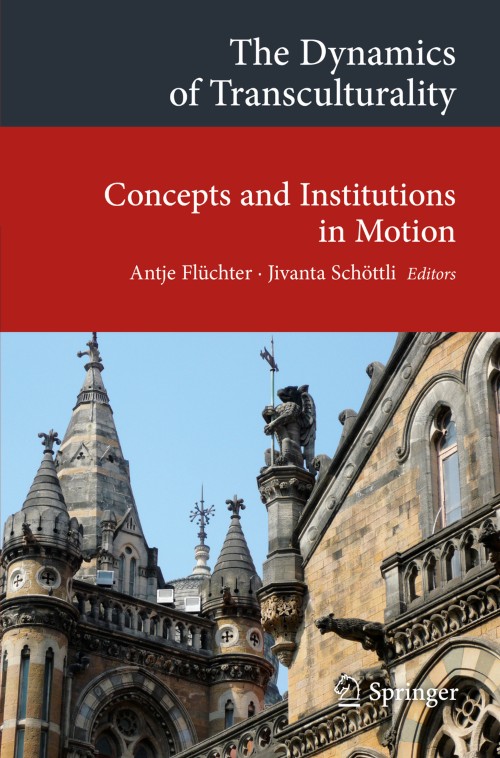
The Dynamics of Transculturality [electronic resource] : Concepts and Institutions in Motion / edited by Antje Flüchter, Jivanta Schöttli.
Erişim Adresi
ISBN
9783319097404
Dil Kodu
İngilizce
Yer Numarası
DK/9528
Basım Bildirimi
1st ed. 2015.
Yayın Bilgisi
Cham : Springer International Publishing : Imprint: Springer, 2015.
Fiziksel Niteleme
IX, 277 p. 26 illus., 5 illus. in color. online resource.
Dizi
Transcultural Research – Heidelberg Studies on Asia and Europe in a Global Context, 2191-6578
İçindekiler Notu
Introduction -- Part I. Conceptual considerations -- Marxism, Modernity, and Revolution: The Asian Experience -- From Religious Contact to Scientific Comparison and back. Some Methodological Considerations on Comparative Perspectives in the Science of Religion -- Part II. Politics and flow -- Hippodamos and Phoenicia: On city Planning and Social Order in a Transcultural Context -- A Forgotten Landscape of the Form of Government -- Military Intelligence and Early Modern Warfare. The Dutch East India Company and China 1622–1624 -- ‘Cultural Citizenship’ and Media Representation in India: Towards a Trans-Policy Approach -- The Era of Crowds: Gustave Le Bon, Crowd Psychology, and Conceptualising of Mass-Elite Relations in China -- Part III. Religion and flow -- The Goddess’s New Clothes. Conceptualising an ‘Eastern’ Goddess for a ‘Western’ Audience -- Across Central Asia: Cultural Crossroads, Religious Interactions? The Monastery, H.2153 fol. 131v, Topkapı Sarayı Müzesi, Istanbul -- Importing and Exporting Gods? On the Flow of Deities between Egypt and its Neighboring Countries.
Özet, vb.
The purpose of this volume is to identify and analyze the mechanisms and processes through which concepts and institutions of transcultural phenomena gain and are given momentum. Applied to a range of cases, including examples drawn from ancient Greece and modern India, the early modern Portuguese presence in China and politics of elite-mass dynamics in the People’s Republic of China, the book provides a template for the study of transcultural dynamics over time. Besides the epochal range, the papers in this volume illustrate the thematic diversity assembled under the umbrella of the Heidelberg Cluster of Excellence “Asia and Europe in a Global Context.” Drawing from both the humanities and social sciences, stretching across several world areas and centuries, the book is an interdisciplinary work, aptly reflected in the collaboration of its editors: a historian and political scientist.
Konu
Culture __ Study and teaching.
Cultural Studies.
Cultural Studies.
Diğer Yazarlar
Kurum Adı
