

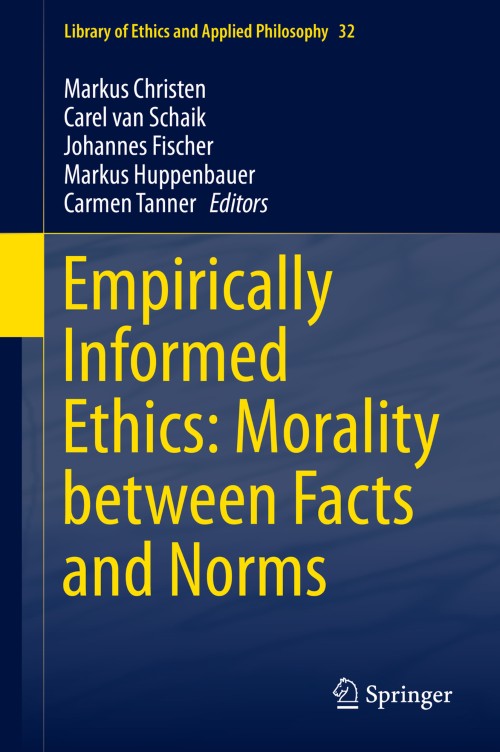
Empirically Informed Ethics: Morality between Facts and Norms [electronic resource] / edited by Markus Christen, Carel van Schaik, Johannes Fischer, Markus Huppenbauer, Carmen Tanner.
Erişim Adresi
ISBN
9783319013695
Dil Kodu
İngilizce
Yer Numarası
DK/9532
Basım Bildirimi
1st ed. 2014.
Yayın Bilgisi
Cham : Springer International Publishing : Imprint: Springer, 2014.
Fiziksel Niteleme
X, 349 p. 13 illus. online resource.
Dizi
Library of Ethics and Applied Philosophy, 2215-0323 ; 32
İçindekiler Notu
Introduction; Bridging the Is-Ought-Dichotomy -- Part I: What is Empirically Informed Ethics? -- Markus Christen, Mark Alfano’ Outlining the Field – A Research Program for Empirically Informed Ethics -- Johannes Fischer; What Kind of Ethics? – How the Understanding of the Fields Affects the Role of Empirical Research on Morality for Ethics -- Adriano Naves de Brito; Moral Behavior and Moral Sentiments – On the Natural Basis for Moral Values -- Part II: Investigating Origins of Morality -- Carel P. van Schaik, Judith Burkart, Adrian Jaeggi, Claudia Rudolf von Rohr; Morality as a Biological Adaptation – an Evolutionary Model based on the Lifestyle of Human Foragers -- Sarah F. Brosnan; Precursors of Morality – Evidence for Moral Behaviors in Non-Human Primates -- Jesse J. Prinz; Where Do Morals Come From? – A Plea for a Cultural Approach -- Part III: Assessing the Moral Agent -- Carmen Tanner, Markus Christen; Moral Intelligence – A Framework for Understanding Moral Competences -- Kristin Prehn, Hauke Heekeren; Moral Brains – Possibilities and Limits of the Neuroscience of Ethics -- Shaun Nichols, Mark Timmons, Theresa Lopez; Using Experiments in Ethics – Ethical Conservatism and the Psychology of Moral Luck -- Part IV: Justifications between Rational Reflections and Intuitions -- Ghislaine J.M.W. van Thiel, Johannes J.M. van Delden; Intuitions in Moral Reasoning – Normative Empirical Reflective Equilibrium as a Model for Substantial Justification of Moral Claims -- Bert Musschenga; Moral Expertise – The Role of Expert Judgments and Expert Intuitions in the Constitution of (Local) Ethical Theories -- Erich H. Witte &, Tobias Gollan; Social Variability in Moral Judgments – Analyzing the Justification of Actions using the Prescriptive Attribution Concept -- Part V: Practicing Morality and Ethics in the Real World;Darcia Narvaez, Daniel Lapsley -- Becoming a Moral Person – Moral Development and Moral Character Education as a Result of Social Interactions -- Markus Huppenbauer, Carmen Tanner; Ethical Leadership – How to Integrate Empirical and Ethical Aspects for Promoting Moral Decision Making in Business Practice -- Tanja Krones; The Empirical Turn in Bioethics – From Boundary Work to a Context-Sensitive, Transdisciplinary Field of Inquiry -- Critical Postscript -- Antti Kauppinen; Ethics and Empirical Psychology – Critical Remarks to Empirically Informed Ethics -- References -- Index -- Authors.
Özet, vb.
This volume provides an overview of the most recent developments in empirical investigations of morality and assesses their impact and importance for ethical thinking. It involves contributions of scholars both from philosophy, theology and empirical sciences with firm standings in their own disciplines, but an inclination to step across borders—in particular the one between the world of facts and the world of norms. Human morality is complex, and probably even messy—and this clean distinction becomes blurred whenever one looks more closely at the various components that enable and influence our moral actions and ethical orientations. In that way, morality may indeed be located between facts and norms—and an empirically informed ethics that is less concerned with analytical purity but immerses into this moral complexity may be an important step to make the contributions of ethics to this world more valuable and relevant.
Konu
Ethics.
Psychobiology.
Biology __ Philosophy.
Community psychology.
Moral Philosophy and Applied Ethics.
Biological Psychology.
Philosophy of Biology.
Community Psychology.
Psychobiology.
Biology __ Philosophy.
Community psychology.
Moral Philosophy and Applied Ethics.
Biological Psychology.
Philosophy of Biology.
Community Psychology.
Diğer Yazarlar
Kurum Adı
Eseri Alıntıla
Referansları kullanmadan önce gözden geçirmeniz ve varsa gerekli düzeltmeleri yapmanız önerilir.
Dijital Kaynak
MARC Görünümü
LEADER 05787nam a22005895i 4500
001 808240
003 TR_AnAIT
005 20260127005710
007 cr nn 008mamaa
008 131007s2014 sz | s |||| 0|eng d
020 |a9783319013695|9978-3-319-01369-5
024 7 |a10.1007/978-3-319-01369-5|2doi
041 |aeng
049 |aTürk Tarih Kurumu Kütüphanesi
050 4|aBJ1-1725
072 7|aHPQ|2bicssc
072 7|aPHI005000|2bisacsh
072 7|aQDTQ|2thema
082 04|a170|223
090 |aDK/9532
245 10|aEmpirically Informed Ethics: Morality between Facts and Norms|h[electronic resource] /|cedited by Markus Christen, Carel van Schaik, Johannes Fischer, Markus Huppenbauer, Carmen Tanner.
250 |a1st ed. 2014.
264 1|aCham :|bSpringer International Publishing :|bImprint: Springer,|c2014.
300 |aX, 349 p. 13 illus.|bonline resource.
336 |atext|btxt|2rdacontent
337 |acomputer|bc|2rdamedia
338 |aonline resource|bcr|2rdacarrier
347 |atext file|bPDF|2rda
490 1 |aLibrary of Ethics and Applied Philosophy,|x2215-0323 ;|v32
505 0 |aIntroduction; Bridging the Is-Ought-Dichotomy -- Part I: What is Empirically Informed Ethics? -- Markus Christen, Mark Alfano’ Outlining the Field – A Research Program for Empirically Informed Ethics -- Johannes Fischer; What Kind of Ethics? – How the Understanding of the Fields Affects the Role of Empirical Research on Morality for Ethics -- Adriano Naves de Brito; Moral Behavior and Moral Sentiments – On the Natural Basis for Moral Values -- Part II: Investigating Origins of Morality -- Carel P. van Schaik, Judith Burkart, Adrian Jaeggi, Claudia Rudolf von Rohr; Morality as a Biological Adaptation – an Evolutionary Model based on the Lifestyle of Human Foragers -- Sarah F. Brosnan; Precursors of Morality – Evidence for Moral Behaviors in Non-Human Primates -- Jesse J. Prinz; Where Do Morals Come From? – A Plea for a Cultural Approach -- Part III: Assessing the Moral Agent -- Carmen Tanner, Markus Christen; Moral Intelligence – A Framework for Understanding Moral Competences -- Kristin Prehn, Hauke Heekeren; Moral Brains – Possibilities and Limits of the Neuroscience of Ethics -- Shaun Nichols, Mark Timmons, Theresa Lopez; Using Experiments in Ethics – Ethical Conservatism and the Psychology of Moral Luck -- Part IV: Justifications between Rational Reflections and Intuitions -- Ghislaine J.M.W. van Thiel, Johannes J.M. van Delden; Intuitions in Moral Reasoning – Normative Empirical Reflective Equilibrium as a Model for Substantial Justification of Moral Claims -- Bert Musschenga; Moral Expertise – The Role of Expert Judgments and Expert Intuitions in the Constitution of (Local) Ethical Theories -- Erich H. Witte &, Tobias Gollan; Social Variability in Moral Judgments – Analyzing the Justification of Actions using the Prescriptive Attribution Concept -- Part V: Practicing Morality and Ethics in the Real World;Darcia Narvaez, Daniel Lapsley -- Becoming a Moral Person – Moral Development and Moral Character Education as a Result of Social Interactions -- Markus Huppenbauer, Carmen Tanner; Ethical Leadership – How to Integrate Empirical and Ethical Aspects for Promoting Moral Decision Making in Business Practice -- Tanja Krones; The Empirical Turn in Bioethics – From Boundary Work to a Context-Sensitive, Transdisciplinary Field of Inquiry -- Critical Postscript -- Antti Kauppinen; Ethics and Empirical Psychology – Critical Remarks to Empirically Informed Ethics -- References -- Index -- Authors.
520 |aThis volume provides an overview of the most recent developments in empirical investigations of morality and assesses their impact and importance for ethical thinking. It involves contributions of scholars both from philosophy, theology and empirical sciences with firm standings in their own disciplines, but an inclination to step across borders—in particular the one between the world of facts and the world of norms. Human morality is complex, and probably even messy—and this clean distinction becomes blurred whenever one looks more closely at the various components that enable and influence our moral actions and ethical orientations. In that way, morality may indeed be located between facts and norms—and an empirically informed ethics that is less concerned with analytical purity but immerses into this moral complexity may be an important step to make the contributions of ethics to this world more valuable and relevant.
650 0|aEthics.
650 0|aPsychobiology.
650 0|aBiology|xPhilosophy.
650 0|aCommunity psychology.
650 14|aMoral Philosophy and Applied Ethics.
650 24|aBiological Psychology.
650 24|aPhilosophy of Biology.
650 24|aCommunity Psychology.
700 1 |aChristen, Markus.|eeditor.|4edt|4http://id.loc.gov/vocabulary/relators/edt
700 1 |avan Schaik, Carel.|eeditor.|4edt|4http://id.loc.gov/vocabulary/relators/edt
700 1 |aFischer, Johannes.|eeditor.|4edt|4http://id.loc.gov/vocabulary/relators/edt
700 1 |aHuppenbauer, Markus.|eeditor.|4edt|4http://id.loc.gov/vocabulary/relators/edt
700 1 |aTanner, Carmen.|eeditor.|4edt|4http://id.loc.gov/vocabulary/relators/edt
710 2 |aSpringerLink (Online service)
773 0 |tSpringer Nature eBook
776 08|iPrinted edition:|z9783319013688
776 08|iPrinted edition:|z9783319013701
776 08|iPrinted edition:|z9783319348483
830 0|aLibrary of Ethics and Applied Philosophy,|x2215-0323 ;|v32
856 40|uhttps://doi.org/10.1007/978-3-319-01369-5
912 |aZDB-2-SHU
912 |aZDB-2-SXPR
950 |aHumanities, Social Sciences and Law (SpringerNature-11648)
950 |aPhilosophy and Religion (R0) (SpringerNature-43725)
001 808240
003 TR_AnAIT
005 20260127005710
007 cr nn 008mamaa
008 131007s2014 sz | s |||| 0|eng d
020 |a9783319013695|9978-3-319-01369-5
024 7 |a10.1007/978-3-319-01369-5|2doi
041 |aeng
049 |aTürk Tarih Kurumu Kütüphanesi
050 4|aBJ1-1725
072 7|aHPQ|2bicssc
072 7|aPHI005000|2bisacsh
072 7|aQDTQ|2thema
082 04|a170|223
090 |aDK/9532
245 10|aEmpirically Informed Ethics: Morality between Facts and Norms|h[electronic resource] /|cedited by Markus Christen, Carel van Schaik, Johannes Fischer, Markus Huppenbauer, Carmen Tanner.
250 |a1st ed. 2014.
264 1|aCham :|bSpringer International Publishing :|bImprint: Springer,|c2014.
300 |aX, 349 p. 13 illus.|bonline resource.
336 |atext|btxt|2rdacontent
337 |acomputer|bc|2rdamedia
338 |aonline resource|bcr|2rdacarrier
347 |atext file|bPDF|2rda
490 1 |aLibrary of Ethics and Applied Philosophy,|x2215-0323 ;|v32
505 0 |aIntroduction; Bridging the Is-Ought-Dichotomy -- Part I: What is Empirically Informed Ethics? -- Markus Christen, Mark Alfano’ Outlining the Field – A Research Program for Empirically Informed Ethics -- Johannes Fischer; What Kind of Ethics? – How the Understanding of the Fields Affects the Role of Empirical Research on Morality for Ethics -- Adriano Naves de Brito; Moral Behavior and Moral Sentiments – On the Natural Basis for Moral Values -- Part II: Investigating Origins of Morality -- Carel P. van Schaik, Judith Burkart, Adrian Jaeggi, Claudia Rudolf von Rohr; Morality as a Biological Adaptation – an Evolutionary Model based on the Lifestyle of Human Foragers -- Sarah F. Brosnan; Precursors of Morality – Evidence for Moral Behaviors in Non-Human Primates -- Jesse J. Prinz; Where Do Morals Come From? – A Plea for a Cultural Approach -- Part III: Assessing the Moral Agent -- Carmen Tanner, Markus Christen; Moral Intelligence – A Framework for Understanding Moral Competences -- Kristin Prehn, Hauke Heekeren; Moral Brains – Possibilities and Limits of the Neuroscience of Ethics -- Shaun Nichols, Mark Timmons, Theresa Lopez; Using Experiments in Ethics – Ethical Conservatism and the Psychology of Moral Luck -- Part IV: Justifications between Rational Reflections and Intuitions -- Ghislaine J.M.W. van Thiel, Johannes J.M. van Delden; Intuitions in Moral Reasoning – Normative Empirical Reflective Equilibrium as a Model for Substantial Justification of Moral Claims -- Bert Musschenga; Moral Expertise – The Role of Expert Judgments and Expert Intuitions in the Constitution of (Local) Ethical Theories -- Erich H. Witte &, Tobias Gollan; Social Variability in Moral Judgments – Analyzing the Justification of Actions using the Prescriptive Attribution Concept -- Part V: Practicing Morality and Ethics in the Real World;Darcia Narvaez, Daniel Lapsley -- Becoming a Moral Person – Moral Development and Moral Character Education as a Result of Social Interactions -- Markus Huppenbauer, Carmen Tanner; Ethical Leadership – How to Integrate Empirical and Ethical Aspects for Promoting Moral Decision Making in Business Practice -- Tanja Krones; The Empirical Turn in Bioethics – From Boundary Work to a Context-Sensitive, Transdisciplinary Field of Inquiry -- Critical Postscript -- Antti Kauppinen; Ethics and Empirical Psychology – Critical Remarks to Empirically Informed Ethics -- References -- Index -- Authors.
520 |aThis volume provides an overview of the most recent developments in empirical investigations of morality and assesses their impact and importance for ethical thinking. It involves contributions of scholars both from philosophy, theology and empirical sciences with firm standings in their own disciplines, but an inclination to step across borders—in particular the one between the world of facts and the world of norms. Human morality is complex, and probably even messy—and this clean distinction becomes blurred whenever one looks more closely at the various components that enable and influence our moral actions and ethical orientations. In that way, morality may indeed be located between facts and norms—and an empirically informed ethics that is less concerned with analytical purity but immerses into this moral complexity may be an important step to make the contributions of ethics to this world more valuable and relevant.
650 0|aEthics.
650 0|aPsychobiology.
650 0|aBiology|xPhilosophy.
650 0|aCommunity psychology.
650 14|aMoral Philosophy and Applied Ethics.
650 24|aBiological Psychology.
650 24|aPhilosophy of Biology.
650 24|aCommunity Psychology.
700 1 |aChristen, Markus.|eeditor.|4edt|4http://id.loc.gov/vocabulary/relators/edt
700 1 |avan Schaik, Carel.|eeditor.|4edt|4http://id.loc.gov/vocabulary/relators/edt
700 1 |aFischer, Johannes.|eeditor.|4edt|4http://id.loc.gov/vocabulary/relators/edt
700 1 |aHuppenbauer, Markus.|eeditor.|4edt|4http://id.loc.gov/vocabulary/relators/edt
700 1 |aTanner, Carmen.|eeditor.|4edt|4http://id.loc.gov/vocabulary/relators/edt
710 2 |aSpringerLink (Online service)
773 0 |tSpringer Nature eBook
776 08|iPrinted edition:|z9783319013688
776 08|iPrinted edition:|z9783319013701
776 08|iPrinted edition:|z9783319348483
830 0|aLibrary of Ethics and Applied Philosophy,|x2215-0323 ;|v32
856 40|uhttps://doi.org/10.1007/978-3-319-01369-5
912 |aZDB-2-SHU
912 |aZDB-2-SXPR
950 |aHumanities, Social Sciences and Law (SpringerNature-11648)
950 |aPhilosophy and Religion (R0) (SpringerNature-43725)
Materyaller
Depodan talep edilen materyal sadece kütüphane içerisinde kullanılmaktadır.
Materyal dışarıya ödünç verilmemektedir.
Materyal dışarıya ödünç verilmemektedir.
