

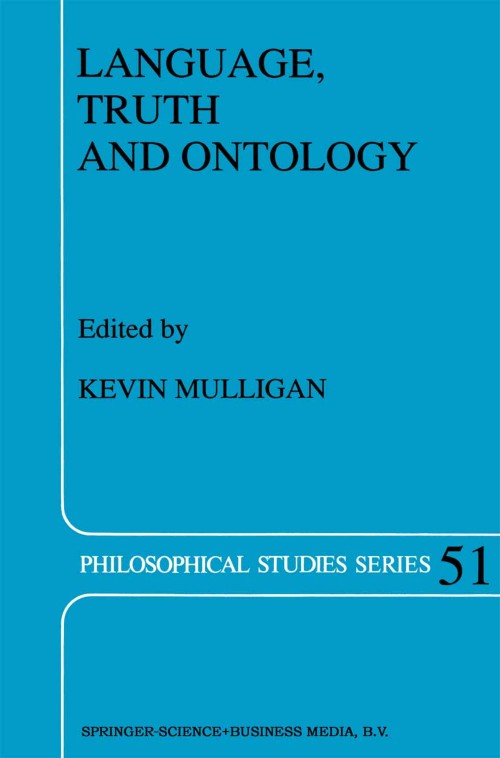
Language, Truth and Ontology [electronic resource] / edited by K. Mulligan.
Erişim Adresi
ISBN
9789401126021
Dil Kodu
İngilizce
Yer Numarası
DK/9538
Basım Bildirimi
1st ed. 1992.
Yayın Bilgisi
Dordrecht : Springer Netherlands : Imprint: Springer, 1992.
Fiziksel Niteleme
X, 214 p. online resource.
Dizi
Philosophical Studies Series, 2542-8349 ; 51
İçindekiler Notu
The Basic Ontological Categories -- 1. Introduction -- 2. The Basic Concepts -- 3. Individual Things and Events -- 4. Beginnings and Processes -- 5. Necessary Substance -- Properties -- 1. Why We Should Admit Properties -- 2. Universals vs. Tropes -- On Negative and Disjunctive Properties -- Particulars, Individual Qualities, and Universals -- Characteristica Universalis -- 1. Preamble -- 2. From Leibniz to Frege -- 3. Directly Depicting Diagrams vs. Existential Graphs -- 4. Some Conditions on a Directly Depicting Language -- 5. The Oil-Painting Principle -- 6. Primitives and Definitions -- 7. Substance -- 8. Accidents -- 9. Sub-Atoms (Mutually Dependent Parts of Atoms) -- 10. Boundaries and Boundary Dependence -- 11. Universals -- Definite Descriptions and the Theory of Objects -- 1. A New Explanation -- 2. An Application of the Foregoing Explanation -- Truth Makers, Truth Predicates, and Truth Types -- Worlds and States of Affairs: How Similar Can They Be? -- 1. Motivation -- 2. Salmon’s Counterexample -- 3. TheBranching Conception -- Was Frege Right about Variable Objects? -- Logical Atomism and Its Ontological Refinement: A Defense -- 1. Introduction -- 2. Logical Atomism, What -- 3. Examples of the Avoidance of Unnecessary Facts -- 4. Disputed Case I: Negative Propositions -- 5. Disputed Case II: Universal Generalization -- 6. Other Higher Order Functors -- 7. Statistical Generalizations and Probability -- 8. Laws of Nature and Causality -- 9. Applied Mathematics, Dispositions, and Others -- 10. Resolution and Ultimate Facts -- 11. Concluding Remarks -- Intentionality and Tendency: How to Make Aristotle Up-To-Date -- 1. Introduction -- 2. The Problem -- 3. Aristotle -- 4. Newtonian Self-Change -- 5. Intentionality -- 6. Temporally Extended Entities -- 7. The Duality of Intentions -- 8. Formal Ontology Today -- 9. Summary -- Leibniz on Properties and Individuals -- Index of Names -- Index of Subjects.
Özet, vb.
All except three of the papers in this volume were presented at the colloquium on "L'Ontologie formelle aujourd'hui", Geneva, 3-5 June 1988. The three exceptions, the papers by David Armstrong, Uwe Meixner and Wolfgang Lenzen, were presented at the colloquium on "Properties", Zinal, June 1-3, 1990. It was, incidentally, at the second of these two colloquia that the European Society for Analytic Philosophy came into being. The fathers of analytic philosophy - Moore and Russell - were in no doubt that ontology or metaphysics as well as the topics oflanguage, truth and logic constituted the core subject-matter of their "analytic realism", 1 for the task of metaphysics as they conceived things was the description of 2 the world. And logic and ontology are indissolubly linked in the system of the grandfather of analytic philosophy, Frege. After the Golden Age of analytic philosophy - in Cambridge and Austria - opposition to realism as well as the "linguistic turn" contributed for a long time to the eclipse of ontology. 3 Thanks in large measure to the work of some of the senior contributors to the present volume - Roderick Chisholm, Herbert Hochberg, David Armstrong and Karel Lambert - ontology and metaphysics now enjoy once again the central position they occupied some eighty years ago in the heyday of analytic philosophy.
Konu
Ontology.
Metaphysics.
Logic.
Ontology.
Metaphysics.
Logic.
Metaphysics.
Logic.
Ontology.
Metaphysics.
Logic.
Diğer Yazarlar
Kurum Adı
Eseri Alıntıla
Referansları kullanmadan önce gözden geçirmeniz ve varsa gerekli düzeltmeleri yapmanız önerilir.
Dijital Kaynak
MARC Görünümü
LEADER 05780nam a22005775i 4500
001 808246
003 TR_AnAIT
005 20260127005717
007 cr nn 008mamaa
008 121227s1992 ne | s |||| 0|eng d
020 |a9789401126021|9978-94-011-2602-1
024 7 |a10.1007/978-94-011-2602-1|2doi
041 |aeng
049 |aTürk Tarih Kurumu Kütüphanesi
050 4|aBD300-450
072 7|aHPJ|2bicssc
072 7|aPHI013000|2bisacsh
072 7|aQDTJ|2thema
082 04|a111|223
090 |aDK/9538
245 10|aLanguage, Truth and Ontology|h[electronic resource] /|cedited by K. Mulligan.
250 |a1st ed. 1992.
264 1|aDordrecht :|bSpringer Netherlands :|bImprint: Springer,|c1992.
300 |aX, 214 p.|bonline resource.
336 |atext|btxt|2rdacontent
337 |acomputer|bc|2rdamedia
338 |aonline resource|bcr|2rdacarrier
347 |atext file|bPDF|2rda
490 1 |aPhilosophical Studies Series,|x2542-8349 ;|v51
505 0 |aThe Basic Ontological Categories -- 1. Introduction -- 2. The Basic Concepts -- 3. Individual Things and Events -- 4. Beginnings and Processes -- 5. Necessary Substance -- Properties -- 1. Why We Should Admit Properties -- 2. Universals vs. Tropes -- On Negative and Disjunctive Properties -- Particulars, Individual Qualities, and Universals -- Characteristica Universalis -- 1. Preamble -- 2. From Leibniz to Frege -- 3. Directly Depicting Diagrams vs. Existential Graphs -- 4. Some Conditions on a Directly Depicting Language -- 5. The Oil-Painting Principle -- 6. Primitives and Definitions -- 7. Substance -- 8. Accidents -- 9. Sub-Atoms (Mutually Dependent Parts of Atoms) -- 10. Boundaries and Boundary Dependence -- 11. Universals -- Definite Descriptions and the Theory of Objects -- 1. A New Explanation -- 2. An Application of the Foregoing Explanation -- Truth Makers, Truth Predicates, and Truth Types -- Worlds and States of Affairs: How Similar Can They Be? -- 1. Motivation -- 2. Salmon’s Counterexample -- 3. TheBranching Conception -- Was Frege Right about Variable Objects? -- Logical Atomism and Its Ontological Refinement: A Defense -- 1. Introduction -- 2. Logical Atomism, What -- 3. Examples of the Avoidance of Unnecessary Facts -- 4. Disputed Case I: Negative Propositions -- 5. Disputed Case II: Universal Generalization -- 6. Other Higher Order Functors -- 7. Statistical Generalizations and Probability -- 8. Laws of Nature and Causality -- 9. Applied Mathematics, Dispositions, and Others -- 10. Resolution and Ultimate Facts -- 11. Concluding Remarks -- Intentionality and Tendency: How to Make Aristotle Up-To-Date -- 1. Introduction -- 2. The Problem -- 3. Aristotle -- 4. Newtonian Self-Change -- 5. Intentionality -- 6. Temporally Extended Entities -- 7. The Duality of Intentions -- 8. Formal Ontology Today -- 9. Summary -- Leibniz on Properties and Individuals -- Index of Names -- Index of Subjects.
520 |aAll except three of the papers in this volume were presented at the colloquium on "L'Ontologie formelle aujourd'hui", Geneva, 3-5 June 1988. The three exceptions, the papers by David Armstrong, Uwe Meixner and Wolfgang Lenzen, were presented at the colloquium on "Properties", Zinal, June 1-3, 1990. It was, incidentally, at the second of these two colloquia that the European Society for Analytic Philosophy came into being. The fathers of analytic philosophy - Moore and Russell - were in no doubt that ontology or metaphysics as well as the topics oflanguage, truth and logic constituted the core subject-matter of their "analytic realism", 1 for the task of metaphysics as they conceived things was the description of 2 the world. And logic and ontology are indissolubly linked in the system of the grandfather of analytic philosophy, Frege. After the Golden Age of analytic philosophy - in Cambridge and Austria - opposition to realism as well as the "linguistic turn" contributed for a long time to the eclipse of ontology. 3 Thanks in large measure to the work of some of the senior contributors to the present volume - Roderick Chisholm, Herbert Hochberg, David Armstrong and Karel Lambert - ontology and metaphysics now enjoy once again the central position they occupied some eighty years ago in the heyday of analytic philosophy.
532 8 |aAccessibility summary: This PDF is not accessible. It is based on scanned pages and does not support features such as screen reader compatibility or described non-text content (images, graphs etc). However, it likely supports searchable and selectable text based on OCR (Optical Character Recognition). Users with accessibility needs may not be able to use this content effectively. Please contact us at accessibilitysupport@springernature.com if you require assistance or an alternative format.
532 8 |aInaccessible, or known limited accessibility
532 8 |aNo reading system accessibility options actively disabled
532 8 |aPublisher contact for further accessibility information: accessibilitysupport@springernature.com
650 0|aOntology.
650 0|aMetaphysics.
650 0|aLogic.
650 14|aOntology.
650 24|aMetaphysics.
650 24|aLogic.
700 1 |aMulligan, K.|eeditor.|4edt|4http://id.loc.gov/vocabulary/relators/edt
710 2 |aSpringerLink (Online service)
773 0 |tSpringer Nature eBook
776 08|iPrinted edition:|z9780792315094
776 08|iPrinted edition:|z9789401126038
776 08|iPrinted edition:|z9789401051491
830 0|aPhilosophical Studies Series,|x2542-8349 ;|v51
856 40|uhttps://doi.org/10.1007/978-94-011-2602-1
912 |aZDB-2-SHU
912 |aZDB-2-SXPR
912 |aZDB-2-BAE
950 |aHumanities, Social Sciences and Law (SpringerNature-11648)
950 |aPhilosophy and Religion (R0) (SpringerNature-43725)
001 808246
003 TR_AnAIT
005 20260127005717
007 cr nn 008mamaa
008 121227s1992 ne | s |||| 0|eng d
020 |a9789401126021|9978-94-011-2602-1
024 7 |a10.1007/978-94-011-2602-1|2doi
041 |aeng
049 |aTürk Tarih Kurumu Kütüphanesi
050 4|aBD300-450
072 7|aHPJ|2bicssc
072 7|aPHI013000|2bisacsh
072 7|aQDTJ|2thema
082 04|a111|223
090 |aDK/9538
245 10|aLanguage, Truth and Ontology|h[electronic resource] /|cedited by K. Mulligan.
250 |a1st ed. 1992.
264 1|aDordrecht :|bSpringer Netherlands :|bImprint: Springer,|c1992.
300 |aX, 214 p.|bonline resource.
336 |atext|btxt|2rdacontent
337 |acomputer|bc|2rdamedia
338 |aonline resource|bcr|2rdacarrier
347 |atext file|bPDF|2rda
490 1 |aPhilosophical Studies Series,|x2542-8349 ;|v51
505 0 |aThe Basic Ontological Categories -- 1. Introduction -- 2. The Basic Concepts -- 3. Individual Things and Events -- 4. Beginnings and Processes -- 5. Necessary Substance -- Properties -- 1. Why We Should Admit Properties -- 2. Universals vs. Tropes -- On Negative and Disjunctive Properties -- Particulars, Individual Qualities, and Universals -- Characteristica Universalis -- 1. Preamble -- 2. From Leibniz to Frege -- 3. Directly Depicting Diagrams vs. Existential Graphs -- 4. Some Conditions on a Directly Depicting Language -- 5. The Oil-Painting Principle -- 6. Primitives and Definitions -- 7. Substance -- 8. Accidents -- 9. Sub-Atoms (Mutually Dependent Parts of Atoms) -- 10. Boundaries and Boundary Dependence -- 11. Universals -- Definite Descriptions and the Theory of Objects -- 1. A New Explanation -- 2. An Application of the Foregoing Explanation -- Truth Makers, Truth Predicates, and Truth Types -- Worlds and States of Affairs: How Similar Can They Be? -- 1. Motivation -- 2. Salmon’s Counterexample -- 3. TheBranching Conception -- Was Frege Right about Variable Objects? -- Logical Atomism and Its Ontological Refinement: A Defense -- 1. Introduction -- 2. Logical Atomism, What -- 3. Examples of the Avoidance of Unnecessary Facts -- 4. Disputed Case I: Negative Propositions -- 5. Disputed Case II: Universal Generalization -- 6. Other Higher Order Functors -- 7. Statistical Generalizations and Probability -- 8. Laws of Nature and Causality -- 9. Applied Mathematics, Dispositions, and Others -- 10. Resolution and Ultimate Facts -- 11. Concluding Remarks -- Intentionality and Tendency: How to Make Aristotle Up-To-Date -- 1. Introduction -- 2. The Problem -- 3. Aristotle -- 4. Newtonian Self-Change -- 5. Intentionality -- 6. Temporally Extended Entities -- 7. The Duality of Intentions -- 8. Formal Ontology Today -- 9. Summary -- Leibniz on Properties and Individuals -- Index of Names -- Index of Subjects.
520 |aAll except three of the papers in this volume were presented at the colloquium on "L'Ontologie formelle aujourd'hui", Geneva, 3-5 June 1988. The three exceptions, the papers by David Armstrong, Uwe Meixner and Wolfgang Lenzen, were presented at the colloquium on "Properties", Zinal, June 1-3, 1990. It was, incidentally, at the second of these two colloquia that the European Society for Analytic Philosophy came into being. The fathers of analytic philosophy - Moore and Russell - were in no doubt that ontology or metaphysics as well as the topics oflanguage, truth and logic constituted the core subject-matter of their "analytic realism", 1 for the task of metaphysics as they conceived things was the description of 2 the world. And logic and ontology are indissolubly linked in the system of the grandfather of analytic philosophy, Frege. After the Golden Age of analytic philosophy - in Cambridge and Austria - opposition to realism as well as the "linguistic turn" contributed for a long time to the eclipse of ontology. 3 Thanks in large measure to the work of some of the senior contributors to the present volume - Roderick Chisholm, Herbert Hochberg, David Armstrong and Karel Lambert - ontology and metaphysics now enjoy once again the central position they occupied some eighty years ago in the heyday of analytic philosophy.
532 8 |aAccessibility summary: This PDF is not accessible. It is based on scanned pages and does not support features such as screen reader compatibility or described non-text content (images, graphs etc). However, it likely supports searchable and selectable text based on OCR (Optical Character Recognition). Users with accessibility needs may not be able to use this content effectively. Please contact us at accessibilitysupport@springernature.com if you require assistance or an alternative format.
532 8 |aInaccessible, or known limited accessibility
532 8 |aNo reading system accessibility options actively disabled
532 8 |aPublisher contact for further accessibility information: accessibilitysupport@springernature.com
650 0|aOntology.
650 0|aMetaphysics.
650 0|aLogic.
650 14|aOntology.
650 24|aMetaphysics.
650 24|aLogic.
700 1 |aMulligan, K.|eeditor.|4edt|4http://id.loc.gov/vocabulary/relators/edt
710 2 |aSpringerLink (Online service)
773 0 |tSpringer Nature eBook
776 08|iPrinted edition:|z9780792315094
776 08|iPrinted edition:|z9789401126038
776 08|iPrinted edition:|z9789401051491
830 0|aPhilosophical Studies Series,|x2542-8349 ;|v51
856 40|uhttps://doi.org/10.1007/978-94-011-2602-1
912 |aZDB-2-SHU
912 |aZDB-2-SXPR
912 |aZDB-2-BAE
950 |aHumanities, Social Sciences and Law (SpringerNature-11648)
950 |aPhilosophy and Religion (R0) (SpringerNature-43725)
Materyaller
Depodan talep edilen materyal sadece kütüphane içerisinde kullanılmaktadır.
Materyal dışarıya ödünç verilmemektedir.
Materyal dışarıya ödünç verilmemektedir.
