

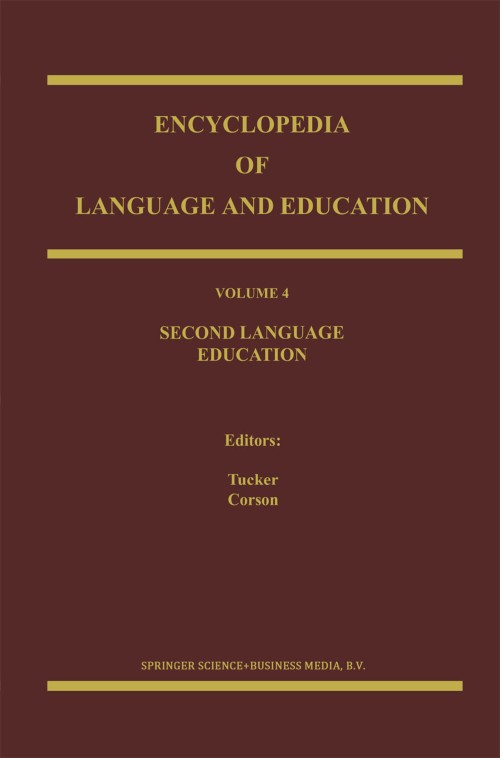
Encyclopedia of Language and Education [electronic resource] : Second Language Education / edited by G. Richard Tucker, P. Corson.
Erişim Adresi
ISBN
9789401144193
Dil Kodu
İngilizce
Yer Numarası
DK/9542
Basım Bildirimi
1st ed. 1997.
Yayın Bilgisi
Dordrecht : Springer Netherlands : Imprint: Springer, 1997.
Fiziksel Niteleme
XVII, 272 p. online resource.
Dizi
Encyclopedia of Language and Education ; 4
İçindekiler Notu
Section 1: Theoretical Underpinnings -- 1. Linguistic Theory and Research: Implications for Second Language Teaching -- 2. Linguistic Theory and Research: Implications for Second Language Learning -- Section 2: Focus on the Learner -- 3. Conditions for Second Language (L2) Learning -- 4. Individual Differences and Second Language Learning -- 5. Age and Second Language Learning -- 6. Language Attrition -- Section 3: Focus on the Delivery of Instruction -- 7. Classroom-Oriented Research in Second Language Learning -- 8. Language Teaching Approaches for School-Aged Learners in Second Language Contexts -- 9. Teaching Exceptional Second Language Learners -- 10. Second Language Teaching Approaches for Adults -- 11. Language for Special Purposes -- Section 4: Focus on Professional Preparation -- 12. Approaches to Second Language Teacher Education -- 13. The Use of Multimedia in Teaching -- 14. Second Language Assessment -- Section 5: Focus on Selected Regions of the World -- 15. Understanding Second Language Educational Policies in Multilingual Settings -- 16. Innovative Second Language Education in North America -- 17. Innovative Second Language Education in Western Europe -- 18. Innovative Second Language Education in Central and Eastern Europe -- 19. Innovative Second Language Education in the Middle East and North Africa -- 20. Innovative Second Language Education in Southern Africa -- 21. Innovative Second Language Education in Southeast Asia -- 22. Innovative Second Language Education in the South Pacific -- Name Index -- Tables of Contents other Volumes.
Özet, vb.
In many parts of the world, it is common for a child to grow up speaking a local language at home, another in the market place, adding another to her repertoire as a lingua franca, and then adding a language of wider communication such as English or French if she continues her formal schooling. The contributions to the volume examine in some detail diverse aspects of second language education, ranging from a focus on the basic contributions of linguistic theory and research to our understanding of second language learning and teaching on the one hand, to a series of reviews of innovative language education practices in selected regions of the world on the other. For the purposes of this volume, second language education has been defined operationally to encompass education which occurs in those settings and situations in which a dominant language is offered as a second language (e.g., ESL in England or the United States whether as a subject of study or a vehicle through which other material is studied), as well as those cases in which an official, but not necessarily dominant, language is mandated (e.g., French or English in certain parts of the Middle East or the Mahgreb). The contributions also focus mainly, albeit not exclusively, on second language education for school-aged learners.
Konu
Education.
International education .
Comparative education.
Psycholinguistics.
Education.
International and Comparative Education.
Psycholinguistics and Cognitive Lingusitics.
International education .
Comparative education.
Psycholinguistics.
Education.
International and Comparative Education.
Psycholinguistics and Cognitive Lingusitics.
Diğer Yazarlar
Kurum Adı
Eseri Alıntıla
Referansları kullanmadan önce gözden geçirmeniz ve varsa gerekli düzeltmeleri yapmanız önerilir.
Dijital Kaynak
MARC Görünümü
LEADER 05693nam a22006135i 4500
001 808253
003 TR_AnAIT
005 20260131032100
007 cr nn 008mamaa
008 110719s1997 ne | s |||| 0|eng d
020 |a9789401144193|9978-94-011-4419-3
024 7 |a10.1007/978-94-011-4419-3|2doi
041 |aeng
049 |aTürk Tarih Kurumu Kütüphanesi
050 4|aL1-991
072 7|aJN|2bicssc
072 7|aEDU000000|2bisacsh
072 7|aJN|2thema
082 04|a370|223
090 |aDK/9542
245 10|aEncyclopedia of Language and Education|h[electronic resource] :|bSecond Language Education /|cedited by G. Richard Tucker, P. Corson.
250 |a1st ed. 1997.
264 1|aDordrecht :|bSpringer Netherlands :|bImprint: Springer,|c1997.
300 |aXVII, 272 p.|bonline resource.
336 |atext|btxt|2rdacontent
337 |acomputer|bc|2rdamedia
338 |aonline resource|bcr|2rdacarrier
347 |atext file|bPDF|2rda
490 1 |aEncyclopedia of Language and Education ;|v4
505 0 |aSection 1: Theoretical Underpinnings -- 1. Linguistic Theory and Research: Implications for Second Language Teaching -- 2. Linguistic Theory and Research: Implications for Second Language Learning -- Section 2: Focus on the Learner -- 3. Conditions for Second Language (L2) Learning -- 4. Individual Differences and Second Language Learning -- 5. Age and Second Language Learning -- 6. Language Attrition -- Section 3: Focus on the Delivery of Instruction -- 7. Classroom-Oriented Research in Second Language Learning -- 8. Language Teaching Approaches for School-Aged Learners in Second Language Contexts -- 9. Teaching Exceptional Second Language Learners -- 10. Second Language Teaching Approaches for Adults -- 11. Language for Special Purposes -- Section 4: Focus on Professional Preparation -- 12. Approaches to Second Language Teacher Education -- 13. The Use of Multimedia in Teaching -- 14. Second Language Assessment -- Section 5: Focus on Selected Regions of the World -- 15. Understanding Second Language Educational Policies in Multilingual Settings -- 16. Innovative Second Language Education in North America -- 17. Innovative Second Language Education in Western Europe -- 18. Innovative Second Language Education in Central and Eastern Europe -- 19. Innovative Second Language Education in the Middle East and North Africa -- 20. Innovative Second Language Education in Southern Africa -- 21. Innovative Second Language Education in Southeast Asia -- 22. Innovative Second Language Education in the South Pacific -- Name Index -- Tables of Contents other Volumes.
520 |aIn many parts of the world, it is common for a child to grow up speaking a local language at home, another in the market place, adding another to her repertoire as a lingua franca, and then adding a language of wider communication such as English or French if she continues her formal schooling. The contributions to the volume examine in some detail diverse aspects of second language education, ranging from a focus on the basic contributions of linguistic theory and research to our understanding of second language learning and teaching on the one hand, to a series of reviews of innovative language education practices in selected regions of the world on the other. For the purposes of this volume, second language education has been defined operationally to encompass education which occurs in those settings and situations in which a dominant language is offered as a second language (e.g., ESL in England or the United States whether as a subject of study or a vehicle through which other material is studied), as well as those cases in which an official, but not necessarily dominant, language is mandated (e.g., French or English in certain parts of the Middle East or the Mahgreb). The contributions also focus mainly, albeit not exclusively, on second language education for school-aged learners.
532 8 |aAccessibility summary: This PDF is not accessible. It is based on scanned pages and does not support features such as screen reader compatibility or described non-text content (images, graphs etc). However, it likely supports searchable and selectable text based on OCR (Optical Character Recognition). Users with accessibility needs may not be able to use this content effectively. Please contact us at accessibilitysupport@springernature.com if you require assistance or an alternative format.
532 8 |aInaccessible, or known limited accessibility
532 8 |aNo reading system accessibility options actively disabled
532 8 |aPublisher contact for further accessibility information: accessibilitysupport@springernature.com
650 0|aEducation.
650 0|aInternational education .
650 0|aComparative education.
650 0|aPsycholinguistics.
650 14|aEducation.
650 24|aInternational and Comparative Education.
650 24|aPsycholinguistics and Cognitive Lingusitics.
700 1 |aTucker, G. Richard.|eeditor.|4edt|4http://id.loc.gov/vocabulary/relators/edt
700 1 |aCorson, P.|eeditor.|4edt|4http://id.loc.gov/vocabulary/relators/edt
710 2 |aSpringerLink (Online service)
773 0 |tSpringer Nature eBook
776 08|iPrinted edition:|z9780792349310
776 08|iPrinted edition:|z9780792346401
776 08|iPrinted edition:|z9789401144209
776 08|iPrinted edition:|z9789400789623
830 0|aEncyclopedia of Language and Education ;|v4
856 40|uhttps://doi.org/10.1007/978-94-011-4419-3
912 |aZDB-2-SHU
912 |aZDB-2-SXED
912 |aZDB-2-BAE
950 |aHumanities, Social Sciences and Law (SpringerNature-11648)
950 |aEducation (R0) (SpringerNature-43721)
001 808253
003 TR_AnAIT
005 20260131032100
007 cr nn 008mamaa
008 110719s1997 ne | s |||| 0|eng d
020 |a9789401144193|9978-94-011-4419-3
024 7 |a10.1007/978-94-011-4419-3|2doi
041 |aeng
049 |aTürk Tarih Kurumu Kütüphanesi
050 4|aL1-991
072 7|aJN|2bicssc
072 7|aEDU000000|2bisacsh
072 7|aJN|2thema
082 04|a370|223
090 |aDK/9542
245 10|aEncyclopedia of Language and Education|h[electronic resource] :|bSecond Language Education /|cedited by G. Richard Tucker, P. Corson.
250 |a1st ed. 1997.
264 1|aDordrecht :|bSpringer Netherlands :|bImprint: Springer,|c1997.
300 |aXVII, 272 p.|bonline resource.
336 |atext|btxt|2rdacontent
337 |acomputer|bc|2rdamedia
338 |aonline resource|bcr|2rdacarrier
347 |atext file|bPDF|2rda
490 1 |aEncyclopedia of Language and Education ;|v4
505 0 |aSection 1: Theoretical Underpinnings -- 1. Linguistic Theory and Research: Implications for Second Language Teaching -- 2. Linguistic Theory and Research: Implications for Second Language Learning -- Section 2: Focus on the Learner -- 3. Conditions for Second Language (L2) Learning -- 4. Individual Differences and Second Language Learning -- 5. Age and Second Language Learning -- 6. Language Attrition -- Section 3: Focus on the Delivery of Instruction -- 7. Classroom-Oriented Research in Second Language Learning -- 8. Language Teaching Approaches for School-Aged Learners in Second Language Contexts -- 9. Teaching Exceptional Second Language Learners -- 10. Second Language Teaching Approaches for Adults -- 11. Language for Special Purposes -- Section 4: Focus on Professional Preparation -- 12. Approaches to Second Language Teacher Education -- 13. The Use of Multimedia in Teaching -- 14. Second Language Assessment -- Section 5: Focus on Selected Regions of the World -- 15. Understanding Second Language Educational Policies in Multilingual Settings -- 16. Innovative Second Language Education in North America -- 17. Innovative Second Language Education in Western Europe -- 18. Innovative Second Language Education in Central and Eastern Europe -- 19. Innovative Second Language Education in the Middle East and North Africa -- 20. Innovative Second Language Education in Southern Africa -- 21. Innovative Second Language Education in Southeast Asia -- 22. Innovative Second Language Education in the South Pacific -- Name Index -- Tables of Contents other Volumes.
520 |aIn many parts of the world, it is common for a child to grow up speaking a local language at home, another in the market place, adding another to her repertoire as a lingua franca, and then adding a language of wider communication such as English or French if she continues her formal schooling. The contributions to the volume examine in some detail diverse aspects of second language education, ranging from a focus on the basic contributions of linguistic theory and research to our understanding of second language learning and teaching on the one hand, to a series of reviews of innovative language education practices in selected regions of the world on the other. For the purposes of this volume, second language education has been defined operationally to encompass education which occurs in those settings and situations in which a dominant language is offered as a second language (e.g., ESL in England or the United States whether as a subject of study or a vehicle through which other material is studied), as well as those cases in which an official, but not necessarily dominant, language is mandated (e.g., French or English in certain parts of the Middle East or the Mahgreb). The contributions also focus mainly, albeit not exclusively, on second language education for school-aged learners.
532 8 |aAccessibility summary: This PDF is not accessible. It is based on scanned pages and does not support features such as screen reader compatibility or described non-text content (images, graphs etc). However, it likely supports searchable and selectable text based on OCR (Optical Character Recognition). Users with accessibility needs may not be able to use this content effectively. Please contact us at accessibilitysupport@springernature.com if you require assistance or an alternative format.
532 8 |aInaccessible, or known limited accessibility
532 8 |aNo reading system accessibility options actively disabled
532 8 |aPublisher contact for further accessibility information: accessibilitysupport@springernature.com
650 0|aEducation.
650 0|aInternational education .
650 0|aComparative education.
650 0|aPsycholinguistics.
650 14|aEducation.
650 24|aInternational and Comparative Education.
650 24|aPsycholinguistics and Cognitive Lingusitics.
700 1 |aTucker, G. Richard.|eeditor.|4edt|4http://id.loc.gov/vocabulary/relators/edt
700 1 |aCorson, P.|eeditor.|4edt|4http://id.loc.gov/vocabulary/relators/edt
710 2 |aSpringerLink (Online service)
773 0 |tSpringer Nature eBook
776 08|iPrinted edition:|z9780792349310
776 08|iPrinted edition:|z9780792346401
776 08|iPrinted edition:|z9789401144209
776 08|iPrinted edition:|z9789400789623
830 0|aEncyclopedia of Language and Education ;|v4
856 40|uhttps://doi.org/10.1007/978-94-011-4419-3
912 |aZDB-2-SHU
912 |aZDB-2-SXED
912 |aZDB-2-BAE
950 |aHumanities, Social Sciences and Law (SpringerNature-11648)
950 |aEducation (R0) (SpringerNature-43721)
Materyaller
Depodan talep edilen materyal sadece kütüphane içerisinde kullanılmaktadır.
Materyal dışarıya ödünç verilmemektedir.
Materyal dışarıya ödünç verilmemektedir.
