

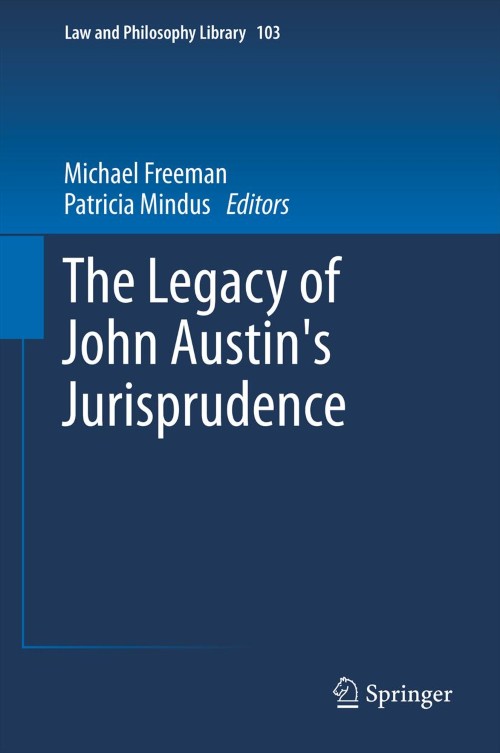
The Legacy of John Austin's Jurisprudence [electronic resource] / edited by Michael Freeman, Patricia Mindus.
Erişim Adresi
ISBN
9789400748309
Dil Kodu
İngilizce
Yer Numarası
DK/9566
Basım Bildirimi
1st ed. 2013.
Yayın Bilgisi
Dordrecht : Springer Netherlands : Imprint: Springer, 2013.
Fiziksel Niteleme
X, 318 p. online resource.
Dizi
Law and Philosophy Library, 2215-0315 ; 103
İçindekiler Notu
Preface; Michael Freeman and Patricia Mindus -- Chapter 1 John Austin and Constructing Theories of law; Brian H. Bix -- Chapter 2 Austin’s Methodology? His Bequest to Jurisprudence; Andrew Halpin -- Chapter 3 "Darkening the Fair Face of Roman Law": Austin and Roman Law; Andrew Lewis -- Chapter 4 Austin, Kelsen and the Model of Sovereignty: Notes on the History of Modern Legal Positivism;Lars Vinx -- Chapter 5 Austin and Scandinavian Realism; Patricia Mindus -- Chapter 6 Sense and Nonsense about Austin's Jurisprudence from a Scandinavian Perspective; Jes Bjarup -- Chapter 7 Did Austin Remain an Austinian?; Wilfrid E. Rumble.- Chapter 8 Austin and the Electors; Pavlos Eleftheriadis -- Chapter 9 Positive Divine Law in Austin; James Bernard Murphy -- Chapter 10 What Is in a Habit?; Michael Rodney -- Chapter 11 Austin, Hobbes, and Dicey; David Dyzenhaus -- Chapter 12 John Stuart Mill on John Austin (and Jeremy Bentham); Philip Schofield -- Chapter 13 Austin and the Germans; Michael Lobban.- Chapter 14 Positivism before Hart; Frederick Schauer -- Chapter 15 Reconstructing Austin's Intuitions: Positive Morality and Law; Maria Isabel Turégano Mansilla -- About the authors.
Özet, vb.
This is the first ever collected volume on John Austin, whose role in the founding of analytical jurisprudence is unquestionable. After 150 years, time has come to assess his legacy. The book fills a void in existing literature, by letting top scholars with diverse outlooks flesh out and discuss Austin’s legacy today. A nuanced, vibrant, and richly diverse picture of both his legal and ethical theories emerges, making a case for a renewal of interest in his work. The book applies multiple perspectives, reflecting Austin’s various interests – stretching from moral theory to theory of law and state, from roman law to constitutional law – and it offers a comparative outlook on Austin and his legacy on the backdrop of the contemporary debate and major movements within legal theory. It sheds new light on some central issues of practical reasoning: the relation between law and morals, the nature of legal systems, the function of effectiveness, the value-free character of legal theory, the connection between normative and factual inquiries in the law, the role of power, the character of obedience and the notion of duty.
Konu
Law __ Philosophy.
Law __ History.
Ethics.
Law.
Philosophy __ History.
Theories of Law, Philosophy of Law, Legal History.
Moral Philosophy and Applied Ethics.
Fundamentals of Law.
Philosophy of Law.
History of Philosophy.
Law __ History.
Ethics.
Law.
Philosophy __ History.
Theories of Law, Philosophy of Law, Legal History.
Moral Philosophy and Applied Ethics.
Fundamentals of Law.
Philosophy of Law.
History of Philosophy.
Diğer Yazarlar
Kurum Adı
Eseri Alıntıla
Referansları kullanmadan önce gözden geçirmeniz ve varsa gerekli düzeltmeleri yapmanız önerilir.
Dijital Kaynak
MARC Görünümü
LEADER 04413nam a22005895i 4500
001 808277
003 TR_AnAIT
005 20260131032005
007 cr nn 008mamaa
008 120914s2013 ne | s |||| 0|eng d
020 |a9789400748309|9978-94-007-4830-9
024 7 |a10.1007/978-94-007-4830-9|2doi
041 |aeng
049 |aTürk Tarih Kurumu Kütüphanesi
050 4|aK201-487
050 4|aK140-165
072 7|aLAB|2bicssc
072 7|aLAW000000|2bisacsh
072 7|aLAB|2thema
082 04|a340.1|223
090 |aDK/9566
245 14|aThe Legacy of John Austin's Jurisprudence|h[electronic resource] /|cedited by Michael Freeman, Patricia Mindus.
250 |a1st ed. 2013.
264 1|aDordrecht :|bSpringer Netherlands :|bImprint: Springer,|c2013.
300 |aX, 318 p.|bonline resource.
336 |atext|btxt|2rdacontent
337 |acomputer|bc|2rdamedia
338 |aonline resource|bcr|2rdacarrier
347 |atext file|bPDF|2rda
490 1 |aLaw and Philosophy Library,|x2215-0315 ;|v103
505 0 |aPreface; Michael Freeman and Patricia Mindus -- Chapter 1 John Austin and Constructing Theories of law; Brian H. Bix -- Chapter 2 Austin’s Methodology? His Bequest to Jurisprudence; Andrew Halpin -- Chapter 3 "Darkening the Fair Face of Roman Law": Austin and Roman Law; Andrew Lewis -- Chapter 4 Austin, Kelsen and the Model of Sovereignty: Notes on the History of Modern Legal Positivism;Lars Vinx -- Chapter 5 Austin and Scandinavian Realism; Patricia Mindus -- Chapter 6 Sense and Nonsense about Austin's Jurisprudence from a Scandinavian Perspective; Jes Bjarup -- Chapter 7 Did Austin Remain an Austinian?; Wilfrid E. Rumble.- Chapter 8 Austin and the Electors; Pavlos Eleftheriadis -- Chapter 9 Positive Divine Law in Austin; James Bernard Murphy -- Chapter 10 What Is in a Habit?; Michael Rodney -- Chapter 11 Austin, Hobbes, and Dicey; David Dyzenhaus -- Chapter 12 John Stuart Mill on John Austin (and Jeremy Bentham); Philip Schofield -- Chapter 13 Austin and the Germans; Michael Lobban.- Chapter 14 Positivism before Hart; Frederick Schauer -- Chapter 15 Reconstructing Austin's Intuitions: Positive Morality and Law; Maria Isabel Turégano Mansilla -- About the authors.
520 |aThis is the first ever collected volume on John Austin, whose role in the founding of analytical jurisprudence is unquestionable. After 150 years, time has come to assess his legacy. The book fills a void in existing literature, by letting top scholars with diverse outlooks flesh out and discuss Austin’s legacy today. A nuanced, vibrant, and richly diverse picture of both his legal and ethical theories emerges, making a case for a renewal of interest in his work. The book applies multiple perspectives, reflecting Austin’s various interests – stretching from moral theory to theory of law and state, from roman law to constitutional law – and it offers a comparative outlook on Austin and his legacy on the backdrop of the contemporary debate and major movements within legal theory. It sheds new light on some central issues of practical reasoning: the relation between law and morals, the nature of legal systems, the function of effectiveness, the value-free character of legal theory, the connection between normative and factual inquiries in the law, the role of power, the character of obedience and the notion of duty.
650 0|aLaw|xPhilosophy.
650 0|aLaw|xHistory.
650 0|aEthics.
650 0|aLaw.
650 0|aPhilosophy|xHistory.
650 14|aTheories of Law, Philosophy of Law, Legal History.
650 24|aMoral Philosophy and Applied Ethics.
650 24|aFundamentals of Law.
650 24|aPhilosophy of Law.
650 24|aHistory of Philosophy.
700 1 |aFreeman, Michael.|eeditor.|4edt|4http://id.loc.gov/vocabulary/relators/edt
700 1 |aMindus, Patricia.|eeditor.|4edt|4http://id.loc.gov/vocabulary/relators/edt
710 2 |aSpringerLink (Online service)
773 0 |tSpringer Nature eBook
776 08|iPrinted edition:|z9789400748293
776 08|iPrinted edition:|z9789400748316
776 08|iPrinted edition:|z9789400794139
830 0|aLaw and Philosophy Library,|x2215-0315 ;|v103
856 40|uhttps://doi.org/10.1007/978-94-007-4830-9
912 |aZDB-2-SHU
912 |aZDB-2-SXLC
950 |aHumanities, Social Sciences and Law (SpringerNature-11648)
950 |aLaw and Criminology (R0) (SpringerNature-43727)
001 808277
003 TR_AnAIT
005 20260131032005
007 cr nn 008mamaa
008 120914s2013 ne | s |||| 0|eng d
020 |a9789400748309|9978-94-007-4830-9
024 7 |a10.1007/978-94-007-4830-9|2doi
041 |aeng
049 |aTürk Tarih Kurumu Kütüphanesi
050 4|aK201-487
050 4|aK140-165
072 7|aLAB|2bicssc
072 7|aLAW000000|2bisacsh
072 7|aLAB|2thema
082 04|a340.1|223
090 |aDK/9566
245 14|aThe Legacy of John Austin's Jurisprudence|h[electronic resource] /|cedited by Michael Freeman, Patricia Mindus.
250 |a1st ed. 2013.
264 1|aDordrecht :|bSpringer Netherlands :|bImprint: Springer,|c2013.
300 |aX, 318 p.|bonline resource.
336 |atext|btxt|2rdacontent
337 |acomputer|bc|2rdamedia
338 |aonline resource|bcr|2rdacarrier
347 |atext file|bPDF|2rda
490 1 |aLaw and Philosophy Library,|x2215-0315 ;|v103
505 0 |aPreface; Michael Freeman and Patricia Mindus -- Chapter 1 John Austin and Constructing Theories of law; Brian H. Bix -- Chapter 2 Austin’s Methodology? His Bequest to Jurisprudence; Andrew Halpin -- Chapter 3 "Darkening the Fair Face of Roman Law": Austin and Roman Law; Andrew Lewis -- Chapter 4 Austin, Kelsen and the Model of Sovereignty: Notes on the History of Modern Legal Positivism;Lars Vinx -- Chapter 5 Austin and Scandinavian Realism; Patricia Mindus -- Chapter 6 Sense and Nonsense about Austin's Jurisprudence from a Scandinavian Perspective; Jes Bjarup -- Chapter 7 Did Austin Remain an Austinian?; Wilfrid E. Rumble.- Chapter 8 Austin and the Electors; Pavlos Eleftheriadis -- Chapter 9 Positive Divine Law in Austin; James Bernard Murphy -- Chapter 10 What Is in a Habit?; Michael Rodney -- Chapter 11 Austin, Hobbes, and Dicey; David Dyzenhaus -- Chapter 12 John Stuart Mill on John Austin (and Jeremy Bentham); Philip Schofield -- Chapter 13 Austin and the Germans; Michael Lobban.- Chapter 14 Positivism before Hart; Frederick Schauer -- Chapter 15 Reconstructing Austin's Intuitions: Positive Morality and Law; Maria Isabel Turégano Mansilla -- About the authors.
520 |aThis is the first ever collected volume on John Austin, whose role in the founding of analytical jurisprudence is unquestionable. After 150 years, time has come to assess his legacy. The book fills a void in existing literature, by letting top scholars with diverse outlooks flesh out and discuss Austin’s legacy today. A nuanced, vibrant, and richly diverse picture of both his legal and ethical theories emerges, making a case for a renewal of interest in his work. The book applies multiple perspectives, reflecting Austin’s various interests – stretching from moral theory to theory of law and state, from roman law to constitutional law – and it offers a comparative outlook on Austin and his legacy on the backdrop of the contemporary debate and major movements within legal theory. It sheds new light on some central issues of practical reasoning: the relation between law and morals, the nature of legal systems, the function of effectiveness, the value-free character of legal theory, the connection between normative and factual inquiries in the law, the role of power, the character of obedience and the notion of duty.
650 0|aLaw|xPhilosophy.
650 0|aLaw|xHistory.
650 0|aEthics.
650 0|aLaw.
650 0|aPhilosophy|xHistory.
650 14|aTheories of Law, Philosophy of Law, Legal History.
650 24|aMoral Philosophy and Applied Ethics.
650 24|aFundamentals of Law.
650 24|aPhilosophy of Law.
650 24|aHistory of Philosophy.
700 1 |aFreeman, Michael.|eeditor.|4edt|4http://id.loc.gov/vocabulary/relators/edt
700 1 |aMindus, Patricia.|eeditor.|4edt|4http://id.loc.gov/vocabulary/relators/edt
710 2 |aSpringerLink (Online service)
773 0 |tSpringer Nature eBook
776 08|iPrinted edition:|z9789400748293
776 08|iPrinted edition:|z9789400748316
776 08|iPrinted edition:|z9789400794139
830 0|aLaw and Philosophy Library,|x2215-0315 ;|v103
856 40|uhttps://doi.org/10.1007/978-94-007-4830-9
912 |aZDB-2-SHU
912 |aZDB-2-SXLC
950 |aHumanities, Social Sciences and Law (SpringerNature-11648)
950 |aLaw and Criminology (R0) (SpringerNature-43727)
Materyaller
Depodan talep edilen materyal sadece kütüphane içerisinde kullanılmaktadır.
Materyal dışarıya ödünç verilmemektedir.
Materyal dışarıya ödünç verilmemektedir.
