

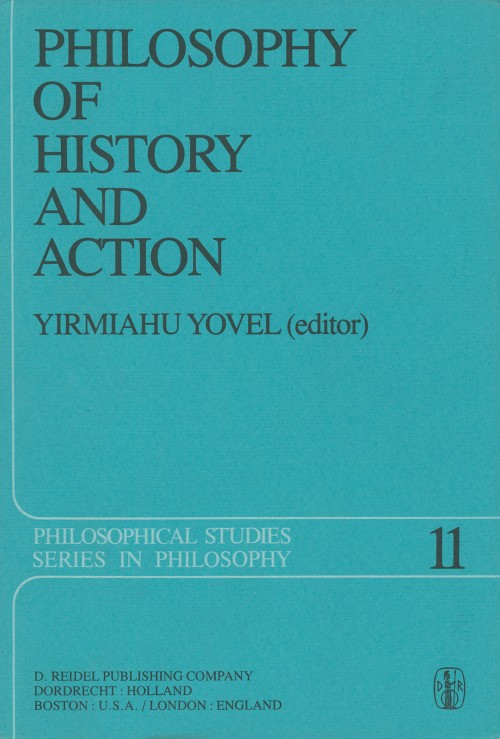
Philosophy of History and Action [electronic resource] : Papers Presented at the First Jerusalem Philosophical Encounter December 1974 / edited by Y. Yovel.
Erişim Adresi
ISBN
9789400993655
Dil Kodu
İngilizce
Yer Numarası
DK/9578
Basım Bildirimi
1st ed. 1978.
Yayın Bilgisi
Dordrecht : Springer Netherlands : Imprint: Springer, 1978.
Fiziksel Niteleme
254 p. online resource.
Dizi
Philosophical Studies Series, 2542-8349 ; 11
İçindekiler Notu
One: History, Interpretation and Action -- History and Hermeneutics -- Comments -- Historical Interpretation -- Comments -- Intending -- Comments -- Historical Actions or Historical Events -- Events -- Descriptions of Actions and their Place in History -- Two: The Philosophy of History from Kant to Sartre -- Kant and the History of Reason -- Hegel’s Sittlichkeit and the Crisis of Representative Institutions -- Comments -- Marx et les leçons de l’histoire -- Demokratie und die dialektische Theorie der Geschichte -- Transhistoricity and the Impossibility of Aufhebung: Remarks on J.-P. Sartre’s Philosophy of History -- Three: Fare Well to the Philosophy of History? -- Farewell to the Philosophy of History -- Is a Philosophy of History Possible?.
Özet, vb.
This volume contains the proceedings of the First Jerusalem Philosophical Encounter - started by the Hebrew University Institute of Philosophy (now the S. H. Bergman Centre for Philosophical Studies), which took place on December 28-31, 1974. In recent years the culture-gap that separates philosophers seems slowly - indeed much too slowly - to be narrowing. Although short circuits in communication still do happen and mutual disrespect has not vanished, it is becoming unfashionable to demonstrate ignorance of another philosophical tradition or to shrug it off with a supercilious smile. Perhaps dialectically, the insufficiency of any self-centred view that tries to immunize itself to challenges from without starts to disturb it from within. Moreover, as the culture- (and language-) bound nature of many philosophical divergencies is sinking more deeply into consciousness, the irony of an attitude of intolerance to them becomes more apparent. Our aim was to make a modest contribution to this development. We did not, however, mean to confuse genuine differences and problems in communication. Consequently, the more realistic term "encounter" was preferred to the idealizing "dialogue. " The Israeli hosts, themselves trained in a variety of philosophical traditions, felt that there is something in between real dialogue on the one hand and mutual estrangement on the other, and wished to provide a meeting place for it.
Konu
Philosophy __ History.
History of Philosophy.
History of Philosophy.
Diğer Yazarlar
Kurum Adı
Eseri Alıntıla
Referansları kullanmadan önce gözden geçirmeniz ve varsa gerekli düzeltmeleri yapmanız önerilir.
Dijital Kaynak
MARC Görünümü
LEADER 04688nam a22005295i 4500
001 808289
003 TR_AnAIT
005 20260131031931
007 cr nn 008mamaa
008 121227s1978 ne | s |||| 0|eng d
020 |a9789400993655|9978-94-009-9365-5
024 7 |a10.1007/978-94-009-9365-5|2doi
041 |aeng
049 |aTürk Tarih Kurumu Kütüphanesi
050 4|aB1-5802
072 7|aHPC|2bicssc
072 7|aPHI009000|2bisacsh
072 7|aQDH|2thema
082 04|a109|223
090 |aDK/9578
245 10|aPhilosophy of History and Action|h[electronic resource] :|bPapers Presented at the First Jerusalem Philosophical Encounter December 1974 /|cedited by Y. Yovel.
250 |a1st ed. 1978.
264 1|aDordrecht :|bSpringer Netherlands :|bImprint: Springer,|c1978.
300 |a254 p.|bonline resource.
336 |atext|btxt|2rdacontent
337 |acomputer|bc|2rdamedia
338 |aonline resource|bcr|2rdacarrier
347 |atext file|bPDF|2rda
490 1 |aPhilosophical Studies Series,|x2542-8349 ;|v11
505 0 |aOne: History, Interpretation and Action -- History and Hermeneutics -- Comments -- Historical Interpretation -- Comments -- Intending -- Comments -- Historical Actions or Historical Events -- Events -- Descriptions of Actions and their Place in History -- Two: The Philosophy of History from Kant to Sartre -- Kant and the History of Reason -- Hegel’s Sittlichkeit and the Crisis of Representative Institutions -- Comments -- Marx et les leçons de l’histoire -- Demokratie und die dialektische Theorie der Geschichte -- Transhistoricity and the Impossibility of Aufhebung: Remarks on J.-P. Sartre’s Philosophy of History -- Three: Fare Well to the Philosophy of History? -- Farewell to the Philosophy of History -- Is a Philosophy of History Possible?.
520 |aThis volume contains the proceedings of the First Jerusalem Philosophical Encounter - started by the Hebrew University Institute of Philosophy (now the S. H. Bergman Centre for Philosophical Studies), which took place on December 28-31, 1974. In recent years the culture-gap that separates philosophers seems slowly - indeed much too slowly - to be narrowing. Although short circuits in communication still do happen and mutual disrespect has not vanished, it is becoming unfashionable to demonstrate ignorance of another philosophical tradition or to shrug it off with a supercilious smile. Perhaps dialectically, the insufficiency of any self-centred view that tries to immunize itself to challenges from without starts to disturb it from within. Moreover, as the culture- (and language-) bound nature of many philosophical divergencies is sinking more deeply into consciousness, the irony of an attitude of intolerance to them becomes more apparent. Our aim was to make a modest contribution to this development. We did not, however, mean to confuse genuine differences and problems in communication. Consequently, the more realistic term "encounter" was preferred to the idealizing "dialogue. " The Israeli hosts, themselves trained in a variety of philosophical traditions, felt that there is something in between real dialogue on the one hand and mutual estrangement on the other, and wished to provide a meeting place for it.
532 8 |aAccessibility summary: This PDF is not accessible. It is based on scanned pages and does not support features such as screen reader compatibility or described non-text content (images, graphs etc). However, it likely supports searchable and selectable text based on OCR (Optical Character Recognition). Users with accessibility needs may not be able to use this content effectively. Please contact us at accessibilitysupport@springernature.com if you require assistance or an alternative format.
532 8 |aInaccessible, or known limited accessibility
532 8 |aNo reading system accessibility options actively disabled
532 8 |aPublisher contact for further accessibility information: accessibilitysupport@springernature.com
650 0|aPhilosophy|xHistory.
650 14|aHistory of Philosophy.
700 1 |aYovel, Y.|eeditor.|4edt|4http://id.loc.gov/vocabulary/relators/edt
710 2 |aSpringerLink (Online service)
773 0 |tSpringer Nature eBook
776 08|iPrinted edition:|z9789027708908
776 08|iPrinted edition:|z9789400993662
776 08|iPrinted edition:|z9789400993679
830 0|aPhilosophical Studies Series,|x2542-8349 ;|v11
856 40|uhttps://doi.org/10.1007/978-94-009-9365-5
912 |aZDB-2-SHU
912 |aZDB-2-SXPR
912 |aZDB-2-BAE
950 |aHumanities, Social Sciences and Law (SpringerNature-11648)
950 |aPhilosophy and Religion (R0) (SpringerNature-43725)
001 808289
003 TR_AnAIT
005 20260131031931
007 cr nn 008mamaa
008 121227s1978 ne | s |||| 0|eng d
020 |a9789400993655|9978-94-009-9365-5
024 7 |a10.1007/978-94-009-9365-5|2doi
041 |aeng
049 |aTürk Tarih Kurumu Kütüphanesi
050 4|aB1-5802
072 7|aHPC|2bicssc
072 7|aPHI009000|2bisacsh
072 7|aQDH|2thema
082 04|a109|223
090 |aDK/9578
245 10|aPhilosophy of History and Action|h[electronic resource] :|bPapers Presented at the First Jerusalem Philosophical Encounter December 1974 /|cedited by Y. Yovel.
250 |a1st ed. 1978.
264 1|aDordrecht :|bSpringer Netherlands :|bImprint: Springer,|c1978.
300 |a254 p.|bonline resource.
336 |atext|btxt|2rdacontent
337 |acomputer|bc|2rdamedia
338 |aonline resource|bcr|2rdacarrier
347 |atext file|bPDF|2rda
490 1 |aPhilosophical Studies Series,|x2542-8349 ;|v11
505 0 |aOne: History, Interpretation and Action -- History and Hermeneutics -- Comments -- Historical Interpretation -- Comments -- Intending -- Comments -- Historical Actions or Historical Events -- Events -- Descriptions of Actions and their Place in History -- Two: The Philosophy of History from Kant to Sartre -- Kant and the History of Reason -- Hegel’s Sittlichkeit and the Crisis of Representative Institutions -- Comments -- Marx et les leçons de l’histoire -- Demokratie und die dialektische Theorie der Geschichte -- Transhistoricity and the Impossibility of Aufhebung: Remarks on J.-P. Sartre’s Philosophy of History -- Three: Fare Well to the Philosophy of History? -- Farewell to the Philosophy of History -- Is a Philosophy of History Possible?.
520 |aThis volume contains the proceedings of the First Jerusalem Philosophical Encounter - started by the Hebrew University Institute of Philosophy (now the S. H. Bergman Centre for Philosophical Studies), which took place on December 28-31, 1974. In recent years the culture-gap that separates philosophers seems slowly - indeed much too slowly - to be narrowing. Although short circuits in communication still do happen and mutual disrespect has not vanished, it is becoming unfashionable to demonstrate ignorance of another philosophical tradition or to shrug it off with a supercilious smile. Perhaps dialectically, the insufficiency of any self-centred view that tries to immunize itself to challenges from without starts to disturb it from within. Moreover, as the culture- (and language-) bound nature of many philosophical divergencies is sinking more deeply into consciousness, the irony of an attitude of intolerance to them becomes more apparent. Our aim was to make a modest contribution to this development. We did not, however, mean to confuse genuine differences and problems in communication. Consequently, the more realistic term "encounter" was preferred to the idealizing "dialogue. " The Israeli hosts, themselves trained in a variety of philosophical traditions, felt that there is something in between real dialogue on the one hand and mutual estrangement on the other, and wished to provide a meeting place for it.
532 8 |aAccessibility summary: This PDF is not accessible. It is based on scanned pages and does not support features such as screen reader compatibility or described non-text content (images, graphs etc). However, it likely supports searchable and selectable text based on OCR (Optical Character Recognition). Users with accessibility needs may not be able to use this content effectively. Please contact us at accessibilitysupport@springernature.com if you require assistance or an alternative format.
532 8 |aInaccessible, or known limited accessibility
532 8 |aNo reading system accessibility options actively disabled
532 8 |aPublisher contact for further accessibility information: accessibilitysupport@springernature.com
650 0|aPhilosophy|xHistory.
650 14|aHistory of Philosophy.
700 1 |aYovel, Y.|eeditor.|4edt|4http://id.loc.gov/vocabulary/relators/edt
710 2 |aSpringerLink (Online service)
773 0 |tSpringer Nature eBook
776 08|iPrinted edition:|z9789027708908
776 08|iPrinted edition:|z9789400993662
776 08|iPrinted edition:|z9789400993679
830 0|aPhilosophical Studies Series,|x2542-8349 ;|v11
856 40|uhttps://doi.org/10.1007/978-94-009-9365-5
912 |aZDB-2-SHU
912 |aZDB-2-SXPR
912 |aZDB-2-BAE
950 |aHumanities, Social Sciences and Law (SpringerNature-11648)
950 |aPhilosophy and Religion (R0) (SpringerNature-43725)
Materyaller
Depodan talep edilen materyal sadece kütüphane içerisinde kullanılmaktadır.
Materyal dışarıya ödünç verilmemektedir.
Materyal dışarıya ödünç verilmemektedir.
