

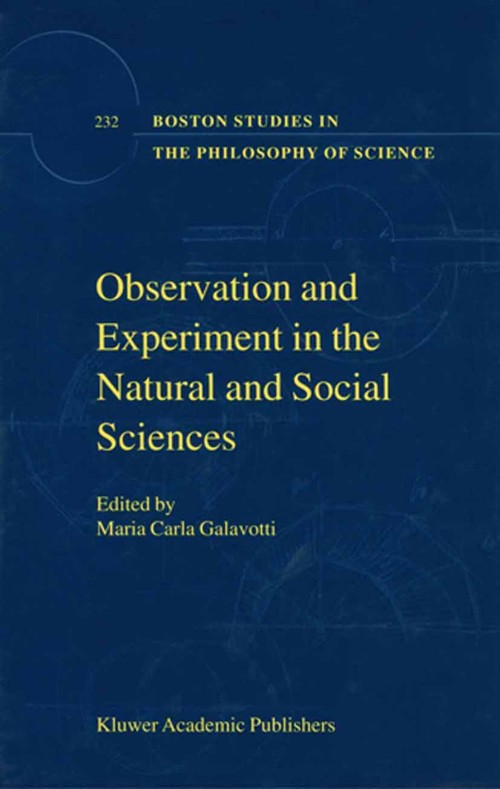
Observation and Experiment in the Natural and Social Sciences [electronic resource] / edited by Maria Carla Galavotti.
Erişim Adresi
ISBN
9780306481239
Dil Kodu
İngilizce
Yer Numarası
DK/9582
Basım Bildirimi
1st ed. 2003.
Yayın Bilgisi
Dordrecht : Springer Netherlands : Imprint: Springer, 2003.
Fiziksel Niteleme
X, 357 p. 8 illus. online resource.
Dizi
Boston Studies in the Philosophy and History of Science, 2214-7942 ; 232
İçindekiler Notu
From Throry to Experiment and Back Again -- NaÏve Probability -- From Theory to Experiments and Back Again ... and Back Again ... Comments on Patrick Suppes -- Emergence and Future of Experimental Economics -- Rationality in Experimental Economics: An Analysis of Reinhard Selten’s Approach -- Experiments, Heuristics and Social Diversity: A Comment on Reinhard Selten -- Where do New Ideas Come From? a Heuristics of Discovery in the Cognitive Sciences -- Comments on Gerd Gigerenzer -- On the Concept of Discovery Comments on Gerd Gigerenzer -- Styles of Experimentation -- On French Concepts and Objects Comments on Ursula Klein -- Some Comments on “Styles of Experimentation” by Ursula Klein -- Improving “Styles of Experimentation” a Comment on Ursula Klein -- Experiments and Thought Experiments in Natural Science -- The Advantages of Theft Over Honest Toil Comments on David Atkinson -- Thinking About Thought Experiments in Physics Comment on “Experiments and Thought Experiments in Natural Science” -- The Dynamics of Thought Experiments A Comment on David Atkinson -- An Attempt at a Philosophy of Experiment -- An Attempt at a Philosophy of Experimental Error a Comment on Giora Hon -- O Happy Error a Comment on Giora Hon -- Bayesian Evidence -- On Bayesian Logic Comments on Colin Howson -- On Bayesian Induction (and Pythagoric Arithmetic) -- Probability and Logic Comments on Colin Howson.
Özet, vb.
According to a long tradition in philosophy of science, a clear cut distinction can be traced between a context of discovery and a context of justification. This tradition dates back to the birth of the discipline in connection with the Circles of Vienna and Berlin, in the twenties and thirties of last century. Convicted that only the context of justification is pertinent to philosophy of science, logical empiricists identified its goal with the “rational reconstruction” of scientific knowledge, taken as the clarification of the logical structure of science, through an analysis of its language and methods. Stressing justification as the proper field of application of philosophy of science, logical empiricists intended to leave discovery out of its remit. The context of discovery was then discarded from philosophy of science and left to sociology, psychology and history. The distinction between context of discovery and context of justification goes hand in hand with the tenet that the theoretical side of science can – and should – be kept separate from its observational and experimental components. Further, the final, abstract formulation of theories should be analysed apart from the process behind it, resulting from a tangle of context-dependent factors. This conviction is reflected by the distinction between theoretical and observational sentences underpinning the Hempelian view of theories as nets, whose knots represent theoretical terms, floating on the plane of observation, to which it is anchored by rules of interpretation.
Konu
Science __ Philosophy.
Knowledge, Theory of.
Philosophy of nature.
Philosophy of Science.
Epistemology.
Philosophy of Nature.
Knowledge, Theory of.
Philosophy of nature.
Philosophy of Science.
Epistemology.
Philosophy of Nature.
Diğer Yazarlar
Kurum Adı
Eseri Alıntıla
Referansları kullanmadan önce gözden geçirmeniz ve varsa gerekli düzeltmeleri yapmanız önerilir.
Dijital Kaynak
MARC Görünümü
LEADER 04917nam a22005415i 4500
001 808293
003 TR_AnAIT
005 20260131031920
007 cr nn 008mamaa
008 100301s2003 ne | s |||| 0|eng d
020 |a9780306481239|9978-0-306-48123-9
024 7 |a10.1007/0-306-48123-5|2doi
041 |aeng
049 |aTürk Tarih Kurumu Kütüphanesi
050 4|aQ174-175.3
050 4|aB67
072 7|aPDA|2bicssc
072 7|aSCI075000|2bisacsh
072 7|aPDA|2thema
082 04|a501|223
090 |aDK/9582
245 10|aObservation and Experiment in the Natural and Social Sciences|h[electronic resource] /|cedited by Maria Carla Galavotti.
250 |a1st ed. 2003.
264 1|aDordrecht :|bSpringer Netherlands :|bImprint: Springer,|c2003.
300 |aX, 357 p. 8 illus.|bonline resource.
336 |atext|btxt|2rdacontent
337 |acomputer|bc|2rdamedia
338 |aonline resource|bcr|2rdacarrier
347 |atext file|bPDF|2rda
490 1 |aBoston Studies in the Philosophy and History of Science,|x2214-7942 ;|v232
505 0 |aFrom Throry to Experiment and Back Again -- NaÏve Probability -- From Theory to Experiments and Back Again ... and Back Again ... Comments on Patrick Suppes -- Emergence and Future of Experimental Economics -- Rationality in Experimental Economics: An Analysis of Reinhard Selten’s Approach -- Experiments, Heuristics and Social Diversity: A Comment on Reinhard Selten -- Where do New Ideas Come From? a Heuristics of Discovery in the Cognitive Sciences -- Comments on Gerd Gigerenzer -- On the Concept of Discovery Comments on Gerd Gigerenzer -- Styles of Experimentation -- On French Concepts and Objects Comments on Ursula Klein -- Some Comments on “Styles of Experimentation” by Ursula Klein -- Improving “Styles of Experimentation” a Comment on Ursula Klein -- Experiments and Thought Experiments in Natural Science -- The Advantages of Theft Over Honest Toil Comments on David Atkinson -- Thinking About Thought Experiments in Physics Comment on “Experiments and Thought Experiments in Natural Science” -- The Dynamics of Thought Experiments A Comment on David Atkinson -- An Attempt at a Philosophy of Experiment -- An Attempt at a Philosophy of Experimental Error a Comment on Giora Hon -- O Happy Error a Comment on Giora Hon -- Bayesian Evidence -- On Bayesian Logic Comments on Colin Howson -- On Bayesian Induction (and Pythagoric Arithmetic) -- Probability and Logic Comments on Colin Howson.
520 |aAccording to a long tradition in philosophy of science, a clear cut distinction can be traced between a context of discovery and a context of justification. This tradition dates back to the birth of the discipline in connection with the Circles of Vienna and Berlin, in the twenties and thirties of last century. Convicted that only the context of justification is pertinent to philosophy of science, logical empiricists identified its goal with the “rational reconstruction” of scientific knowledge, taken as the clarification of the logical structure of science, through an analysis of its language and methods. Stressing justification as the proper field of application of philosophy of science, logical empiricists intended to leave discovery out of its remit. The context of discovery was then discarded from philosophy of science and left to sociology, psychology and history. The distinction between context of discovery and context of justification goes hand in hand with the tenet that the theoretical side of science can – and should – be kept separate from its observational and experimental components. Further, the final, abstract formulation of theories should be analysed apart from the process behind it, resulting from a tangle of context-dependent factors. This conviction is reflected by the distinction between theoretical and observational sentences underpinning the Hempelian view of theories as nets, whose knots represent theoretical terms, floating on the plane of observation, to which it is anchored by rules of interpretation.
650 0|aScience|xPhilosophy.
650 0|aKnowledge, Theory of.
650 0|aPhilosophy of nature.
650 14|aPhilosophy of Science.
650 24|aEpistemology.
650 24|aPhilosophy of Nature.
700 1 |aGalavotti, Maria Carla.|eeditor.|4edt|4http://id.loc.gov/vocabulary/relators/edt
710 2 |aSpringerLink (Online service)
773 0 |tSpringer Nature eBook
776 08|iPrinted edition:|z9781402012518
776 08|iPrinted edition:|z9789048162789
776 08|iPrinted edition:|z9789401742078
830 0|aBoston Studies in the Philosophy and History of Science,|x2214-7942 ;|v232
856 40|uhttps://doi.org/10.1007/0-306-48123-5
912 |aZDB-2-SHU
912 |aZDB-2-SXPR
912 |aZDB-2-BAE
950 |aHumanities, Social Sciences and Law (SpringerNature-11648)
950 |aPhilosophy and Religion (R0) (SpringerNature-43725)
001 808293
003 TR_AnAIT
005 20260131031920
007 cr nn 008mamaa
008 100301s2003 ne | s |||| 0|eng d
020 |a9780306481239|9978-0-306-48123-9
024 7 |a10.1007/0-306-48123-5|2doi
041 |aeng
049 |aTürk Tarih Kurumu Kütüphanesi
050 4|aQ174-175.3
050 4|aB67
072 7|aPDA|2bicssc
072 7|aSCI075000|2bisacsh
072 7|aPDA|2thema
082 04|a501|223
090 |aDK/9582
245 10|aObservation and Experiment in the Natural and Social Sciences|h[electronic resource] /|cedited by Maria Carla Galavotti.
250 |a1st ed. 2003.
264 1|aDordrecht :|bSpringer Netherlands :|bImprint: Springer,|c2003.
300 |aX, 357 p. 8 illus.|bonline resource.
336 |atext|btxt|2rdacontent
337 |acomputer|bc|2rdamedia
338 |aonline resource|bcr|2rdacarrier
347 |atext file|bPDF|2rda
490 1 |aBoston Studies in the Philosophy and History of Science,|x2214-7942 ;|v232
505 0 |aFrom Throry to Experiment and Back Again -- NaÏve Probability -- From Theory to Experiments and Back Again ... and Back Again ... Comments on Patrick Suppes -- Emergence and Future of Experimental Economics -- Rationality in Experimental Economics: An Analysis of Reinhard Selten’s Approach -- Experiments, Heuristics and Social Diversity: A Comment on Reinhard Selten -- Where do New Ideas Come From? a Heuristics of Discovery in the Cognitive Sciences -- Comments on Gerd Gigerenzer -- On the Concept of Discovery Comments on Gerd Gigerenzer -- Styles of Experimentation -- On French Concepts and Objects Comments on Ursula Klein -- Some Comments on “Styles of Experimentation” by Ursula Klein -- Improving “Styles of Experimentation” a Comment on Ursula Klein -- Experiments and Thought Experiments in Natural Science -- The Advantages of Theft Over Honest Toil Comments on David Atkinson -- Thinking About Thought Experiments in Physics Comment on “Experiments and Thought Experiments in Natural Science” -- The Dynamics of Thought Experiments A Comment on David Atkinson -- An Attempt at a Philosophy of Experiment -- An Attempt at a Philosophy of Experimental Error a Comment on Giora Hon -- O Happy Error a Comment on Giora Hon -- Bayesian Evidence -- On Bayesian Logic Comments on Colin Howson -- On Bayesian Induction (and Pythagoric Arithmetic) -- Probability and Logic Comments on Colin Howson.
520 |aAccording to a long tradition in philosophy of science, a clear cut distinction can be traced between a context of discovery and a context of justification. This tradition dates back to the birth of the discipline in connection with the Circles of Vienna and Berlin, in the twenties and thirties of last century. Convicted that only the context of justification is pertinent to philosophy of science, logical empiricists identified its goal with the “rational reconstruction” of scientific knowledge, taken as the clarification of the logical structure of science, through an analysis of its language and methods. Stressing justification as the proper field of application of philosophy of science, logical empiricists intended to leave discovery out of its remit. The context of discovery was then discarded from philosophy of science and left to sociology, psychology and history. The distinction between context of discovery and context of justification goes hand in hand with the tenet that the theoretical side of science can – and should – be kept separate from its observational and experimental components. Further, the final, abstract formulation of theories should be analysed apart from the process behind it, resulting from a tangle of context-dependent factors. This conviction is reflected by the distinction between theoretical and observational sentences underpinning the Hempelian view of theories as nets, whose knots represent theoretical terms, floating on the plane of observation, to which it is anchored by rules of interpretation.
650 0|aScience|xPhilosophy.
650 0|aKnowledge, Theory of.
650 0|aPhilosophy of nature.
650 14|aPhilosophy of Science.
650 24|aEpistemology.
650 24|aPhilosophy of Nature.
700 1 |aGalavotti, Maria Carla.|eeditor.|4edt|4http://id.loc.gov/vocabulary/relators/edt
710 2 |aSpringerLink (Online service)
773 0 |tSpringer Nature eBook
776 08|iPrinted edition:|z9781402012518
776 08|iPrinted edition:|z9789048162789
776 08|iPrinted edition:|z9789401742078
830 0|aBoston Studies in the Philosophy and History of Science,|x2214-7942 ;|v232
856 40|uhttps://doi.org/10.1007/0-306-48123-5
912 |aZDB-2-SHU
912 |aZDB-2-SXPR
912 |aZDB-2-BAE
950 |aHumanities, Social Sciences and Law (SpringerNature-11648)
950 |aPhilosophy and Religion (R0) (SpringerNature-43725)
Materyaller
Depodan talep edilen materyal sadece kütüphane içerisinde kullanılmaktadır.
Materyal dışarıya ödünç verilmemektedir.
Materyal dışarıya ödünç verilmemektedir.
