LEADER 03803nam a22005535i 4500
001 808318
003 TR_AnAIT
005 20260131031809
007 cr nn 008mamaa
008 110106s2011 ne | s |||| 0|eng d
020 |a9789048198030|9978-90-481-9803-0
024 7 |a10.1007/978-90-481-9803-0|2doi
041 |aeng
049 |aTürk Tarih Kurumu Kütüphanesi
050 4|aQA10.92-20
072 7|aJNU|2bicssc
072 7|aPB|2bicssc
072 7|aEDU029010|2bisacsh
072 7|aJNU|2thema
072 7|aPB|2thema
082 04|a510.71|223
090 |aDK/9607
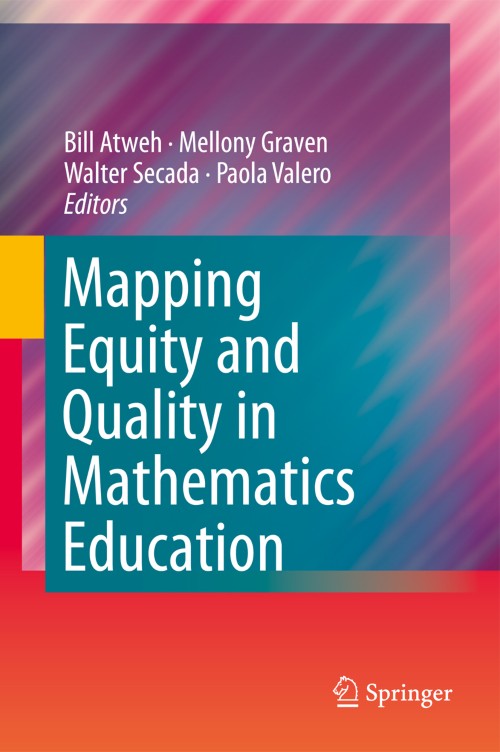
245 10|aMapping Equity and Quality in Mathematics Education|h[electronic resource] /|cedited by Bill Atweh, Mellony Graven, Walter Secada, Paola Valero.
250 |a1st ed. 2011.
264 1|aDordrecht :|bSpringer Netherlands :|bImprint: Springer,|c2011.
300 |aXXXV, 624 p.|bonline resource.
336 |atext|btxt|2rdacontent
337 |acomputer|bc|2rdamedia
338 |aonline resource|bcr|2rdacarrier
347 |atext file|bPDF|2rda
505 0 |aContributors -- Dedication -- Preface -- Part 1: The Theoretical Landscape -- Part 2: Mapping Social Construction and Complexities -- Part 3: Landmarks of Concern -- Part 4: No Highway and No Destination?
520 |aThe issues of equity and quality have been central to international debates on mathematics in research, policy, curriculum and teaching. This book covers a wide variety of topics in the research and practice of mathematics education, demonstrating how equity and quality are inherently political terms whose political bedrock is obscured by them being taken for granted. Mapping Equity and Quality in Mathematics Education is broken into four parts. Section 1 addresses the constructs of equity and quality from a variety of theoretical perspectives and outlines new directions to approach the question, “What are equity and quality?” Section 2 discusses the complexities in which the discourses of equity and quality move in constant construction and recontextualisation from societal trends to the constitution of subjectivities, passing through policy, the media and pedagogy. Section 3 covers insights and implications from research on the special needs of different “equity groups,” illuminating the way in which a “one-size-fits-all” approach tends to limit quality education to only dominant groups. And Section 4 contains lessons learned by researchers and practitioners who attempted to manage equity and quality within various educational contexts and with a variety of marginalized populations. Written by teachers, researchers and academics from all over the world, this book represents a powerful response to the international call for quality education of all students in mathematics around the globe. .
650 0|aMathematics|xStudy and teaching .
650 0|aEducation and state.
650 0|aEducational sociology.
650 14|aMathematics Education.
650 24|aEducational Policy and Politics.
650 24|aSociology of Education.
700 1 |aAtweh, Bill.|eeditor.|4edt|4http://id.loc.gov/vocabulary/relators/edt
700 1 |aGraven, Mellony.|eeditor.|4edt|4http://id.loc.gov/vocabulary/relators/edt
700 1 |aSecada, Walter.|eeditor.|4edt|4http://id.loc.gov/vocabulary/relators/edt
700 1 |aValero, Paola.|eeditor.|4edt|4http://id.loc.gov/vocabulary/relators/edt
710 2 |aSpringerLink (Online service)
773 0 |tSpringer Nature eBook
776 08|iPrinted edition:|z9789048198023
776 08|iPrinted edition:|z9789048198047
776 08|iPrinted edition:|z9789400790032
856 40|uhttps://doi.org/10.1007/978-90-481-9803-0
912 |aZDB-2-SHU
912 |aZDB-2-SXED
950 |aHumanities, Social Sciences and Law (SpringerNature-11648)
950 |aEducation (R0) (SpringerNature-43721)