

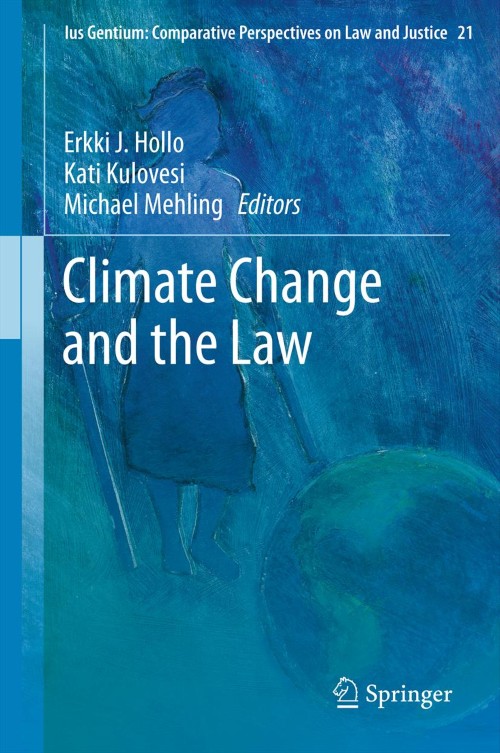
Climate Change and the Law [electronic resource] / edited by Erkki J. Hollo, Kati Kulovesi, Michael Mehling.
Erişim Adresi
ISBN
9789400754409
Dil Kodu
İngilizce
Yer Numarası
DK/9638
Basım Bildirimi
1st ed. 2013.
Yayın Bilgisi
Dordrecht : Springer Netherlands : Imprint: Springer, 2013.
Fiziksel Niteleme
XXI, 693 p. 4 illus., 1 illus. in color. online resource.
Dizi
Ius Gentium: Comparative Perspectives on Law and Justice, 2214-9902 ; 21
İçindekiler Notu
Table of Contents -- Contributors -- Abbreviations -- 1. Introduction: Climate Change and the Law; Erkki J. Hollo, Kati Kulovesi and Michael Mehling -- Part I: Climate Law as an Emerging Discipline -- 2. Implementing Climate Law: Instrument Choice and Interaction; Michael Mehling -- 3. Exploring the Landscape of Climate Law and Scholarship: Two Emerging Trends; Kati Kulovesi -- 4. Climate Change and Justice: Perspectives of Legal Theory; Felix Ekardt -- Part II: International Climate Law -- Section I: Architecture and Institutions -- 5. Foundations of International Climate Law: Objectives, Principles and Methods; Rowena Maguire -- 6. Alternative Venues of Climate Cooperation: An Institutional Perspective; Camilla Bausch and Michael Mehling -- 7. Analyzing Soft Law and Hard Law in Climate Change; Antto Vihma -- 8. Compliance and Enforcement in the Climate Change Regime; Meinhard Doelle -- Section II: Cross-Cutting Issues -- 9. The New Framework for Climate Finance under the United Nations Framework Convention on Climate Change: A Breakthrough or an Empty Promise?; Yulia Yamineva and Kati Kulovesi -- 10. Climate Justice: The Clean Development Mechanism as a Case Study; Tomilola Eni-ibukun -- 11. Legal Aspects of Climate Change Adaptation; Jonathan Verschuuren -- 12. Climate Change and Human Rights; Timo Koivurova, Sébastien Duyck and Leena Heinämäki -- Section III: Sectoral Issues -- 13. Managing the Fragmentation of International Climate Law; Harro van Asselt -- 14. No Need to Reinvent the Wheel for a Human Rights-Based Approach to Tackling Climate Change: The Contribution of International Biodiversity Law; Elisa Morgera -- 15. The Role of REDD in the Harmonization of Overlapping International Obligations; Annalisa Savaresi -- 16. Climate Change and Trade: At the Intersection of Two International Legal Regimes; Kati Kulovesi -- 17. Climate Law and Geoengineering; Ralph Bodle -- Part III: Comparative Climate Law -- 18. Climate Law in the United States: Facing Structural andProcedural Barriers; Michael Mehling and David Frenkil -- 19. Canada and the Kyoto Protocol: An Aesop Fable; Jane Matthews Glenn and Jose Otero -- 20. Climate Law in the European Union: Accidental Success or Deliberate Leadership?; Michael Mehling and Kati Kulovesi -- 21. Climate Law in Germany; Felix Ekardt -- 22. Climate Law in the United Kingdom; Colin T. Reid -- 23. Climate Law and Policy in Russia: A Peasant Needs Thunder to Cross Himself and Wonder; Yulia Yamineva -- 24. Australia: From ‘No Regrets’ to A Clean Energy Future?; Sharon Mascher and David Hodgkinson -- 25. Climate Law and Policy in Japan; Hitomi Kimura -- 26. Sustainable Development and Climate Policy and Law in China; Christopher Tung -- 27. India’s Evolving Climate Change Strategy; Namrata Patodia Rastogi -- 28. Climate Change Responses in South Africa; Ed Couzens and Michael Kidd -- 29. Climate Change Policy and Legislation in Brazil; Haroldo Machado Filho -- 30. Climate Law in Latin American Countries; Soledad Aguilar and Eugenia Recio.
Özet, vb.
Climate Change and the Law is the first scholarly effort to systematically address doctrinal issues related to climate law as an emergent legal discipline. It assembles some of the most recognized experts in the field to identify relevant trends and common themes from a variety of geographic and professional perspectives. In a remarkably short time span, climate change has become deeply embedded in important areas of the law. As a global challenge calling for collective action, climate change has elicited substantial rulemaking at the international plane, percolating through the broader legal system to the regional, national and local levels. More than other areas of law, the normative and practical framework dedicated to climate change has embraced new instruments and softened traditional boundaries between formal and informal, public and private, substantive and procedural; so ubiquitous is the reach of relevant rules nowadays that scholars routinely devote attention to the intersection of climate change and more established fields of legal study, such as international trade law. Climate Change and the Law explores the rich diversity of international, regional, national, sub-national and transnational legal responses to climate change. Is climate law emerging as a new legal discipline? If so, what shared objectives and concepts define it? How does climate law relate to other areas of law? Such questions lie at the heart of this new book, whose thirty chapters cover doctrinal questions as well as a range of thematic and regional case studies. As Christiana Figueres, Executive Secretary of the United Nations Framework Convention on Climate Change (UNFCCC), states in her preface, these chapters collectively provide a “review of the emergence of a new discipline, its core principles and legal techniques, and its relationship and potential interaction with other disciplines.”.
Konu
Private international law.
Conflict of laws.
International law.
Comparative law.
Climatology.
Renewable energy sources.
Business.
Management science.
Private International Law, International and Foreign Law, Comparative Law.
Climate Sciences.
Renewable Energy.
Business and Management.
Conflict of laws.
International law.
Comparative law.
Climatology.
Renewable energy sources.
Business.
Management science.
Private International Law, International and Foreign Law, Comparative Law.
Climate Sciences.
Renewable Energy.
Business and Management.
Diğer Yazarlar
Kurum Adı
Eseri Alıntıla
Referansları kullanmadan önce gözden geçirmeniz ve varsa gerekli düzeltmeleri yapmanız önerilir.
Dijital Kaynak
MARC Görünümü
LEADER 07343nam a22006375i 4500
001 808349
003 TR_AnAIT
005 20260131031600
007 cr nn 008mamaa
008 121205s2013 ne | s |||| 0|eng d
020 |a9789400754409|9978-94-007-5440-9
024 7 |a10.1007/978-94-007-5440-9|2doi
041 |aeng
049 |aTürk Tarih Kurumu Kütüphanesi
050 4|aK7000-7720.22
072 7|aLB|2bicssc
072 7|aLAM|2bicssc
072 7|aLAW051000|2bisacsh
072 7|aLB|2thema
072 7|aLAM|2thema
082 04|a340.9|223
090 |aDK/9638
245 10|aClimate Change and the Law|h[electronic resource] /|cedited by Erkki J. Hollo, Kati Kulovesi, Michael Mehling.
250 |a1st ed. 2013.
264 1|aDordrecht :|bSpringer Netherlands :|bImprint: Springer,|c2013.
300 |aXXI, 693 p. 4 illus., 1 illus. in color.|bonline resource.
336 |atext|btxt|2rdacontent
337 |acomputer|bc|2rdamedia
338 |aonline resource|bcr|2rdacarrier
347 |atext file|bPDF|2rda
490 1 |aIus Gentium: Comparative Perspectives on Law and Justice,|x2214-9902 ;|v21
505 0 |aTable of Contents -- Contributors -- Abbreviations -- 1. Introduction: Climate Change and the Law; Erkki J. Hollo, Kati Kulovesi and Michael Mehling -- Part I: Climate Law as an Emerging Discipline -- 2. Implementing Climate Law: Instrument Choice and Interaction; Michael Mehling -- 3. Exploring the Landscape of Climate Law and Scholarship: Two Emerging Trends; Kati Kulovesi -- 4. Climate Change and Justice: Perspectives of Legal Theory; Felix Ekardt -- Part II: International Climate Law -- Section I: Architecture and Institutions -- 5. Foundations of International Climate Law: Objectives, Principles and Methods; Rowena Maguire -- 6. Alternative Venues of Climate Cooperation: An Institutional Perspective; Camilla Bausch and Michael Mehling -- 7. Analyzing Soft Law and Hard Law in Climate Change; Antto Vihma -- 8. Compliance and Enforcement in the Climate Change Regime; Meinhard Doelle -- Section II: Cross-Cutting Issues -- 9. The New Framework for Climate Finance under the United Nations Framework Convention on Climate Change: A Breakthrough or an Empty Promise?; Yulia Yamineva and Kati Kulovesi -- 10. Climate Justice: The Clean Development Mechanism as a Case Study; Tomilola Eni-ibukun -- 11. Legal Aspects of Climate Change Adaptation; Jonathan Verschuuren -- 12. Climate Change and Human Rights; Timo Koivurova, Sébastien Duyck and Leena Heinämäki -- Section III: Sectoral Issues -- 13. Managing the Fragmentation of International Climate Law; Harro van Asselt -- 14. No Need to Reinvent the Wheel for a Human Rights-Based Approach to Tackling Climate Change: The Contribution of International Biodiversity Law; Elisa Morgera -- 15. The Role of REDD in the Harmonization of Overlapping International Obligations; Annalisa Savaresi -- 16. Climate Change and Trade: At the Intersection of Two International Legal Regimes; Kati Kulovesi -- 17. Climate Law and Geoengineering; Ralph Bodle -- Part III: Comparative Climate Law -- 18. Climate Law in the United States: Facing Structural andProcedural Barriers; Michael Mehling and David Frenkil -- 19. Canada and the Kyoto Protocol: An Aesop Fable; Jane Matthews Glenn and Jose Otero -- 20. Climate Law in the European Union: Accidental Success or Deliberate Leadership?; Michael Mehling and Kati Kulovesi -- 21. Climate Law in Germany; Felix Ekardt -- 22. Climate Law in the United Kingdom; Colin T. Reid -- 23. Climate Law and Policy in Russia: A Peasant Needs Thunder to Cross Himself and Wonder; Yulia Yamineva -- 24. Australia: From ‘No Regrets’ to A Clean Energy Future?; Sharon Mascher and David Hodgkinson -- 25. Climate Law and Policy in Japan; Hitomi Kimura -- 26. Sustainable Development and Climate Policy and Law in China; Christopher Tung -- 27. India’s Evolving Climate Change Strategy; Namrata Patodia Rastogi -- 28. Climate Change Responses in South Africa; Ed Couzens and Michael Kidd -- 29. Climate Change Policy and Legislation in Brazil; Haroldo Machado Filho -- 30. Climate Law in Latin American Countries; Soledad Aguilar and Eugenia Recio.
520 |aClimate Change and the Law is the first scholarly effort to systematically address doctrinal issues related to climate law as an emergent legal discipline. It assembles some of the most recognized experts in the field to identify relevant trends and common themes from a variety of geographic and professional perspectives. In a remarkably short time span, climate change has become deeply embedded in important areas of the law. As a global challenge calling for collective action, climate change has elicited substantial rulemaking at the international plane, percolating through the broader legal system to the regional, national and local levels. More than other areas of law, the normative and practical framework dedicated to climate change has embraced new instruments and softened traditional boundaries between formal and informal, public and private, substantive and procedural; so ubiquitous is the reach of relevant rules nowadays that scholars routinely devote attention to the intersection of climate change and more established fields of legal study, such as international trade law. Climate Change and the Law explores the rich diversity of international, regional, national, sub-national and transnational legal responses to climate change. Is climate law emerging as a new legal discipline? If so, what shared objectives and concepts define it? How does climate law relate to other areas of law? Such questions lie at the heart of this new book, whose thirty chapters cover doctrinal questions as well as a range of thematic and regional case studies. As Christiana Figueres, Executive Secretary of the United Nations Framework Convention on Climate Change (UNFCCC), states in her preface, these chapters collectively provide a “review of the emergence of a new discipline, its core principles and legal techniques, and its relationship and potential interaction with other disciplines.”.
650 0|aPrivate international law.
650 0|aConflict of laws.
650 0|aInternational law.
650 0|aComparative law.
650 0|aClimatology.
650 0|aRenewable energy sources.
650 0|aBusiness.
650 0|aManagement science.
650 14|aPrivate International Law, International and Foreign Law, Comparative Law.
650 24|aClimate Sciences.
650 24|aRenewable Energy.
650 24|aBusiness and Management.
700 1 |aHollo, Erkki J.|eeditor.|4edt|4http://id.loc.gov/vocabulary/relators/edt
700 1 |aKulovesi, Kati.|eeditor.|4edt|4http://id.loc.gov/vocabulary/relators/edt
700 1 |aMehling, Michael.|eeditor.|4edt|4http://id.loc.gov/vocabulary/relators/edt
710 2 |aSpringerLink (Online service)
773 0 |tSpringer Nature eBook
776 08|iPrinted edition:|z9789400754393
776 08|iPrinted edition:|z9789400754416
776 08|iPrinted edition:|z9789401778657
830 0|aIus Gentium: Comparative Perspectives on Law and Justice,|x2214-9902 ;|v21
856 40|uhttps://doi.org/10.1007/978-94-007-5440-9
912 |aZDB-2-SHU
912 |aZDB-2-SXLC
950 |aHumanities, Social Sciences and Law (SpringerNature-11648)
950 |aLaw and Criminology (R0) (SpringerNature-43727)
001 808349
003 TR_AnAIT
005 20260131031600
007 cr nn 008mamaa
008 121205s2013 ne | s |||| 0|eng d
020 |a9789400754409|9978-94-007-5440-9
024 7 |a10.1007/978-94-007-5440-9|2doi
041 |aeng
049 |aTürk Tarih Kurumu Kütüphanesi
050 4|aK7000-7720.22
072 7|aLB|2bicssc
072 7|aLAM|2bicssc
072 7|aLAW051000|2bisacsh
072 7|aLB|2thema
072 7|aLAM|2thema
082 04|a340.9|223
090 |aDK/9638
245 10|aClimate Change and the Law|h[electronic resource] /|cedited by Erkki J. Hollo, Kati Kulovesi, Michael Mehling.
250 |a1st ed. 2013.
264 1|aDordrecht :|bSpringer Netherlands :|bImprint: Springer,|c2013.
300 |aXXI, 693 p. 4 illus., 1 illus. in color.|bonline resource.
336 |atext|btxt|2rdacontent
337 |acomputer|bc|2rdamedia
338 |aonline resource|bcr|2rdacarrier
347 |atext file|bPDF|2rda
490 1 |aIus Gentium: Comparative Perspectives on Law and Justice,|x2214-9902 ;|v21
505 0 |aTable of Contents -- Contributors -- Abbreviations -- 1. Introduction: Climate Change and the Law; Erkki J. Hollo, Kati Kulovesi and Michael Mehling -- Part I: Climate Law as an Emerging Discipline -- 2. Implementing Climate Law: Instrument Choice and Interaction; Michael Mehling -- 3. Exploring the Landscape of Climate Law and Scholarship: Two Emerging Trends; Kati Kulovesi -- 4. Climate Change and Justice: Perspectives of Legal Theory; Felix Ekardt -- Part II: International Climate Law -- Section I: Architecture and Institutions -- 5. Foundations of International Climate Law: Objectives, Principles and Methods; Rowena Maguire -- 6. Alternative Venues of Climate Cooperation: An Institutional Perspective; Camilla Bausch and Michael Mehling -- 7. Analyzing Soft Law and Hard Law in Climate Change; Antto Vihma -- 8. Compliance and Enforcement in the Climate Change Regime; Meinhard Doelle -- Section II: Cross-Cutting Issues -- 9. The New Framework for Climate Finance under the United Nations Framework Convention on Climate Change: A Breakthrough or an Empty Promise?; Yulia Yamineva and Kati Kulovesi -- 10. Climate Justice: The Clean Development Mechanism as a Case Study; Tomilola Eni-ibukun -- 11. Legal Aspects of Climate Change Adaptation; Jonathan Verschuuren -- 12. Climate Change and Human Rights; Timo Koivurova, Sébastien Duyck and Leena Heinämäki -- Section III: Sectoral Issues -- 13. Managing the Fragmentation of International Climate Law; Harro van Asselt -- 14. No Need to Reinvent the Wheel for a Human Rights-Based Approach to Tackling Climate Change: The Contribution of International Biodiversity Law; Elisa Morgera -- 15. The Role of REDD in the Harmonization of Overlapping International Obligations; Annalisa Savaresi -- 16. Climate Change and Trade: At the Intersection of Two International Legal Regimes; Kati Kulovesi -- 17. Climate Law and Geoengineering; Ralph Bodle -- Part III: Comparative Climate Law -- 18. Climate Law in the United States: Facing Structural andProcedural Barriers; Michael Mehling and David Frenkil -- 19. Canada and the Kyoto Protocol: An Aesop Fable; Jane Matthews Glenn and Jose Otero -- 20. Climate Law in the European Union: Accidental Success or Deliberate Leadership?; Michael Mehling and Kati Kulovesi -- 21. Climate Law in Germany; Felix Ekardt -- 22. Climate Law in the United Kingdom; Colin T. Reid -- 23. Climate Law and Policy in Russia: A Peasant Needs Thunder to Cross Himself and Wonder; Yulia Yamineva -- 24. Australia: From ‘No Regrets’ to A Clean Energy Future?; Sharon Mascher and David Hodgkinson -- 25. Climate Law and Policy in Japan; Hitomi Kimura -- 26. Sustainable Development and Climate Policy and Law in China; Christopher Tung -- 27. India’s Evolving Climate Change Strategy; Namrata Patodia Rastogi -- 28. Climate Change Responses in South Africa; Ed Couzens and Michael Kidd -- 29. Climate Change Policy and Legislation in Brazil; Haroldo Machado Filho -- 30. Climate Law in Latin American Countries; Soledad Aguilar and Eugenia Recio.
520 |aClimate Change and the Law is the first scholarly effort to systematically address doctrinal issues related to climate law as an emergent legal discipline. It assembles some of the most recognized experts in the field to identify relevant trends and common themes from a variety of geographic and professional perspectives. In a remarkably short time span, climate change has become deeply embedded in important areas of the law. As a global challenge calling for collective action, climate change has elicited substantial rulemaking at the international plane, percolating through the broader legal system to the regional, national and local levels. More than other areas of law, the normative and practical framework dedicated to climate change has embraced new instruments and softened traditional boundaries between formal and informal, public and private, substantive and procedural; so ubiquitous is the reach of relevant rules nowadays that scholars routinely devote attention to the intersection of climate change and more established fields of legal study, such as international trade law. Climate Change and the Law explores the rich diversity of international, regional, national, sub-national and transnational legal responses to climate change. Is climate law emerging as a new legal discipline? If so, what shared objectives and concepts define it? How does climate law relate to other areas of law? Such questions lie at the heart of this new book, whose thirty chapters cover doctrinal questions as well as a range of thematic and regional case studies. As Christiana Figueres, Executive Secretary of the United Nations Framework Convention on Climate Change (UNFCCC), states in her preface, these chapters collectively provide a “review of the emergence of a new discipline, its core principles and legal techniques, and its relationship and potential interaction with other disciplines.”.
650 0|aPrivate international law.
650 0|aConflict of laws.
650 0|aInternational law.
650 0|aComparative law.
650 0|aClimatology.
650 0|aRenewable energy sources.
650 0|aBusiness.
650 0|aManagement science.
650 14|aPrivate International Law, International and Foreign Law, Comparative Law.
650 24|aClimate Sciences.
650 24|aRenewable Energy.
650 24|aBusiness and Management.
700 1 |aHollo, Erkki J.|eeditor.|4edt|4http://id.loc.gov/vocabulary/relators/edt
700 1 |aKulovesi, Kati.|eeditor.|4edt|4http://id.loc.gov/vocabulary/relators/edt
700 1 |aMehling, Michael.|eeditor.|4edt|4http://id.loc.gov/vocabulary/relators/edt
710 2 |aSpringerLink (Online service)
773 0 |tSpringer Nature eBook
776 08|iPrinted edition:|z9789400754393
776 08|iPrinted edition:|z9789400754416
776 08|iPrinted edition:|z9789401778657
830 0|aIus Gentium: Comparative Perspectives on Law and Justice,|x2214-9902 ;|v21
856 40|uhttps://doi.org/10.1007/978-94-007-5440-9
912 |aZDB-2-SHU
912 |aZDB-2-SXLC
950 |aHumanities, Social Sciences and Law (SpringerNature-11648)
950 |aLaw and Criminology (R0) (SpringerNature-43727)
Materyaller
Depodan talep edilen materyal sadece kütüphane içerisinde kullanılmaktadır.
Materyal dışarıya ödünç verilmemektedir.
Materyal dışarıya ödünç verilmemektedir.
