

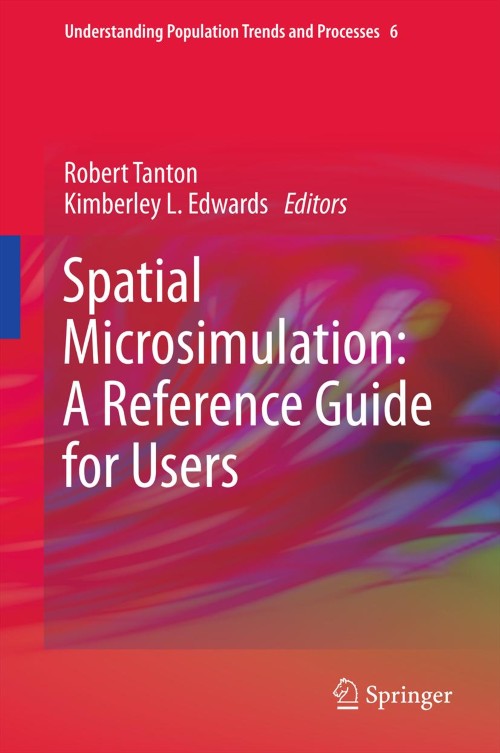
Spatial Microsimulation: A Reference Guide for Users [electronic resource] / edited by Robert Tanton, Kimberley Edwards.
Erişim Adresi
ISBN
9789400746237
Dil Kodu
İngilizce
Yer Numarası
DK/9674
Basım Bildirimi
1st ed. 2013.
Yayın Bilgisi
Dordrecht : Springer Netherlands : Imprint: Springer, 2013.
Fiziksel Niteleme
VIII, 280 p. online resource.
Dizi
Understanding Population Trends and Processes ; 6
İçindekiler Notu
Part 1: Background: Chapter 1: Introduction to spatial microsimulation – History, Methods and Applications: Robert Tanton and Kimberley Edwards -- Chapter 2: Building a static spatial microsimulation model: data preparation: Rebecca Cassells, Riyana Miranti and Ann Harding -- Part 2: Static spatial microsimulation models -- Chapter 3: An Evaluation of Two Synthetic Small-Area Microdata simulation methodologies: Synthetic Reconstruction and Combinatorial Optimisation methodologies: Paul Williamson -- Chapter 4: Estimating Small Area Income Deprivation: An Iterative Proportional Fitting Approach: Ben Anderson -- Chapter 5: SimObesity: Combinatorial Optimisation (deterministic) model: Kimberley Edwards and Graham Clarke -- Chapter 6: Spatial Microsimulation using a generalised regression model: Robert Tanton, Ann Harding and Justine McNamara -- Chapter 7: Creating a Spatial Microsimulation model of the Irish Local Economy: Niall Farrell, Karyn Morrissey andCathal O’Donoghue -- Chapter 8: Linking static spatial microsimulation modelling to meso-scale models: The Relationship between Access to GP services & Long Term Illness: Karyn Morrissey, Graham Clarke and Cathal O’Donoghue -- Chapter 9: Projections using a static Spatial Microsimulation model: Yogi Vidyattama and Robert Tanton -- Chapter 10: Limits of static Spatial Microsimulation models: Robert Tanton and Kimberley Edwards -- Part 3: Dynamic spatial microsimulation models -- Chapter 11: Moses: A dynamic spatial microsimulation model for demographic planning: Belinda Wu and Mark Birkin -- Chapter 12: Design principles for micro models: Einar Holm and Kalle Mäkilä -- Chapter 13: SimEducation: a dynamic spatial microsimulation model for understanding educational inequalities: Dimitris Kavroudakis, Dimitris Ballas and Mark Birkin -- Chapter 14: Challenges for spatial dynamic microsimulation modelling: Mark Birkin -- Part 4: Validation of spatial microsimulation models and conclusion -- Chapter 15: Validation of spatial microsimulation models: Kimberley Edwards and Robert Tanton -- Chapter 16: Conclusions and the future of spatial microsimulation modelling: Graham Clarke and Ann Harding.
Özet, vb.
This book is a practical guide on how to design, create and validate a spatial microsimulation model. These models are becoming more popular as academics and policy makers recognise the value of place in research and policy making. Recent spatial microsimulation models have been used to analyse health and social disadvantage for small areas; and to look at the effect of policy change for small areas. This provides a powerful analysis tool for researchers and policy makers. This book covers preparing the data for spatial microsimulation; a number of methods for both static and dynamic spatial microsimulation models; validation of the models to ensure the outputs are reasonable; and the future of spatial microsimulation. The book will be an essential handbook for any researcher or policy maker looking to design and create a spatial microsimulation model. This book will also be useful to those policy makers who are commissioning a spatial microsimulation model, or looking to commission work using a spatial microsimulation model, as it provides information on the different methods in a non-technical way.
Konu
Demography.
Population.
Statistics .
Geography.
Quality of life.
Population and Demography.
Statistics in Business, Management, Economics, Finance, Insurance.
Geography.
Quality of Life Research.
Population.
Statistics .
Geography.
Quality of life.
Population and Demography.
Statistics in Business, Management, Economics, Finance, Insurance.
Geography.
Quality of Life Research.
Diğer Yazarlar
Kurum Adı
Eseri Alıntıla
Referansları kullanmadan önce gözden geçirmeniz ve varsa gerekli düzeltmeleri yapmanız önerilir.
Dijital Kaynak
MARC Görünümü
LEADER 05349nam a22005655i 4500
001 808385
003 TR_AnAIT
005 20260131031429
007 cr nn 008mamaa
008 121116s2013 ne | s |||| 0|eng d
020 |a9789400746237|9978-94-007-4623-7
024 7 |a10.1007/978-94-007-4623-7|2doi
041 |aeng
049 |aTürk Tarih Kurumu Kütüphanesi
050 4|aHB848-3697
072 7|aJHBD|2bicssc
072 7|aSOC006000|2bisacsh
072 7|aJHBD|2thema
082 04|a304.6|223
090 |aDK/9674
245 10|aSpatial Microsimulation: A Reference Guide for Users|h[electronic resource] /|cedited by Robert Tanton, Kimberley Edwards.
250 |a1st ed. 2013.
264 1|aDordrecht :|bSpringer Netherlands :|bImprint: Springer,|c2013.
300 |aVIII, 280 p.|bonline resource.
336 |atext|btxt|2rdacontent
337 |acomputer|bc|2rdamedia
338 |aonline resource|bcr|2rdacarrier
347 |atext file|bPDF|2rda
490 1 |aUnderstanding Population Trends and Processes ;|v6
505 0 |aPart 1: Background: Chapter 1: Introduction to spatial microsimulation – History, Methods and Applications: Robert Tanton and Kimberley Edwards -- Chapter 2: Building a static spatial microsimulation model: data preparation: Rebecca Cassells, Riyana Miranti and Ann Harding -- Part 2: Static spatial microsimulation models -- Chapter 3: An Evaluation of Two Synthetic Small-Area Microdata simulation methodologies: Synthetic Reconstruction and Combinatorial Optimisation methodologies: Paul Williamson -- Chapter 4: Estimating Small Area Income Deprivation: An Iterative Proportional Fitting Approach: Ben Anderson -- Chapter 5: SimObesity: Combinatorial Optimisation (deterministic) model: Kimberley Edwards and Graham Clarke -- Chapter 6: Spatial Microsimulation using a generalised regression model: Robert Tanton, Ann Harding and Justine McNamara -- Chapter 7: Creating a Spatial Microsimulation model of the Irish Local Economy: Niall Farrell, Karyn Morrissey andCathal O’Donoghue -- Chapter 8: Linking static spatial microsimulation modelling to meso-scale models: The Relationship between Access to GP services & Long Term Illness: Karyn Morrissey, Graham Clarke and Cathal O’Donoghue -- Chapter 9: Projections using a static Spatial Microsimulation model: Yogi Vidyattama and Robert Tanton -- Chapter 10: Limits of static Spatial Microsimulation models: Robert Tanton and Kimberley Edwards -- Part 3: Dynamic spatial microsimulation models -- Chapter 11: Moses: A dynamic spatial microsimulation model for demographic planning: Belinda Wu and Mark Birkin -- Chapter 12: Design principles for micro models: Einar Holm and Kalle Mäkilä -- Chapter 13: SimEducation: a dynamic spatial microsimulation model for understanding educational inequalities: Dimitris Kavroudakis, Dimitris Ballas and Mark Birkin -- Chapter 14: Challenges for spatial dynamic microsimulation modelling: Mark Birkin -- Part 4: Validation of spatial microsimulation models and conclusion -- Chapter 15: Validation of spatial microsimulation models: Kimberley Edwards and Robert Tanton -- Chapter 16: Conclusions and the future of spatial microsimulation modelling: Graham Clarke and Ann Harding.
520 |aThis book is a practical guide on how to design, create and validate a spatial microsimulation model. These models are becoming more popular as academics and policy makers recognise the value of place in research and policy making. Recent spatial microsimulation models have been used to analyse health and social disadvantage for small areas; and to look at the effect of policy change for small areas. This provides a powerful analysis tool for researchers and policy makers. This book covers preparing the data for spatial microsimulation; a number of methods for both static and dynamic spatial microsimulation models; validation of the models to ensure the outputs are reasonable; and the future of spatial microsimulation. The book will be an essential handbook for any researcher or policy maker looking to design and create a spatial microsimulation model. This book will also be useful to those policy makers who are commissioning a spatial microsimulation model, or looking to commission work using a spatial microsimulation model, as it provides information on the different methods in a non-technical way.
650 0|aDemography.
650 0|aPopulation.
650 0|aStatistics .
650 0|aGeography.
650 0|aQuality of life.
650 14|aPopulation and Demography.
650 24|aStatistics in Business, Management, Economics, Finance, Insurance.
650 24|aGeography.
650 24|aQuality of Life Research.
700 1 |aTanton, Robert.|eeditor.|4edt|4http://id.loc.gov/vocabulary/relators/edt
700 1 |aEdwards, Kimberley.|eeditor.|4edt|4http://id.loc.gov/vocabulary/relators/edt
710 2 |aSpringerLink (Online service)
773 0 |tSpringer Nature eBook
776 08|iPrinted edition:|z9789400746220
776 08|iPrinted edition:|z9789400746244
776 08|iPrinted edition:|z9789401781336
830 0|aUnderstanding Population Trends and Processes ;|v6
856 40|uhttps://doi.org/10.1007/978-94-007-4623-7
912 |aZDB-2-SHU
912 |aZDB-2-SXS
950 |aHumanities, Social Sciences and Law (SpringerNature-11648)
950 |aSocial Sciences (R0) (SpringerNature-43726)
001 808385
003 TR_AnAIT
005 20260131031429
007 cr nn 008mamaa
008 121116s2013 ne | s |||| 0|eng d
020 |a9789400746237|9978-94-007-4623-7
024 7 |a10.1007/978-94-007-4623-7|2doi
041 |aeng
049 |aTürk Tarih Kurumu Kütüphanesi
050 4|aHB848-3697
072 7|aJHBD|2bicssc
072 7|aSOC006000|2bisacsh
072 7|aJHBD|2thema
082 04|a304.6|223
090 |aDK/9674
245 10|aSpatial Microsimulation: A Reference Guide for Users|h[electronic resource] /|cedited by Robert Tanton, Kimberley Edwards.
250 |a1st ed. 2013.
264 1|aDordrecht :|bSpringer Netherlands :|bImprint: Springer,|c2013.
300 |aVIII, 280 p.|bonline resource.
336 |atext|btxt|2rdacontent
337 |acomputer|bc|2rdamedia
338 |aonline resource|bcr|2rdacarrier
347 |atext file|bPDF|2rda
490 1 |aUnderstanding Population Trends and Processes ;|v6
505 0 |aPart 1: Background: Chapter 1: Introduction to spatial microsimulation – History, Methods and Applications: Robert Tanton and Kimberley Edwards -- Chapter 2: Building a static spatial microsimulation model: data preparation: Rebecca Cassells, Riyana Miranti and Ann Harding -- Part 2: Static spatial microsimulation models -- Chapter 3: An Evaluation of Two Synthetic Small-Area Microdata simulation methodologies: Synthetic Reconstruction and Combinatorial Optimisation methodologies: Paul Williamson -- Chapter 4: Estimating Small Area Income Deprivation: An Iterative Proportional Fitting Approach: Ben Anderson -- Chapter 5: SimObesity: Combinatorial Optimisation (deterministic) model: Kimberley Edwards and Graham Clarke -- Chapter 6: Spatial Microsimulation using a generalised regression model: Robert Tanton, Ann Harding and Justine McNamara -- Chapter 7: Creating a Spatial Microsimulation model of the Irish Local Economy: Niall Farrell, Karyn Morrissey andCathal O’Donoghue -- Chapter 8: Linking static spatial microsimulation modelling to meso-scale models: The Relationship between Access to GP services & Long Term Illness: Karyn Morrissey, Graham Clarke and Cathal O’Donoghue -- Chapter 9: Projections using a static Spatial Microsimulation model: Yogi Vidyattama and Robert Tanton -- Chapter 10: Limits of static Spatial Microsimulation models: Robert Tanton and Kimberley Edwards -- Part 3: Dynamic spatial microsimulation models -- Chapter 11: Moses: A dynamic spatial microsimulation model for demographic planning: Belinda Wu and Mark Birkin -- Chapter 12: Design principles for micro models: Einar Holm and Kalle Mäkilä -- Chapter 13: SimEducation: a dynamic spatial microsimulation model for understanding educational inequalities: Dimitris Kavroudakis, Dimitris Ballas and Mark Birkin -- Chapter 14: Challenges for spatial dynamic microsimulation modelling: Mark Birkin -- Part 4: Validation of spatial microsimulation models and conclusion -- Chapter 15: Validation of spatial microsimulation models: Kimberley Edwards and Robert Tanton -- Chapter 16: Conclusions and the future of spatial microsimulation modelling: Graham Clarke and Ann Harding.
520 |aThis book is a practical guide on how to design, create and validate a spatial microsimulation model. These models are becoming more popular as academics and policy makers recognise the value of place in research and policy making. Recent spatial microsimulation models have been used to analyse health and social disadvantage for small areas; and to look at the effect of policy change for small areas. This provides a powerful analysis tool for researchers and policy makers. This book covers preparing the data for spatial microsimulation; a number of methods for both static and dynamic spatial microsimulation models; validation of the models to ensure the outputs are reasonable; and the future of spatial microsimulation. The book will be an essential handbook for any researcher or policy maker looking to design and create a spatial microsimulation model. This book will also be useful to those policy makers who are commissioning a spatial microsimulation model, or looking to commission work using a spatial microsimulation model, as it provides information on the different methods in a non-technical way.
650 0|aDemography.
650 0|aPopulation.
650 0|aStatistics .
650 0|aGeography.
650 0|aQuality of life.
650 14|aPopulation and Demography.
650 24|aStatistics in Business, Management, Economics, Finance, Insurance.
650 24|aGeography.
650 24|aQuality of Life Research.
700 1 |aTanton, Robert.|eeditor.|4edt|4http://id.loc.gov/vocabulary/relators/edt
700 1 |aEdwards, Kimberley.|eeditor.|4edt|4http://id.loc.gov/vocabulary/relators/edt
710 2 |aSpringerLink (Online service)
773 0 |tSpringer Nature eBook
776 08|iPrinted edition:|z9789400746220
776 08|iPrinted edition:|z9789400746244
776 08|iPrinted edition:|z9789401781336
830 0|aUnderstanding Population Trends and Processes ;|v6
856 40|uhttps://doi.org/10.1007/978-94-007-4623-7
912 |aZDB-2-SHU
912 |aZDB-2-SXS
950 |aHumanities, Social Sciences and Law (SpringerNature-11648)
950 |aSocial Sciences (R0) (SpringerNature-43726)
Materyaller
Depodan talep edilen materyal sadece kütüphane içerisinde kullanılmaktadır.
Materyal dışarıya ödünç verilmemektedir.
Materyal dışarıya ödünç verilmemektedir.
