LEADER 04632nam a22005655i 4500
001 808401
003 TR_AnAIT
005 20260131031340
007 cr nn 008mamaa
008 121227s1992 ne | s |||| 0|eng d
020 |a9789401129701|9978-94-011-2970-1
024 7 |a10.1007/978-94-011-2970-1|2doi
041 |aeng
049 |aTürk Tarih Kurumu Kütüphanesi
050 4|aLB3050-3060.87
072 7|aJNKD|2bicssc
072 7|aEDU030000|2bisacsh
072 7|aJNDH|2thema
082 04|a371.26|223
090 |aDK/9690
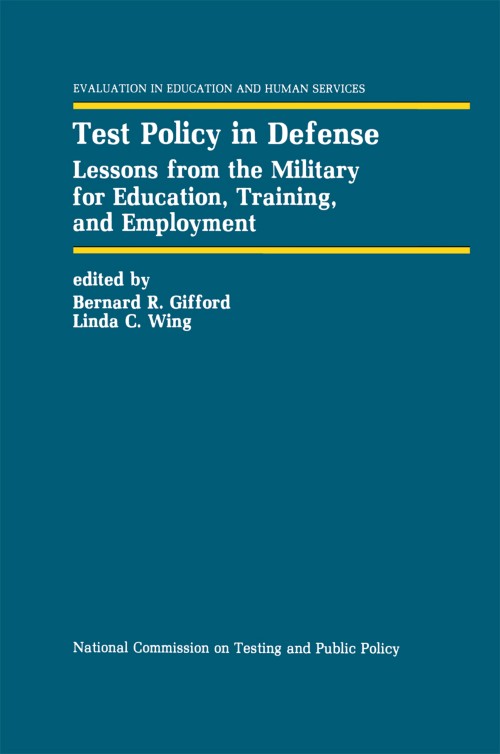
245 10|aTest Policy in Defense|h[electronic resource] :|bLessons from the Military for Education, Training, and Employment /|cedited by Bernard R. Gifford, Linda C. Wing.
250 |a1st ed. 1992.
264 1|aDordrecht :|bSpringer Netherlands :|bImprint: Springer,|c1992.
300 |aXV, 270 p.|bonline resource.
336 |atext|btxt|2rdacontent
337 |acomputer|bc|2rdamedia
338 |aonline resource|bcr|2rdacarrier
347 |atext file|bPDF|2rda
490 1 |aEvaluation in Education and Human Services ;|v31
505 0 |aMilitary Testing and Public Policy: Selected Studies of Lower Aptitude Personnel -- Becoming Brass: Issues in the Testing, Recruiting, and Selection of American Military Officers -- The Validity of Test Scores for Selecting and Classifying Enlisted Recruits.
520 |aBernard R. Gifford and Linda C. Wing Standardized testing has become a ubiquitous feature of American life. As a major source of information for reducing uncertainty in the alJocation of merit based educational, training, and employment opportunities, testing affects the life chances of individuals. Moreover, testing inOuences the way in which our societyjudgesitselfandprovides for ourcollective future. Test scores may determine a child's admission to lcindergarten and promotion to the fIrst grade. Most states award the high school diploma only ifa student has passed a minimum competency test. Major institutions of higher education typically require applicants to supplement their records of academic achievement with scores on college admissions tests. In the labor market, as a condition of employment or assignment to training programs, more and more employers are requiring workers to sit for personnel selection tests. Additionally, it has become commonplace to use test scores to calibrate our national sociopolitical condition and our capacity to compete with other countries in the global economy. In short, with increasing frequency and intensity, scores on examinations that purport to be objective and precise measures of individual knowledge, abilities, and potential are playing a critical role in the opportunity marketplace. Similarly, test scores are exercising growing influence in assessments of our social and economic institutions and in policy decisions about the relative invesunents that should be made in each. In all these instantiations, test scores are at the center of high-stakes decision making about the future of individuals and of the nation itself.
532 8 |aAccessibility summary: This PDF is not accessible. It is based on scanned pages and does not support features such as screen reader compatibility or described non-text content (images, graphs etc). However, it likely supports searchable and selectable text based on OCR (Optical Character Recognition). Users with accessibility needs may not be able to use this content effectively. Please contact us at accessibilitysupport@springernature.com if you require assistance or an alternative format.
532 8 |aInaccessible, or known limited accessibility
532 8 |aNo reading system accessibility options actively disabled
532 8 |aPublisher contact for further accessibility information: accessibilitysupport@springernature.com
650 0|aEducational tests and measurements.
650 0|aEconomic policy.
650 14|aAssessment and Testing.
650 24|aEconomic Policy.
700 1 |aGifford, Bernard R.|eeditor.|4edt|4http://id.loc.gov/vocabulary/relators/edt
700 1 |aWing, Linda C.|eeditor.|4edt|4http://id.loc.gov/vocabulary/relators/edt
710 2 |aSpringerLink (Online service)
773 0 |tSpringer Nature eBook
776 08|iPrinted edition:|z9780792391760
776 08|iPrinted edition:|z9789401129718
776 08|iPrinted edition:|z9789401053198
830 0|aEvaluation in Education and Human Services ;|v31
856 40|uhttps://doi.org/10.1007/978-94-011-2970-1
912 |aZDB-2-SHU
912 |aZDB-2-SXED
912 |aZDB-2-BAE
950 |aHumanities, Social Sciences and Law (SpringerNature-11648)
950 |aEducation (R0) (SpringerNature-43721)