

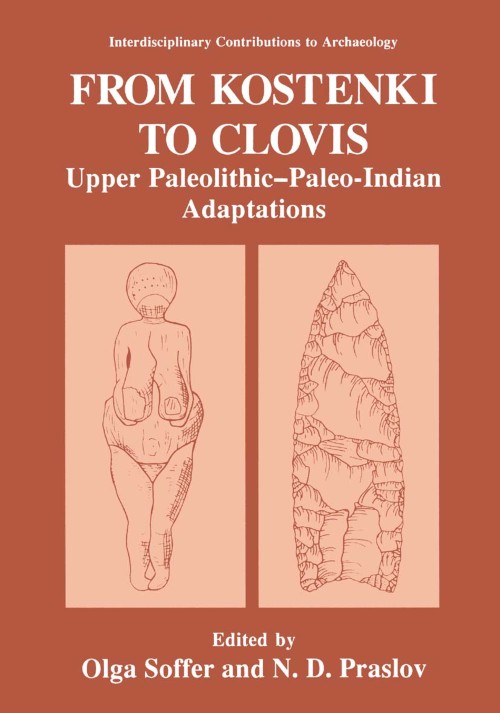
From Kostenki to Clovis [electronic resource] : Upper Paleolithic—Paleo-Indian Adaptations / edited by Olga Soffer, N.D. Praslov.
Erişim Adresi
ISBN
9781489911124
Dil Kodu
İngilizce
Yer Numarası
DK/9735
Basım Bildirimi
1st ed. 1993.
Yayın Bilgisi
New York, NY : Springer US : Imprint: Springer, 1993.
Fiziksel Niteleme
XX, 334 p. online resource.
Dizi
Interdisciplinary Contributions to Archaeology, 2730-6984
İçindekiler Notu
I Introduction -- 1 • Introduction: Fluted Points and Female Figurines—Understanding Late Paleolithic People of the New and Old Worlds -- 2 • The Environment and Human Adaptation Systems in Prehistoric Times -- II The Upper Paleolithic Record -- 3 • Radiocarbon Chronology for the Upper Paleolithic Sites on the East European Plain -- 4 • Upper Paleolithic Adaptations in Central and Eastern Europe and Man-Mammoth Interactions -- 5 • The Kostenki-Avdeevo Archaeological Culture and the Willendorf-Pavlov-Kostenki-Avdeevo Cultural Unity -- 6 • Subsistence Practices of Late Paleolithic Groups along the Dnestr River and Its Tributaries -- 7 • Two Examples of Terminal Paleolithic Adaptations -- 8 • Bones for Stones: Considerations of Analogues for Features Found on the Central Russian Plain -- 9 • Amvrosievka: A Unique Upper Paleolithic Site in Eastern Europe -- 10 • Determining Upper Paleolithic Historicocultural Regions: A Case Study -- 11 • Criteria for Estimating the Duration of Occupation at Paleolithic Sites: An Example from Kamennaia Balka II -- 12 • The Technology and Function of Tools in the Context of Regional Adaptations: A Case Study of the Upper Paleolithic and Mesolithic of the Northwestern Black Sea Region -- 13 • Man and Nature in Northeastern Europe in the Middle and Late Pleistocene -- 14 • The Pleistocene-Holocene Boundary: Environmental Processes and Social Adaptations -- III The Paleo-Indian Record -- 15 • The Ones that Will Not Go Away: A Biased View of Pre-Clovis Populations in the New World -- 16 • Clovis-Folsom Geochronology and Climatic Change -- 17 • North American High Plains Paleo-Indian Hunting Strategies and Weaponry Assemblages -- 18 • Paleo-Indian Flaked Stone Technology in the North American High Plains -- 19 • Paleo-IndianArchaeology in the High Plains and Rocky Mountains of Montana -- 20 • Fluted Points in the Eastern Forests -- 21 • Is There a Clovis Adaptation? -- IV Interpreting the Records: Some Caveats -- 22 • The Center at the Edge.
Özet, vb.
From the American Side I went to the USSR for the first time in 1982 to attend the 11th meeting of the International Union for Quaternary research (INQUA) held at the Moscow State University. At that time relations between our two countries were anything but congenial and many restrictions were placed on our viewing the archaeological and paleontological collections and labora tory facilities. This was not the ideal climate for the free exchange of ideas needed for meaningful research. However, it was obvious to us that the strained relations did not extend to scientific discussions between scholars. We left that meeting well aware that if the problems of prehistoric Old World-New World relationships were to be resolved, it would eventually require cooperative research efforts within the world community of archaeologists. At that time, the pre-Clovis problem in New World archaeology was foremost in the minds of many North American researchers: tool technology and assemblages were being studied as a possible means of establishing cultural relationships across the Bering Strait, Clovis sites and mammoth kills were being looked at with new ideas for interpretation, and New World researchers realized that to resolve these questions they had to become familiar with the archaeological record of northeast Asia. A chance meeting of the writer with Olga Soffer in 1983 led to serious discussions of the sites on the Russian or East European Plain.
Konu
Archaeology.
Anthropology.
Archaeology.
Anthropology.
Anthropology.
Archaeology.
Anthropology.
Diğer Yazarlar
Kurum Adı
Eseri Alıntıla
Referansları kullanmadan önce gözden geçirmeniz ve varsa gerekli düzeltmeleri yapmanız önerilir.
Dijital Kaynak
MARC Görünümü
LEADER 06121nam a22005655i 4500
001 808446
003 TR_AnAIT
005 20260131031116
007 cr nn 008mamaa
008 130628s1993 xxu| s |||| 0|eng d
020 |a9781489911124|9978-1-4899-1112-4
024 7 |a10.1007/978-1-4899-1112-4|2doi
041 |aeng
049 |aTürk Tarih Kurumu Kütüphanesi
050 4|aCC1-960
072 7|aHD|2bicssc
072 7|aSOC003000|2bisacsh
072 7|aNK|2thema
082 04|a930.1|223
090 |aDK/9735
245 10|aFrom Kostenki to Clovis|h[electronic resource] :|bUpper Paleolithic—Paleo-Indian Adaptations /|cedited by Olga Soffer, N.D. Praslov.
250 |a1st ed. 1993.
264 1|aNew York, NY :|bSpringer US :|bImprint: Springer,|c1993.
300 |aXX, 334 p.|bonline resource.
336 |atext|btxt|2rdacontent
337 |acomputer|bc|2rdamedia
338 |aonline resource|bcr|2rdacarrier
347 |atext file|bPDF|2rda
490 1 |aInterdisciplinary Contributions to Archaeology,|x2730-6984
505 0 |aI Introduction -- 1 • Introduction: Fluted Points and Female Figurines—Understanding Late Paleolithic People of the New and Old Worlds -- 2 • The Environment and Human Adaptation Systems in Prehistoric Times -- II The Upper Paleolithic Record -- 3 • Radiocarbon Chronology for the Upper Paleolithic Sites on the East European Plain -- 4 • Upper Paleolithic Adaptations in Central and Eastern Europe and Man-Mammoth Interactions -- 5 • The Kostenki-Avdeevo Archaeological Culture and the Willendorf-Pavlov-Kostenki-Avdeevo Cultural Unity -- 6 • Subsistence Practices of Late Paleolithic Groups along the Dnestr River and Its Tributaries -- 7 • Two Examples of Terminal Paleolithic Adaptations -- 8 • Bones for Stones: Considerations of Analogues for Features Found on the Central Russian Plain -- 9 • Amvrosievka: A Unique Upper Paleolithic Site in Eastern Europe -- 10 • Determining Upper Paleolithic Historicocultural Regions: A Case Study -- 11 • Criteria for Estimating the Duration of Occupation at Paleolithic Sites: An Example from Kamennaia Balka II -- 12 • The Technology and Function of Tools in the Context of Regional Adaptations: A Case Study of the Upper Paleolithic and Mesolithic of the Northwestern Black Sea Region -- 13 • Man and Nature in Northeastern Europe in the Middle and Late Pleistocene -- 14 • The Pleistocene-Holocene Boundary: Environmental Processes and Social Adaptations -- III The Paleo-Indian Record -- 15 • The Ones that Will Not Go Away: A Biased View of Pre-Clovis Populations in the New World -- 16 • Clovis-Folsom Geochronology and Climatic Change -- 17 • North American High Plains Paleo-Indian Hunting Strategies and Weaponry Assemblages -- 18 • Paleo-Indian Flaked Stone Technology in the North American High Plains -- 19 • Paleo-IndianArchaeology in the High Plains and Rocky Mountains of Montana -- 20 • Fluted Points in the Eastern Forests -- 21 • Is There a Clovis Adaptation? -- IV Interpreting the Records: Some Caveats -- 22 • The Center at the Edge.
520 |aFrom the American Side I went to the USSR for the first time in 1982 to attend the 11th meeting of the International Union for Quaternary research (INQUA) held at the Moscow State University. At that time relations between our two countries were anything but congenial and many restrictions were placed on our viewing the archaeological and paleontological collections and labora tory facilities. This was not the ideal climate for the free exchange of ideas needed for meaningful research. However, it was obvious to us that the strained relations did not extend to scientific discussions between scholars. We left that meeting well aware that if the problems of prehistoric Old World-New World relationships were to be resolved, it would eventually require cooperative research efforts within the world community of archaeologists. At that time, the pre-Clovis problem in New World archaeology was foremost in the minds of many North American researchers: tool technology and assemblages were being studied as a possible means of establishing cultural relationships across the Bering Strait, Clovis sites and mammoth kills were being looked at with new ideas for interpretation, and New World researchers realized that to resolve these questions they had to become familiar with the archaeological record of northeast Asia. A chance meeting of the writer with Olga Soffer in 1983 led to serious discussions of the sites on the Russian or East European Plain.
532 8 |aAccessibility summary: This PDF is not accessible. It is based on scanned pages and does not support features such as screen reader compatibility or described non-text content (images, graphs etc). However, it likely supports searchable and selectable text based on OCR (Optical Character Recognition). Users with accessibility needs may not be able to use this content effectively. Please contact us at accessibilitysupport@springernature.com if you require assistance or an alternative format.
532 8 |aInaccessible, or known limited accessibility
532 8 |aNo reading system accessibility options actively disabled
532 8 |aPublisher contact for further accessibility information: accessibilitysupport@springernature.com
650 0|aArchaeology.
650 0|aAnthropology.
650 14|aArchaeology.
650 24|aAnthropology.
700 1 |aSoffer, Olga.|eeditor.|4edt|4http://id.loc.gov/vocabulary/relators/edt
700 1 |aPraslov, N.D.|eeditor.|4edt|4http://id.loc.gov/vocabulary/relators/edt
710 2 |aSpringerLink (Online service)
773 0 |tSpringer Nature eBook
776 08|iPrinted edition:|z9780306442711
776 08|iPrinted edition:|z9781489911131
776 08|iPrinted edition:|z9781489911148
830 0|aInterdisciplinary Contributions to Archaeology,|x2730-6984
856 40|uhttps://doi.org/10.1007/978-1-4899-1112-4
912 |aZDB-2-SHU
912 |aZDB-2-SXS
912 |aZDB-2-BAE
950 |aHumanities, Social Sciences and Law (SpringerNature-11648)
950 |aSocial Sciences (R0) (SpringerNature-43726)
001 808446
003 TR_AnAIT
005 20260131031116
007 cr nn 008mamaa
008 130628s1993 xxu| s |||| 0|eng d
020 |a9781489911124|9978-1-4899-1112-4
024 7 |a10.1007/978-1-4899-1112-4|2doi
041 |aeng
049 |aTürk Tarih Kurumu Kütüphanesi
050 4|aCC1-960
072 7|aHD|2bicssc
072 7|aSOC003000|2bisacsh
072 7|aNK|2thema
082 04|a930.1|223
090 |aDK/9735
245 10|aFrom Kostenki to Clovis|h[electronic resource] :|bUpper Paleolithic—Paleo-Indian Adaptations /|cedited by Olga Soffer, N.D. Praslov.
250 |a1st ed. 1993.
264 1|aNew York, NY :|bSpringer US :|bImprint: Springer,|c1993.
300 |aXX, 334 p.|bonline resource.
336 |atext|btxt|2rdacontent
337 |acomputer|bc|2rdamedia
338 |aonline resource|bcr|2rdacarrier
347 |atext file|bPDF|2rda
490 1 |aInterdisciplinary Contributions to Archaeology,|x2730-6984
505 0 |aI Introduction -- 1 • Introduction: Fluted Points and Female Figurines—Understanding Late Paleolithic People of the New and Old Worlds -- 2 • The Environment and Human Adaptation Systems in Prehistoric Times -- II The Upper Paleolithic Record -- 3 • Radiocarbon Chronology for the Upper Paleolithic Sites on the East European Plain -- 4 • Upper Paleolithic Adaptations in Central and Eastern Europe and Man-Mammoth Interactions -- 5 • The Kostenki-Avdeevo Archaeological Culture and the Willendorf-Pavlov-Kostenki-Avdeevo Cultural Unity -- 6 • Subsistence Practices of Late Paleolithic Groups along the Dnestr River and Its Tributaries -- 7 • Two Examples of Terminal Paleolithic Adaptations -- 8 • Bones for Stones: Considerations of Analogues for Features Found on the Central Russian Plain -- 9 • Amvrosievka: A Unique Upper Paleolithic Site in Eastern Europe -- 10 • Determining Upper Paleolithic Historicocultural Regions: A Case Study -- 11 • Criteria for Estimating the Duration of Occupation at Paleolithic Sites: An Example from Kamennaia Balka II -- 12 • The Technology and Function of Tools in the Context of Regional Adaptations: A Case Study of the Upper Paleolithic and Mesolithic of the Northwestern Black Sea Region -- 13 • Man and Nature in Northeastern Europe in the Middle and Late Pleistocene -- 14 • The Pleistocene-Holocene Boundary: Environmental Processes and Social Adaptations -- III The Paleo-Indian Record -- 15 • The Ones that Will Not Go Away: A Biased View of Pre-Clovis Populations in the New World -- 16 • Clovis-Folsom Geochronology and Climatic Change -- 17 • North American High Plains Paleo-Indian Hunting Strategies and Weaponry Assemblages -- 18 • Paleo-Indian Flaked Stone Technology in the North American High Plains -- 19 • Paleo-IndianArchaeology in the High Plains and Rocky Mountains of Montana -- 20 • Fluted Points in the Eastern Forests -- 21 • Is There a Clovis Adaptation? -- IV Interpreting the Records: Some Caveats -- 22 • The Center at the Edge.
520 |aFrom the American Side I went to the USSR for the first time in 1982 to attend the 11th meeting of the International Union for Quaternary research (INQUA) held at the Moscow State University. At that time relations between our two countries were anything but congenial and many restrictions were placed on our viewing the archaeological and paleontological collections and labora tory facilities. This was not the ideal climate for the free exchange of ideas needed for meaningful research. However, it was obvious to us that the strained relations did not extend to scientific discussions between scholars. We left that meeting well aware that if the problems of prehistoric Old World-New World relationships were to be resolved, it would eventually require cooperative research efforts within the world community of archaeologists. At that time, the pre-Clovis problem in New World archaeology was foremost in the minds of many North American researchers: tool technology and assemblages were being studied as a possible means of establishing cultural relationships across the Bering Strait, Clovis sites and mammoth kills were being looked at with new ideas for interpretation, and New World researchers realized that to resolve these questions they had to become familiar with the archaeological record of northeast Asia. A chance meeting of the writer with Olga Soffer in 1983 led to serious discussions of the sites on the Russian or East European Plain.
532 8 |aAccessibility summary: This PDF is not accessible. It is based on scanned pages and does not support features such as screen reader compatibility or described non-text content (images, graphs etc). However, it likely supports searchable and selectable text based on OCR (Optical Character Recognition). Users with accessibility needs may not be able to use this content effectively. Please contact us at accessibilitysupport@springernature.com if you require assistance or an alternative format.
532 8 |aInaccessible, or known limited accessibility
532 8 |aNo reading system accessibility options actively disabled
532 8 |aPublisher contact for further accessibility information: accessibilitysupport@springernature.com
650 0|aArchaeology.
650 0|aAnthropology.
650 14|aArchaeology.
650 24|aAnthropology.
700 1 |aSoffer, Olga.|eeditor.|4edt|4http://id.loc.gov/vocabulary/relators/edt
700 1 |aPraslov, N.D.|eeditor.|4edt|4http://id.loc.gov/vocabulary/relators/edt
710 2 |aSpringerLink (Online service)
773 0 |tSpringer Nature eBook
776 08|iPrinted edition:|z9780306442711
776 08|iPrinted edition:|z9781489911131
776 08|iPrinted edition:|z9781489911148
830 0|aInterdisciplinary Contributions to Archaeology,|x2730-6984
856 40|uhttps://doi.org/10.1007/978-1-4899-1112-4
912 |aZDB-2-SHU
912 |aZDB-2-SXS
912 |aZDB-2-BAE
950 |aHumanities, Social Sciences and Law (SpringerNature-11648)
950 |aSocial Sciences (R0) (SpringerNature-43726)
Materyaller
Depodan talep edilen materyal sadece kütüphane içerisinde kullanılmaktadır.
Materyal dışarıya ödünç verilmemektedir.
Materyal dışarıya ödünç verilmemektedir.
