

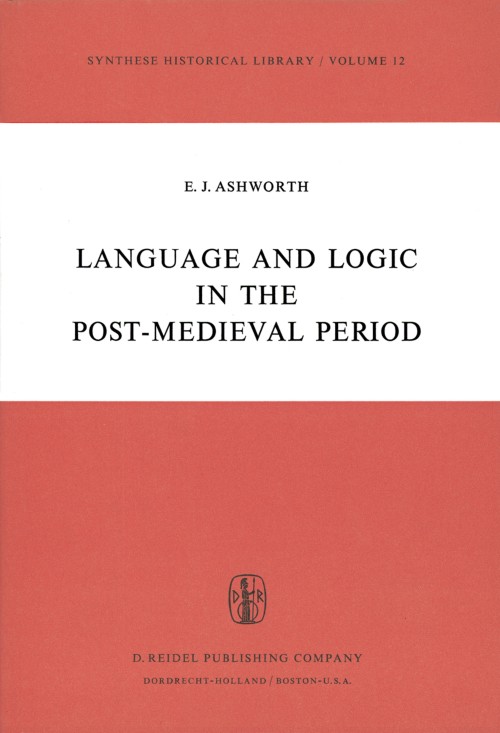
Language and Logic in the Post-Medieval Period [electronic resource] / by E.J. Ashworth.
Erişim Adresi
ISBN
9789401022262
Dil Kodu
İngilizce
Yer Numarası
DK/9739
Yazar
Basım Bildirimi
1st ed. 1974.
Yayın Bilgisi
Dordrecht : Springer Netherlands : Imprint: Springer, 1974.
Fiziksel Niteleme
XV, 309 p. online resource.
Dizi
Synthese Historical Library ; 12
İçindekiler Notu
I/Historical Introduction -- 1. The Publication of Medieval Works -- 2. Scholasticism in Italy and Germany -- 3. Scholasticism in France and Spain -- 4. Humanism -- 5. Rudolph Agricola and His Influence -- 6. Petrus Ramus and His Influence -- 7. Seventeenth Century Logic: Eclecticism -- 8. Humanism and Late Scholasticism in Spain -- 9. Other Schools of Logic -- 10. A Note on Terminology -- II/Meaning and Reference -- I. The Nature of Logic -- II. Problems of Language -- II. Supposition Theory -- III. Semantic Paradoxes -- III/Formal Logic. Part One: Unanalyzed Propositions -- I. The Theory of Consequence -- II. Propositional Connectives -- III. An Analysis of the Rules Found in Some Individual Authors -- IV/ Formal Logic. Part Two: The Logic of Analyzed Propositions -- I. The Relationships Between Propositions -- II. Supposition Theory and Quantification -- III. Categorical Syllogisms -- Appendix/Latin Texts -- 1. Primary Sources -- 2. Secondary Sources on the History of Logic 1400–1650 -- Index of names.
Özet, vb.
Keckermann remarked of the sixteenth century, "never from the begin ning of the world was there a period so keen on logic, or in which more books on logic were produced and studies oflogic flourished more abun dantly than the period-in which we live. " 1 But despite the great profusion of books to which he refers, and despite the dominant position occupied by logic in the educational system of the fifteenth, sixteenth and seven teenth centuries, very little work has been done on the logic of the post medieval period. The only complete study is that of Risse, whose account, while historically exhaustive, pays little attention to the actual logical 2 doctrines discussed. Otherwise, one can tum to Vasoli for a study of humanism, to Munoz Delgado for scholastic logic in Spain, and to Gilbert and Randall for scientific method, but this still leaves vast areas untouched. In this book I cannot hope to remedy all the deficiencies of previous studies, for to survey the literature alone would take a life-time. As a result I have limited myself in various ways. In the first place, I con centrate only on those matters which are of particular interest to me, namely theories of meaning and reference, and formal logic.
Konu
Philosophy, Medieval.
History.
Logic.
Medieval Philosophy.
History.
Logic.
History.
Logic.
Medieval Philosophy.
History.
Logic.
Kurum Adı
Eseri Alıntıla
Referansları kullanmadan önce gözden geçirmeniz ve varsa gerekli düzeltmeleri yapmanız önerilir.
Dijital Kaynak
MARC Görünümü
LEADER 04760nam a22005775i 4500
001 808450
003 TR_AnAIT
005 20260131031041
007 cr nn 008mamaa
008 121227s1974 ne | s |||| 0|eng d
020 |a9789401022262|9978-94-010-2226-2
024 7 |a10.1007/978-94-010-2226-2|2doi
041 |aeng
049 |aTürk Tarih Kurumu Kütüphanesi
050 4|aB720-765
072 7|aHPCB|2bicssc
072 7|aPHI012000|2bisacsh
072 7|aQDHF|2thema
082 04|a189|223
090 |aDK/9739
100 1 |aAshworth, E.J.|eauthor.|4aut|4http://id.loc.gov/vocabulary/relators/aut
245 10|aLanguage and Logic in the Post-Medieval Period|h[electronic resource] /|cby E.J. Ashworth.
250 |a1st ed. 1974.
264 1|aDordrecht :|bSpringer Netherlands :|bImprint: Springer,|c1974.
300 |aXV, 309 p.|bonline resource.
336 |atext|btxt|2rdacontent
337 |acomputer|bc|2rdamedia
338 |aonline resource|bcr|2rdacarrier
347 |atext file|bPDF|2rda
490 1 |aSynthese Historical Library ;|v12
505 0 |aI/Historical Introduction -- 1. The Publication of Medieval Works -- 2. Scholasticism in Italy and Germany -- 3. Scholasticism in France and Spain -- 4. Humanism -- 5. Rudolph Agricola and His Influence -- 6. Petrus Ramus and His Influence -- 7. Seventeenth Century Logic: Eclecticism -- 8. Humanism and Late Scholasticism in Spain -- 9. Other Schools of Logic -- 10. A Note on Terminology -- II/Meaning and Reference -- I. The Nature of Logic -- II. Problems of Language -- II. Supposition Theory -- III. Semantic Paradoxes -- III/Formal Logic. Part One: Unanalyzed Propositions -- I. The Theory of Consequence -- II. Propositional Connectives -- III. An Analysis of the Rules Found in Some Individual Authors -- IV/ Formal Logic. Part Two: The Logic of Analyzed Propositions -- I. The Relationships Between Propositions -- II. Supposition Theory and Quantification -- III. Categorical Syllogisms -- Appendix/Latin Texts -- 1. Primary Sources -- 2. Secondary Sources on the History of Logic 1400–1650 -- Index of names.
520 |aKeckermann remarked of the sixteenth century, "never from the begin ning of the world was there a period so keen on logic, or in which more books on logic were produced and studies oflogic flourished more abun dantly than the period-in which we live. " 1 But despite the great profusion of books to which he refers, and despite the dominant position occupied by logic in the educational system of the fifteenth, sixteenth and seven teenth centuries, very little work has been done on the logic of the post medieval period. The only complete study is that of Risse, whose account, while historically exhaustive, pays little attention to the actual logical 2 doctrines discussed. Otherwise, one can tum to Vasoli for a study of humanism, to Munoz Delgado for scholastic logic in Spain, and to Gilbert and Randall for scientific method, but this still leaves vast areas untouched. In this book I cannot hope to remedy all the deficiencies of previous studies, for to survey the literature alone would take a life-time. As a result I have limited myself in various ways. In the first place, I con centrate only on those matters which are of particular interest to me, namely theories of meaning and reference, and formal logic.
532 8 |aAccessibility summary: This PDF is not accessible. It is based on scanned pages and does not support features such as screen reader compatibility or described non-text content (images, graphs etc). However, it likely supports searchable and selectable text based on OCR (Optical Character Recognition). Users with accessibility needs may not be able to use this content effectively. Please contact us at accessibilitysupport@springernature.com if you require assistance or an alternative format.
532 8 |aInaccessible, or known limited accessibility
532 8 |aNo reading system accessibility options actively disabled
532 8 |aPublisher contact for further accessibility information: accessibilitysupport@springernature.com
650 0|aPhilosophy, Medieval.
650 0|aHistory.
650 0|aLogic.
650 14|aMedieval Philosophy.
650 24|aHistory.
650 24|aLogic.
710 2 |aSpringerLink (Online service)
773 0 |tSpringer Nature eBook
776 08|iPrinted edition:|z9789027704641
776 08|iPrinted edition:|z9789401022279
776 08|iPrinted edition:|z9789401022286
830 0|aSynthese Historical Library ;|v12
856 40|uhttps://doi.org/10.1007/978-94-010-2226-2
912 |aZDB-2-SHU
912 |aZDB-2-SXPR
912 |aZDB-2-BAE
950 |aHumanities, Social Sciences and Law (SpringerNature-11648)
950 |aPhilosophy and Religion (R0) (SpringerNature-43725)
001 808450
003 TR_AnAIT
005 20260131031041
007 cr nn 008mamaa
008 121227s1974 ne | s |||| 0|eng d
020 |a9789401022262|9978-94-010-2226-2
024 7 |a10.1007/978-94-010-2226-2|2doi
041 |aeng
049 |aTürk Tarih Kurumu Kütüphanesi
050 4|aB720-765
072 7|aHPCB|2bicssc
072 7|aPHI012000|2bisacsh
072 7|aQDHF|2thema
082 04|a189|223
090 |aDK/9739
100 1 |aAshworth, E.J.|eauthor.|4aut|4http://id.loc.gov/vocabulary/relators/aut
245 10|aLanguage and Logic in the Post-Medieval Period|h[electronic resource] /|cby E.J. Ashworth.
250 |a1st ed. 1974.
264 1|aDordrecht :|bSpringer Netherlands :|bImprint: Springer,|c1974.
300 |aXV, 309 p.|bonline resource.
336 |atext|btxt|2rdacontent
337 |acomputer|bc|2rdamedia
338 |aonline resource|bcr|2rdacarrier
347 |atext file|bPDF|2rda
490 1 |aSynthese Historical Library ;|v12
505 0 |aI/Historical Introduction -- 1. The Publication of Medieval Works -- 2. Scholasticism in Italy and Germany -- 3. Scholasticism in France and Spain -- 4. Humanism -- 5. Rudolph Agricola and His Influence -- 6. Petrus Ramus and His Influence -- 7. Seventeenth Century Logic: Eclecticism -- 8. Humanism and Late Scholasticism in Spain -- 9. Other Schools of Logic -- 10. A Note on Terminology -- II/Meaning and Reference -- I. The Nature of Logic -- II. Problems of Language -- II. Supposition Theory -- III. Semantic Paradoxes -- III/Formal Logic. Part One: Unanalyzed Propositions -- I. The Theory of Consequence -- II. Propositional Connectives -- III. An Analysis of the Rules Found in Some Individual Authors -- IV/ Formal Logic. Part Two: The Logic of Analyzed Propositions -- I. The Relationships Between Propositions -- II. Supposition Theory and Quantification -- III. Categorical Syllogisms -- Appendix/Latin Texts -- 1. Primary Sources -- 2. Secondary Sources on the History of Logic 1400–1650 -- Index of names.
520 |aKeckermann remarked of the sixteenth century, "never from the begin ning of the world was there a period so keen on logic, or in which more books on logic were produced and studies oflogic flourished more abun dantly than the period-in which we live. " 1 But despite the great profusion of books to which he refers, and despite the dominant position occupied by logic in the educational system of the fifteenth, sixteenth and seven teenth centuries, very little work has been done on the logic of the post medieval period. The only complete study is that of Risse, whose account, while historically exhaustive, pays little attention to the actual logical 2 doctrines discussed. Otherwise, one can tum to Vasoli for a study of humanism, to Munoz Delgado for scholastic logic in Spain, and to Gilbert and Randall for scientific method, but this still leaves vast areas untouched. In this book I cannot hope to remedy all the deficiencies of previous studies, for to survey the literature alone would take a life-time. As a result I have limited myself in various ways. In the first place, I con centrate only on those matters which are of particular interest to me, namely theories of meaning and reference, and formal logic.
532 8 |aAccessibility summary: This PDF is not accessible. It is based on scanned pages and does not support features such as screen reader compatibility or described non-text content (images, graphs etc). However, it likely supports searchable and selectable text based on OCR (Optical Character Recognition). Users with accessibility needs may not be able to use this content effectively. Please contact us at accessibilitysupport@springernature.com if you require assistance or an alternative format.
532 8 |aInaccessible, or known limited accessibility
532 8 |aNo reading system accessibility options actively disabled
532 8 |aPublisher contact for further accessibility information: accessibilitysupport@springernature.com
650 0|aPhilosophy, Medieval.
650 0|aHistory.
650 0|aLogic.
650 14|aMedieval Philosophy.
650 24|aHistory.
650 24|aLogic.
710 2 |aSpringerLink (Online service)
773 0 |tSpringer Nature eBook
776 08|iPrinted edition:|z9789027704641
776 08|iPrinted edition:|z9789401022279
776 08|iPrinted edition:|z9789401022286
830 0|aSynthese Historical Library ;|v12
856 40|uhttps://doi.org/10.1007/978-94-010-2226-2
912 |aZDB-2-SHU
912 |aZDB-2-SXPR
912 |aZDB-2-BAE
950 |aHumanities, Social Sciences and Law (SpringerNature-11648)
950 |aPhilosophy and Religion (R0) (SpringerNature-43725)
Materyaller
Depodan talep edilen materyal sadece kütüphane içerisinde kullanılmaktadır.
Materyal dışarıya ödünç verilmemektedir.
Materyal dışarıya ödünç verilmemektedir.
