

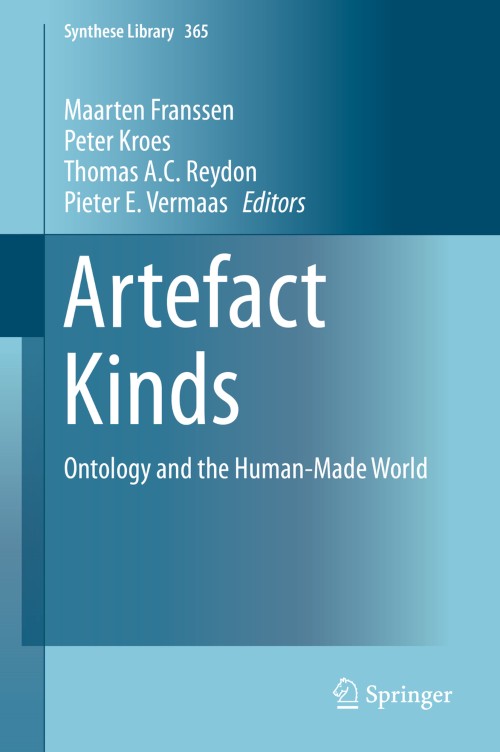
Artefact Kinds [electronic resource] : Ontology and the Human-Made World / edited by Maarten Franssen, Peter Kroes, Thomas A.C. Reydon, Pieter E. Vermaas.
Erişim Adresi
ISBN
9783319008011
Dil Kodu
İngilizce
Yer Numarası
DK/9766
Basım Bildirimi
1st ed. 2014.
Yayın Bilgisi
Cham : Springer International Publishing : Imprint: Springer, 2014.
Fiziksel Niteleme
VI, 225 p. 3 illus., 1 illus. in color. online resource.
Dizi
Synthese Library, Studies in Epistemology, Logic, Methodology, and Philosophy of Science, 2542-8292 ; 365
İçindekiler Notu
Chapter 1. Introduction: The Ontology of Technical Artefacts; Maarten Franssen, Peter Kroes, Thomas A. C. Reydon and Pieter E. Vermaas -- Part I: Artefact Kinds and Metaphysics -- Chapter 2. How Real are Artefacts and Artefact Kinds?; E. J. Lowe -- Chapter 3. Artifacts and Mind-Independence; Crawford L. Elder -- Chapter 4. Public Artifacts, Intentions, and Norms; Amie L. Thomasson -- Chapter 5. Artefact Kinds, Ontological Criteria and Forms of Mind-Dependence; Maarten Franssen and Peter Kroes -- Chapter 6. Artifact Kinds, Identity Criteria and Logical Adequacy; Massimiliano Carrara, Silvia Gaio and Marzia Soavi -- Part II: Artefact Kinds and New Perspectives -- Chapter 7. Creating Artifactual Kinds; Jesús Vega-Encabo and Diego Lawler -- Chapter 8. Metaphysical and Epistemological Approaches to Developing a Theory of Artifact Kinds; Thomas A. C. Reydon -- Chapter 9. Ethnotechnology: A Manifesto; Beth Preston -- Part III: Artefact Kinds and Engineering Practice -- Chapter 10. On What is Made: Instruments, Products and Natural Kinds of Artefacts; Wybo Houkes and Pieter E. Vermaas -- Chapter 11. Artefactual Systems, Missing Components and Replaceability; Nicola Guarino -- Chapter 12. Engineering Differences Between Natural, Social and Artificial Kinds; Eric T. Kerr.
Özet, vb.
This book is concerned with two intimately related topics of metaphysics: the identity of entities and the foundations of classification. What it adds to previous discussions of these topics is that it addresses them with respect to human-made entities, that is, artefacts. As the chapters in the book show, questions of identity and classification require other treatments and lead to other answers for artefacts than for natural entities. These answers are of interest to philosophers not only for their clarification of artefacts as a category of things but also for the new light they may shed on these issue with respect to to natural entities. This volume is structured in three parts. The contributions in Part I address basic ontological and metaphysical questions in relation to artefact kinds: How should we conceive of artefact kinds? Are they real kinds? How are identity conditions for artefacts and artefact kinds related? The contributions in Part II address meta-ontological questions: What, exactly, should an ontological account of artefact kinds provide us with? What scope can it aim for? Which ways of approaching the ontology of artefact kinds are there, how promising are they, and how should we assess this? In Part III, the essays offer engineering practice rather than theoretical philosophy as a point of reference. The issues addressed here include: How do engineers classify technical artefacts and on what grounds? What makes specific classes of technical artefacts candidates for ontologically real kinds, and by which criteria?
Konu
Technology __ Philosophy.
Engineering design.
Philosophy of Technology.
Engineering Design.
Engineering design.
Philosophy of Technology.
Engineering Design.
Diğer Yazarlar
Kurum Adı
Eseri Alıntıla
Referansları kullanmadan önce gözden geçirmeniz ve varsa gerekli düzeltmeleri yapmanız önerilir.
Dijital Kaynak
MARC Görünümü
LEADER 05192nam a22005535i 4500
001 808477
003 TR_AnAIT
005 20260131030905
007 cr nn 008mamaa
008 131004s2014 sz | s |||| 0|eng d
020 |a9783319008011|9978-3-319-00801-1
024 7 |a10.1007/978-3-319-00801-1|2doi
041 |aeng
049 |aTürk Tarih Kurumu Kütüphanesi
050 4|aT14
072 7|aHP|2bicssc
072 7|aTB|2bicssc
072 7|aSCI075000|2bisacsh
072 7|aQD|2thema
072 7|aTB|2thema
082 04|a601|223
090 |aDK/9766
245 10|aArtefact Kinds|h[electronic resource] :|bOntology and the Human-Made World /|cedited by Maarten Franssen, Peter Kroes, Thomas A.C. Reydon, Pieter E. Vermaas.
250 |a1st ed. 2014.
264 1|aCham :|bSpringer International Publishing :|bImprint: Springer,|c2014.
300 |aVI, 225 p. 3 illus., 1 illus. in color.|bonline resource.
336 |atext|btxt|2rdacontent
337 |acomputer|bc|2rdamedia
338 |aonline resource|bcr|2rdacarrier
347 |atext file|bPDF|2rda
490 1 |aSynthese Library, Studies in Epistemology, Logic, Methodology, and Philosophy of Science,|x2542-8292 ;|v365
505 0 |aChapter 1. Introduction: The Ontology of Technical Artefacts; Maarten Franssen, Peter Kroes, Thomas A. C. Reydon and Pieter E. Vermaas -- Part I: Artefact Kinds and Metaphysics -- Chapter 2. How Real are Artefacts and Artefact Kinds?; E. J. Lowe -- Chapter 3. Artifacts and Mind-Independence; Crawford L. Elder -- Chapter 4. Public Artifacts, Intentions, and Norms; Amie L. Thomasson -- Chapter 5. Artefact Kinds, Ontological Criteria and Forms of Mind-Dependence; Maarten Franssen and Peter Kroes -- Chapter 6. Artifact Kinds, Identity Criteria and Logical Adequacy; Massimiliano Carrara, Silvia Gaio and Marzia Soavi -- Part II: Artefact Kinds and New Perspectives -- Chapter 7. Creating Artifactual Kinds; Jesús Vega-Encabo and Diego Lawler -- Chapter 8. Metaphysical and Epistemological Approaches to Developing a Theory of Artifact Kinds; Thomas A. C. Reydon -- Chapter 9. Ethnotechnology: A Manifesto; Beth Preston -- Part III: Artefact Kinds and Engineering Practice -- Chapter 10. On What is Made: Instruments, Products and Natural Kinds of Artefacts; Wybo Houkes and Pieter E. Vermaas -- Chapter 11. Artefactual Systems, Missing Components and Replaceability; Nicola Guarino -- Chapter 12. Engineering Differences Between Natural, Social and Artificial Kinds; Eric T. Kerr.
520 |aThis book is concerned with two intimately related topics of metaphysics: the identity of entities and the foundations of classification. What it adds to previous discussions of these topics is that it addresses them with respect to human-made entities, that is, artefacts. As the chapters in the book show, questions of identity and classification require other treatments and lead to other answers for artefacts than for natural entities. These answers are of interest to philosophers not only for their clarification of artefacts as a category of things but also for the new light they may shed on these issue with respect to to natural entities. This volume is structured in three parts. The contributions in Part I address basic ontological and metaphysical questions in relation to artefact kinds: How should we conceive of artefact kinds? Are they real kinds? How are identity conditions for artefacts and artefact kinds related? The contributions in Part II address meta-ontological questions: What, exactly, should an ontological account of artefact kinds provide us with? What scope can it aim for? Which ways of approaching the ontology of artefact kinds are there, how promising are they, and how should we assess this? In Part III, the essays offer engineering practice rather than theoretical philosophy as a point of reference. The issues addressed here include: How do engineers classify technical artefacts and on what grounds? What makes specific classes of technical artefacts candidates for ontologically real kinds, and by which criteria?
650 0|aTechnology|xPhilosophy.
650 0|aEngineering design.
650 14|aPhilosophy of Technology.
650 24|aEngineering Design.
700 1 |aFranssen, Maarten.|eeditor.|4edt|4http://id.loc.gov/vocabulary/relators/edt
700 1 |aKroes, Peter.|eeditor.|4edt|4http://id.loc.gov/vocabulary/relators/edt
700 1 |aReydon, Thomas A.C.|eeditor.|0(orcid)0000-0002-1804-0532|1https://orcid.org/0000-0002-1804-0532|4edt|4http://id.loc.gov/vocabulary/relators/edt
700 1 |aVermaas, Pieter E.|eeditor.|4edt|4http://id.loc.gov/vocabulary/relators/edt
710 2 |aSpringerLink (Online service)
773 0 |tSpringer Nature eBook
776 08|iPrinted edition:|z9783319008004
776 08|iPrinted edition:|z9783319008028
776 08|iPrinted edition:|z9783319346410
830 0|aSynthese Library, Studies in Epistemology, Logic, Methodology, and Philosophy of Science,|x2542-8292 ;|v365
856 40|uhttps://doi.org/10.1007/978-3-319-00801-1
912 |aZDB-2-SHU
912 |aZDB-2-SXPR
950 |aHumanities, Social Sciences and Law (SpringerNature-11648)
950 |aPhilosophy and Religion (R0) (SpringerNature-43725)
001 808477
003 TR_AnAIT
005 20260131030905
007 cr nn 008mamaa
008 131004s2014 sz | s |||| 0|eng d
020 |a9783319008011|9978-3-319-00801-1
024 7 |a10.1007/978-3-319-00801-1|2doi
041 |aeng
049 |aTürk Tarih Kurumu Kütüphanesi
050 4|aT14
072 7|aHP|2bicssc
072 7|aTB|2bicssc
072 7|aSCI075000|2bisacsh
072 7|aQD|2thema
072 7|aTB|2thema
082 04|a601|223
090 |aDK/9766
245 10|aArtefact Kinds|h[electronic resource] :|bOntology and the Human-Made World /|cedited by Maarten Franssen, Peter Kroes, Thomas A.C. Reydon, Pieter E. Vermaas.
250 |a1st ed. 2014.
264 1|aCham :|bSpringer International Publishing :|bImprint: Springer,|c2014.
300 |aVI, 225 p. 3 illus., 1 illus. in color.|bonline resource.
336 |atext|btxt|2rdacontent
337 |acomputer|bc|2rdamedia
338 |aonline resource|bcr|2rdacarrier
347 |atext file|bPDF|2rda
490 1 |aSynthese Library, Studies in Epistemology, Logic, Methodology, and Philosophy of Science,|x2542-8292 ;|v365
505 0 |aChapter 1. Introduction: The Ontology of Technical Artefacts; Maarten Franssen, Peter Kroes, Thomas A. C. Reydon and Pieter E. Vermaas -- Part I: Artefact Kinds and Metaphysics -- Chapter 2. How Real are Artefacts and Artefact Kinds?; E. J. Lowe -- Chapter 3. Artifacts and Mind-Independence; Crawford L. Elder -- Chapter 4. Public Artifacts, Intentions, and Norms; Amie L. Thomasson -- Chapter 5. Artefact Kinds, Ontological Criteria and Forms of Mind-Dependence; Maarten Franssen and Peter Kroes -- Chapter 6. Artifact Kinds, Identity Criteria and Logical Adequacy; Massimiliano Carrara, Silvia Gaio and Marzia Soavi -- Part II: Artefact Kinds and New Perspectives -- Chapter 7. Creating Artifactual Kinds; Jesús Vega-Encabo and Diego Lawler -- Chapter 8. Metaphysical and Epistemological Approaches to Developing a Theory of Artifact Kinds; Thomas A. C. Reydon -- Chapter 9. Ethnotechnology: A Manifesto; Beth Preston -- Part III: Artefact Kinds and Engineering Practice -- Chapter 10. On What is Made: Instruments, Products and Natural Kinds of Artefacts; Wybo Houkes and Pieter E. Vermaas -- Chapter 11. Artefactual Systems, Missing Components and Replaceability; Nicola Guarino -- Chapter 12. Engineering Differences Between Natural, Social and Artificial Kinds; Eric T. Kerr.
520 |aThis book is concerned with two intimately related topics of metaphysics: the identity of entities and the foundations of classification. What it adds to previous discussions of these topics is that it addresses them with respect to human-made entities, that is, artefacts. As the chapters in the book show, questions of identity and classification require other treatments and lead to other answers for artefacts than for natural entities. These answers are of interest to philosophers not only for their clarification of artefacts as a category of things but also for the new light they may shed on these issue with respect to to natural entities. This volume is structured in three parts. The contributions in Part I address basic ontological and metaphysical questions in relation to artefact kinds: How should we conceive of artefact kinds? Are they real kinds? How are identity conditions for artefacts and artefact kinds related? The contributions in Part II address meta-ontological questions: What, exactly, should an ontological account of artefact kinds provide us with? What scope can it aim for? Which ways of approaching the ontology of artefact kinds are there, how promising are they, and how should we assess this? In Part III, the essays offer engineering practice rather than theoretical philosophy as a point of reference. The issues addressed here include: How do engineers classify technical artefacts and on what grounds? What makes specific classes of technical artefacts candidates for ontologically real kinds, and by which criteria?
650 0|aTechnology|xPhilosophy.
650 0|aEngineering design.
650 14|aPhilosophy of Technology.
650 24|aEngineering Design.
700 1 |aFranssen, Maarten.|eeditor.|4edt|4http://id.loc.gov/vocabulary/relators/edt
700 1 |aKroes, Peter.|eeditor.|4edt|4http://id.loc.gov/vocabulary/relators/edt
700 1 |aReydon, Thomas A.C.|eeditor.|0(orcid)0000-0002-1804-0532|1https://orcid.org/0000-0002-1804-0532|4edt|4http://id.loc.gov/vocabulary/relators/edt
700 1 |aVermaas, Pieter E.|eeditor.|4edt|4http://id.loc.gov/vocabulary/relators/edt
710 2 |aSpringerLink (Online service)
773 0 |tSpringer Nature eBook
776 08|iPrinted edition:|z9783319008004
776 08|iPrinted edition:|z9783319008028
776 08|iPrinted edition:|z9783319346410
830 0|aSynthese Library, Studies in Epistemology, Logic, Methodology, and Philosophy of Science,|x2542-8292 ;|v365
856 40|uhttps://doi.org/10.1007/978-3-319-00801-1
912 |aZDB-2-SHU
912 |aZDB-2-SXPR
950 |aHumanities, Social Sciences and Law (SpringerNature-11648)
950 |aPhilosophy and Religion (R0) (SpringerNature-43725)
Materyaller
Depodan talep edilen materyal sadece kütüphane içerisinde kullanılmaktadır.
Materyal dışarıya ödünç verilmemektedir.
Materyal dışarıya ödünç verilmemektedir.
