

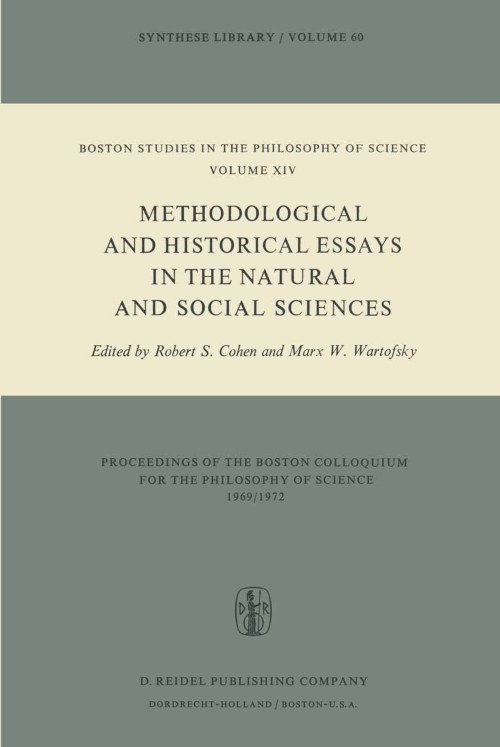
Methodological and Historical Essays in the Natural and Social Sciences [electronic resource] / edited by Robert S. Cohen, Marx W. Wartofsky.
Erişim Adresi
ISBN
9789401021289
Dil Kodu
İngilizce
Yer Numarası
DK/9769
Basım Bildirimi
1st ed. 1974.
Yayın Bilgisi
Dordrecht : Springer Netherlands : Imprint: Springer, 1974.
Fiziksel Niteleme
413 p. online resource.
Dizi
Boston Studies in the Philosophy and History of Science, 2214-7942 ; 14
İçindekiler Notu
Empiricism at Bay?: Revisions and a New Defense -- Empiricism at Sea -- What Duhem Really Meant -- Genius in Science -- Regularity and Law -- Teleological and Teleonomic, a New Analysis -- Forces, Powers, Aethers, and Fields -- Natural Science and the Future of Metaphysics -- Is the Transition from an Old Theory to a New One of a Sudden and Unexpected Character? -- Some Practical Issues in the Recent Controversy on the Nature of Scientific Revolutions -- The Divergent-Convergent Method — A Heuristic Approach to Problem-Solving -- The Logical and the Extra-Logical -- What is a Logical Constant? -- On the Law of Inertia -- Scientific and Metaphysical Problems: Euler and Kant -- Theory of Language and Philosophy of Science as Instruments of Educational Reform: Wittgenstein and Popper as Austrian Schoolteachers -- Bible Criticism and Social Science -- Kant, Marx and the Modern Rationality -- The Marxist Conception of Science -- The Idea of Statistical Law in Nineteenth Century Science.
Özet, vb.
Modem philosophy of science has turned out to be a Pandora's box. Once opened, the puzzling monsters appeared: not only was the neat structure of classical physics radically changed, but a variety of broader questions were let loose, bearing on the nature of scientific inquiry and of human knowledge in general. Philosophy of science could not help becoming epistemological and historical, and could no longer avoid metaphysical questions, even when these were posed in disguise. Once the identification of scientific methodology with that of physics had been queried, not only did biology and psychology come under scrutiny as major modes of scientific inquiry, but so too did history and the social sciences - particularly economics, sociology and anthropology. And now, new 'monsters' are emerging - for example, medicine and political science as disciplined inquiries. This raises anew a much older question, namely whether the conception of science is to be distinguished from a wider conception of learning and inquiry? Or is science to be more deeply understood as the most adequate form of learning and inquiry, whose methods reach every domain of rational thought? Is modern science matured reason, or is it simply one historically adapted and limited species of western reason? In our colloquia at Boston University, over the past fourteen years, we have been probing and testing the scope of philosophy of science.
Konu
Science __ Philosophy.
Philosophy of Science.
Philosophy of Science.
Diğer Yazarlar
Kurum Adı
Eseri Alıntıla
Referansları kullanmadan önce gözden geçirmeniz ve varsa gerekli düzeltmeleri yapmanız önerilir.
Dijital Kaynak
MARC Görünümü
LEADER 05077nam a22005535i 4500
001 808480
003 TR_AnAIT
005 20260131030855
007 cr nn 008mamaa
008 121227s1974 ne | s |||| 0|eng d
020 |a9789401021289|9978-94-010-2128-9
024 7 |a10.1007/978-94-010-2128-9|2doi
041 |aeng
049 |aTürk Tarih Kurumu Kütüphanesi
050 4|aQ174-175.3
050 4|aB67
072 7|aPDA|2bicssc
072 7|aSCI075000|2bisacsh
072 7|aPDA|2thema
082 04|a501|223
090 |aDK/9769
245 10|aMethodological and Historical Essays in the Natural and Social Sciences|h[electronic resource] /|cedited by Robert S. Cohen, Marx W. Wartofsky.
250 |a1st ed. 1974.
264 1|aDordrecht :|bSpringer Netherlands :|bImprint: Springer,|c1974.
300 |a413 p.|bonline resource.
336 |atext|btxt|2rdacontent
337 |acomputer|bc|2rdamedia
338 |aonline resource|bcr|2rdacarrier
347 |atext file|bPDF|2rda
490 1 |aBoston Studies in the Philosophy and History of Science,|x2214-7942 ;|v14
505 0 |aEmpiricism at Bay?: Revisions and a New Defense -- Empiricism at Sea -- What Duhem Really Meant -- Genius in Science -- Regularity and Law -- Teleological and Teleonomic, a New Analysis -- Forces, Powers, Aethers, and Fields -- Natural Science and the Future of Metaphysics -- Is the Transition from an Old Theory to a New One of a Sudden and Unexpected Character? -- Some Practical Issues in the Recent Controversy on the Nature of Scientific Revolutions -- The Divergent-Convergent Method — A Heuristic Approach to Problem-Solving -- The Logical and the Extra-Logical -- What is a Logical Constant? -- On the Law of Inertia -- Scientific and Metaphysical Problems: Euler and Kant -- Theory of Language and Philosophy of Science as Instruments of Educational Reform: Wittgenstein and Popper as Austrian Schoolteachers -- Bible Criticism and Social Science -- Kant, Marx and the Modern Rationality -- The Marxist Conception of Science -- The Idea of Statistical Law in Nineteenth Century Science.
520 |aModem philosophy of science has turned out to be a Pandora's box. Once opened, the puzzling monsters appeared: not only was the neat structure of classical physics radically changed, but a variety of broader questions were let loose, bearing on the nature of scientific inquiry and of human knowledge in general. Philosophy of science could not help becoming epistemological and historical, and could no longer avoid metaphysical questions, even when these were posed in disguise. Once the identification of scientific methodology with that of physics had been queried, not only did biology and psychology come under scrutiny as major modes of scientific inquiry, but so too did history and the social sciences - particularly economics, sociology and anthropology. And now, new 'monsters' are emerging - for example, medicine and political science as disciplined inquiries. This raises anew a much older question, namely whether the conception of science is to be distinguished from a wider conception of learning and inquiry? Or is science to be more deeply understood as the most adequate form of learning and inquiry, whose methods reach every domain of rational thought? Is modern science matured reason, or is it simply one historically adapted and limited species of western reason? In our colloquia at Boston University, over the past fourteen years, we have been probing and testing the scope of philosophy of science.
532 8 |aAccessibility summary: This PDF is not accessible. It is based on scanned pages and does not support features such as screen reader compatibility or described non-text content (images, graphs etc). However, it likely supports searchable and selectable text based on OCR (Optical Character Recognition). Users with accessibility needs may not be able to use this content effectively. Please contact us at accessibilitysupport@springernature.com if you require assistance or an alternative format.
532 8 |aInaccessible, or known limited accessibility
532 8 |aNo reading system accessibility options actively disabled
532 8 |aPublisher contact for further accessibility information: accessibilitysupport@springernature.com
650 0|aScience|xPhilosophy.
650 14|aPhilosophy of Science.
700 1 |aCohen, Robert S.|eeditor.|4edt|4http://id.loc.gov/vocabulary/relators/edt
700 1 |aWartofsky, Marx W.|eeditor.|4edt|4http://id.loc.gov/vocabulary/relators/edt
710 2 |aSpringerLink (Online service)
773 0 |tSpringer Nature eBook
776 08|iPrinted edition:|z9789027703927
776 08|iPrinted edition:|z9789027703781
776 08|iPrinted edition:|z9789401021296
830 0|aBoston Studies in the Philosophy and History of Science,|x2214-7942 ;|v14
856 40|uhttps://doi.org/10.1007/978-94-010-2128-9
912 |aZDB-2-SHU
912 |aZDB-2-SXPR
912 |aZDB-2-BAE
950 |aHumanities, Social Sciences and Law (SpringerNature-11648)
950 |aPhilosophy and Religion (R0) (SpringerNature-43725)
001 808480
003 TR_AnAIT
005 20260131030855
007 cr nn 008mamaa
008 121227s1974 ne | s |||| 0|eng d
020 |a9789401021289|9978-94-010-2128-9
024 7 |a10.1007/978-94-010-2128-9|2doi
041 |aeng
049 |aTürk Tarih Kurumu Kütüphanesi
050 4|aQ174-175.3
050 4|aB67
072 7|aPDA|2bicssc
072 7|aSCI075000|2bisacsh
072 7|aPDA|2thema
082 04|a501|223
090 |aDK/9769
245 10|aMethodological and Historical Essays in the Natural and Social Sciences|h[electronic resource] /|cedited by Robert S. Cohen, Marx W. Wartofsky.
250 |a1st ed. 1974.
264 1|aDordrecht :|bSpringer Netherlands :|bImprint: Springer,|c1974.
300 |a413 p.|bonline resource.
336 |atext|btxt|2rdacontent
337 |acomputer|bc|2rdamedia
338 |aonline resource|bcr|2rdacarrier
347 |atext file|bPDF|2rda
490 1 |aBoston Studies in the Philosophy and History of Science,|x2214-7942 ;|v14
505 0 |aEmpiricism at Bay?: Revisions and a New Defense -- Empiricism at Sea -- What Duhem Really Meant -- Genius in Science -- Regularity and Law -- Teleological and Teleonomic, a New Analysis -- Forces, Powers, Aethers, and Fields -- Natural Science and the Future of Metaphysics -- Is the Transition from an Old Theory to a New One of a Sudden and Unexpected Character? -- Some Practical Issues in the Recent Controversy on the Nature of Scientific Revolutions -- The Divergent-Convergent Method — A Heuristic Approach to Problem-Solving -- The Logical and the Extra-Logical -- What is a Logical Constant? -- On the Law of Inertia -- Scientific and Metaphysical Problems: Euler and Kant -- Theory of Language and Philosophy of Science as Instruments of Educational Reform: Wittgenstein and Popper as Austrian Schoolteachers -- Bible Criticism and Social Science -- Kant, Marx and the Modern Rationality -- The Marxist Conception of Science -- The Idea of Statistical Law in Nineteenth Century Science.
520 |aModem philosophy of science has turned out to be a Pandora's box. Once opened, the puzzling monsters appeared: not only was the neat structure of classical physics radically changed, but a variety of broader questions were let loose, bearing on the nature of scientific inquiry and of human knowledge in general. Philosophy of science could not help becoming epistemological and historical, and could no longer avoid metaphysical questions, even when these were posed in disguise. Once the identification of scientific methodology with that of physics had been queried, not only did biology and psychology come under scrutiny as major modes of scientific inquiry, but so too did history and the social sciences - particularly economics, sociology and anthropology. And now, new 'monsters' are emerging - for example, medicine and political science as disciplined inquiries. This raises anew a much older question, namely whether the conception of science is to be distinguished from a wider conception of learning and inquiry? Or is science to be more deeply understood as the most adequate form of learning and inquiry, whose methods reach every domain of rational thought? Is modern science matured reason, or is it simply one historically adapted and limited species of western reason? In our colloquia at Boston University, over the past fourteen years, we have been probing and testing the scope of philosophy of science.
532 8 |aAccessibility summary: This PDF is not accessible. It is based on scanned pages and does not support features such as screen reader compatibility or described non-text content (images, graphs etc). However, it likely supports searchable and selectable text based on OCR (Optical Character Recognition). Users with accessibility needs may not be able to use this content effectively. Please contact us at accessibilitysupport@springernature.com if you require assistance or an alternative format.
532 8 |aInaccessible, or known limited accessibility
532 8 |aNo reading system accessibility options actively disabled
532 8 |aPublisher contact for further accessibility information: accessibilitysupport@springernature.com
650 0|aScience|xPhilosophy.
650 14|aPhilosophy of Science.
700 1 |aCohen, Robert S.|eeditor.|4edt|4http://id.loc.gov/vocabulary/relators/edt
700 1 |aWartofsky, Marx W.|eeditor.|4edt|4http://id.loc.gov/vocabulary/relators/edt
710 2 |aSpringerLink (Online service)
773 0 |tSpringer Nature eBook
776 08|iPrinted edition:|z9789027703927
776 08|iPrinted edition:|z9789027703781
776 08|iPrinted edition:|z9789401021296
830 0|aBoston Studies in the Philosophy and History of Science,|x2214-7942 ;|v14
856 40|uhttps://doi.org/10.1007/978-94-010-2128-9
912 |aZDB-2-SHU
912 |aZDB-2-SXPR
912 |aZDB-2-BAE
950 |aHumanities, Social Sciences and Law (SpringerNature-11648)
950 |aPhilosophy and Religion (R0) (SpringerNature-43725)
Materyaller
Depodan talep edilen materyal sadece kütüphane içerisinde kullanılmaktadır.
Materyal dışarıya ödünç verilmemektedir.
Materyal dışarıya ödünç verilmemektedir.
