LEADER 04117nam a22005415i 4500
001 808488
003 TR_AnAIT
005 20260131030825
007 cr nn 008mamaa
008 121227s1952 ne | s |||| 0|eng d
020 |a9789401174978|9978-94-011-7497-8
024 7 |a10.1007/978-94-011-7497-8|2doi
041 |aeng
049 |aTürk Tarih Kurumu Kütüphanesi
050 4|aD1-2027
072 7|aHB|2bicssc
072 7|aHBAH|2bicssc
072 7|aHIS000000|2bisacsh
072 7|aNH|2thema
072 7|aNHAH|2thema
082 04|a900|223
090 |aDK/9777
100 1 |aPetersen, W.|eauthor.|4aut|4http://id.loc.gov/vocabulary/relators/aut
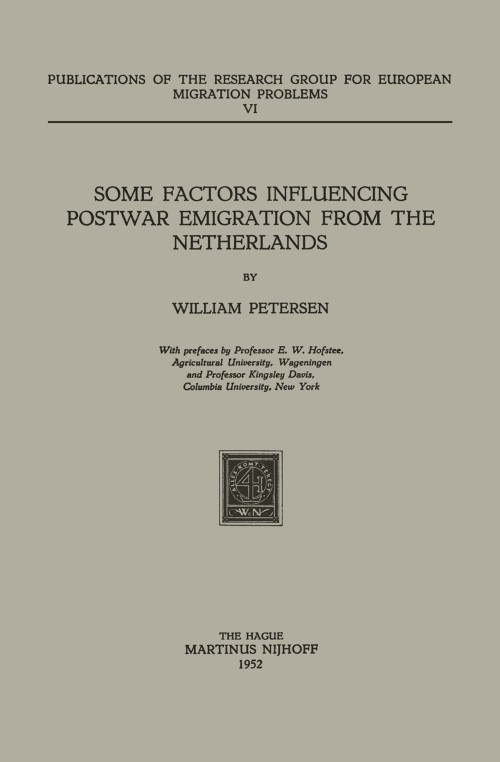
245 10|aSome Factors Influencing Postwar Emigration from the Netherlands|h[electronic resource] /|cby W. Petersen.
250 |a1st ed. 1952.
264 1|aDordrecht :|bSpringer Netherlands :|bImprint: Springer,|c1952.
300 |a92 p.|bonline resource.
336 |atext|btxt|2rdacontent
337 |acomputer|bc|2rdamedia
338 |aonline resource|bcr|2rdacarrier
347 |atext file|bPDF|2rda
490 1 |aResearch Group for European Migration Problems ;|v6
505 0 |aPopulation Pressure in the Netherlands -- An Emigration-Minded Country -- Motivation of Emigrants -- Migration Statistics -- Immigration Countries -- France -- Canada -- Australia -- New Zealand -- United States -- South Africa -- Latin America -- Indonesia -- Undeveloped Countries -- The Role of Government in Migration -- Selection of Migrants -- Age, sexy marital status -- Occupation -- Religion -- Race, nationality -- Assimilation of Emigrants -- Conclusions -- Sommaire Français.
520 |aAs Mr Petersen points out in this study, since the war there has been a very strong belief in the Netherlands that emigration is necessary. Even those who never before occupied themselves with these matters now speak of the large natural increase, the overpopulation, and the lack of opportunities in the Netherlands. Thousands are considering the possibility of leaving their home land and creating a new existence for themselves overseas. It is a mistake to suppose, however, that these ideas stem from the special demographic and economic conditions that arose in the Netherlands since the war; the opposite is the case. From this point of view, there has never been less reason for emigrating during the past decades than in these postwar years. As far as the demographic situation is concerned, by 1930 the natural increase had decreased markedly as compared with the preceding decades, so that the number of young persons entering the labor market after the war has been relatively small. On the other hand, there have been more openings in industry and in other sectors of the economy than ever before, so that unemploy ment pretty much disappeared. Only in 1951 did it again become at all significant.
532 8 |aAccessibility summary: This PDF is not accessible. It is based on scanned pages and does not support features such as screen reader compatibility or described non-text content (images, graphs etc). However, it likely supports searchable and selectable text based on OCR (Optical Character Recognition). Users with accessibility needs may not be able to use this content effectively. Please contact us at accessibilitysupport@springernature.com if you require assistance or an alternative format.
532 8 |aInaccessible, or known limited accessibility
532 8 |aNo reading system accessibility options actively disabled
532 8 |aPublisher contact for further accessibility information: accessibilitysupport@springernature.com
650 0|aHistory.
650 14|aHistory.
710 2 |aSpringerLink (Online service)
773 0 |tSpringer Nature eBook
776 08|iPrinted edition:|z9789024704606
776 08|iPrinted edition:|z9789401174985
830 0|aResearch Group for European Migration Problems ;|v6
856 40|uhttps://doi.org/10.1007/978-94-011-7497-8
912 |aZDB-2-SHU
912 |aZDB-2-SXH
912 |aZDB-2-BAE
950 |aHumanities, Social Sciences and Law (SpringerNature-11648)
950 |aHistory (R0) (SpringerNature-43722)