

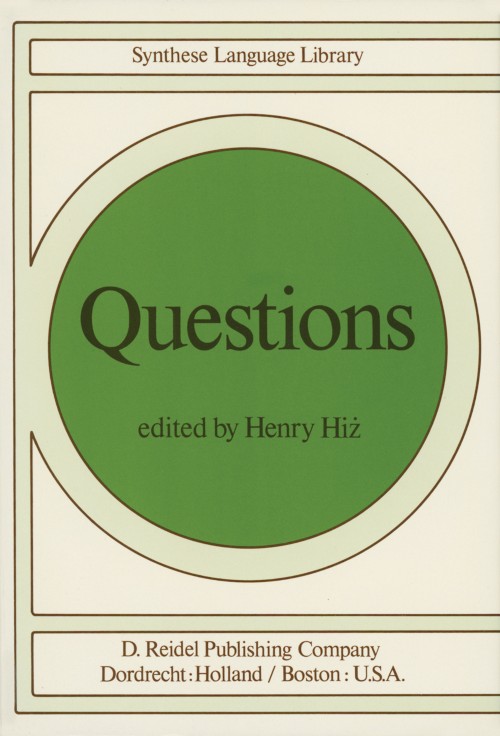
Questions [electronic resource] / edited by H. Hiz.
Erişim Adresi
ISBN
9789400995093
Dil Kodu
İngilizce
Yer Numarası
DK/9778
Basım Bildirimi
1st ed. 1978.
Yayın Bilgisi
Dordrecht : Springer Netherlands : Imprint: Springer, 1978.
Fiziksel Niteleme
383 p. online resource.
Dizi
Studies in Linguistics and Philosophy, 2215-034X ; 1
İçindekiler Notu
The Interrogative in a Syntactic Framework -- Generative-Transformational Studies in English Interrogatives -- Yes—No Questions Are Not Alternative Questions -- Asking More Than One Thing at a Time -- Q-Morpheme Hypothesis -- Syntax and Semantics of Questions -- Difficult Questions -- Questions and Categories -- Answers to Questions -- Questions as Epistemic Requests -- A Prolegomenon to an Interrogative Theory of Scientific Inquiry.
Özet, vb.
To the philosopher, the logician, and the linguist, questions have a special fascination. The two main views of language, that it describes the world, and that it expresses thought, are not directly applicable to questions. Ques tions are not assertions. A question may be apt, sharp, to the point, impor tant, or it may be inappropriate, ambiguous, awkward, irrelevant or irreverent. But it cannot be true or false. It does not have a truth value not just because an utterance like Was the letter long? does not indicate which letter is being talked about. The indicative The letter was not long has the same indeter minacy. In actual context the anaphoric definite article will be resolved both for a question and for an indicative sentence. Contextual resolutions are easily found for most cross-references. A question cannot be either true or it does not describe a state of affairs. Neither does it express false, because thought, because it is an expression of suspended thought, of lack of judge ment. To dress it in other philosophical styles, a question is not a judgment, it is not a proposition, it is not an assertion. A philosopher may try to paraphrase a question as an indicative sentence, for instance as a statement of ignorance, or as a statement of the desire to know. Hintikka, Wachowicz and Lang explore this territory. Or he may interpret it as a meta statement intimating the direction in which the flow of the discourse is going.
Konu
Semiotics.
Language and languages __ Philosophy.
Semiotics.
Philosophy of Language.
Language and languages __ Philosophy.
Semiotics.
Philosophy of Language.
Diğer Yazarlar
Kurum Adı
Eseri Alıntıla
Referansları kullanmadan önce gözden geçirmeniz ve varsa gerekli düzeltmeleri yapmanız önerilir.
Dijital Kaynak
MARC Görünümü
LEADER 04365nam a22005535i 4500
001 808489
003 TR_AnAIT
005 20260131030819
007 cr nn 008mamaa
008 121227s1978 ne | s |||| 0|eng d
020 |a9789400995093|9978-94-009-9509-3
024 7 |a10.1007/978-94-009-9509-3|2doi
041 |aeng
049 |aTürk Tarih Kurumu Kütüphanesi
050 4|aP99-99.4
072 7|aGTE|2bicssc
072 7|aLIT006000|2bisacsh
072 7|aGTD|2thema
082 04|a401.4|223
090 |aDK/9778
245 10|aQuestions|h[electronic resource] /|cedited by H. Hiz.
250 |a1st ed. 1978.
264 1|aDordrecht :|bSpringer Netherlands :|bImprint: Springer,|c1978.
300 |a383 p.|bonline resource.
336 |atext|btxt|2rdacontent
337 |acomputer|bc|2rdamedia
338 |aonline resource|bcr|2rdacarrier
347 |atext file|bPDF|2rda
490 1 |aStudies in Linguistics and Philosophy,|x2215-034X ;|v1
505 0 |aThe Interrogative in a Syntactic Framework -- Generative-Transformational Studies in English Interrogatives -- Yes—No Questions Are Not Alternative Questions -- Asking More Than One Thing at a Time -- Q-Morpheme Hypothesis -- Syntax and Semantics of Questions -- Difficult Questions -- Questions and Categories -- Answers to Questions -- Questions as Epistemic Requests -- A Prolegomenon to an Interrogative Theory of Scientific Inquiry.
520 |aTo the philosopher, the logician, and the linguist, questions have a special fascination. The two main views of language, that it describes the world, and that it expresses thought, are not directly applicable to questions. Ques tions are not assertions. A question may be apt, sharp, to the point, impor tant, or it may be inappropriate, ambiguous, awkward, irrelevant or irreverent. But it cannot be true or false. It does not have a truth value not just because an utterance like Was the letter long? does not indicate which letter is being talked about. The indicative The letter was not long has the same indeter minacy. In actual context the anaphoric definite article will be resolved both for a question and for an indicative sentence. Contextual resolutions are easily found for most cross-references. A question cannot be either true or it does not describe a state of affairs. Neither does it express false, because thought, because it is an expression of suspended thought, of lack of judge ment. To dress it in other philosophical styles, a question is not a judgment, it is not a proposition, it is not an assertion. A philosopher may try to paraphrase a question as an indicative sentence, for instance as a statement of ignorance, or as a statement of the desire to know. Hintikka, Wachowicz and Lang explore this territory. Or he may interpret it as a meta statement intimating the direction in which the flow of the discourse is going.
532 8 |aAccessibility summary: This PDF is not accessible. It is based on scanned pages and does not support features such as screen reader compatibility or described non-text content (images, graphs etc). However, it likely supports searchable and selectable text based on OCR (Optical Character Recognition). Users with accessibility needs may not be able to use this content effectively. Please contact us at accessibilitysupport@springernature.com if you require assistance or an alternative format.
532 8 |aInaccessible, or known limited accessibility
532 8 |aNo reading system accessibility options actively disabled
532 8 |aPublisher contact for further accessibility information: accessibilitysupport@springernature.com
650 0|aSemiotics.
650 0|aLanguage and languages|xPhilosophy.
650 14|aSemiotics.
650 24|aPhilosophy of Language.
700 1 |aHiz, H.|eeditor.|4edt|4http://id.loc.gov/vocabulary/relators/edt
710 2 |aSpringerLink (Online service)
773 0 |tSpringer Nature eBook
776 08|iPrinted edition:|z9789027708137
776 08|iPrinted edition:|z9789027710352
776 08|iPrinted edition:|z9789400995109
830 0|aStudies in Linguistics and Philosophy,|x2215-034X ;|v1
856 40|uhttps://doi.org/10.1007/978-94-009-9509-3
912 |aZDB-2-SHU
912 |aZDB-2-SXS
912 |aZDB-2-BAE
950 |aHumanities, Social Sciences and Law (SpringerNature-11648)
950 |aSocial Sciences (R0) (SpringerNature-43726)
001 808489
003 TR_AnAIT
005 20260131030819
007 cr nn 008mamaa
008 121227s1978 ne | s |||| 0|eng d
020 |a9789400995093|9978-94-009-9509-3
024 7 |a10.1007/978-94-009-9509-3|2doi
041 |aeng
049 |aTürk Tarih Kurumu Kütüphanesi
050 4|aP99-99.4
072 7|aGTE|2bicssc
072 7|aLIT006000|2bisacsh
072 7|aGTD|2thema
082 04|a401.4|223
090 |aDK/9778
245 10|aQuestions|h[electronic resource] /|cedited by H. Hiz.
250 |a1st ed. 1978.
264 1|aDordrecht :|bSpringer Netherlands :|bImprint: Springer,|c1978.
300 |a383 p.|bonline resource.
336 |atext|btxt|2rdacontent
337 |acomputer|bc|2rdamedia
338 |aonline resource|bcr|2rdacarrier
347 |atext file|bPDF|2rda
490 1 |aStudies in Linguistics and Philosophy,|x2215-034X ;|v1
505 0 |aThe Interrogative in a Syntactic Framework -- Generative-Transformational Studies in English Interrogatives -- Yes—No Questions Are Not Alternative Questions -- Asking More Than One Thing at a Time -- Q-Morpheme Hypothesis -- Syntax and Semantics of Questions -- Difficult Questions -- Questions and Categories -- Answers to Questions -- Questions as Epistemic Requests -- A Prolegomenon to an Interrogative Theory of Scientific Inquiry.
520 |aTo the philosopher, the logician, and the linguist, questions have a special fascination. The two main views of language, that it describes the world, and that it expresses thought, are not directly applicable to questions. Ques tions are not assertions. A question may be apt, sharp, to the point, impor tant, or it may be inappropriate, ambiguous, awkward, irrelevant or irreverent. But it cannot be true or false. It does not have a truth value not just because an utterance like Was the letter long? does not indicate which letter is being talked about. The indicative The letter was not long has the same indeter minacy. In actual context the anaphoric definite article will be resolved both for a question and for an indicative sentence. Contextual resolutions are easily found for most cross-references. A question cannot be either true or it does not describe a state of affairs. Neither does it express false, because thought, because it is an expression of suspended thought, of lack of judge ment. To dress it in other philosophical styles, a question is not a judgment, it is not a proposition, it is not an assertion. A philosopher may try to paraphrase a question as an indicative sentence, for instance as a statement of ignorance, or as a statement of the desire to know. Hintikka, Wachowicz and Lang explore this territory. Or he may interpret it as a meta statement intimating the direction in which the flow of the discourse is going.
532 8 |aAccessibility summary: This PDF is not accessible. It is based on scanned pages and does not support features such as screen reader compatibility or described non-text content (images, graphs etc). However, it likely supports searchable and selectable text based on OCR (Optical Character Recognition). Users with accessibility needs may not be able to use this content effectively. Please contact us at accessibilitysupport@springernature.com if you require assistance or an alternative format.
532 8 |aInaccessible, or known limited accessibility
532 8 |aNo reading system accessibility options actively disabled
532 8 |aPublisher contact for further accessibility information: accessibilitysupport@springernature.com
650 0|aSemiotics.
650 0|aLanguage and languages|xPhilosophy.
650 14|aSemiotics.
650 24|aPhilosophy of Language.
700 1 |aHiz, H.|eeditor.|4edt|4http://id.loc.gov/vocabulary/relators/edt
710 2 |aSpringerLink (Online service)
773 0 |tSpringer Nature eBook
776 08|iPrinted edition:|z9789027708137
776 08|iPrinted edition:|z9789027710352
776 08|iPrinted edition:|z9789400995109
830 0|aStudies in Linguistics and Philosophy,|x2215-034X ;|v1
856 40|uhttps://doi.org/10.1007/978-94-009-9509-3
912 |aZDB-2-SHU
912 |aZDB-2-SXS
912 |aZDB-2-BAE
950 |aHumanities, Social Sciences and Law (SpringerNature-11648)
950 |aSocial Sciences (R0) (SpringerNature-43726)
Materyaller
Depodan talep edilen materyal sadece kütüphane içerisinde kullanılmaktadır.
Materyal dışarıya ödünç verilmemektedir.
Materyal dışarıya ödünç verilmemektedir.
