LEADER 03388nam a22005535i 4500
001 808504
003 TR_AnAIT
005 20260131030734
007 cr nn 008mamaa
008 100301s2002 ne | s |||| 0|eng d
020 |a9780306472138|9978-0-306-47213-8
024 7 |a10.1007/0-306-47213-9|2doi
041 |aeng
049 |aTürk Tarih Kurumu Kütüphanesi
050 4|aQA10.92-20
072 7|aJNU|2bicssc
072 7|aPB|2bicssc
072 7|aEDU029010|2bisacsh
072 7|aJNU|2thema
072 7|aPB|2thema
082 04|a510.71|223
090 |aDK/9793
100 1 |aBrown, Tony.|eauthor.|4aut|4http://id.loc.gov/vocabulary/relators/aut
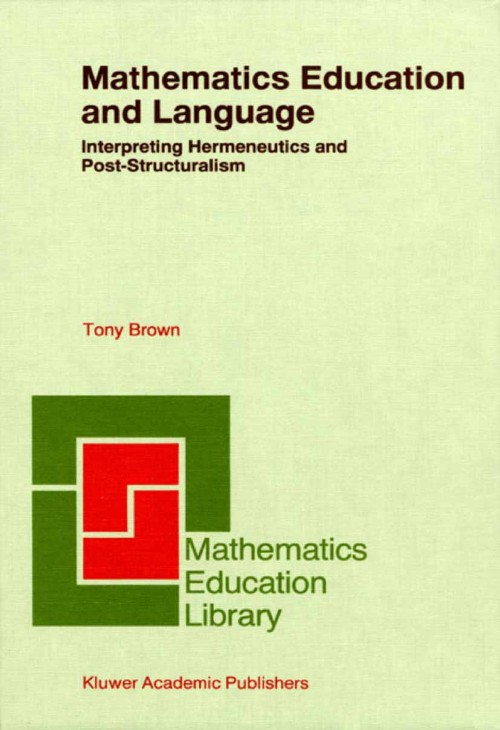
245 10|aMathematics Education and Language|h[electronic resource] :|bInterpreting Hermeneutics and Post-Structuralism /|cby Tony Brown.
250 |a1st ed. 2002.
264 1|aDordrecht :|bSpringer Netherlands :|bImprint: Springer,|c2002.
300 |aIX, 270 p. 7 illus.|bonline resource.
336 |atext|btxt|2rdacontent
337 |acomputer|bc|2rdamedia
338 |aonline resource|bcr|2rdacarrier
347 |atext file|bPDF|2rda
490 1 |aMathematics Education Library,|x2214-983X ;|v20
505 0 |aShort Review of Recent Research -- Experiencing Mathematics -- Hermeneutics and Mathematics Education -- The Production of Mathematical Meaning: A Post-Structuralist Perspective -- Sharing Mathematical Perspectives -- The Classroom Environment -- Some Lessons -- The Phenomenology of the Mathematics Classroom -- The Teacher’s Perspective -- Teacher-Student Interactions -- Developing Teacher Practice -- Conclusion -- Conclusion.
520 |a`Contemporary thinking on philosophy and the social sciences has been dominated by analyses that emphasise the importance of language in understanding societies and individuals functioning within them; important developments which have been under-utilised by researchers in mathematics education. This book reaches out to contemporary work in these broader fields; drawing on original sources in key areas such as Gadamer and Ricoeur's development of hermeneutics, Habermas' work in critical social theory, Schutz's social phenomenology, Saussure's linguistics and the post-structuralist analysis of Derrida, Foucault and Barthes. Through examining the writings of these major thinkers it is shown how language is necessarily instrumental in developing mathematical understanding; but a language that is in a permanent state of becoming, resisting stable connections to the ideas it locates. The analysis offered extends from children doing mathematics to teachers inspecting and developing their own professional practices.'.
650 0|aMathematics|xStudy and teaching .
650 0|aEducation|xPhilosophy.
650 0|aScience|xStudy and teaching.
650 14|aMathematics Education.
650 24|aPhilosophy of Education.
650 24|aScience Education.
710 2 |aSpringerLink (Online service)
773 0 |tSpringer Nature eBook
776 08|iPrinted edition:|z9780792345541
776 08|iPrinted edition:|z9789401737999
776 08|iPrinted edition:|z9789401738002
830 0|aMathematics Education Library,|x2214-983X ;|v20
856 40|uhttps://doi.org/10.1007/0-306-47213-9
912 |aZDB-2-SHU
912 |aZDB-2-SXED
912 |aZDB-2-BAE
950 |aHumanities, Social Sciences and Law (SpringerNature-11648)
950 |aEducation (R0) (SpringerNature-43721)