LEADER 03621nam a22005055i 4500
001 808536
003 TR_AnAIT
005 20260131030628
007 cr nn 008mamaa
008 100301s2002 ne | s |||| 0|eng d
020 |a9780306472114|9978-0-306-47211-4
024 7 |a10.1007/0-306-47211-2|2doi
041 |aeng
049 |aTürk Tarih Kurumu Kütüphanesi
050 4|aQA10.92-20
072 7|aJNU|2bicssc
072 7|aPB|2bicssc
072 7|aEDU029010|2bisacsh
072 7|aJNU|2thema
072 7|aPB|2thema
082 04|a510.71|223
090 |aDK/9825
100 1 |aBrousseau, Guy.|eauthor.|4aut|4http://id.loc.gov/vocabulary/relators/aut
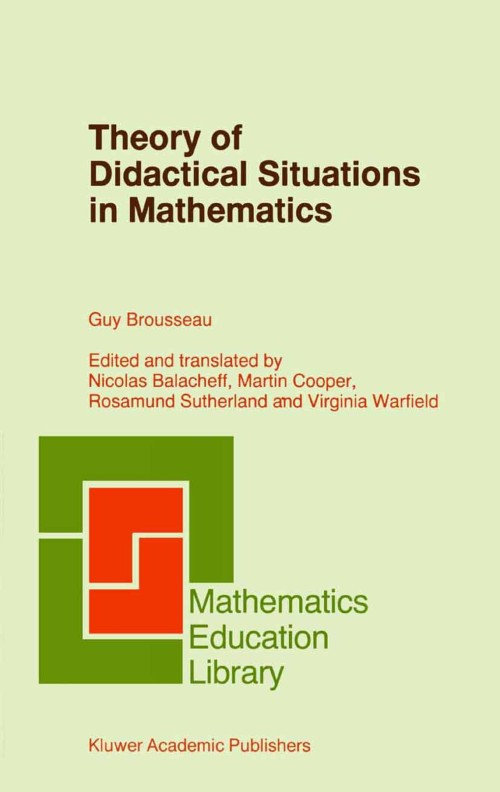
245 10|aTheory of Didactical Situations in Mathematics|h[electronic resource] :|bDidactique des Mathématiques, 1970–1990 /|cby Guy Brousseau.
250 |a1st ed. 2002.
264 1|aDordrecht :|bSpringer Netherlands :|bImprint: Springer,|c2002.
300 |aXX, 306 p.|bonline resource.
336 |atext|btxt|2rdacontent
337 |acomputer|bc|2rdamedia
338 |aonline resource|bcr|2rdacarrier
347 |atext file|bPDF|2rda
490 1 |aMathematics Education Library,|x2214-983X ;|v19
505 0 |aPrelude to the Introduction -- Setting the Scene with an Example: the Race to 20 -- Prelude -- Foundations and Methods of Didactique -- Prelude -- Epistemological Obstacles, Problems, and Didactical Engineering -- Prelude -- Problems with Teaching Decimal Numbers -- Interlude -- Didactical Problems with Decimals -- Postlude Didactique and Teaching Problems -- Prelude -- The Didactical Contract: The Teacher, the Student and the Milieu -- Prelude -- Didactique: What Use is it to a Teacher?.
520 |aOn the occasion of the celebration of “Twenty Years of Didactique of Ma- ematics” in France, Jeremy Kilpatrick commented that though the works of Guy Brousseau are known through texts referring to them or mentioning their existence, the original texts are unknown, or known only with difficulty, in the non-Fren- speaking world. With very few exceptions, what has been available until now have been interpretations of the works of Brousseau rather than the works themselves. It was in response to this need that two of us, in the euphoria of an unforgettable Mexican evening at the time of the 1990 PME conference, decided to undertake the task of translating into English most of the works of Guy Brousseau. The ceuvre is immense, and once past the initial moments ofenthusiasm, with the accompanying ambition to produce the entire of it, we recognized the need to choose both the texts and a method of proceeding. As far as the texts go, we chose to take the period from 1970 to 1990, in the course of which it seemed to us that Brousseau had forged the essentials of the Theory of Didactical Situations. But even there the collection is huge. So, after an initial translation of most of the publications of the period, we carved out a selection, retaining the texts which gave the best presentation of the principles and key concepts of the Theory.
650 0|aMathematics|xStudy and teaching .
650 14|aMathematics Education.
710 2 |aSpringerLink (Online service)
773 0 |tSpringer Nature eBook
776 08|iPrinted edition:|z9780792345268
776 08|iPrinted edition:|z9789048148424
776 08|iPrinted edition:|z9789401737968
830 0|aMathematics Education Library,|x2214-983X ;|v19
856 40|uhttps://doi.org/10.1007/0-306-47211-2
912 |aZDB-2-SHU
912 |aZDB-2-SXED
912 |aZDB-2-BAE
950 |aHumanities, Social Sciences and Law (SpringerNature-11648)
950 |aEducation (R0) (SpringerNature-43721)