LEADER 03584nam a22005415i 4500
001 808558
003 TR_AnAIT
005 20260131030549
007 cr nn 008mamaa
008 100301s2000 xxu| s |||| 0|eng d
020 |a9780306474682|9978-0-306-47468-2
024 7 |a10.1007/b100324|2doi
041 |aeng
049 |aTürk Tarih Kurumu Kütüphanesi
050 4|aCC1-960
072 7|aHD|2bicssc
072 7|aSOC003000|2bisacsh
072 7|aNK|2thema
082 04|a930.1|223
090 |aDK/9847
100 1 |aO'Brien, Michael J.|eauthor.|4aut|4http://id.loc.gov/vocabulary/relators/aut
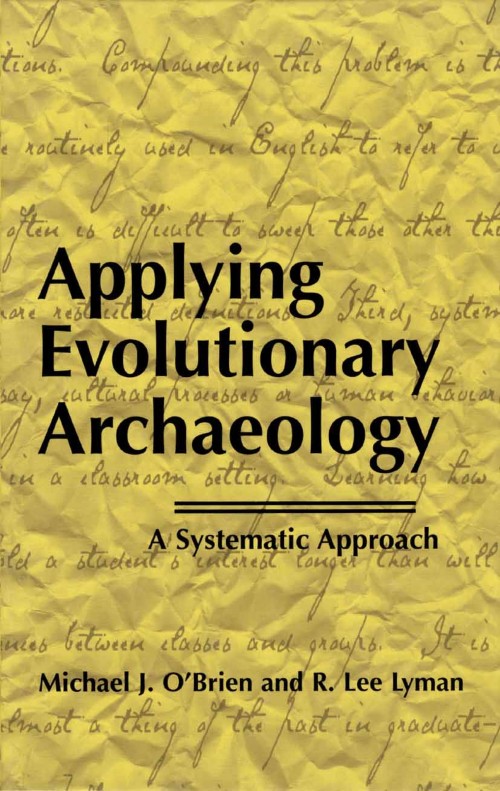
245 10|aApplying Evolutionary Archaeology|h[electronic resource] :|bA Systematic Approach /|cby Michael J. O'Brien, R. Lee Lyman.
250 |a1st ed. 2000.
264 1|aNew York, NY :|bSpringer US :|bImprint: Springer,|c2000.
300 |aXIX, 471 p.|bonline resource.
336 |atext|btxt|2rdacontent
337 |acomputer|bc|2rdamedia
338 |aonline resource|bcr|2rdacarrier
347 |atext file|bPDF|2rda
505 0 |aDarwinian Theory and Archaeology -- Two Kinds of Science -- The Materialist Paradox in Archaeology -- The Place of History in Modern Paleobiology and Archaeology -- Archaeological Units and Their Construction -- Building and Testing Historical Lineages -- Tempo and Mode in Evolution -- Explaining Lineage Histories -- Evolutionary Archaeology.
520 |aAnthropology, and by extension archaeology, has had a long-standing interest in evolution in one or several of its various guises. Pick up any lengthy treatise on humankind written in the last quarter of the nineteenth century and the chances are good that the word evolution will appear somewhere in the text. If for some reason the word itself is absent, the odds are excellent that at least the concept of change over time will have a central role in the discussion. After one of the preeminent (and often vilified) social scientists of the nineteenth century, Herbert Spencer, popularized the term in the 1850s, evolution became more or less a household word, usually being used synonymously with change, albeit change over extended periods of time. Later, through the writings of Edward Burnett Tylor, Lewis Henry Morgan, and others, the notion of evolution as it applies to stages of social and political development assumed a prominent position in anthropological disc- sions. To those with only a passing knowledge of American anthropology, it often appears that evolutionism in the early twentieth century went into a decline at the hands of Franz Boas and those of similar outlook, often termed particularists. However, it was not evolutionism that was under attack but rather comparativism— an approach that used the ethnographic present as a key to understanding how and why past peoples lived the way they did (Boas 1896).
650 0|aArchaeology.
650 0|aAnthropology.
650 0|aSedimentology.
650 0|aPaleontology .
650 14|aArchaeology.
650 24|aAnthropology.
650 24|aSedimentology.
650 24|aPaleontology.
700 1 |aLyman, R. Lee.|eauthor.|4aut|4http://id.loc.gov/vocabulary/relators/aut
710 2 |aSpringerLink (Online service)
773 0 |tSpringer Nature eBook
776 08|iPrinted edition:|z9780306462535
776 08|iPrinted edition:|z9780306462542
776 08|iPrinted edition:|z9781475773804
856 40|uhttps://doi.org/10.1007/b100324
912 |aZDB-2-SHU
912 |aZDB-2-SXS
912 |aZDB-2-BAE
950 |aHumanities, Social Sciences and Law (SpringerNature-11648)
950 |aSocial Sciences (R0) (SpringerNature-43726)