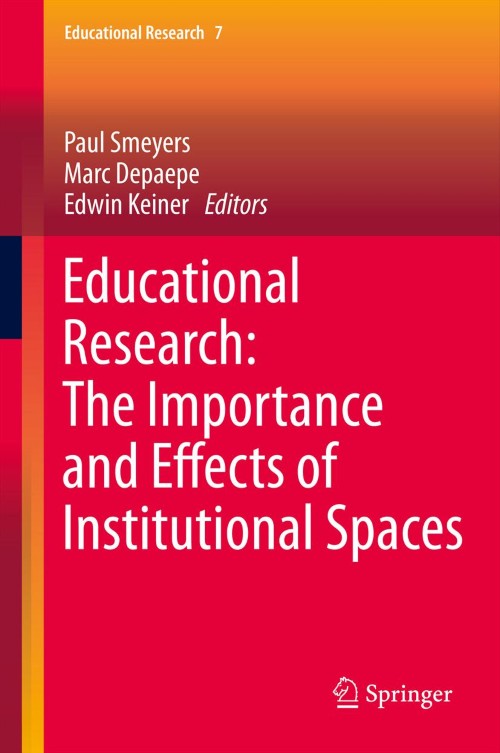
Educational Research: The Importance and Effects of Institutional Spaces [electronic resource] / edited by Paul Smeyers, Marc Depaepe, Edwin Keiner.
Erişim Adresi
ISBN
9789400762473
Dil Kodu
İngilizce
Yer Numarası
DK/9855
Basım Bildirimi
1st ed. 2013.
Yayın Bilgisi
Dordrecht : Springer Netherlands : Imprint: Springer, 2013.
Fiziksel Niteleme
VIII, 221 p. online resource.
Dizi
Educational Research, 2543-0653 ; 7
İçindekiler Notu
1. Exploring a multitude of spaces in education and educational research -- 2. American democracy and Harold D. Lasswell: Institutional spaces of ‘failure’ and ‘success’, present and past -- 3. The power of the parochial in shaping the American system of Higher Education -- 4. Crossing the Atlantic to gain knowledge in the field of psycho-pedagogy: The 1922 mission of Ovide Decroly and Raymond Buyse to the USA and the travel diary of the latter -- 5. The emergence of institutional educational spaces for young children: In pursuit of more controllability of education and development as part of the long-term growth of educational space in history -- 6. A different training, a different practice. Infant care in Belgium in the interwar years in the city and in the countryside -- 7. Disability, rehabilitation & the Great War: Making space for silence in the History of Education -- 8. Interpretation: The space of text -- 9. Exploring educational research as a multi-layered discursive space.-10. The spaces of mathematics: Dynamic encounters between local and universal -- 11. The classroom space: A problem or a mystery?- 12. Spaces and places in the virtual university -- 13. Material contexts and creation of meaning in virtual places: Web 2.0 as a space of educational research. 14. From entrepreneurialism to innovation: Research, critique, and the Innovation Union -- 15. About the Authors -- Index.
Özet, vb.
This collection of fresh analyses aims to map the links between educational theory and research, and the geographical and physical spaces in which teaching is practiced and discussed. The authors combine historical and philosophical perspectives in examining the differing institutional loci of education research, and also assess the potential and the limitations of each. The contributors trace the effects of ‘space’ on educational practice in the classroom, in the broader institutions, and in the academic discipline of education—doing so for a range of international contexts. The chapters address various topics relating to the physical and geographical environment. How, for example, does geographical space shape researchers’ mental frameworks? How did the learning environments in which young children are taught today evolve? To what extent did parochialism shape America’s higher education system? How can our understanding of classroom practice be enhanced by concepts of space? The book acknowledges that texts themselves, as well as the research ‘arena’, are ‘spaces’ too, and notes the fascinating debate on the concept of space in the field of mathematics education. Indeed, as more and more students move online, the book analyses the rising importance of virtual spaces such as Web 2.0, which have major educational implications for researchers and students joining the innovative ‘virtual’ universities of the future. This publication, as well as the ones that are mentioned in the preliminary pages of this work, were realized by the Research Community (FWO Vlaanderen / Research Foundation Flanders, Belgium) Philosophy and History of the Discipline of Education: Faces and Spaces of Educational Research.
Konu
Education __ Philosophy.
Educational sociology.
Educational Philosophy.
Philosophy of Education.
Sociology of Education.
Educational sociology.
Educational Philosophy.
Philosophy of Education.
Sociology of Education.
Diğer Yazarlar
Kurum Adı

Eseri Alıntıla
Referansları kullanmadan önce gözden geçirmeniz ve varsa gerekli düzeltmeleri yapmanız önerilir.
Dijital Kaynak
MARC Görünümü
LEADER 05152nam a22005295i 4500
001 808566
003 TR_AnAIT
005 20260131030531
007 cr nn 008mamaa
008 130406s2013 ne | s |||| 0|eng d
020 |a9789400762473|9978-94-007-6247-3
024 7 |a10.1007/978-94-007-6247-3|2doi
041 |aeng
049 |aTürk Tarih Kurumu Kütüphanesi
050 4|aLB1-3640
072 7|aJNA|2bicssc
072 7|aEDU040000|2bisacsh
072 7|aJNA|2thema
082 04|a370.1|223
090 |aDK/9855
245 10|aEducational Research: The Importance and Effects of Institutional Spaces|h[electronic resource] /|cedited by Paul Smeyers, Marc Depaepe, Edwin Keiner.
250 |a1st ed. 2013.
264 1|aDordrecht :|bSpringer Netherlands :|bImprint: Springer,|c2013.
300 |aVIII, 221 p.|bonline resource.
336 |atext|btxt|2rdacontent
337 |acomputer|bc|2rdamedia
338 |aonline resource|bcr|2rdacarrier
347 |atext file|bPDF|2rda
490 1 |aEducational Research,|x2543-0653 ;|v7
505 0 |a1. Exploring a multitude of spaces in education and educational research -- 2. American democracy and Harold D. Lasswell: Institutional spaces of ‘failure’ and ‘success’, present and past -- 3. The power of the parochial in shaping the American system of Higher Education -- 4. Crossing the Atlantic to gain knowledge in the field of psycho-pedagogy: The 1922 mission of Ovide Decroly and Raymond Buyse to the USA and the travel diary of the latter -- 5. The emergence of institutional educational spaces for young children: In pursuit of more controllability of education and development as part of the long-term growth of educational space in history -- 6. A different training, a different practice. Infant care in Belgium in the interwar years in the city and in the countryside -- 7. Disability, rehabilitation & the Great War: Making space for silence in the History of Education -- 8. Interpretation: The space of text -- 9. Exploring educational research as a multi-layered discursive space.-10. The spaces of mathematics: Dynamic encounters between local and universal -- 11. The classroom space: A problem or a mystery?- 12. Spaces and places in the virtual university -- 13. Material contexts and creation of meaning in virtual places: Web 2.0 as a space of educational research. 14. From entrepreneurialism to innovation: Research, critique, and the Innovation Union -- 15. About the Authors -- Index.
520 |aThis collection of fresh analyses aims to map the links between educational theory and research, and the geographical and physical spaces in which teaching is practiced and discussed. The authors combine historical and philosophical perspectives in examining the differing institutional loci of education research, and also assess the potential and the limitations of each. The contributors trace the effects of ‘space’ on educational practice in the classroom, in the broader institutions, and in the academic discipline of education—doing so for a range of international contexts. The chapters address various topics relating to the physical and geographical environment. How, for example, does geographical space shape researchers’ mental frameworks? How did the learning environments in which young children are taught today evolve? To what extent did parochialism shape America’s higher education system? How can our understanding of classroom practice be enhanced by concepts of space? The book acknowledges that texts themselves, as well as the research ‘arena’, are ‘spaces’ too, and notes the fascinating debate on the concept of space in the field of mathematics education. Indeed, as more and more students move online, the book analyses the rising importance of virtual spaces such as Web 2.0, which have major educational implications for researchers and students joining the innovative ‘virtual’ universities of the future. This publication, as well as the ones that are mentioned in the preliminary pages of this work, were realized by the Research Community (FWO Vlaanderen / Research Foundation Flanders, Belgium) Philosophy and History of the Discipline of Education: Faces and Spaces of Educational Research.
650 0|aEducation|xPhilosophy.
650 0|aEducational sociology.
650 14|aEducational Philosophy.
650 24|aPhilosophy of Education.
650 24|aSociology of Education.
700 1 |aSmeyers, Paul.|eeditor.|4edt|4http://id.loc.gov/vocabulary/relators/edt
700 1 |aDepaepe, Marc.|eeditor.|4edt|4http://id.loc.gov/vocabulary/relators/edt
700 1 |aKeiner, Edwin.|eeditor.|4edt|4http://id.loc.gov/vocabulary/relators/edt
710 2 |aSpringerLink (Online service)
773 0 |tSpringer Nature eBook
776 08|iPrinted edition:|z9789400762466
776 08|iPrinted edition:|z9789400762480
776 08|iPrinted edition:|z9789400794344
830 0|aEducational Research,|x2543-0653 ;|v7
856 40|uhttps://doi.org/10.1007/978-94-007-6247-3
912 |aZDB-2-SHU
912 |aZDB-2-SXED
950 |aHumanities, Social Sciences and Law (SpringerNature-11648)
950 |aEducation (R0) (SpringerNature-43721)
001 808566
003 TR_AnAIT
005 20260131030531
007 cr nn 008mamaa
008 130406s2013 ne | s |||| 0|eng d
020 |a9789400762473|9978-94-007-6247-3
024 7 |a10.1007/978-94-007-6247-3|2doi
041 |aeng
049 |aTürk Tarih Kurumu Kütüphanesi
050 4|aLB1-3640
072 7|aJNA|2bicssc
072 7|aEDU040000|2bisacsh
072 7|aJNA|2thema
082 04|a370.1|223
090 |aDK/9855
245 10|aEducational Research: The Importance and Effects of Institutional Spaces|h[electronic resource] /|cedited by Paul Smeyers, Marc Depaepe, Edwin Keiner.
250 |a1st ed. 2013.
264 1|aDordrecht :|bSpringer Netherlands :|bImprint: Springer,|c2013.
300 |aVIII, 221 p.|bonline resource.
336 |atext|btxt|2rdacontent
337 |acomputer|bc|2rdamedia
338 |aonline resource|bcr|2rdacarrier
347 |atext file|bPDF|2rda
490 1 |aEducational Research,|x2543-0653 ;|v7
505 0 |a1. Exploring a multitude of spaces in education and educational research -- 2. American democracy and Harold D. Lasswell: Institutional spaces of ‘failure’ and ‘success’, present and past -- 3. The power of the parochial in shaping the American system of Higher Education -- 4. Crossing the Atlantic to gain knowledge in the field of psycho-pedagogy: The 1922 mission of Ovide Decroly and Raymond Buyse to the USA and the travel diary of the latter -- 5. The emergence of institutional educational spaces for young children: In pursuit of more controllability of education and development as part of the long-term growth of educational space in history -- 6. A different training, a different practice. Infant care in Belgium in the interwar years in the city and in the countryside -- 7. Disability, rehabilitation & the Great War: Making space for silence in the History of Education -- 8. Interpretation: The space of text -- 9. Exploring educational research as a multi-layered discursive space.-10. The spaces of mathematics: Dynamic encounters between local and universal -- 11. The classroom space: A problem or a mystery?- 12. Spaces and places in the virtual university -- 13. Material contexts and creation of meaning in virtual places: Web 2.0 as a space of educational research. 14. From entrepreneurialism to innovation: Research, critique, and the Innovation Union -- 15. About the Authors -- Index.
520 |aThis collection of fresh analyses aims to map the links between educational theory and research, and the geographical and physical spaces in which teaching is practiced and discussed. The authors combine historical and philosophical perspectives in examining the differing institutional loci of education research, and also assess the potential and the limitations of each. The contributors trace the effects of ‘space’ on educational practice in the classroom, in the broader institutions, and in the academic discipline of education—doing so for a range of international contexts. The chapters address various topics relating to the physical and geographical environment. How, for example, does geographical space shape researchers’ mental frameworks? How did the learning environments in which young children are taught today evolve? To what extent did parochialism shape America’s higher education system? How can our understanding of classroom practice be enhanced by concepts of space? The book acknowledges that texts themselves, as well as the research ‘arena’, are ‘spaces’ too, and notes the fascinating debate on the concept of space in the field of mathematics education. Indeed, as more and more students move online, the book analyses the rising importance of virtual spaces such as Web 2.0, which have major educational implications for researchers and students joining the innovative ‘virtual’ universities of the future. This publication, as well as the ones that are mentioned in the preliminary pages of this work, were realized by the Research Community (FWO Vlaanderen / Research Foundation Flanders, Belgium) Philosophy and History of the Discipline of Education: Faces and Spaces of Educational Research.
650 0|aEducation|xPhilosophy.
650 0|aEducational sociology.
650 14|aEducational Philosophy.
650 24|aPhilosophy of Education.
650 24|aSociology of Education.
700 1 |aSmeyers, Paul.|eeditor.|4edt|4http://id.loc.gov/vocabulary/relators/edt
700 1 |aDepaepe, Marc.|eeditor.|4edt|4http://id.loc.gov/vocabulary/relators/edt
700 1 |aKeiner, Edwin.|eeditor.|4edt|4http://id.loc.gov/vocabulary/relators/edt
710 2 |aSpringerLink (Online service)
773 0 |tSpringer Nature eBook
776 08|iPrinted edition:|z9789400762466
776 08|iPrinted edition:|z9789400762480
776 08|iPrinted edition:|z9789400794344
830 0|aEducational Research,|x2543-0653 ;|v7
856 40|uhttps://doi.org/10.1007/978-94-007-6247-3
912 |aZDB-2-SHU
912 |aZDB-2-SXED
950 |aHumanities, Social Sciences and Law (SpringerNature-11648)
950 |aEducation (R0) (SpringerNature-43721)
Materyaller
Depodan talep edilen materyal sadece kütüphane içerisinde kullanılmaktadır.
Materyal dışarıya ödünç verilmemektedir.
