LEADER 03961nam a22004695i 4500
001 808592
003 TR_AnAIT
005 20260131030235
007 cr nn 008mamaa
008 120906s2012 ne | s |||| 0|eng d
020 |a9789460919039|9978-94-6091-903-9
024 7 |a10.1007/978-94-6091-903-9|2doi
041 |aeng
049 |aTürk Tarih Kurumu Kütüphanesi
050 4|aL1-991
072 7|aJN|2bicssc
072 7|aEDU000000|2bisacsh
072 7|aJN|2thema
082 04|a370|223
090 |aDK/9881
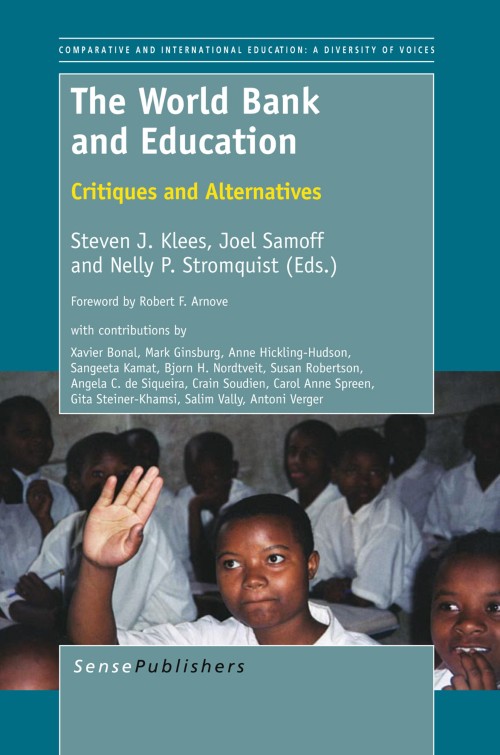
245 14|aThe World Bank and Education|h[electronic resource] :|bCritiques and Alternatives /|cedited by Steven J. Klees, Joel Samoff, Nelly P. Stromquist.
250 |a1st ed. 2012.
264 1|aRotterdam :|bSensePublishers :|bImprint: SensePublishers,|c2012.
300 |aXXI, 245 p.|bonline resource.
336 |atext|btxt|2rdacontent
337 |acomputer|bc|2rdamedia
338 |aonline resource|bcr|2rdacarrier
347 |atext file|bPDF|2rda
490 1 |aComparative and International Education: A Diversity of Voices, A Diversity of Voices,|x2214-9899 ;|v14
520 |aWorld Bank and Education: Book Blurb For more than three decades, the World Bank has been proposing global policies for education. Presented as research-based, validated by experience, and broadly applicable, these policies are ideologically driven, insensitive to local contexts, and treat education as independent of international dynamics and national and local economies and cultures. Target countries, needing resources and unable to generate comparable research, find it difficult to challenge World Bank recommendations. The World Bank and Education: Critiques and Alternatives represents a powerful challenge to World Bank proposals. Probing core issues—equity, quality, finance, privatization, teaching and learning, gender, and human rights—highlights the disabilities of neoliberal globalization. The authors demonstrate the ideological nature of the evidence marshaled by the World Bank and the accompanying policy advice. Addressing key education issues in developing countries, the authors’ analyses provide tools for resisting and rejecting generic policy prescriptions as well as alternative directions to consider. Robert Arnove, in his preface, says, “whether the Bank is responsive to the critiques and alternatives brilliantly offered by the present authors, the book is certain to influence development and education scholars, policymakers, and practitioners around the globe.”.
532 8 |aAccessibility summary: This PDF eBook is produced by a third-party. We have requested that the file be made accessible and compliant with the European Accessibility Act (EAA). However, we have not been able to fully verify its compliance with recognized accessibility standards (such as PDF/UA or WCAG). For detailed accessibility information, please refer to the original publisher’s website. If you require an accessible version of this content, please contact accessibilitysupport@springernature.com. We are committed to improving accessibility and will work with the publisher to meet your needs wherever possible.
532 8 |aPublisher contact for further accessibility information: accessibilitysupport@springernature.com
650 0|aEducation.
650 14|aEducation.
700 1 |aKlees, Steven J.|eeditor.|4edt|4http://id.loc.gov/vocabulary/relators/edt
700 1 |aSamoff, Joel.|eeditor.|4edt|4http://id.loc.gov/vocabulary/relators/edt
700 1 |aStromquist, Nelly P.|eeditor.|4edt|4http://id.loc.gov/vocabulary/relators/edt
710 2 |aSpringerLink (Online service)
773 0 |tSpringer Nature eBook
830 0|aComparative and International Education: A Diversity of Voices, A Diversity of Voices,|x2214-9899 ;|v14
856 40|uhttps://doi.org/10.1007/978-94-6091-903-9
912 |aZDB-2-SHU
912 |aZDB-2-SXED
950 |aHumanities, Social Sciences and Law (SpringerNature-11648)
950 |aEducation (R0) (SpringerNature-43721)