

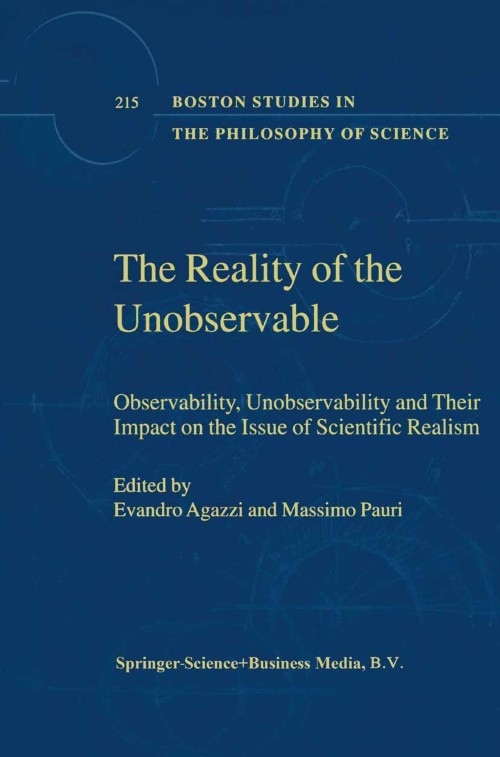
The Reality of the Unobservable [electronic resource] : Observability, Unobservability and Their Impact on the Issue of Scientific Realism / edited by E. Agazzi, M. Pauri.
Erişim Adresi
ISBN
9789401593915
Dil Kodu
İngilizce
Yer Numarası
DK/9977
Basım Bildirimi
1st ed. 2000.
Yayın Bilgisi
Dordrecht : Springer Netherlands : Imprint: Springer, 2000.
Fiziksel Niteleme
VIII, 378 p. online resource.
Dizi
Boston Studies in the Philosophy and History of Science, 2214-7942 ; 215
İçindekiler Notu
Observability and Scientific Realism -- History -- The Origin of Scientific Realism: Boltzman, Planck, Einstein -- General Philosophy, Scientific Realism -- Observability and Referentiality -- A new Approach to Human Cognition and its Significance for the Philosophy of Science -- Abduction and Non-Observability — Some Examples from Language Science and the Cognitive Science -- ‘Scientific Realism’ and Scientific Practice -- Random Philosophy -- Formal Representation and the Subjective Side of Scientific Realism -- Convention and Observability — Poincaré once again -- Scientific Realism, Objectivity, and ‘Technological Realism’ -- Philosophy of Observation -- Testability and Empiricism -- Observing the Unobservable -- What does it Mean to Observe Physical Reality? -- Realism, and the Case of Rival Theories without Observable Differences -- Measurability, Computability and the Existence of Theoretical Entities -- Observation, Construction and Speculation in Cosmology -- Where did the Notion that Forces are Unobservable come from? -- Philosophy of Quantum Theory -- Quantum Mechanics without the Observables -- Observation, Contextuality and Realism -- Leibniz, Kant and the Quantum — A Provocative Point of View about Observation, Space-Time, and the Mind-Body Issue -- Efficient and Final Causes as CPT Reciprocals -- Specific Issues of Observability in Quantum Theory -- Observability and Realism in Modern Experiments with Correlated Quantum Systems -- Quantum Mechanics, Realism and the Ultimate Observer -- Individualistic and Statistical Interpretation of Quantum Mechanics -- How to Observe Quarks -- Common Experience and Quantum Theory — Observables and Beables -- On the Relationships between Classical and Quantum Mechanics.
Özet, vb.
Observability and Scientific Realism It is commonly thought that the birth of modern natural science was made possible by an intellectual shift from a mainly abstract and specuJative conception of the world to a carefully elaborated image based on observations. There is some grain of truth in this claim, but this grain depends very much on what one takes observation to be. In the philosophy of science of our century, observation has been practically equated with sense perception. This is understandable if we think of the attitude of radical empiricism that inspired Ernst Mach and the philosophers of the Vienna Circle, who powerfully influenced our century's philosophy of science. However, this was not the atti tude of the f ounders of modern science: Galileo, f or example, expressed in a f amous passage of the Assayer the conviction that perceptual features of the world are merely subjective, and are produced in the 'anima!' by the motion and impacts of unobservable particles that are endowed uniquely with mathematically expressible properties, and which are therefore the real features of the world. Moreover, on other occasions, when defending the Copernican theory, he explicitly remarked that in admitting that the Sun is static and the Earth turns on its own axis, 'reason must do violence to the sense' , and that it is thanks to this violence that one can know the tme constitution of the universe.
Konu
Science __ Philosophy.
Knowledge, Theory of.
Quantum physics.
Artificial intelligence.
Gravitation.
Philosophy of Science.
Epistemology.
Quantum Physics.
Artificial Intelligence.
Classical and Quantum Gravity.
Knowledge, Theory of.
Quantum physics.
Artificial intelligence.
Gravitation.
Philosophy of Science.
Epistemology.
Quantum Physics.
Artificial Intelligence.
Classical and Quantum Gravity.
Diğer Yazarlar
Kurum Adı
Eseri Alıntıla
Referansları kullanmadan önce gözden geçirmeniz ve varsa gerekli düzeltmeleri yapmanız önerilir.
Dijital Kaynak
MARC Görünümü
LEADER 06156nam a22006495i 4500
001 808688
003 TR_AnAIT
005 20260131025758
007 cr nn 008mamaa
008 130409s2000 ne | s |||| 0|eng d
020 |a9789401593915|9978-94-015-9391-5
024 7 |a10.1007/978-94-015-9391-5|2doi
041 |aeng
049 |aTürk Tarih Kurumu Kütüphanesi
050 4|aQ174-175.3
050 4|aB67
072 7|aPDA|2bicssc
072 7|aSCI075000|2bisacsh
072 7|aPDA|2thema
082 04|a501|223
090 |aDK/9977
245 14|aThe Reality of the Unobservable|h[electronic resource] :|bObservability, Unobservability and Their Impact on the Issue of Scientific Realism /|cedited by E. Agazzi, M. Pauri.
250 |a1st ed. 2000.
264 1|aDordrecht :|bSpringer Netherlands :|bImprint: Springer,|c2000.
300 |aVIII, 378 p.|bonline resource.
336 |atext|btxt|2rdacontent
337 |acomputer|bc|2rdamedia
338 |aonline resource|bcr|2rdacarrier
347 |atext file|bPDF|2rda
490 1 |aBoston Studies in the Philosophy and History of Science,|x2214-7942 ;|v215
505 0 |aObservability and Scientific Realism -- History -- The Origin of Scientific Realism: Boltzman, Planck, Einstein -- General Philosophy, Scientific Realism -- Observability and Referentiality -- A new Approach to Human Cognition and its Significance for the Philosophy of Science -- Abduction and Non-Observability — Some Examples from Language Science and the Cognitive Science -- ‘Scientific Realism’ and Scientific Practice -- Random Philosophy -- Formal Representation and the Subjective Side of Scientific Realism -- Convention and Observability — Poincaré once again -- Scientific Realism, Objectivity, and ‘Technological Realism’ -- Philosophy of Observation -- Testability and Empiricism -- Observing the Unobservable -- What does it Mean to Observe Physical Reality? -- Realism, and the Case of Rival Theories without Observable Differences -- Measurability, Computability and the Existence of Theoretical Entities -- Observation, Construction and Speculation in Cosmology -- Where did the Notion that Forces are Unobservable come from? -- Philosophy of Quantum Theory -- Quantum Mechanics without the Observables -- Observation, Contextuality and Realism -- Leibniz, Kant and the Quantum — A Provocative Point of View about Observation, Space-Time, and the Mind-Body Issue -- Efficient and Final Causes as CPT Reciprocals -- Specific Issues of Observability in Quantum Theory -- Observability and Realism in Modern Experiments with Correlated Quantum Systems -- Quantum Mechanics, Realism and the Ultimate Observer -- Individualistic and Statistical Interpretation of Quantum Mechanics -- How to Observe Quarks -- Common Experience and Quantum Theory — Observables and Beables -- On the Relationships between Classical and Quantum Mechanics.
520 |aObservability and Scientific Realism It is commonly thought that the birth of modern natural science was made possible by an intellectual shift from a mainly abstract and specuJative conception of the world to a carefully elaborated image based on observations. There is some grain of truth in this claim, but this grain depends very much on what one takes observation to be. In the philosophy of science of our century, observation has been practically equated with sense perception. This is understandable if we think of the attitude of radical empiricism that inspired Ernst Mach and the philosophers of the Vienna Circle, who powerfully influenced our century's philosophy of science. However, this was not the atti tude of the f ounders of modern science: Galileo, f or example, expressed in a f amous passage of the Assayer the conviction that perceptual features of the world are merely subjective, and are produced in the 'anima!' by the motion and impacts of unobservable particles that are endowed uniquely with mathematically expressible properties, and which are therefore the real features of the world. Moreover, on other occasions, when defending the Copernican theory, he explicitly remarked that in admitting that the Sun is static and the Earth turns on its own axis, 'reason must do violence to the sense' , and that it is thanks to this violence that one can know the tme constitution of the universe.
532 8 |aAccessibility summary: This PDF is not accessible. It is based on scanned pages and does not support features such as screen reader compatibility or described non-text content (images, graphs etc). However, it likely supports searchable and selectable text based on OCR (Optical Character Recognition). Users with accessibility needs may not be able to use this content effectively. Please contact us at accessibilitysupport@springernature.com if you require assistance or an alternative format.
532 8 |aInaccessible, or known limited accessibility
532 8 |aNo reading system accessibility options actively disabled
532 8 |aPublisher contact for further accessibility information: accessibilitysupport@springernature.com
650 0|aScience|xPhilosophy.
650 0|aKnowledge, Theory of.
650 0|aQuantum physics.
650 0|aArtificial intelligence.
650 0|aGravitation.
650 14|aPhilosophy of Science.
650 24|aEpistemology.
650 24|aQuantum Physics.
650 24|aArtificial Intelligence.
650 24|aClassical and Quantum Gravity.
700 1 |aAgazzi, E.|eeditor.|4edt|4http://id.loc.gov/vocabulary/relators/edt
700 1 |aPauri, M.|eeditor.|4edt|4http://id.loc.gov/vocabulary/relators/edt
710 2 |aSpringerLink (Online service)
773 0 |tSpringer Nature eBook
776 08|iPrinted edition:|z9780792363118
776 08|iPrinted edition:|z9789048154586
776 08|iPrinted edition:|z9789401593922
830 0|aBoston Studies in the Philosophy and History of Science,|x2214-7942 ;|v215
856 40|uhttps://doi.org/10.1007/978-94-015-9391-5
912 |aZDB-2-SHU
912 |aZDB-2-SXPR
912 |aZDB-2-BAE
950 |aHumanities, Social Sciences and Law (SpringerNature-11648)
950 |aPhilosophy and Religion (R0) (SpringerNature-43725)
001 808688
003 TR_AnAIT
005 20260131025758
007 cr nn 008mamaa
008 130409s2000 ne | s |||| 0|eng d
020 |a9789401593915|9978-94-015-9391-5
024 7 |a10.1007/978-94-015-9391-5|2doi
041 |aeng
049 |aTürk Tarih Kurumu Kütüphanesi
050 4|aQ174-175.3
050 4|aB67
072 7|aPDA|2bicssc
072 7|aSCI075000|2bisacsh
072 7|aPDA|2thema
082 04|a501|223
090 |aDK/9977
245 14|aThe Reality of the Unobservable|h[electronic resource] :|bObservability, Unobservability and Their Impact on the Issue of Scientific Realism /|cedited by E. Agazzi, M. Pauri.
250 |a1st ed. 2000.
264 1|aDordrecht :|bSpringer Netherlands :|bImprint: Springer,|c2000.
300 |aVIII, 378 p.|bonline resource.
336 |atext|btxt|2rdacontent
337 |acomputer|bc|2rdamedia
338 |aonline resource|bcr|2rdacarrier
347 |atext file|bPDF|2rda
490 1 |aBoston Studies in the Philosophy and History of Science,|x2214-7942 ;|v215
505 0 |aObservability and Scientific Realism -- History -- The Origin of Scientific Realism: Boltzman, Planck, Einstein -- General Philosophy, Scientific Realism -- Observability and Referentiality -- A new Approach to Human Cognition and its Significance for the Philosophy of Science -- Abduction and Non-Observability — Some Examples from Language Science and the Cognitive Science -- ‘Scientific Realism’ and Scientific Practice -- Random Philosophy -- Formal Representation and the Subjective Side of Scientific Realism -- Convention and Observability — Poincaré once again -- Scientific Realism, Objectivity, and ‘Technological Realism’ -- Philosophy of Observation -- Testability and Empiricism -- Observing the Unobservable -- What does it Mean to Observe Physical Reality? -- Realism, and the Case of Rival Theories without Observable Differences -- Measurability, Computability and the Existence of Theoretical Entities -- Observation, Construction and Speculation in Cosmology -- Where did the Notion that Forces are Unobservable come from? -- Philosophy of Quantum Theory -- Quantum Mechanics without the Observables -- Observation, Contextuality and Realism -- Leibniz, Kant and the Quantum — A Provocative Point of View about Observation, Space-Time, and the Mind-Body Issue -- Efficient and Final Causes as CPT Reciprocals -- Specific Issues of Observability in Quantum Theory -- Observability and Realism in Modern Experiments with Correlated Quantum Systems -- Quantum Mechanics, Realism and the Ultimate Observer -- Individualistic and Statistical Interpretation of Quantum Mechanics -- How to Observe Quarks -- Common Experience and Quantum Theory — Observables and Beables -- On the Relationships between Classical and Quantum Mechanics.
520 |aObservability and Scientific Realism It is commonly thought that the birth of modern natural science was made possible by an intellectual shift from a mainly abstract and specuJative conception of the world to a carefully elaborated image based on observations. There is some grain of truth in this claim, but this grain depends very much on what one takes observation to be. In the philosophy of science of our century, observation has been practically equated with sense perception. This is understandable if we think of the attitude of radical empiricism that inspired Ernst Mach and the philosophers of the Vienna Circle, who powerfully influenced our century's philosophy of science. However, this was not the atti tude of the f ounders of modern science: Galileo, f or example, expressed in a f amous passage of the Assayer the conviction that perceptual features of the world are merely subjective, and are produced in the 'anima!' by the motion and impacts of unobservable particles that are endowed uniquely with mathematically expressible properties, and which are therefore the real features of the world. Moreover, on other occasions, when defending the Copernican theory, he explicitly remarked that in admitting that the Sun is static and the Earth turns on its own axis, 'reason must do violence to the sense' , and that it is thanks to this violence that one can know the tme constitution of the universe.
532 8 |aAccessibility summary: This PDF is not accessible. It is based on scanned pages and does not support features such as screen reader compatibility or described non-text content (images, graphs etc). However, it likely supports searchable and selectable text based on OCR (Optical Character Recognition). Users with accessibility needs may not be able to use this content effectively. Please contact us at accessibilitysupport@springernature.com if you require assistance or an alternative format.
532 8 |aInaccessible, or known limited accessibility
532 8 |aNo reading system accessibility options actively disabled
532 8 |aPublisher contact for further accessibility information: accessibilitysupport@springernature.com
650 0|aScience|xPhilosophy.
650 0|aKnowledge, Theory of.
650 0|aQuantum physics.
650 0|aArtificial intelligence.
650 0|aGravitation.
650 14|aPhilosophy of Science.
650 24|aEpistemology.
650 24|aQuantum Physics.
650 24|aArtificial Intelligence.
650 24|aClassical and Quantum Gravity.
700 1 |aAgazzi, E.|eeditor.|4edt|4http://id.loc.gov/vocabulary/relators/edt
700 1 |aPauri, M.|eeditor.|4edt|4http://id.loc.gov/vocabulary/relators/edt
710 2 |aSpringerLink (Online service)
773 0 |tSpringer Nature eBook
776 08|iPrinted edition:|z9780792363118
776 08|iPrinted edition:|z9789048154586
776 08|iPrinted edition:|z9789401593922
830 0|aBoston Studies in the Philosophy and History of Science,|x2214-7942 ;|v215
856 40|uhttps://doi.org/10.1007/978-94-015-9391-5
912 |aZDB-2-SHU
912 |aZDB-2-SXPR
912 |aZDB-2-BAE
950 |aHumanities, Social Sciences and Law (SpringerNature-11648)
950 |aPhilosophy and Religion (R0) (SpringerNature-43725)
Materyaller
Depodan talep edilen materyal sadece kütüphane içerisinde kullanılmaktadır.
Materyal dışarıya ödünç verilmemektedir.
Materyal dışarıya ödünç verilmemektedir.
