

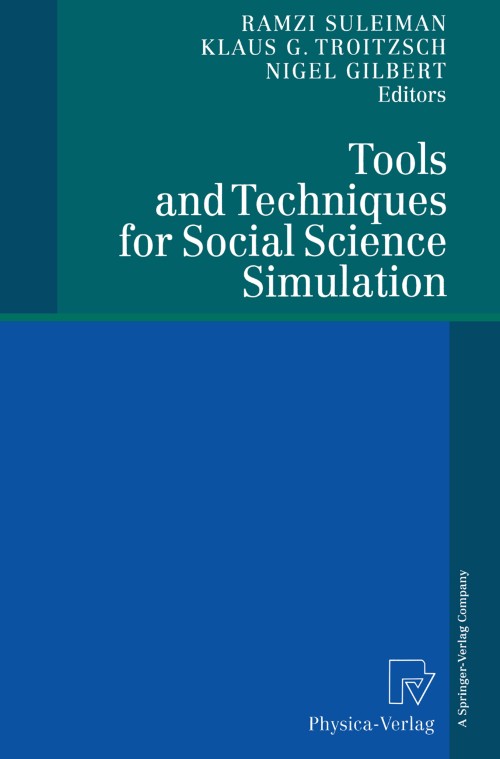
Tools and Techniques for Social Science Simulation [electronic resource] / edited by Ramzi Suleiman, Klaus G. Troitzsch, Nigel Gilbert.
Erişim Adresi
ISBN
9783642517440
Dil Kodu
İngilizce
Yer Numarası
DK/10041
Basım Bildirimi
1st ed. 2000.
Yayın Bilgisi
Heidelberg : Physica-Verlag HD : Imprint: Physica, 2000.
Fiziksel Niteleme
VIII, 387 p. online resource.
İçindekiler Notu
I Simulations as Tools for Modelling and Theory Building -- 1 Models, Processes and Algorithms: Towards a Simulation Toolkit -- 2 Questions in the Methodology of Artificial Societies -- 3 Computer Assisted Interfacing: On the Use of Computer Simulation for Theory Construction -- 4 Interactive Neural Networks as Tools for Modeling Social Systems -- II Multi-Agent Based Simulations -- 5 SMASS: A Serial Multi-Agent System for Social Simulion -- 6 PECS: A Reference Model for the Simulation of Multi-Agent Systems -- 7 Bedrock: Building Multi-Agent Simulation Applications -- 8 Diversity in Strategies of Partnership Formation -- III Game Theory and Cellular Automata -- 9 Cellular Automata Models as a Modelling Tool -- 10 Evolution of Learning Rules in Space -- 11 Maintaining Diversity: Simulating the Role of Nonliniarity and Discreteness in Dynamic Social Impact -- 12 Representation Methods and the Emergence of Inter-Group Cooperation -- IV Sensitivity Analysis -- 13 Sensitivity Analysis in the Social Sciences: Problems and Prospects -- 14 Tests of Dynamic Social Models with Time Related Surveys: an Experimental Approach -- 15 What Is the Use of Gossip? A Sensitivity Analysis of the Spreading of Respectful Reputation -- V Applications -- 16 Modelling Greening Investors: Economic Development, Opinion Formation, and Technological Change in a Multilevel Simulation Model -- 17 Microsimulating Farm Business Performance -- 18 Ordering Parameters in the Rule Space of Social Systems -- Biographical Sketches -- Author Index.
Özet, vb.
The use of computer simulations to study social phenomena has grown rapidly during the last few years. Many social scientists from the fields of economics, sociology, psychology and other disciplines now use computer simulations to study a wide range of social phenomena. The availability of powerful personal computers, the development of multidisciplinary approaches and the use of artificial intelligence models have all contributed to this development. The benefits of using computer simulations in the social sciences are obvious. This holds true for the use of simulations as tools for theory building and for its implementation as a tool for sensitivity analysis and parameter optimization in application-oriented models. In both, simulation provides powerful tools for the study of complex social systems, especially for dynamic and multi-agent social systems in which mathematical tractability is often impossible. The graphical display of simulation output renders it user friendly to many social scientists that lack sufficient familiarity with the language of mathematics. The present volume aims to contribute in four directions: (1) To examine theoretical and methodological issues related to the application of simulations in the social sciences. By this we wish to promote the objective of designing a unified, user-friendly, simulation toolkit which could be applied to diverse social problems. While no claim is made that this objective has been met, the theoretical issues treated in Part 1 of this volume are a contribution towards this objective.
Konu
Sociology.
Econometrics.
Computer simulation.
Sociology.
Econometrics.
Computer Modelling.
Econometrics.
Computer simulation.
Sociology.
Econometrics.
Computer Modelling.
Diğer Yazarlar
Kurum Adı
Eseri Alıntıla
Referansları kullanmadan önce gözden geçirmeniz ve varsa gerekli düzeltmeleri yapmanız önerilir.
Dijital Kaynak
MARC Görünümü
LEADER 05742nam a22005895i 4500
001 808752
003 TR_AnAIT
005 20260131025504
007 cr nn 008mamaa
008 121227s2000 gw | s |||| 0|eng d
020 |a9783642517440|9978-3-642-51744-0
024 7 |a10.1007/978-3-642-51744-0|2doi
041 |aeng
049 |aTürk Tarih Kurumu Kütüphanesi
050 4|aHM
072 7|aJHB|2bicssc
072 7|aJHB|2bicssc
072 7|aSOC026000|2bisacsh
072 7|aJHB|2thema
072 7|aJHB|2thema
082 04|a301|223
090 |aDK/10041
245 10|aTools and Techniques for Social Science Simulation|h[electronic resource] /|cedited by Ramzi Suleiman, Klaus G. Troitzsch, Nigel Gilbert.
250 |a1st ed. 2000.
264 1|aHeidelberg :|bPhysica-Verlag HD :|bImprint: Physica,|c2000.
300 |aVIII, 387 p.|bonline resource.
336 |atext|btxt|2rdacontent
337 |acomputer|bc|2rdamedia
338 |aonline resource|bcr|2rdacarrier
347 |atext file|bPDF|2rda
505 0 |aI Simulations as Tools for Modelling and Theory Building -- 1 Models, Processes and Algorithms: Towards a Simulation Toolkit -- 2 Questions in the Methodology of Artificial Societies -- 3 Computer Assisted Interfacing: On the Use of Computer Simulation for Theory Construction -- 4 Interactive Neural Networks as Tools for Modeling Social Systems -- II Multi-Agent Based Simulations -- 5 SMASS: A Serial Multi-Agent System for Social Simulion -- 6 PECS: A Reference Model for the Simulation of Multi-Agent Systems -- 7 Bedrock: Building Multi-Agent Simulation Applications -- 8 Diversity in Strategies of Partnership Formation -- III Game Theory and Cellular Automata -- 9 Cellular Automata Models as a Modelling Tool -- 10 Evolution of Learning Rules in Space -- 11 Maintaining Diversity: Simulating the Role of Nonliniarity and Discreteness in Dynamic Social Impact -- 12 Representation Methods and the Emergence of Inter-Group Cooperation -- IV Sensitivity Analysis -- 13 Sensitivity Analysis in the Social Sciences: Problems and Prospects -- 14 Tests of Dynamic Social Models with Time Related Surveys: an Experimental Approach -- 15 What Is the Use of Gossip? A Sensitivity Analysis of the Spreading of Respectful Reputation -- V Applications -- 16 Modelling Greening Investors: Economic Development, Opinion Formation, and Technological Change in a Multilevel Simulation Model -- 17 Microsimulating Farm Business Performance -- 18 Ordering Parameters in the Rule Space of Social Systems -- Biographical Sketches -- Author Index.
520 |aThe use of computer simulations to study social phenomena has grown rapidly during the last few years. Many social scientists from the fields of economics, sociology, psychology and other disciplines now use computer simulations to study a wide range of social phenomena. The availability of powerful personal computers, the development of multidisciplinary approaches and the use of artificial intelligence models have all contributed to this development. The benefits of using computer simulations in the social sciences are obvious. This holds true for the use of simulations as tools for theory building and for its implementation as a tool for sensitivity analysis and parameter optimization in application-oriented models. In both, simulation provides powerful tools for the study of complex social systems, especially for dynamic and multi-agent social systems in which mathematical tractability is often impossible. The graphical display of simulation output renders it user friendly to many social scientists that lack sufficient familiarity with the language of mathematics. The present volume aims to contribute in four directions: (1) To examine theoretical and methodological issues related to the application of simulations in the social sciences. By this we wish to promote the objective of designing a unified, user-friendly, simulation toolkit which could be applied to diverse social problems. While no claim is made that this objective has been met, the theoretical issues treated in Part 1 of this volume are a contribution towards this objective.
532 8 |aAccessibility summary: This PDF is not accessible. It is based on scanned pages and does not support features such as screen reader compatibility or described non-text content (images, graphs etc). However, it likely supports searchable and selectable text based on OCR (Optical Character Recognition). Users with accessibility needs may not be able to use this content effectively. Please contact us at accessibilitysupport@springernature.com if you require assistance or an alternative format.
532 8 |aInaccessible, or known limited accessibility
532 8 |aNo reading system accessibility options actively disabled
532 8 |aPublisher contact for further accessibility information: accessibilitysupport@springernature.com
650 0|aSociology.
650 0|aEconometrics.
650 0|aComputer simulation.
650 14|aSociology.
650 24|aEconometrics.
650 24|aComputer Modelling.
700 1 |aSuleiman, Ramzi.|eeditor.|4edt|4http://id.loc.gov/vocabulary/relators/edt
700 1 |aTroitzsch, Klaus G.|eeditor.|4edt|4http://id.loc.gov/vocabulary/relators/edt
700 1 |aGilbert, Nigel.|eeditor.|4edt|4http://id.loc.gov/vocabulary/relators/edt
710 2 |aSpringerLink (Online service)
773 0 |tSpringer Nature eBook
776 08|iPrinted edition:|z9783790812657
776 08|iPrinted edition:|z9783642517457
856 40|uhttps://doi.org/10.1007/978-3-642-51744-0
912 |aZDB-2-SHU
912 |aZDB-2-SXS
912 |aZDB-2-BAE
950 |aHumanities, Social Sciences and Law (SpringerNature-11648)
950 |aSocial Sciences (R0) (SpringerNature-43726)
001 808752
003 TR_AnAIT
005 20260131025504
007 cr nn 008mamaa
008 121227s2000 gw | s |||| 0|eng d
020 |a9783642517440|9978-3-642-51744-0
024 7 |a10.1007/978-3-642-51744-0|2doi
041 |aeng
049 |aTürk Tarih Kurumu Kütüphanesi
050 4|aHM
072 7|aJHB|2bicssc
072 7|aJHB|2bicssc
072 7|aSOC026000|2bisacsh
072 7|aJHB|2thema
072 7|aJHB|2thema
082 04|a301|223
090 |aDK/10041
245 10|aTools and Techniques for Social Science Simulation|h[electronic resource] /|cedited by Ramzi Suleiman, Klaus G. Troitzsch, Nigel Gilbert.
250 |a1st ed. 2000.
264 1|aHeidelberg :|bPhysica-Verlag HD :|bImprint: Physica,|c2000.
300 |aVIII, 387 p.|bonline resource.
336 |atext|btxt|2rdacontent
337 |acomputer|bc|2rdamedia
338 |aonline resource|bcr|2rdacarrier
347 |atext file|bPDF|2rda
505 0 |aI Simulations as Tools for Modelling and Theory Building -- 1 Models, Processes and Algorithms: Towards a Simulation Toolkit -- 2 Questions in the Methodology of Artificial Societies -- 3 Computer Assisted Interfacing: On the Use of Computer Simulation for Theory Construction -- 4 Interactive Neural Networks as Tools for Modeling Social Systems -- II Multi-Agent Based Simulations -- 5 SMASS: A Serial Multi-Agent System for Social Simulion -- 6 PECS: A Reference Model for the Simulation of Multi-Agent Systems -- 7 Bedrock: Building Multi-Agent Simulation Applications -- 8 Diversity in Strategies of Partnership Formation -- III Game Theory and Cellular Automata -- 9 Cellular Automata Models as a Modelling Tool -- 10 Evolution of Learning Rules in Space -- 11 Maintaining Diversity: Simulating the Role of Nonliniarity and Discreteness in Dynamic Social Impact -- 12 Representation Methods and the Emergence of Inter-Group Cooperation -- IV Sensitivity Analysis -- 13 Sensitivity Analysis in the Social Sciences: Problems and Prospects -- 14 Tests of Dynamic Social Models with Time Related Surveys: an Experimental Approach -- 15 What Is the Use of Gossip? A Sensitivity Analysis of the Spreading of Respectful Reputation -- V Applications -- 16 Modelling Greening Investors: Economic Development, Opinion Formation, and Technological Change in a Multilevel Simulation Model -- 17 Microsimulating Farm Business Performance -- 18 Ordering Parameters in the Rule Space of Social Systems -- Biographical Sketches -- Author Index.
520 |aThe use of computer simulations to study social phenomena has grown rapidly during the last few years. Many social scientists from the fields of economics, sociology, psychology and other disciplines now use computer simulations to study a wide range of social phenomena. The availability of powerful personal computers, the development of multidisciplinary approaches and the use of artificial intelligence models have all contributed to this development. The benefits of using computer simulations in the social sciences are obvious. This holds true for the use of simulations as tools for theory building and for its implementation as a tool for sensitivity analysis and parameter optimization in application-oriented models. In both, simulation provides powerful tools for the study of complex social systems, especially for dynamic and multi-agent social systems in which mathematical tractability is often impossible. The graphical display of simulation output renders it user friendly to many social scientists that lack sufficient familiarity with the language of mathematics. The present volume aims to contribute in four directions: (1) To examine theoretical and methodological issues related to the application of simulations in the social sciences. By this we wish to promote the objective of designing a unified, user-friendly, simulation toolkit which could be applied to diverse social problems. While no claim is made that this objective has been met, the theoretical issues treated in Part 1 of this volume are a contribution towards this objective.
532 8 |aAccessibility summary: This PDF is not accessible. It is based on scanned pages and does not support features such as screen reader compatibility or described non-text content (images, graphs etc). However, it likely supports searchable and selectable text based on OCR (Optical Character Recognition). Users with accessibility needs may not be able to use this content effectively. Please contact us at accessibilitysupport@springernature.com if you require assistance or an alternative format.
532 8 |aInaccessible, or known limited accessibility
532 8 |aNo reading system accessibility options actively disabled
532 8 |aPublisher contact for further accessibility information: accessibilitysupport@springernature.com
650 0|aSociology.
650 0|aEconometrics.
650 0|aComputer simulation.
650 14|aSociology.
650 24|aEconometrics.
650 24|aComputer Modelling.
700 1 |aSuleiman, Ramzi.|eeditor.|4edt|4http://id.loc.gov/vocabulary/relators/edt
700 1 |aTroitzsch, Klaus G.|eeditor.|4edt|4http://id.loc.gov/vocabulary/relators/edt
700 1 |aGilbert, Nigel.|eeditor.|4edt|4http://id.loc.gov/vocabulary/relators/edt
710 2 |aSpringerLink (Online service)
773 0 |tSpringer Nature eBook
776 08|iPrinted edition:|z9783790812657
776 08|iPrinted edition:|z9783642517457
856 40|uhttps://doi.org/10.1007/978-3-642-51744-0
912 |aZDB-2-SHU
912 |aZDB-2-SXS
912 |aZDB-2-BAE
950 |aHumanities, Social Sciences and Law (SpringerNature-11648)
950 |aSocial Sciences (R0) (SpringerNature-43726)
Materyaller
Depodan talep edilen materyal sadece kütüphane içerisinde kullanılmaktadır.
Materyal dışarıya ödünç verilmemektedir.
Materyal dışarıya ödünç verilmemektedir.
