

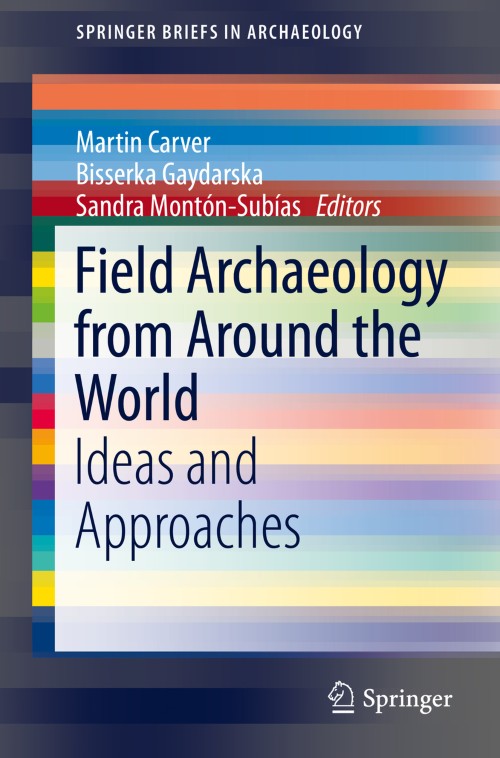
Field Archaeology from Around the World [electronic resource] : Ideas and Approaches / edited by Martin Carver, Bisserka Gaydarska, Sandra Montón-Subías.
Erişim Adresi
ISBN
9783319098197
Dil Kodu
İngilizce
Yer Numarası
DK/10061
Basım Bildirimi
1st ed. 2015.
Yayın Bilgisi
Cham : Springer International Publishing : Imprint: Springer, 2015.
Fiziksel Niteleme
XXXII, 245 p. 120 illus., 80 illus. in color. online resource.
Dizi
SpringerBriefs in Archaeology, 2192-4910
İçindekiler Notu
Part 1: Methods -- Chapter 1: Field Method in Archaeology: Overview -- Chapter 2: Natural and Cultural Formation Processes -- Chapter 3: Aerial archaeology -- Chapter 4: Surface Survey: Method and Strategies -- Chapter 5: Non-destructive Subsurface Mapping -- Chapter 6: Excavation methods -- Chapter 7: The Archaeological Study of Buildings -- Chapter 8: Recording Fieldwork -- Chapter 9: Spatial analysis -- Chapter 10: Sequence and Date -- Chapter 11: Ethno-archaeology: approaches to fieldwork -- Chapter 12: Publication -- Part 2: Projects -- Chapter 13: Large scale landscape mapping in Yorkshire, England -- Chapter 14: Seascape Survey on the Inner Ionian archipelago -- Chapter 15: Archaeology in advance of motorway construction in Ireland -- Chapter 16: Digging through permafrost in Siberia -- Chapter 17: A tropical rainforest site in Belize Cynthia Robin -- Chapter 18: Excavating a Rock shelter in north-west Greece Nena Galanidou -- Chapter 19: Excavation and survey at Pinnacle Point, S Africa -- Chapter 20: An upper Paleolithic living floor at Monruz, Switzerland -- Chapter 21: On the beach in Remote Oceania -- Chapter 22: Defining the Neolithic on the German loess -- Chapter 23: Crannóg investigations in Scotland -- Chapter 24: Investigating Tells in Syria -- Chapter 25: Terp excavation in the Netherlands -- Chapter 26: A terramare site on the Po Plain, Italy -- Chapter 27: Hillfort investigations in the Czech Republic -- Chapter 28: Excavating burials in Anglo-Saxon England -- Chapter 29: A Burial mound dissection in Sweden -- Chapter 30: Down a mine at Gavá, Spain -- Chapter 31: Urban archaeology at Five Points New York City -- Chapter 32: After the earthquake in Bam, Iran; archaeological and social investigations -- Chapter 33: Ethnoarchaeology in the field: Learning from potters in Gilund, India -- Part 3: Traditions -- Chapter 34: America -- Chapter 35: Poland -- Chapter 36: Britain -- Chapter 37: Scandinavia -- Chapter 38: France -- Chapter 39: China -- Chapter 40: Japan -- Chapter41: Australia.
Özet, vb.
Field practice in archaeology varies greatly throughout the world, mainly because archaeological sites survive in very different ways in different counties. Many manuals see this as a problem - to be defeated by the imposition of standardised procedures. In this book we relish the variety of field practice, seeing it rather as the way the best archaeologists have responded creatively to the challenges of terrain, research objectives and the communities within which they work. While insisting on the highest levels of investigation, we celebrate the different designs, concepts, scientific detection methods and recording systems applied - so embracing standards, but not standardisation. The book is organised in four parts: Part 1 offers a summary of field procedures. Part 2 reviews the principal methods applied, above and below ground, and how the results are analysed. Part 3 illustrates the huge variety confronted by field workers with a series of exemplary commercial and academic projects enacted in downland, jungle, desert, permafrost, road schemes and towns. Approaches also differ according to the traditional methodologies that have evolved in particular countries. In Part 4 we give examples of some the strongest and oldest of those practised on four continents.
Konu
Archaeology.
Anthropology.
Archaeology.
Anthropology.
Anthropology.
Archaeology.
Anthropology.
Diğer Yazarlar
Kurum Adı
Eseri Alıntıla
Referansları kullanmadan önce gözden geçirmeniz ve varsa gerekli düzeltmeleri yapmanız önerilir.
Dijital Kaynak
MARC Görünümü
LEADER 05269nam a22005055i 4500
001 808772
003 TR_AnAIT
005 20260131025348
007 cr nn 008mamaa
008 141126s2015 sz | s |||| 0|eng d
020 |a9783319098197|9978-3-319-09819-7
024 7 |a10.1007/978-3-319-09819-7|2doi
041 |aeng
049 |aTürk Tarih Kurumu Kütüphanesi
050 4|aCC1-960
072 7|aHD|2bicssc
072 7|aSOC003000|2bisacsh
072 7|aNK|2thema
082 04|a930.1|223
090 |aDK/10061
245 10|aField Archaeology from Around the World|h[electronic resource] :|bIdeas and Approaches /|cedited by Martin Carver, Bisserka Gaydarska, Sandra Montón-Subías.
250 |a1st ed. 2015.
264 1|aCham :|bSpringer International Publishing :|bImprint: Springer,|c2015.
300 |aXXXII, 245 p. 120 illus., 80 illus. in color.|bonline resource.
336 |atext|btxt|2rdacontent
337 |acomputer|bc|2rdamedia
338 |aonline resource|bcr|2rdacarrier
347 |atext file|bPDF|2rda
490 1 |aSpringerBriefs in Archaeology,|x2192-4910
505 0 |aPart 1: Methods -- Chapter 1: Field Method in Archaeology: Overview -- Chapter 2: Natural and Cultural Formation Processes -- Chapter 3: Aerial archaeology -- Chapter 4: Surface Survey: Method and Strategies -- Chapter 5: Non-destructive Subsurface Mapping -- Chapter 6: Excavation methods -- Chapter 7: The Archaeological Study of Buildings -- Chapter 8: Recording Fieldwork -- Chapter 9: Spatial analysis -- Chapter 10: Sequence and Date -- Chapter 11: Ethno-archaeology: approaches to fieldwork -- Chapter 12: Publication -- Part 2: Projects -- Chapter 13: Large scale landscape mapping in Yorkshire, England -- Chapter 14: Seascape Survey on the Inner Ionian archipelago -- Chapter 15: Archaeology in advance of motorway construction in Ireland -- Chapter 16: Digging through permafrost in Siberia -- Chapter 17: A tropical rainforest site in Belize Cynthia Robin -- Chapter 18: Excavating a Rock shelter in north-west Greece Nena Galanidou -- Chapter 19: Excavation and survey at Pinnacle Point, S Africa -- Chapter 20: An upper Paleolithic living floor at Monruz, Switzerland -- Chapter 21: On the beach in Remote Oceania -- Chapter 22: Defining the Neolithic on the German loess -- Chapter 23: Crannóg investigations in Scotland -- Chapter 24: Investigating Tells in Syria -- Chapter 25: Terp excavation in the Netherlands -- Chapter 26: A terramare site on the Po Plain, Italy -- Chapter 27: Hillfort investigations in the Czech Republic -- Chapter 28: Excavating burials in Anglo-Saxon England -- Chapter 29: A Burial mound dissection in Sweden -- Chapter 30: Down a mine at Gavá, Spain -- Chapter 31: Urban archaeology at Five Points New York City -- Chapter 32: After the earthquake in Bam, Iran; archaeological and social investigations -- Chapter 33: Ethnoarchaeology in the field: Learning from potters in Gilund, India -- Part 3: Traditions -- Chapter 34: America -- Chapter 35: Poland -- Chapter 36: Britain -- Chapter 37: Scandinavia -- Chapter 38: France -- Chapter 39: China -- Chapter 40: Japan -- Chapter41: Australia.
520 |aField practice in archaeology varies greatly throughout the world, mainly because archaeological sites survive in very different ways in different counties. Many manuals see this as a problem - to be defeated by the imposition of standardised procedures. In this book we relish the variety of field practice, seeing it rather as the way the best archaeologists have responded creatively to the challenges of terrain, research objectives and the communities within which they work. While insisting on the highest levels of investigation, we celebrate the different designs, concepts, scientific detection methods and recording systems applied - so embracing standards, but not standardisation. The book is organised in four parts: Part 1 offers a summary of field procedures. Part 2 reviews the principal methods applied, above and below ground, and how the results are analysed. Part 3 illustrates the huge variety confronted by field workers with a series of exemplary commercial and academic projects enacted in downland, jungle, desert, permafrost, road schemes and towns. Approaches also differ according to the traditional methodologies that have evolved in particular countries. In Part 4 we give examples of some the strongest and oldest of those practised on four continents.
650 0|aArchaeology.
650 0|aAnthropology.
650 14|aArchaeology.
650 24|aAnthropology.
700 1 |aCarver, Martin.|eeditor.|4edt|4http://id.loc.gov/vocabulary/relators/edt
700 1 |aGaydarska, Bisserka.|eeditor.|4edt|4http://id.loc.gov/vocabulary/relators/edt
700 1 |aMontón-Subías, Sandra.|eeditor.|4edt|4http://id.loc.gov/vocabulary/relators/edt
710 2 |aSpringerLink (Online service)
773 0 |tSpringer Nature eBook
776 08|iPrinted edition:|z9783319098180
776 08|iPrinted edition:|z9783319098203
830 0|aSpringerBriefs in Archaeology,|x2192-4910
856 40|uhttps://doi.org/10.1007/978-3-319-09819-7
912 |aZDB-2-SHU
912 |aZDB-2-SXS
950 |aHumanities, Social Sciences and Law (SpringerNature-11648)
950 |aSocial Sciences (R0) (SpringerNature-43726)
001 808772
003 TR_AnAIT
005 20260131025348
007 cr nn 008mamaa
008 141126s2015 sz | s |||| 0|eng d
020 |a9783319098197|9978-3-319-09819-7
024 7 |a10.1007/978-3-319-09819-7|2doi
041 |aeng
049 |aTürk Tarih Kurumu Kütüphanesi
050 4|aCC1-960
072 7|aHD|2bicssc
072 7|aSOC003000|2bisacsh
072 7|aNK|2thema
082 04|a930.1|223
090 |aDK/10061
245 10|aField Archaeology from Around the World|h[electronic resource] :|bIdeas and Approaches /|cedited by Martin Carver, Bisserka Gaydarska, Sandra Montón-Subías.
250 |a1st ed. 2015.
264 1|aCham :|bSpringer International Publishing :|bImprint: Springer,|c2015.
300 |aXXXII, 245 p. 120 illus., 80 illus. in color.|bonline resource.
336 |atext|btxt|2rdacontent
337 |acomputer|bc|2rdamedia
338 |aonline resource|bcr|2rdacarrier
347 |atext file|bPDF|2rda
490 1 |aSpringerBriefs in Archaeology,|x2192-4910
505 0 |aPart 1: Methods -- Chapter 1: Field Method in Archaeology: Overview -- Chapter 2: Natural and Cultural Formation Processes -- Chapter 3: Aerial archaeology -- Chapter 4: Surface Survey: Method and Strategies -- Chapter 5: Non-destructive Subsurface Mapping -- Chapter 6: Excavation methods -- Chapter 7: The Archaeological Study of Buildings -- Chapter 8: Recording Fieldwork -- Chapter 9: Spatial analysis -- Chapter 10: Sequence and Date -- Chapter 11: Ethno-archaeology: approaches to fieldwork -- Chapter 12: Publication -- Part 2: Projects -- Chapter 13: Large scale landscape mapping in Yorkshire, England -- Chapter 14: Seascape Survey on the Inner Ionian archipelago -- Chapter 15: Archaeology in advance of motorway construction in Ireland -- Chapter 16: Digging through permafrost in Siberia -- Chapter 17: A tropical rainforest site in Belize Cynthia Robin -- Chapter 18: Excavating a Rock shelter in north-west Greece Nena Galanidou -- Chapter 19: Excavation and survey at Pinnacle Point, S Africa -- Chapter 20: An upper Paleolithic living floor at Monruz, Switzerland -- Chapter 21: On the beach in Remote Oceania -- Chapter 22: Defining the Neolithic on the German loess -- Chapter 23: Crannóg investigations in Scotland -- Chapter 24: Investigating Tells in Syria -- Chapter 25: Terp excavation in the Netherlands -- Chapter 26: A terramare site on the Po Plain, Italy -- Chapter 27: Hillfort investigations in the Czech Republic -- Chapter 28: Excavating burials in Anglo-Saxon England -- Chapter 29: A Burial mound dissection in Sweden -- Chapter 30: Down a mine at Gavá, Spain -- Chapter 31: Urban archaeology at Five Points New York City -- Chapter 32: After the earthquake in Bam, Iran; archaeological and social investigations -- Chapter 33: Ethnoarchaeology in the field: Learning from potters in Gilund, India -- Part 3: Traditions -- Chapter 34: America -- Chapter 35: Poland -- Chapter 36: Britain -- Chapter 37: Scandinavia -- Chapter 38: France -- Chapter 39: China -- Chapter 40: Japan -- Chapter41: Australia.
520 |aField practice in archaeology varies greatly throughout the world, mainly because archaeological sites survive in very different ways in different counties. Many manuals see this as a problem - to be defeated by the imposition of standardised procedures. In this book we relish the variety of field practice, seeing it rather as the way the best archaeologists have responded creatively to the challenges of terrain, research objectives and the communities within which they work. While insisting on the highest levels of investigation, we celebrate the different designs, concepts, scientific detection methods and recording systems applied - so embracing standards, but not standardisation. The book is organised in four parts: Part 1 offers a summary of field procedures. Part 2 reviews the principal methods applied, above and below ground, and how the results are analysed. Part 3 illustrates the huge variety confronted by field workers with a series of exemplary commercial and academic projects enacted in downland, jungle, desert, permafrost, road schemes and towns. Approaches also differ according to the traditional methodologies that have evolved in particular countries. In Part 4 we give examples of some the strongest and oldest of those practised on four continents.
650 0|aArchaeology.
650 0|aAnthropology.
650 14|aArchaeology.
650 24|aAnthropology.
700 1 |aCarver, Martin.|eeditor.|4edt|4http://id.loc.gov/vocabulary/relators/edt
700 1 |aGaydarska, Bisserka.|eeditor.|4edt|4http://id.loc.gov/vocabulary/relators/edt
700 1 |aMontón-Subías, Sandra.|eeditor.|4edt|4http://id.loc.gov/vocabulary/relators/edt
710 2 |aSpringerLink (Online service)
773 0 |tSpringer Nature eBook
776 08|iPrinted edition:|z9783319098180
776 08|iPrinted edition:|z9783319098203
830 0|aSpringerBriefs in Archaeology,|x2192-4910
856 40|uhttps://doi.org/10.1007/978-3-319-09819-7
912 |aZDB-2-SHU
912 |aZDB-2-SXS
950 |aHumanities, Social Sciences and Law (SpringerNature-11648)
950 |aSocial Sciences (R0) (SpringerNature-43726)
Materyaller
Depodan talep edilen materyal sadece kütüphane içerisinde kullanılmaktadır.
Materyal dışarıya ödünç verilmemektedir.
Materyal dışarıya ödünç verilmemektedir.
