

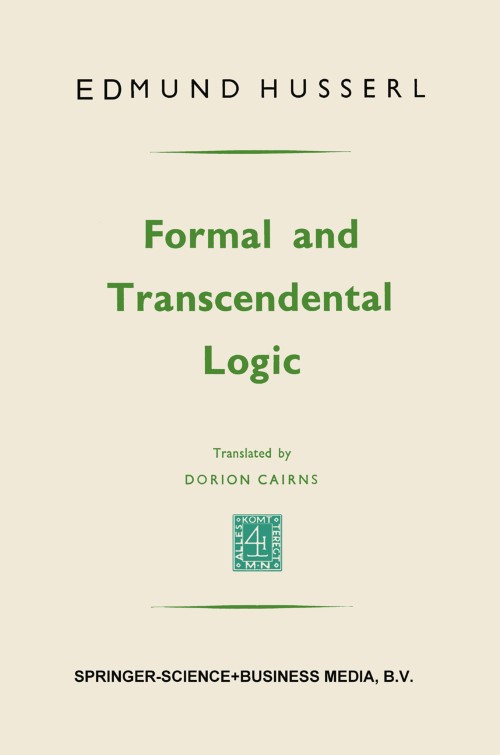
Formal and transcendental logic [electronic resource] / by Edmund Husserl.
Erişim Adresi
ISBN
9789401749008
Dil Kodu
İngilizce
Yer Numarası
DK/10089
Yazar
Basım Bildirimi
1st ed. 1969.
Yayın Bilgisi
Dordrecht : Springer Netherlands : Imprint: Springer, 1969.
Fiziksel Niteleme
XIX, 340 p. online resource.
İçindekiler Notu
Preparatory Considerations -- I / The Structures and the Sphere of Objective Formal Logic -- 1. Formal logic as apophantic analytics -- 2. Formal apophantics, formal mathematics -- 3. Theory of deductive systems and theory of multiplicities -- 4. Focusing on objects and focusing on judgments -- 5. Apophantics, as theory of sense, and truthlogic -- II / From Formal to Transcendental Logic -- 1. Psychologism and the laying of a transcendental foundation for logic -- 2. Initial questions of transcendental-logic: problems concerning fundamental concepts -- 3. The idealizing presuppositions of logic and the constitutive criticism of them -- 4. Evidential criticism of logical principles carried back to evidential criticism of experience -- 5. The subjective grounding of logic as a problem belonging to transcendental philosophy -- 6. Transcendental phenomenology and intentional psychology. The problem of transcendental psychologism -- 7. Objective logic and the phenomenology of reason -- Conclusion -- Appendix I / Syntactical Forms and Syntactical Stuffs; Core-Forms and Core-Stuffs -- § 1. The articulation of predicative judgments -- § 2. Relatedness to subject-matter in judgments -- § 3. Pure forms and pure stuffs -- § 4. Lower and higher forms. Their sense-relation to one another -- § 5. The self-contained functional unity of the self-sufficient apophansis. Division of the combination-forms of wholes into copulatives and conjunctions -- § 6. Transition to the broadest categorial sphere -- a. Universality of the combination-forms that we have distinguished -- b. The distinctions connected with articulation can be made throughout the entire categorial sphere -- c. The amplified concept of the categorial proposition contrasted with the concept of the proposition in the old apophantic analytics.-§ 7. Syntactical forms, syntactical stuffs, syntaxes -- § 8. Syntagma and member. Self-sufficient judgments, and likewise judgments in the amplified sense, as syntagmas -- § 9. The “judgment-content” as the syntactical stuff of the judgment qua syntagma -- § 10. Levels of syntactical forming -- § 11. Non-syntactical forms and stuffs — exhibited within the pure syntactical stuffs -- § 12. The core-formation, with core-stuff and core-form -- § 13. Pre-eminence of the substantival category. Substantivation -- § 14. Transition to complications -- § 15. The concept of the “term” in traditional formal logic -- Appendix II / The Phenomenological Constitution of the Judgment. Originally Active Judging and Its Secondary Modifications -- § 1. Active judging, as generating objects themselves, contrasted with its secondary modifications -- § 2. From the general theory of intentionality -- a. Original consciousness and intentional modification. Static intentional explication. Explication of the “meaning” and of the meant “itself.” The multiplicity of possible modes of consciousness of the Same -- b. Intentional explication of genesis. The genetic, as well as static, originality of the experiencing manners of givenness. The “primal instituting” of “apperception” with respect to every object-category -- c. The time-form of intentional genesis and the constitution of that form. Retentional modification Sedimentation in the inconspicuous substratum (unconsciousness) -- § 3. Non-original manners of givenness of the judgment -- a. The retentional form as the intrinsically first form of “secondary sensuousness”. The livingly changing constitution of a many-membered judgment -- b. Passive recollection and its constitutional effect for the judgment as an abidingunity -- c. The emergence of something that comes to mind apperceptionally is analogous to something coming to mind after the fashion of passive recollection -- § 4. The essential possibilities of activating passive manners of givenness -- § 5. The fundamental types of originally generative judging and of any judging whatever -- § 6. Indistinct verbal judging and its function -- § 7. The superiority of retentional and recollectional to apperceptional confusion; secondary evidence in confusion -- Appendix III / The Idea of a “Logic of Mere Non-Contradiction” or a “Logic of Mere Consequence” -- § 1. The goal of formal non-contradiction and of formal consequence. Broader and narrower framing of these concepts -- § 2. Relation of the systematic and radical building of a pure analytics, back to the theory of syntaxes -- § 3. The characterization of analytic judgments as merely “elucidative of knowledge” and as “tautologies” -- § 4. Remarks on “tautology” in the logistical sense, with reference to §§ 14–18 of the main text. (By Oskar Becker.).
Özet, vb.
called in question, then naturally no fact, science, could be presupposed. Thus Plato was set on the path to the pure idea. Not gathered from the de facto sciences but formative of pure norms, his dialectic of pure ideas-as we say, his logic or his theory of science - was called on to make genuine 1 science possible now for the first time, to guide its practice. And precisely in fulfilling this vocation the Platonic dialectic actually helped create sciences in the pregnant sense, sciences that were consciously sustained by the idea of logical science and sought to actualize it so far as possible. Such were the strict mathematics and natural science whose further developments at higher stages are our modem sciences. But the original relationship between logic and science has undergone a remarkable reversal in modem times. The sciences made themselves independent. Without being able to satisfy completely the spirit of critical self-justification, they fashioned extremely differentiated methods, whose fruitfulness, it is true, was practically certain, but whose productivity was not clarified by ultimate insight. They fashioned these methods, not indeed with the everyday man's naivete, but still with a na!ivete of a higher level, which abandoned the appeal to the pure idea, the justifying of method by pure principles, according to ultimate a priori possibilities and necessities.
Konu
Phenomenology .
Logic.
Phenomenology.
Logic.
Logic.
Phenomenology.
Logic.
Kurum Adı
Eseri Alıntıla
Referansları kullanmadan önce gözden geçirmeniz ve varsa gerekli düzeltmeleri yapmanız önerilir.
Dijital Kaynak
MARC Görünümü
LEADER 08409nam a22005175i 4500
001 808800
003 TR_AnAIT
005 20260131025151
007 cr nn 008mamaa
008 130609s1969 ne | s |||| 0|eng d
020 |a9789401749008|9978-94-017-4900-8
024 7 |a10.1007/978-94-017-4900-8|2doi
041 |aeng
049 |aTürk Tarih Kurumu Kütüphanesi
050 4|aB829.5.A-Z
072 7|aHPCF3|2bicssc
072 7|aPHI018000|2bisacsh
072 7|aQDHR5|2thema
082 04|a142.7|223
090 |aDK/10089
100 1 |aHusserl, Edmund.|eauthor.|4aut|4http://id.loc.gov/vocabulary/relators/aut
245 10|aFormal and transcendental logic|h[electronic resource] /|cby Edmund Husserl.
250 |a1st ed. 1969.
264 1|aDordrecht :|bSpringer Netherlands :|bImprint: Springer,|c1969.
300 |aXIX, 340 p.|bonline resource.
336 |atext|btxt|2rdacontent
337 |acomputer|bc|2rdamedia
338 |aonline resource|bcr|2rdacarrier
347 |atext file|bPDF|2rda
505 0 |aPreparatory Considerations -- I / The Structures and the Sphere of Objective Formal Logic -- 1. Formal logic as apophantic analytics -- 2. Formal apophantics, formal mathematics -- 3. Theory of deductive systems and theory of multiplicities -- 4. Focusing on objects and focusing on judgments -- 5. Apophantics, as theory of sense, and truthlogic -- II / From Formal to Transcendental Logic -- 1. Psychologism and the laying of a transcendental foundation for logic -- 2. Initial questions of transcendental-logic: problems concerning fundamental concepts -- 3. The idealizing presuppositions of logic and the constitutive criticism of them -- 4. Evidential criticism of logical principles carried back to evidential criticism of experience -- 5. The subjective grounding of logic as a problem belonging to transcendental philosophy -- 6. Transcendental phenomenology and intentional psychology. The problem of transcendental psychologism -- 7. Objective logic and the phenomenology of reason -- Conclusion -- Appendix I / Syntactical Forms and Syntactical Stuffs; Core-Forms and Core-Stuffs -- § 1. The articulation of predicative judgments -- § 2. Relatedness to subject-matter in judgments -- § 3. Pure forms and pure stuffs -- § 4. Lower and higher forms. Their sense-relation to one another -- § 5. The self-contained functional unity of the self-sufficient apophansis. Division of the combination-forms of wholes into copulatives and conjunctions -- § 6. Transition to the broadest categorial sphere -- a. Universality of the combination-forms that we have distinguished -- b. The distinctions connected with articulation can be made throughout the entire categorial sphere -- c. The amplified concept of the categorial proposition contrasted with the concept of the proposition in the old apophantic analytics.-§ 7. Syntactical forms, syntactical stuffs, syntaxes -- § 8. Syntagma and member. Self-sufficient judgments, and likewise judgments in the amplified sense, as syntagmas -- § 9. The “judgment-content” as the syntactical stuff of the judgment qua syntagma -- § 10. Levels of syntactical forming -- § 11. Non-syntactical forms and stuffs — exhibited within the pure syntactical stuffs -- § 12. The core-formation, with core-stuff and core-form -- § 13. Pre-eminence of the substantival category. Substantivation -- § 14. Transition to complications -- § 15. The concept of the “term” in traditional formal logic -- Appendix II / The Phenomenological Constitution of the Judgment. Originally Active Judging and Its Secondary Modifications -- § 1. Active judging, as generating objects themselves, contrasted with its secondary modifications -- § 2. From the general theory of intentionality -- a. Original consciousness and intentional modification. Static intentional explication. Explication of the “meaning” and of the meant “itself.” The multiplicity of possible modes of consciousness of the Same -- b. Intentional explication of genesis. The genetic, as well as static, originality of the experiencing manners of givenness. The “primal instituting” of “apperception” with respect to every object-category -- c. The time-form of intentional genesis and the constitution of that form. Retentional modification Sedimentation in the inconspicuous substratum (unconsciousness) -- § 3. Non-original manners of givenness of the judgment -- a. The retentional form as the intrinsically first form of “secondary sensuousness”. The livingly changing constitution of a many-membered judgment -- b. Passive recollection and its constitutional effect for the judgment as an abidingunity -- c. The emergence of something that comes to mind apperceptionally is analogous to something coming to mind after the fashion of passive recollection -- § 4. The essential possibilities of activating passive manners of givenness -- § 5. The fundamental types of originally generative judging and of any judging whatever -- § 6. Indistinct verbal judging and its function -- § 7. The superiority of retentional and recollectional to apperceptional confusion; secondary evidence in confusion -- Appendix III / The Idea of a “Logic of Mere Non-Contradiction” or a “Logic of Mere Consequence” -- § 1. The goal of formal non-contradiction and of formal consequence. Broader and narrower framing of these concepts -- § 2. Relation of the systematic and radical building of a pure analytics, back to the theory of syntaxes -- § 3. The characterization of analytic judgments as merely “elucidative of knowledge” and as “tautologies” -- § 4. Remarks on “tautology” in the logistical sense, with reference to §§ 14–18 of the main text. (By Oskar Becker.).
520 |acalled in question, then naturally no fact, science, could be presupposed. Thus Plato was set on the path to the pure idea. Not gathered from the de facto sciences but formative of pure norms, his dialectic of pure ideas-as we say, his logic or his theory of science - was called on to make genuine 1 science possible now for the first time, to guide its practice. And precisely in fulfilling this vocation the Platonic dialectic actually helped create sciences in the pregnant sense, sciences that were consciously sustained by the idea of logical science and sought to actualize it so far as possible. Such were the strict mathematics and natural science whose further developments at higher stages are our modem sciences. But the original relationship between logic and science has undergone a remarkable reversal in modem times. The sciences made themselves independent. Without being able to satisfy completely the spirit of critical self-justification, they fashioned extremely differentiated methods, whose fruitfulness, it is true, was practically certain, but whose productivity was not clarified by ultimate insight. They fashioned these methods, not indeed with the everyday man's naivete, but still with a na!ivete of a higher level, which abandoned the appeal to the pure idea, the justifying of method by pure principles, according to ultimate a priori possibilities and necessities.
532 8 |aAccessibility summary: This PDF is not accessible. It is based on scanned pages and does not support features such as screen reader compatibility or described non-text content (images, graphs etc). However, it likely supports searchable and selectable text based on OCR (Optical Character Recognition). Users with accessibility needs may not be able to use this content effectively. Please contact us at accessibilitysupport@springernature.com if you require assistance or an alternative format.
532 8 |aInaccessible, or known limited accessibility
532 8 |aNo reading system accessibility options actively disabled
532 8 |aPublisher contact for further accessibility information: accessibilitysupport@springernature.com
650 0|aPhenomenology .
650 0|aLogic.
650 14|aPhenomenology.
650 24|aLogic.
710 2 |aSpringerLink (Online service)
773 0 |tSpringer Nature eBook
776 08|iPrinted edition:|z9789401746380
776 08|iPrinted edition:|z9789401749015
856 40|uhttps://doi.org/10.1007/978-94-017-4900-8
912 |aZDB-2-SHU
912 |aZDB-2-SXPR
912 |aZDB-2-BAE
950 |aHumanities, Social Sciences and Law (SpringerNature-11648)
950 |aPhilosophy and Religion (R0) (SpringerNature-43725)
001 808800
003 TR_AnAIT
005 20260131025151
007 cr nn 008mamaa
008 130609s1969 ne | s |||| 0|eng d
020 |a9789401749008|9978-94-017-4900-8
024 7 |a10.1007/978-94-017-4900-8|2doi
041 |aeng
049 |aTürk Tarih Kurumu Kütüphanesi
050 4|aB829.5.A-Z
072 7|aHPCF3|2bicssc
072 7|aPHI018000|2bisacsh
072 7|aQDHR5|2thema
082 04|a142.7|223
090 |aDK/10089
100 1 |aHusserl, Edmund.|eauthor.|4aut|4http://id.loc.gov/vocabulary/relators/aut
245 10|aFormal and transcendental logic|h[electronic resource] /|cby Edmund Husserl.
250 |a1st ed. 1969.
264 1|aDordrecht :|bSpringer Netherlands :|bImprint: Springer,|c1969.
300 |aXIX, 340 p.|bonline resource.
336 |atext|btxt|2rdacontent
337 |acomputer|bc|2rdamedia
338 |aonline resource|bcr|2rdacarrier
347 |atext file|bPDF|2rda
505 0 |aPreparatory Considerations -- I / The Structures and the Sphere of Objective Formal Logic -- 1. Formal logic as apophantic analytics -- 2. Formal apophantics, formal mathematics -- 3. Theory of deductive systems and theory of multiplicities -- 4. Focusing on objects and focusing on judgments -- 5. Apophantics, as theory of sense, and truthlogic -- II / From Formal to Transcendental Logic -- 1. Psychologism and the laying of a transcendental foundation for logic -- 2. Initial questions of transcendental-logic: problems concerning fundamental concepts -- 3. The idealizing presuppositions of logic and the constitutive criticism of them -- 4. Evidential criticism of logical principles carried back to evidential criticism of experience -- 5. The subjective grounding of logic as a problem belonging to transcendental philosophy -- 6. Transcendental phenomenology and intentional psychology. The problem of transcendental psychologism -- 7. Objective logic and the phenomenology of reason -- Conclusion -- Appendix I / Syntactical Forms and Syntactical Stuffs; Core-Forms and Core-Stuffs -- § 1. The articulation of predicative judgments -- § 2. Relatedness to subject-matter in judgments -- § 3. Pure forms and pure stuffs -- § 4. Lower and higher forms. Their sense-relation to one another -- § 5. The self-contained functional unity of the self-sufficient apophansis. Division of the combination-forms of wholes into copulatives and conjunctions -- § 6. Transition to the broadest categorial sphere -- a. Universality of the combination-forms that we have distinguished -- b. The distinctions connected with articulation can be made throughout the entire categorial sphere -- c. The amplified concept of the categorial proposition contrasted with the concept of the proposition in the old apophantic analytics.-§ 7. Syntactical forms, syntactical stuffs, syntaxes -- § 8. Syntagma and member. Self-sufficient judgments, and likewise judgments in the amplified sense, as syntagmas -- § 9. The “judgment-content” as the syntactical stuff of the judgment qua syntagma -- § 10. Levels of syntactical forming -- § 11. Non-syntactical forms and stuffs — exhibited within the pure syntactical stuffs -- § 12. The core-formation, with core-stuff and core-form -- § 13. Pre-eminence of the substantival category. Substantivation -- § 14. Transition to complications -- § 15. The concept of the “term” in traditional formal logic -- Appendix II / The Phenomenological Constitution of the Judgment. Originally Active Judging and Its Secondary Modifications -- § 1. Active judging, as generating objects themselves, contrasted with its secondary modifications -- § 2. From the general theory of intentionality -- a. Original consciousness and intentional modification. Static intentional explication. Explication of the “meaning” and of the meant “itself.” The multiplicity of possible modes of consciousness of the Same -- b. Intentional explication of genesis. The genetic, as well as static, originality of the experiencing manners of givenness. The “primal instituting” of “apperception” with respect to every object-category -- c. The time-form of intentional genesis and the constitution of that form. Retentional modification Sedimentation in the inconspicuous substratum (unconsciousness) -- § 3. Non-original manners of givenness of the judgment -- a. The retentional form as the intrinsically first form of “secondary sensuousness”. The livingly changing constitution of a many-membered judgment -- b. Passive recollection and its constitutional effect for the judgment as an abidingunity -- c. The emergence of something that comes to mind apperceptionally is analogous to something coming to mind after the fashion of passive recollection -- § 4. The essential possibilities of activating passive manners of givenness -- § 5. The fundamental types of originally generative judging and of any judging whatever -- § 6. Indistinct verbal judging and its function -- § 7. The superiority of retentional and recollectional to apperceptional confusion; secondary evidence in confusion -- Appendix III / The Idea of a “Logic of Mere Non-Contradiction” or a “Logic of Mere Consequence” -- § 1. The goal of formal non-contradiction and of formal consequence. Broader and narrower framing of these concepts -- § 2. Relation of the systematic and radical building of a pure analytics, back to the theory of syntaxes -- § 3. The characterization of analytic judgments as merely “elucidative of knowledge” and as “tautologies” -- § 4. Remarks on “tautology” in the logistical sense, with reference to §§ 14–18 of the main text. (By Oskar Becker.).
520 |acalled in question, then naturally no fact, science, could be presupposed. Thus Plato was set on the path to the pure idea. Not gathered from the de facto sciences but formative of pure norms, his dialectic of pure ideas-as we say, his logic or his theory of science - was called on to make genuine 1 science possible now for the first time, to guide its practice. And precisely in fulfilling this vocation the Platonic dialectic actually helped create sciences in the pregnant sense, sciences that were consciously sustained by the idea of logical science and sought to actualize it so far as possible. Such were the strict mathematics and natural science whose further developments at higher stages are our modem sciences. But the original relationship between logic and science has undergone a remarkable reversal in modem times. The sciences made themselves independent. Without being able to satisfy completely the spirit of critical self-justification, they fashioned extremely differentiated methods, whose fruitfulness, it is true, was practically certain, but whose productivity was not clarified by ultimate insight. They fashioned these methods, not indeed with the everyday man's naivete, but still with a na!ivete of a higher level, which abandoned the appeal to the pure idea, the justifying of method by pure principles, according to ultimate a priori possibilities and necessities.
532 8 |aAccessibility summary: This PDF is not accessible. It is based on scanned pages and does not support features such as screen reader compatibility or described non-text content (images, graphs etc). However, it likely supports searchable and selectable text based on OCR (Optical Character Recognition). Users with accessibility needs may not be able to use this content effectively. Please contact us at accessibilitysupport@springernature.com if you require assistance or an alternative format.
532 8 |aInaccessible, or known limited accessibility
532 8 |aNo reading system accessibility options actively disabled
532 8 |aPublisher contact for further accessibility information: accessibilitysupport@springernature.com
650 0|aPhenomenology .
650 0|aLogic.
650 14|aPhenomenology.
650 24|aLogic.
710 2 |aSpringerLink (Online service)
773 0 |tSpringer Nature eBook
776 08|iPrinted edition:|z9789401746380
776 08|iPrinted edition:|z9789401749015
856 40|uhttps://doi.org/10.1007/978-94-017-4900-8
912 |aZDB-2-SHU
912 |aZDB-2-SXPR
912 |aZDB-2-BAE
950 |aHumanities, Social Sciences and Law (SpringerNature-11648)
950 |aPhilosophy and Religion (R0) (SpringerNature-43725)
Materyaller
Depodan talep edilen materyal sadece kütüphane içerisinde kullanılmaktadır.
Materyal dışarıya ödünç verilmemektedir.
Materyal dışarıya ödünç verilmemektedir.
